When you hear the name Bidesk, you might think of a crypto exchange that offered low fees, a simple interface, and a native token that slashed trading costs. But here’s the truth: Bidesk doesn’t exist anymore. It shut down in October 2021, and thousands of users were left wondering what happened to their funds, their BDK tokens, and why they never got a clear answer.
Bidesk launched in October 2019 as a centralized exchange based in the British Virgin Islands. It wasn’t trying to compete with Binance or Coinbase. Instead, it targeted beginners - people who wanted to buy crypto with a credit card, trade a few coins, and not get lost in a sea of charts and complex orders. For a while, it worked. The platform had a clean design, a 0.10% flat trading fee, and a native token called BDK that gave users discounts on fees and access to exclusive IEOs.
How Bidesk Worked - And What Made It Stand Out
Bidesk’s biggest selling point was its pricing. While Coinbase charged 0.50% per trade back then, and even newer exchanges like Kraken were hovering around 0.15-0.20%, Bidesk locked in a flat 0.10% for both makers and takers. That meant if you traded $1,000 in Bitcoin, you paid exactly $1 in fees. No tiered system. No volume discounts. Just simple math.
The BDK token, built on Ethereum as an ERC-20 token, was the engine behind this. With a fixed supply of 100 million tokens, BDK wasn’t just a loyalty card - it was a utility key. Holders got reduced fees, early access to new token listings, and participation in platform events. It was a smart model, especially for a small exchange trying to build user loyalty without big marketing budgets.
Bidesk also supported spot trading and futures contracts. You could trade BTC/USDT, ETH/USDT, and BCH/USDT with up to 10x leverage. That was rare for an exchange of its size. Most platforms under 100 trading pairs didn’t offer derivatives. Bidesk did. And it made sense - if you were a beginner, you could start with spot trades, then test futures without switching platforms.
Fiat on-ramps were another win. Through Moonpay, users could deposit USD, EUR, or GBP using Visa or Mastercard. The fee was 4.50% - a bit higher than average - but it was there. No bank transfer hassles. No waiting days. Just buy crypto in minutes.
Where Bidesk Fell Short
But simplicity came at a cost. Bidesk supported only about 50 trading pairs. Compare that to Binance’s 1,000+, and you start to see the gap. If you wanted to trade Solana, Avalanche, or even a decent altcoin like Polygon, you were out of luck. Most of the volume was stuck in BTC and ETH. Liquidity on other pairs was thin. One user reported that when trying to sell 500 USDT of XRP, the price slippage was over 8% because there weren’t enough buyers.
The trading tools were basic. No stop-limit orders. No trailing stops. No advanced charting. If you were using trading bots or doing technical analysis, you’d hit a wall. The interface looked clean, but it was built for someone who didn’t know what a limit order was - not for someone who wanted to scalp or hedge.
And then there was the mobile app. Android users reported constant crashes. iOS users said it worked better but still froze during market spikes. Wallet Scrutiny’s tests in mid-2021 showed the app crashed 3 out of 10 times during high volatility. That’s not acceptable for a trading platform.
Security, Transparency, and the Red Flags
Bidesk claimed to use cold storage, two-factor authentication, and encryption. But they never published proof. No third-party audit reports. No transparency page showing wallet addresses. That’s not normal for any exchange - even small ones. Binance and Kraken publish their Proof of Reserves monthly. Bidesk didn’t even try.
Withdrawals were another issue. While the exchange didn’t charge its own withdrawal fees (a plus), the processing time was brutal. Most exchanges clear crypto withdrawals in under 2 hours. Bidesk? Users reported an average of 8.2 hours. And during outages - which happened more often than the platform admitted - withdrawals would freeze for up to 72 hours. Reddit threads from July 2021 show 17 users who couldn’t access their funds at all. The exchange eventually fixed it, but the damage was done.
Customer support was slow. On Trustpilot, users complained about 72-hour response times. One user waited five days for help with a failed deposit. Another said they emailed twice and got no reply. When you’re trading crypto, time is money. Waiting days for support isn’t a feature - it’s a risk.
The BDK Token: A Promise That Vanished
BDK was the heart of Bidesk’s ecosystem. At its peak, it traded around $0.012 per token. With 100 million tokens issued, that meant a $1.2 million market cap. It wasn’t huge, but it had traction. Users bought it to reduce fees. Some held it as an investment.
Then came the shutdown.
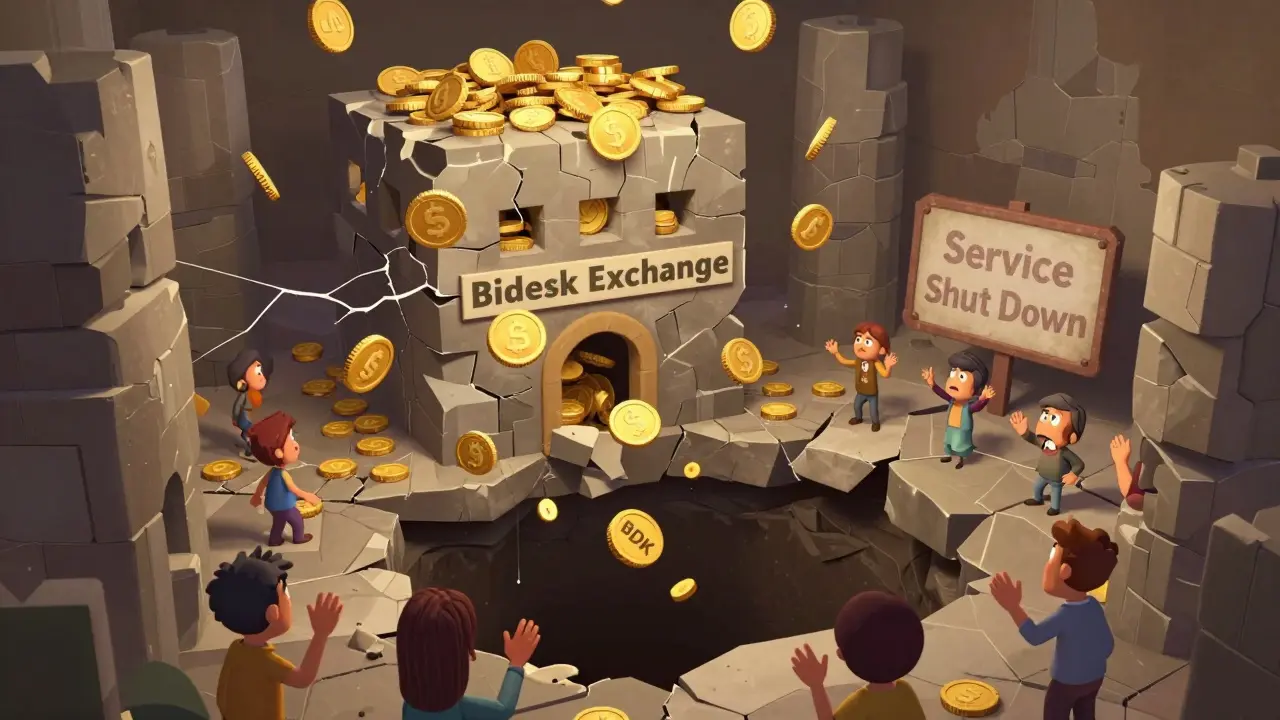
No announcement. No warning. No migration plan. Just a terse note on October 22, 2021: “The service is shutting down.” No email. No forum post. No social media update. The website went dark. The Telegram group vanished. The mobile app stopped working.
BDK tokens? Worthless. CoinGecko delisted them. No exchange would touch them. No burn mechanism. No buyback. No refund. The 100 million tokens are still out there - floating in wallets, unusable, untradeable. People who held BDK as a long-term asset lost everything. No legal recourse. No recourse at all.
Why Did Bidesk Fail?
It wasn’t just one thing. It was a mix of poor decisions and bad timing.
- Low trading volume: At its peak, Bidesk handled $28.7 million in 24-hour volume. CryptoCompare says exchanges need at least $50 million to be profitable. Bidesk never got there.
- Offshore registration: Operating from the British Virgin Islands meant no oversight. That’s fine until regulators crack down - and they did. Exchanges from tax havens had a 34.2% failure rate between 2018 and 2021.
- Over-reliance on BDK: Instead of earning revenue from fees, Bidesk pushed users to buy BDK. But if the token’s value drops, the whole model collapses. No burning, no staking, no utility beyond discounts - it was unsustainable.
- Lack of trust: No audits. No transparency. No communication. When users couldn’t withdraw, they didn’t trust the platform. And trust is everything in crypto.
Delphi Digital scored Bidesk 7.8/10 for failure risk. That’s high. And they were right.
What You Can Learn From Bidesk
Bidesk’s story isn’t just history. It’s a warning.
- Never put money into an exchange that doesn’t publish audits or transparency reports.
- A low fee isn’t enough if the platform can’t handle withdrawals or has no liquidity.
- Don’t trust a token that only exists to reduce fees - especially if the exchange doesn’t burn it or create real demand.
- Always check if an exchange supports your country. Bidesk banned U.S. and Canadian users - and that’s a red flag. Legit exchanges don’t exclude major markets unless they’re legally forced to.
If you’re looking for a beginner-friendly exchange today, look at Kraken or KuCoin. Both offer low fees, fiat on-ramps, and strong security. Both have been around for over a decade. Both have published Proof of Reserves.
Bidesk had potential. But potential doesn’t pay bills. Transparency does. Liquidity does. Trust does. And when those are missing - even the cheapest fees won’t save you.
Frequently Asked Questions
Is Bidesk still operating?
No, Bidesk shut down permanently on October 22, 2021. Its website, mobile apps, and customer support channels are offline. There is no way to access accounts or withdraw funds.
What happened to BDK tokens?
BDK tokens lost all value after Bidesk shut down. There was no migration plan, no buyback, and no burn mechanism. The tokens are now delisted from all exchanges and are effectively worthless. Anyone holding BDK cannot trade or use them.
Could users withdraw their funds before the shutdown?
Some users were able to withdraw funds in the weeks leading up to the shutdown. However, many reported delays - often 8+ hours - and during the final days, withdrawals were frozen for up to 72 hours. After October 22, 2021, all withdrawals stopped permanently.
Why did Bidesk choose the British Virgin Islands?
The British Virgin Islands is a tax-friendly jurisdiction with minimal financial regulation. Many small crypto exchanges register there to avoid strict licensing requirements in the U.S., EU, or UK. But this also means no oversight, which increases the risk of sudden shutdowns - as happened with Bidesk.
Are there any legal options for Bidesk users?
No legal recourse exists. Bidesk was not licensed in any major jurisdiction, and no regulatory body is investigating the shutdown. Users have no claim to funds or tokens. This is why it’s critical to only use regulated exchanges with clear jurisdiction and user protections.


Comments
Bidesk was a walking red flag from day one. 0.10% fees? Cute. But no audits, no transparency, and a token that meant nothing? That’s not innovation - that’s a Ponzi with a UI. 🤡
Don’t let this scare you off crypto entirely. Bidesk was a dumpster fire, but Kraken and KuCoin? Solid. Do your homework, use regulated platforms, and you’ll be fine. Stay smart, not scared. 💪
I’ve been trading since 2017… and I’ve seen a LOT of exchanges come and go. Bidesk? Yeah, they had a clean interface, but no one ever checked their wallet addresses. No one. And then… poof. Just gone. Always check for Proof of Reserves. Always. 🔍
It’s heartbreaking when people lose money because a platform just… vanished. No warning. No email. No nothing. I feel for everyone who held BDK. It wasn’t just money - it was trust. And trust? Once it’s gone, it’s gone forever. 😔
British Virgin Islands? Of course. That’s where all the shady ones hide. Meanwhile, the U.S. government is busy banning TikTok. Hypocrites. 🇺🇸
They didn’t just shut down - they ghosted people. Like a bad date who disappears after the third date. And now you’re stuck with a token that’s worth less than the paper it’s printed on. Classic. 🥲
Simple is good. But simple without security? That’s just laziness. Bidesk thought looking pretty was enough. It’s not. You need substance. Always.
Anyone who used Bidesk deserves what they got. You don’t trust a platform that doesn’t publish audits? You’re not a trader - you’re a tourist. And tourists get robbed. Every. Single. Time.
Let me tell you something - in India, we’ve seen this before. Exchanges promise low fees, native tokens, easy on-ramps - and then vanish. The lesson? Never invest in something you can’t verify. No audit, no trust. Period. 🇮🇳
It’s not just about money. It’s about the people behind the code. Bidesk had potential - but they chose to disappear instead of owning up. That’s the real tragedy.
Low fees are great but if you can’t withdraw? It’s a trap. Always test withdrawals first. Even small amounts. Don’t wait till it’s too late.
The British Virgin Islands jurisdiction, while legally permissible, represents a profound absence of accountability. The failure of Bidesk is not merely a commercial misstep - it is a systemic indictment of unregulated financial innovation. One must ask: at what cost does accessibility come?
This is why regulated exchanges matter. If you’re not KYC/AML compliant and you’re not publishing proof of reserves, you’re not a trustworthy platform - you’re a gamble. Stick with the ones that play by the rules.
BDK token? More like BDK scam. Who even thought this was a good idea? A token with no burning, no staking, no utility? Just a way to trick people into thinking they’re getting a discount. Classic. 🤦♂️
It’s so easy to get sucked in by low fees and clean design. But those are just the candy coating. The real question is: who’s behind it? And do they have skin in the game? Bidesk didn’t. And that’s why it collapsed.
0.10% fee? Cute. But when your app crashes during a 15% price swing and your withdrawal takes 72 hours? That’s not beginner-friendly - that’s dangerous. People died financially because of this. No excuses.
Let’s be real - Bidesk was a vaporwave crypto fantasy. Clean UI, zero substance. They didn’t build infrastructure - they built a TikTok filter for trading. And when the algorithm changed? The whole thing just… dissolved. The BDK token? A digital ghost. A spectral discount. A meme with no utility. 🌌
I used Bidesk for a few months. The interface was nice, but I always felt uneasy. Never had a problem… until I tried to withdraw. Took 14 hours. Then it vanished. I still don’t know if they’re gone for good or just hiding. Either way - not worth the risk.
Thank you for this detailed breakdown. It’s rare to see someone lay out the failure so clearly. Most just say "don’t use it" - you explained why. That’s helpful.
why do people think low fees = safe?? i used bidesk cause it was easy and then when i needed my money out… nope. no response. no nothing. i lost 2k. not cool.
They didn’t just shut down - they erased themselves. No press release. No Reddit post. No email. That’s not negligence. That’s malice. And if you’re telling me that’s normal in crypto? Then I’m done. This isn’t finance - it’s a haunted house with a trading interface.
Anyone who thinks Bidesk was an accident hasn’t been paying attention. This was a targeted exit scam. The token, the lack of audits, the offshore registration - it was all engineered. The founders left with the money. They just waited until the BDK price dropped enough to make the exit clean.
Let me tell you something no one else will - Bidesk didn’t fail because of bad decisions. It failed because the world was ready for it to fail. People wanted simplicity, but they didn’t want to learn. They wanted crypto without the work. And Bidesk gave them that… until it didn’t. And then everyone screamed "scam!" But the truth? They were the ones who chose ignorance. The platform was just the mirror.
Maybe the real lesson isn’t about Bidesk - it’s about how we treat trust in digital spaces. We want convenience, but we forget that trust isn’t built in a UI. It’s built in transparency, in accountability, in showing up when things go wrong. Bidesk never showed up. And that’s why it disappeared.