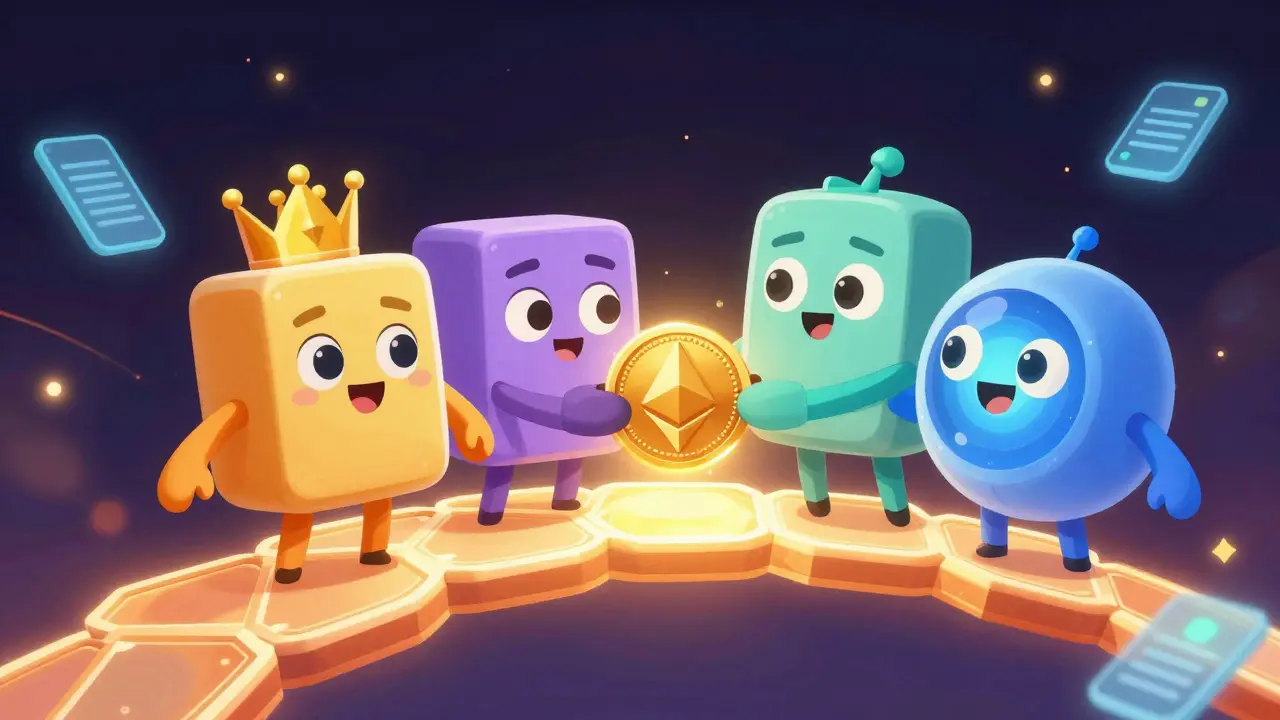
Imagine trying to send money from your bank account to a friend who uses a different bank-but you can’t. You need to withdraw cash, drive to their bank, deposit it, and wait days for it to clear. That’s what using different blockchains felt like before modular designs and interoperability solutions came along. Today, you can move assets between Ethereum, Solana, and dozens of other chains in minutes. But how? And why does it matter?
Why Modular Blockchains Are Different
Monolithic blockchains like Bitcoin and early Ethereum tried to do everything in one layer: execute transactions, reach consensus, store data, and secure the network. That made them simple but slow. As usage grew, fees spiked and transactions piled up. The solution? Break things apart. Modular blockchains split those functions into separate layers. Think of it like building a car with interchangeable parts. One chain handles consensus (making sure everyone agrees on what happened). Another handles data availability (keeping a public record). A third handles execution (running smart contracts). Each part can be optimized independently. This lets networks scale without sacrificing security or speed. This shift wasn’t accidental. Dr. Gavin Wood, co-founder of Ethereum, left to build Polkadot specifically to solve this problem. Polkadot’s Relay Chain handles consensus and shared security, while specialized parachains handle execution. Each parachain can have its own rules, tokens, and speed-yet they all inherit Polkadot’s security. No need to reinvent the wheel for every new blockchain.How Chains Actually Talk to Each Other
For two blockchains to interact, they need three things: a way to send messages, a way to move assets, and a way to trust each other. Cross-chain messaging is the backbone. Protocols like Polkadot’s XCM (Cross-Consensus Messaging) let one chain send a verified message to another. It’s not just sending a file-it’s sending a provable instruction: “Transfer 5 ETH from this address to that one.” The receiving chain checks the proof, confirms it came from the right source, and acts on it. Asset portability follows. Instead of locking up your Bitcoin on a centralized exchange and issuing a fake version on Ethereum (called a “wrapped token”), modern systems let you move native assets directly. You send your SOL from Solana to a Polkadot parachain, and it appears there as a verifiable, redeemable version-no middleman, no counterparty risk. Smart contract composability takes it further. A DeFi app on one chain can now call a contract on another. Imagine a lending protocol on Arbitrum that uses price data from a decentralized oracle on Chainlink. Or a yield aggregator that automatically moves your funds between Aave, Compound, and Curve based on real-time rates. That’s possible now-not in theory, but in live apps.The Two Types of Interoperability: 1-to-1 vs. n-to-1
Not all cross-chain needs are the same. There are two big categories: 1-to-1 and n-to-1. 1-to-1 interoperability is the most common today. It’s when two chains talk directly. For example, a DEX like SushiSwap might connect Ethereum and Polygon so users can swap tokens between them. That’s useful, but limited. It works for pairs, but not for complex, multi-chain workflows. n-to-1 interoperability is the next frontier. It’s when one app needs to interact with dozens-or hundreds-of chains at once. Think of a global DeFi dashboard that tracks your assets across 20 different chains and finds the best yield. Or a cross-chain NFT marketplace that verifies ownership on Solana, Ethereum, and Aptos simultaneously. Current messaging protocols can’t handle this efficiently. Each additional chain adds latency, cost, and complexity. This is where orchestration frameworks come in. Projects like Klaster, Li.Fi, and Agoric don’t just connect chains-they manage the chaos. They act like air traffic controllers for blockchain transactions. You say, “Move my USDC from Ethereum to Arbitrum, then stake it on Aave.” The orchestration layer figures out the path, signs the right transactions, handles gas fees on each chain, and confirms everything-all without you needing to open five different wallets or understand what a rollup is.
Wallet and Account Abstraction: Making It Feel Simple
The biggest barrier to adoption isn’t tech-it’s user experience. Most people still have to juggle multiple wallets, different gas tokens (ETH, SOL, MATIC), and confusing approval flows. That’s where abstraction layers fix the problem. Account abstraction means your wallet doesn’t have to be tied to a single blockchain. Projects like Avocado and Turnkey let you use one login-email, Google, or Apple-to control assets across chains. Behind the scenes, your private keys are managed securely, and transactions are signed automatically. You don’t need to understand EIP-4337 or account abstraction protocols. You just click “Send.” Wallet abstraction takes it further. Platforms like OneBalance, Particle Network, and Arcana let you see all your tokens-on Solana, Ethereum, Base, and more-in one interface. No more switching between Phantom, MetaMask, and Trust Wallet. Your portfolio is unified. Your keys are still yours. But the complexity? Hidden. This isn’t just convenience. It’s survival. If users have to learn five different systems to use DeFi, most won’t bother. Abstraction is what brings mainstream users in.Security Risks and Why Bridges Keep Getting Hacked
Interoperability is powerful-but dangerous. The $600 million Ronin Bridge hack in 2022 wasn’t an anomaly. It was a symptom. Most bridges rely on centralized validators or multisig keys to confirm cross-chain transfers. If those keys are compromised, all assets on that bridge are at risk. Modular blockchains like Polkadot avoid this by using shared security. Instead of trusting a small group of validators to secure a bridge, Polkadot uses its own large, decentralized validator set. Every parachain benefits from the same security as the Relay Chain. No single point of failure. No “trustless” bridge that’s actually full of trust. Even so, security isn’t solved. Cross-chain communication still requires complex cryptographic proofs. If a proof is flawed, a malicious actor could fake a transaction. That’s why projects are moving toward zk-proofs and verifiable computation. These let one chain prove to another that a transaction happened without revealing the underlying data. It’s like showing a notary a sealed envelope-you know it’s real, but you don’t need to see what’s inside.
What’s Next: The Rise of Chain Abstraction
The next phase isn’t just about connecting chains. It’s about making them disappear. Chain abstraction means users no longer need to think about which chain they’re on. Apps run on the best chain for the job-whether that’s Solana for speed, Ethereum for security, or a custom rollup for low fees-and the user never notices. The app, not the user, picks the chain. This is already happening. Games on Immutable X don’t ask players to switch wallets. DeFi protocols on Layer 2s auto-bridge liquidity when needed. Even NFT minting now happens seamlessly across chains. The goal? One interface. One experience. One blockchain in spirit-even if ten exist under the hood. Adoption is accelerating. The modular blockchain and chain abstraction ecosystem has grown 300% in the past year. More developers are building on modular stacks because they can launch faster, scale easier, and connect to other chains without reinventing security. The future isn’t one blockchain to rule them all. It’s a web of specialized chains, talking to each other, sharing security, and working as one. The user doesn’t care about the architecture. They just want their transaction to work-fast, cheap, and safe.What You Need to Know Right Now
If you’re using DeFi, NFTs, or Web3 apps today, you’re already interacting with modular interoperability-even if you don’t realize it.- When you swap tokens between Ethereum and Polygon, you’re using a cross-chain bridge powered by modular design.
- When you use MetaMask to manage assets on multiple chains, you’re benefiting from wallet abstraction.
- When your NFT shows up on OpenSea regardless of which chain it was minted on, that’s chain abstraction at work.
What is modular blockchain interoperability?
Modular blockchain interoperability is the ability for different blockchain networks-each handling specific tasks like execution, consensus, or data storage-to communicate, transfer assets, and share data securely. Unlike older blockchains that do everything in one layer, modular chains split functions into specialized components, making them faster and more scalable. Interoperability lets these chains work together without needing to trust third-party bridges.
How does Polkadot enable interoperability?
Polkadot uses a Relay Chain that provides shared security and consensus for all connected parachains. Each parachain can run its own rules and tokens, but they all communicate through Polkadot’s native XCM (Cross-Consensus Messaging) protocol. This allows secure, direct transfers between chains without external bridges. Because all parachains inherit the Relay Chain’s security, they’re protected from the vulnerabilities common in third-party bridges.
What’s the difference between 1-to-1 and n-to-1 interoperability?
1-to-1 interoperability connects two specific blockchains-like Ethereum and Arbitrum-directly. It’s great for simple swaps or transfers. n-to-1 interoperability lets one application interact with many chains at once. For example, a DeFi dashboard that pulls liquidity data from 15 different chains to find the best rate. Current bridges mostly support 1-to-1. n-to-1 requires advanced orchestration and is the next big challenge in the space.
Why are cross-chain hacks so common?
Most cross-chain bridges rely on centralized validators or multisig wallets to approve transfers. If those keys are stolen or compromised, attackers can drain all funds. The Ronin Bridge hack in 2022, which lost $600 million, happened because five out of nine validator keys were compromised. Modular blockchains like Polkadot avoid this by using decentralized, shared security instead of external bridges.
What is chain abstraction?
Chain abstraction hides the complexity of multiple blockchains from users. Instead of choosing which chain to use, the system picks the best one automatically. Your wallet shows all your assets in one place, regardless of whether they’re on Solana, Ethereum, or a custom rollup. You don’t need to switch wallets, buy different gas tokens, or understand L2s. It’s like using Wi-Fi-you don’t care which router you’re connected to, just that it works.
Do I need multiple wallets for different blockchains?
Not anymore. Wallet abstraction platforms like OneBalance, Particle Network, and Arcana let you manage assets across Ethereum, Solana, Base, and more from a single interface. Your private keys are still yours, but the complexity is handled behind the scenes. You log in once, see all your tokens, and send funds without ever switching wallets.

Comments
This is literally the most overhyped thing since crypto bros said blockchain would kill banks. lol.
Honestly? I've been using a few chains for months now and I barely notice the difference. It just works. 🤷♂️
I love how this feels like the internet finally got its own plumbing system. No more duct tape and prayers when sending crypto 😊
Bro, Polkadot’s XCM is the real MVP. I watched a friend move SOL to a parachain and it took 17 seconds. No bridge. No drama. Just pure tech magic. 🤖💎
The philosophical shift here is profound. We’re not just building better tools-we’re redefining digital sovereignty. Chains aren’t competitors anymore; they’re collaborators in a decentralized symphony. This isn’t innovation. It’s evolution.
I just want to send my NFT to my mom without her needing a degree in computer science. If I have to click 'Send' and it just... works? I'm all in. 🥹
One must question the underlying ontological assumption that interoperability equals progress. Are we not merely constructing a more efficient labyrinth?
Ugh. Another ‘blockchain will save the world’ essay. 😒 Meanwhile, my wallet got drained by a bridge last year. Still salty.
You don’t need to overcomplicate this. Just make it simple. One wallet. One click. Done. That’s all people want. 🙏
This is exactly why I switched from Ethereum-only to multi-chain. Gas fees dropped 80%. Speed is insane. And no more switching wallets. Game changer.
The U.S. must lead in this space. We cannot allow foreign entities to dictate the future of financial infrastructure. National security is at stake.
If you’re not using zk-proofs for cross-chain verification, you’re basically trusting a stranger with your life savings. Amateur hour.
Nah, this is just centralized control with extra steps. They’re just replacing banks with crypto oligarchs. 🤫
Let’s be real-modular blockchains are just a fancy way to say ‘we couldn’t scale Ethereum so we broke it into pieces and called it innovation.’ The truth? It’s a patchwork quilt held together by optimism and API calls. I’ve seen more reliable systems in my toaster.
I remember when I first tried to move ETH to Polygon and ended up losing $20 in gas fees because I didn’t know I needed MATIC. Now? I just click ‘Send’ and it’s done. I cried. Not because I saved money-because I finally felt like a normal human being using tech instead of a sysadmin.
This is all a distraction from the real issue: central banks are watching this and will shut it down before it becomes a threat. You think your keys are safe? Think again. The state always wins
Everyone’s so excited about ‘chain abstraction’ like it’s magic. But it’s just hiding the complexity. That’s not progress. That’s delusion.
I just want to send my NFT to my mom without her needing a degree in computer science. If I have to click 'Send' and it just... works? I'm all in. 🥹
I remember when I first tried to move ETH to Polygon and ended up losing $20 in gas fees because I didn’t know I needed MATIC. Now? I just click ‘Send’ and it’s done. I cried. Not because I saved money-because I finally felt like a normal human being using tech instead of a sysadmin.