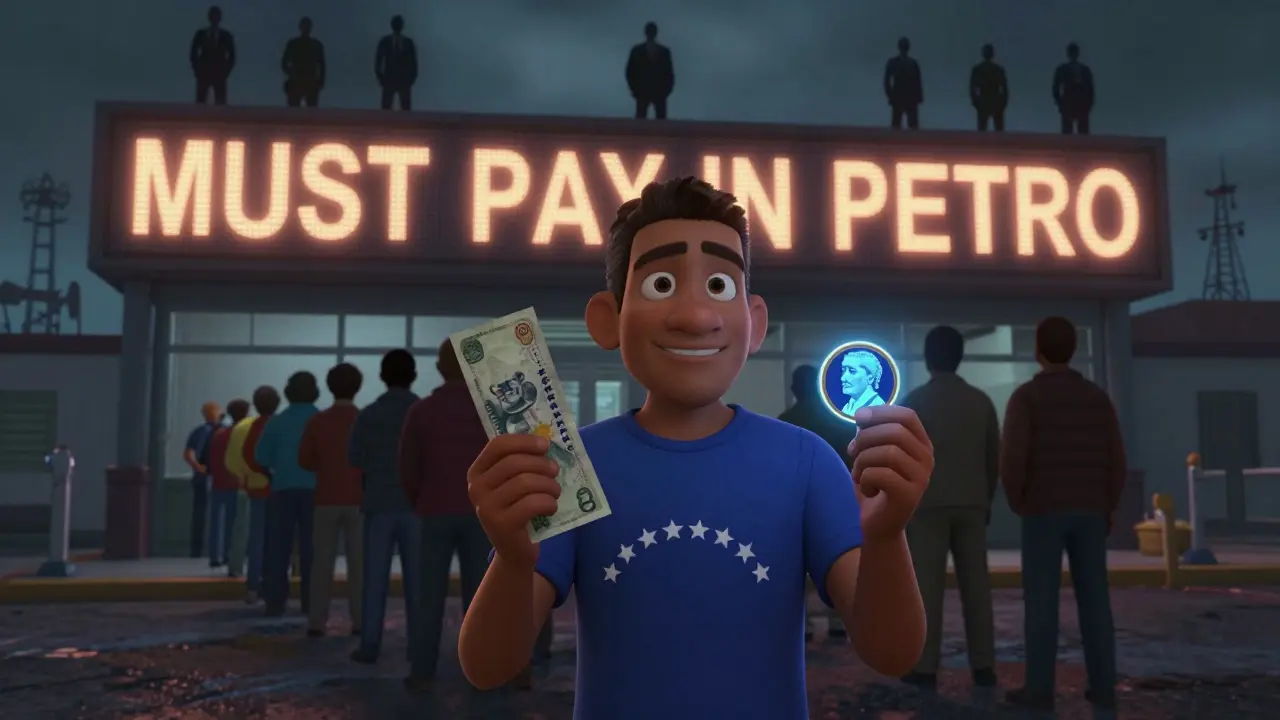
When Venezuela launched the Petro in 2018, it wasn’t just trying to create a new digital currency. It was trying to bypass sanctions, stop the collapse of its currency, and rewrite the rules of international finance-all with a coin backed by oil, gold, and diamonds. Five years later, the Petro is still around, but not because people want to use it. It’s because the government says they have to.
How the Petro Was Supposed to Save Venezuela
In December 2017, President Nicolás Maduro announced the Petro as Venezuela’s answer to economic collapse. The bolívar had lost 99% of its value since 2012. Inflation hit 1,000,000%. The country owed $140 billion in foreign debt. The U.S. and other nations had frozen Venezuelan assets and blocked access to global banking systems. The Petro was presented as a lifeline: a state-backed cryptocurrency tied to Venezuela’s natural resources, designed to attract foreign investment and let the government trade oil without using the dollar.
The plan was simple on paper. The government would mint 100 million Petro tokens, each supposedly worth $60-based on the value of one barrel of oil. It claimed the entire issuance was worth $6 billion. The Petro would run on a federated blockchain, meaning only government-approved nodes could validate transactions. That gave the state total control. No decentralization. No anonymity. Just a digital version of state power.
The Legal War Inside Venezuela
Even before the Petro launched, it was controversial inside Venezuela. The opposition-controlled National Assembly declared it illegal in March 2018, calling it an unconstitutional debt issuance. They argued the government was creating money without congressional approval, violating the constitution. The Supreme Court, loyal to Maduro, sided with the executive branch. That created a legal gray zone: the Petro is legal under presidential decree but illegal under the country’s own constitution.
To enforce it, the government created SUPCACVEN-the Superintendence of Crypto Assets and Related Activities. This agency controls everything: who can mine Petro, where exchanges can operate, and who gets to hold the tokens. It also collects fees and keeps records of miners and traders. But SUPCACVEN doesn’t answer to the public. It answers to the Vice President. There’s no transparency. No audits. No independent oversight.
Forced Adoption: Paying for Gas and Paperwork in Petro
By January 2020, the government made Petro mandatory for certain services. You couldn’t get a passport, renew your driver’s license, or buy airplane fuel without paying in Petros. This wasn’t encouragement. It was coercion. People didn’t choose the Petro-they were forced into it.
Why? Because the government needed to create artificial demand. No one was buying Petros on their own. The open market didn’t trust them. So the state made itself the only buyer-and the only seller. Citizens had to exchange their worthless bolívares for Petros just to do basic things. The Petro became a tax tool, not a currency.

The Petro Zones: Empty Promises on Paper
Maduro announced four special zones where the Petro would thrive: Margarita Island, Los Roques, the Paraguaná Peninsula, and the border area with Colombia. These zones were supposed to be crypto havens. Mining equipment imported there would be tax-free. Businesses could accept Petros. Foreigners could invest. The government promised a boom.
But five years later, there’s no evidence of real activity. No crowds of miners. No crypto cafes. No foreign investors lining up. Reports from locals and journalists show the zones are mostly empty. The tax breaks were never fully implemented. The promised infrastructure never arrived. The Petro Zones exist mostly as a PR stunt-photographs of empty buildings with signs saying "Petro Zone"-used in state media to pretend the program is working.
Why No One Trusts the Petro
Even inside Venezuela, people don’t use the Petro for daily life. They use Bitcoin. Or USDT (Tether). Or even cash from family abroad. Why? Because those options are real. They’re liquid. They’re accepted globally. The Petro is not.
Leaked documents from Venezuela’s crypto advisory group, VIBE, revealed the truth. The government planned to sell $2.3 billion in Petros privately-at discounts of up to 60%. That means the market believed the Petro was worth only $24 per token, not $60. The government knew it. They just didn’t tell the public.
Experts outside Venezuela were even harsher. The U.S. Treasury labeled the Petro a tool for sanctions evasion. In 2018, the U.S. banned Americans from dealing in Petros. Congress passed S.37 in 2020 to make those sanctions permanent. The European Union and Canada followed with their own restrictions. No major exchange lists the Petro. Not Binance. Not Coinbase. Not Kraken. The token can’t be traded. It can’t be converted. It can’t be used outside Venezuela’s borders.
The Blockchain That Isn’t a Blockchain
The Petro runs on a federated blockchain. That sounds technical, but it just means the government controls every node. There’s no decentralization. No open participation. No mining by ordinary people. You can’t run a Petro node unless the state approves you. That’s the opposite of Bitcoin. It’s more like a digital spreadsheet owned by the Ministry of Finance.
Most people who care about cryptocurrency want freedom-from censorship, from control, from inflation. The Petro offers none of that. It’s a tool of control. That’s why crypto enthusiasts around the world ignore it. Even in Venezuela, people who understand blockchain avoid it. They use Bitcoin because it’s censorship-resistant. The Petro? It’s censorship enforced.
The Reality in 2026
As of 2026, the Petro still exists. The government still requires it for some services. The Petro Zones still have their signs. SUPCACVEN still collects fees. But the currency has no market value, no international presence, and no public trust.
What’s worse, the Petro has damaged Venezuela’s credibility in the global crypto space. When countries like El Salvador adopted Bitcoin, they were praised. When Venezuela launched the Petro, the world saw it as a scam. That’s made it harder for legitimate Venezuelan crypto projects to get attention or funding.
The Petro didn’t save Venezuela’s economy. It didn’t attract foreign capital. It didn’t stabilize the bolívar. Instead, it became a symbol of economic desperation and authoritarian control. The only thing it’s good for is giving the government a way to extract value from its own people under the guise of innovation.
What’s Next for the Petro?
Unless Venezuela’s economy recovers, sanctions are lifted, and trust is rebuilt, the Petro won’t change. It’s not going to become a global currency. It’s not going to be listed on exchanges. It’s not going to be used by businesses outside the government’s control.
Its future depends on two things: political stability and international relations. If Maduro’s government falls, the Petro will likely be scrapped. If sanctions are lifted and the economy opens up, maybe someone will try to rebrand it. But right now, the Petro is a relic-a failed experiment in digital authoritarianism.
For Venezuelans, the real crypto revolution isn’t the Petro. It’s Bitcoin. It’s stablecoins. It’s the hidden networks of people sending money across borders, using apps they downloaded on secondhand phones, avoiding the state’s control. That’s where the real innovation is happening-not in the government’s blockchain.
Is the Petro cryptocurrency still active in Venezuela?
Yes, the Petro is still officially active, but only because the government requires it for certain services like paying for government documents and aviation fuel. There is no widespread public adoption. Most Venezuelans avoid it and use Bitcoin or stablecoins instead.
Can you buy or trade Petro on international exchanges?
No, the Petro is not listed on any major international cryptocurrency exchanges like Binance, Coinbase, or Kraken. It has no open market value and cannot be legally traded outside Venezuela due to U.S. and international sanctions.
Why did Venezuela create the Petro?
Venezuela created the Petro to bypass U.S. financial sanctions, stabilize its collapsing economy, and access international financing without using the U.S. dollar. The government claimed it was backed by oil, gold, and diamonds, but the currency has never been trusted by markets or citizens.
Are the Petro Zones actually functioning?
There is no verifiable evidence that the four designated Petro Zones-Margarita Island, Los Roques, Paraguaná, and Ureña-San Antonio-are functioning as intended. While tax incentives were promised for mining equipment, reports show minimal activity, and no significant foreign investment or local adoption has occurred.
Is the Petro legal under Venezuela’s constitution?
No. Venezuela’s opposition-controlled National Assembly declared the Petro illegal in March 2018, arguing it violated constitutional rules on issuing debt and currency. The Supreme Court, aligned with the government, overruled this, creating ongoing legal conflict. The Petro exists only by presidential decree, not by constitutional authority.
What do Venezuelans use instead of the Petro?
Most Venezuelans use Bitcoin, USDT (Tether), and other stablecoins to protect their savings from hyperinflation. These currencies are accepted by local businesses, used for remittances, and can be traded internationally. The Petro is avoided because it has no real value and is tied to a government people distrust.

Comments
So the Petro is basically the government’s way of saying, "Here, take this digital glitter and call it gold." 🤡
This is what happens when you let a dictator think he’s Satoshi Nakamoto. The Petro isn’t crypto-it’s a prison token. And the fact that people still have to use it? That’s not innovation. That’s tyranny with a blockchain logo.
i mean… at least they tried? 🤷♀️ i get it, sanctions sucked, but this feels like trying to fix a flat tire with duct tape and a prayer. still, bet the venezuelans using btc are laughing all the way to the bank (or whatever app they use)
What’s haunting about the Petro isn’t just its failure-it’s the quiet tragedy of a people being forced to participate in a performance of economic revival. The government didn’t just create a currency. It created a ritual of compliance. People aren’t using the Petro because they believe in it. They’re using it because they have no other way to buy medicine, pay for a bus ticket, or get their child’s birth certificate. The real innovation isn’t on the blockchain. It’s in the smuggled USB drives full of Tether, passed hand to hand like contraband. That’s the underground economy of dignity.
I’ve always believed crypto should be about freedom, not forced adoption. The Petro is a cautionary tale for every country thinking they can outsmart global finance with a gimmick. It’s not about the tech-it’s about trust. And you can’t mint trust with a presidential decree.
The Petro Zones are the most expensive art installation in history. Empty buildings with neon signs saying "CRYPTO FUTURE" while kids in Caracas barter phone credits for canned beans. The government didn’t build a currency. They built a theme park for delusion.
Let’s not forget: this is what happens when you mix authoritarianism with tech buzzwords. The Petro didn’t fail because the blockchain was bad-it failed because the people behind it were more interested in control than creation. Real crypto thrives in chaos. The Petro was designed to kill it.
Okay but imagine being the intern assigned to design the Petro logo. "Make it look like oil, gold, AND diamonds but also futuristic and socialist?" Bro, that’s not a currency-that’s a fever dream from a PowerPoint deck written by a guy who thinks "decentralized" means "we control it but say we don’t."
It is worth noting, with a degree of scholarly gravitas, that the Petro constitutes not merely a monetary instrument, but a sovereign epistemological assertion: the state’s claim to redefine value itself, divorced from market mechanisms, and enforced via bureaucratic coercion. The absence of liquidity, coupled with the presence of legal contradiction, renders the Petro not a currency, but a performative artifact of state legitimacy.
The Petro is like if someone took Bitcoin’s DNA, removed every gene of freedom, and replaced it with a government ID card. It’s not crypto. It’s a loyalty card for the regime.
I just think… maybe the real story isn’t the Petro at all. It’s the Venezuelans who figured out how to use Bitcoin on a $20 Android phone, with a Wi-Fi hotspot from a neighbor, sending money to family in Miami while the government’s blockchain sits there like a statue nobody visits. That’s the real miracle. Not the Petro. Not the oil-backed promise. Just… people being stubbornly, beautifully human.
You know who’s behind this? The Bilderberg Group. They wanted to test a digital authoritarian model on a failed state before rolling it out globally. The Petro? It’s a prototype. The fact that it’s useless is the point-it’s not meant to work. It’s meant to normalize control. Next stop: your bank account.
The Petro isn’t dead. It’s just in a coma. And the government keeps poking it with a stick to see if it’ll wake up.
The only thing more pathetic than the Petro is the people still defending it like it’s some kind of revolutionary act. Bro it’s a government spreadsheet with a fancy name. Bitcoin is the real revolution and you know it
I think… the most tragic part? The Petro didn’t just fail as a currency. It failed as a symbol. It was supposed to represent resilience, innovation, sovereignty. Instead, it became a symbol of desperation, deception, and the crushing weight of state control. And now, every time someone mentions "crypto" and "Venezuela" together, the whole world remembers this. Not the people who hacked their way to survival with Bitcoin. Not the engineers building decentralized apps in secret. But this… this hollow shell of a project that the government forced on its own people. That’s the legacy.