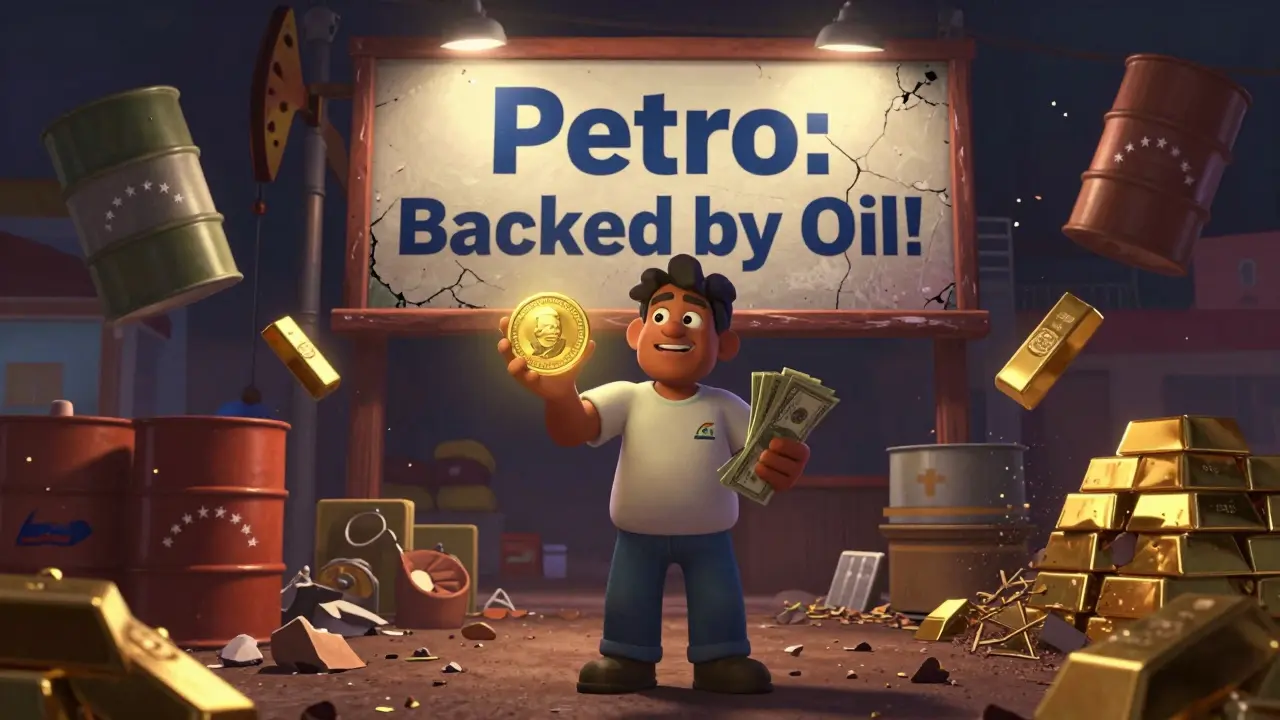
The Petro was never meant to be a currency people chose-it was designed to be one they had to use. Launched in February 2018 by Venezuela’s government, the Petro was pitched as a digital asset backed by the country’s oil, gold, and diamond reserves. The goal? To bypass U.S. sanctions, stabilize the collapsing bolívar, and unlock foreign investment. But five years later, the Petro isn’t a tool of economic freedom. It’s a state-controlled instrument with limited reach, deep skepticism, and legal contradictions built into its foundation.
How the Petro Was Supposed to Work
President Nicolás Maduro announced the Petro in December 2017, declaring it would be the first sovereign cryptocurrency backed by natural resources. Each Petro was officially valued at the price of one barrel of Venezuelan crude oil-roughly $60 at the time. The government planned to issue 100 million tokens, totaling a $6 billion market cap. Unlike Bitcoin, which runs on a public, decentralized network, the Petro operates on a federated blockchain. That means only a select group of government-approved nodes validate transactions. Control rests entirely with Venezuela’s Superintendence of Crypto Assets and Related Activities (SUPCACVEN), a state body created specifically to oversee the Petro’s circulation, mining, and exchange. To encourage adoption, the government created four "Petro Zones"-Margarita Island, Los Roques, Paraguaná Peninsula, and the Ureña-San Antonio border region. In these zones, businesses could accept Petros for goods and services. Importers of mining equipment got two years of tax exemptions on everything from air conditioners to solar panels. The idea was simple: lure miners and businesses with incentives, create local demand, and eventually expand nationwide.Why the Petro Failed to Gain Real Trust
Even before launch, doubts were mounting. A leaked document from Venezuela’s cryptocurrency advisory group, VIBE, revealed a plan to sell $2.3 billion in Petros at discounts of up to 60% in private deals. That wasn’t a vote of confidence-it was an admission that no one believed the official price. If the market truly valued each Petro at $60, why offer it for $24? The answer: no one was buying at face value. International financial institutions ignored it. Major exchanges like Binance and Coinbase never listed the Petro. The U.S. Treasury slapped sanctions on the project in March 2018, making it illegal for Americans to trade or invest in it. Congress later passed S.37, a bill aimed at permanently blocking any Venezuelan cryptocurrency activity. Without access to global markets, the Petro couldn’t be converted into dollars, euros, or even Bitcoin easily. It was trapped in a closed loop. Inside Venezuela, citizens didn’t embrace it either. Hyperinflation had already destroyed the bolívar. People turned to Bitcoin, Ethereum, and especially USD-backed stablecoins like USDT and USDC to protect their savings. These currencies were open, decentralized, and could be sent across borders. The Petro? It required government approval to use, had no transparent pricing, and couldn’t be traded outside Venezuela’s restricted network. Why use a currency controlled by the same government that printed money until the bolívar became worthless?Forced Adoption, Not Real Use
By January 2020, the government made it mandatory to pay for certain services in Petros-government documents, airplane fuel, and some public utilities. This wasn’t market-driven adoption. It was coercion. People had to use Petros because they had no choice. But forcing compliance doesn’t create value. It creates resentment. Reports from inside Venezuela show most citizens still pay for groceries, rent, and medicine in U.S. dollars or stablecoins. Even state employees who receive part of their salary in Petros immediately convert them into dollars on the black market. The Petro became a middleman, not a medium of exchange. The government collected Petros from taxpayers, then sold them to state-owned companies at fixed rates to buy real goods abroad. The system was a financial shell game. The four Petro Zones never became hubs of crypto innovation. Mining activity remained minimal. The tax breaks didn’t attract foreign miners because the infrastructure was unreliable-power outages, internet blackouts, and bureaucratic delays made operations unprofitable. Local businesses that accepted Petros often did so only because they were pressured by local officials. There are no public records showing how many Petros are actually circulating in commerce.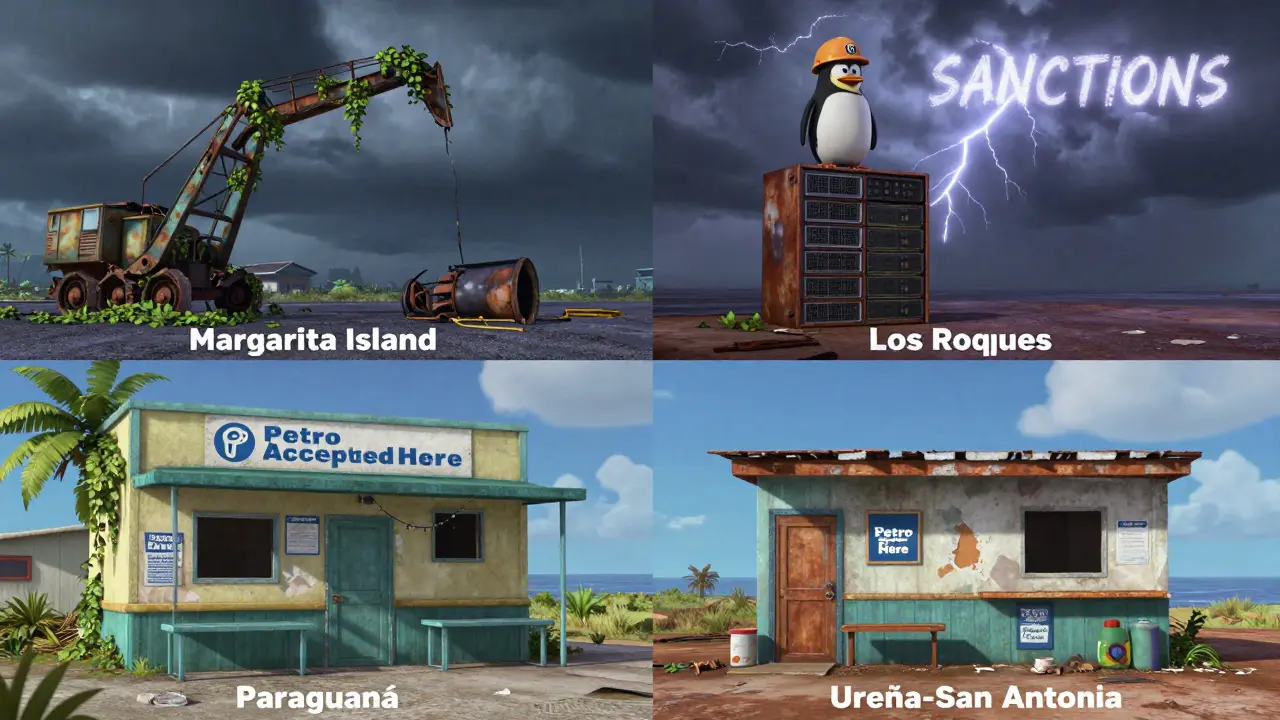
Legal Chaos and Political Opposition
The Petro’s biggest weakness isn’t technology-it’s legitimacy. In March 2018, Venezuela’s opposition-controlled National Assembly declared the Petro illegal, calling it an unconstitutional debt issuance. That ruling still stands. So technically, within Venezuela’s own legal system, the Petro exists in a gray zone: banned by one branch of government, enforced by another. The Treasury of Cryptoassets, a state-owned company under the Vice-Presidency, handles issuance and custody. But without independent audits, no one knows how many Petros are really in circulation or what assets back them. The government claims oil reserves support the currency, but Venezuela’s oil production has dropped to a fraction of its peak. In 2025, the country produces less than 700,000 barrels per day-down from 3 million in the early 2000s. Can oil that doesn’t exist really back a digital currency? Even the name "Petro" is misleading. It suggests a direct link to oil, but there’s no mechanism to redeem Petros for crude. No refinery, no export contract, no bank account holds barrels in exchange for tokens. It’s a promise without a delivery system.Current Status in 2026
As of early 2026, the Petro still exists-but only as a bureaucratic artifact. It’s used for internal government accounting and some state-to-state payments with allies like Russia and China, who may accept it as a way to sidestep U.S. sanctions. But for the average Venezuelan, it’s invisible. The currency they rely on is the U.S. dollar. The digital wallet they trust is on their phone, loaded with USDT. The Petro Zones still exist on paper. The tax exemptions are still in place. But no new mining rigs have been imported in over two years. The government hasn’t released updated data on token supply, transaction volume, or user counts since 2021. The entire program has gone silent. International sanctions remain firm. The U.S. continues to block any financial institution from processing Petro-related transactions. The European Union and Canada follow similar restrictions. Even countries that don’t recognize U.S. sanctions avoid the Petro-because dealing with it carries too much risk.
What the Petro Really Is
The Petro isn’t a cryptocurrency. It’s a political tool. It was created to project an image of technological innovation while hiding deeper economic failures. It’s a way for the government to say, "We’re not broke-we have digital oil." But without transparency, market trust, or real utility, it’s just digital smoke. It shares nothing with Bitcoin or Ethereum. It doesn’t empower users. It doesn’t offer decentralization. It doesn’t solve inflation. It doesn’t create jobs. It doesn’t attract investment. All it does is centralize control-and make it harder for Venezuelans to escape the system. For anyone looking to understand Venezuela’s economic collapse, the Petro tells the whole story: a government that tries to outsmart its problems with technology, but never fixes the root causes. The bolívar still crashes. The people still flee. And the Petro? It sits on a blockchain no one uses, backed by oil no one can sell.What’s Next for Venezuela’s Digital Currency Experiment?
Unless Venezuela stabilizes its economy, lifts sanctions, and opens its financial system to independent oversight, the Petro will remain a footnote in crypto history. No amount of decrees, tax breaks, or propaganda will change that. The real winners in Venezuela’s crypto story aren’t the government or the Petro. They’re the citizens who found ways to use Bitcoin, stablecoins, and peer-to-peer networks to survive. They didn’t wait for permission. They didn’t need a state-backed token. They just needed access to a global financial system-and they built it themselves. The Petro’s legacy won’t be its technology. It will be its lesson: when a government tries to control money, it doesn’t create value. It just creates another kind of prison.Is the Petro still in use today?
Yes, but only in limited, government-controlled ways. It’s required for some state services like renewing documents or buying aviation fuel. However, the vast majority of Venezuelans don’t use it for daily transactions. Most rely on U.S. dollars or stablecoins like USDT instead. There’s no public data showing significant circulation beyond state channels.
Can you buy or trade Petro on major exchanges like Binance or Coinbase?
No. The Petro is not listed on any major international cryptocurrency exchange. It was never approved for trading on platforms like Binance, Coinbase, or Kraken. Its value isn’t determined by market demand-it’s set by the Venezuelan government, and even then, it’s not transparent. The only way to access Petros is through state-run platforms, which are restricted and heavily monitored.
Why did the U.S. impose sanctions on the Petro?
The U.S. government viewed the Petro as an attempt by Venezuela to bypass financial sanctions and access international capital markets illegally. In March 2018, the Treasury Department banned U.S. persons from dealing in Petro tokens. Later, Congress passed S.37 to permanently block any transactions involving Venezuelan cryptocurrencies. The goal was to prevent the Maduro government from using digital assets to evade economic restrictions.
Is the Petro backed by actual oil or gold?
Officially, yes-but there’s no verifiable proof. The government claims each Petro is backed by a barrel of oil or a gram of gold, but there are no independent audits, no public ledgers showing reserves, and no mechanism to redeem tokens for physical assets. Experts and international observers consider the backing to be theoretical at best, and likely fictional.
Why don’t Venezuelans trust the Petro?
Because they’ve seen this before. The bolívar collapsed due to hyperinflation and mismanagement. The Petro is another state-issued currency with no market validation, no transparency, and no freedom to convert. Venezuelans learned the hard way that government promises about money don’t protect their savings. They turned to Bitcoin and stablecoins because those are decentralized, globally accessible, and not controlled by the state.
Are the Petro Zones still active?
They exist on paper, but there’s little evidence of real activity. The four designated zones were meant to be crypto hubs with tax breaks for mining equipment. But reports of actual mining, business use, or economic growth in those areas are scarce. Power outages, poor internet, and lack of investment have kept them from becoming anything more than symbolic projects.
Could the Petro ever become a real cryptocurrency?
Only if Venezuela completely changes its approach. It would need to open its blockchain to public verification, allow free trading on global exchanges, remove state control, and allow independent audits. But that would require political and economic reforms the current government has shown no willingness to make. As long as it’s a tool of state control, it will remain a failed experiment.

Comments
So the Petro is basically the government’s way of saying 'trust us' while holding a gun to your wallet? Classic. 🤡
This isn't crypto-it's a propaganda stunt wrapped in blockchain jargon. The moment you need state permission to use money, you’re already dead in the water. The fact that people still use USD like it’s oxygen? That’s the real story.
Let me get this straight-Venezuela thinks printing digital tokens backed by oil they can’t even pump is a solution to sanctions? Bro. We’re in 2026. This isn’t economic policy. This is a bad sci-fi movie where the villain is a central bank.
The Petro exposes the fundamental flaw in state-backed digital currencies: they can’t escape the tyranny of their creators. Bitcoin works because it refuses to be owned. The Petro? It’s owned by the same people who printed money until toilet paper had more value.
I’ve talked to folks in Caracas who use USDT to buy milk. They don’t care about Petro Zones or tax breaks. They care about whether their money keeps its value when they walk into a store. The Petro doesn’t even qualify as a backup plan-it’s a glitch in the system.
There’s something deeply tragic about a population forced to invent financial survival tactics while their government clings to symbolic illusions. The Petro isn’t a currency-it’s a monument to institutional failure dressed up in crypto cosplay.
It is, in fact, a fascinating case study in the ontological failure of centralized digital assets. The Petro's architecture-federated, opaque, and non-interoperable-contradicts the very epistemological foundations of decentralized value systems. One might argue that its existence is less an economic instrument than a performative act of statecraft.
so like... the petro is the digital version of a government saying "i promise i wont steal your money" while holding your wallet? 😅
I’ve seen people in Venezuela trade USDT on Telegram like it’s currency-because it is. Meanwhile, the government’s still printing Petro tokens like they’re collectible trading cards. The real heroes? The moms and students who hacked their way into global finance. Not the state. Not the Petro. THEM.
You think this is bad wait till they launch Petro 2.0 with AI and blockchain and NFTs of oil barrels and call it Web3 socialism 🤣
The Petro is the perfect metaphor for authoritarianism: looks high-tech, feels like a trap, and no one actually wants to use it. The fact that it still exists proves nothing about its utility-only about the state’s refusal to admit defeat.
People are using crypto to survive and the government is trying to control it like its some kind of video game currency bro stop pretending this is innovation its just control with a fancy name
If you want to understand why the Petro failed, look at the people who use it. Not the officials. Not the propaganda. The ordinary Venezuelans. They chose freedom over forced compliance. That’s the real victory here.
I just can’t stop thinking about how the people who built this system really believed they could outsmart global markets with a blockchain that only their own computers could validate. It’s like trying to win a chess match by moving your pieces in a room with no windows and no one else playing. You’re not winning-you’re just alone.
The Petro is the crypto equivalent of a government-issued loyalty card. You get points for obeying. No one wants them. But you still have to carry the damn thing.
Let’s not pretend this was ever about technology. It was about laundering the illusion of legitimacy. The Petro was designed to make the West think Venezuela had a plan. Meanwhile, the people were trading USDT on WhatsApp like it was the only thing keeping them alive. The real blockchain? It’s the one they built themselves-off the grid, off the books, off the government’s radar.
I’m waiting for the day the Venezuelan government announces the Petro NFT Collection: Limited Edition Oil Barrels (Only 700,000 minted! But the oil? Not real. Sorry.)
It’s wild how the most decentralized thing in Venezuela is its people’s ingenuity. The Petro is just a relic. The real revolution? The WhatsApp groups, the peer-to-peer USDT trades, the crypto cafes in basements. That’s where hope lives.
The Petro didn’t fail because of sanctions. It failed because no one believed it. Not even the people who were forced to use it. And that’s the lesson: money is trust. Not code. Not oil. Not decrees. Trust. And the government burned all of theirs.
The Petro is what happens when a government confuses control with innovation. Real crypto empowers. This? It’s just another tax.
lol imagine being so desperate you make a digital currency backed by oil you cant even pump anymore the petro is the ultimate meme
I think... the real tragedy isn’t that the Petro failed... it’s that the people who built the alternative systems-those who used USDT, Bitcoin, cash under the table-did it without permission, without funding, without applause. They didn’t wait for a government to save them. They just... did it. And that’s the quietest, most powerful revolution of all.
The Petro is still technically active. But so is a dead phone that still shows a battery icon. It’s not alive. It’s just pretending.
I’m actually kind of proud of Venezuelans. They didn’t wait for a miracle. They didn’t beg for permission. They just built their own financial lifeline with nothing but phones and grit. The Petro? It’s just a ghost in the machine.