Imagine buying Bitcoin in Lisbon and selling it a year later without paying a single cent in capital gains tax. For years, this was the reality for crypto investors in Portugal. But did the rules change? Yes, they did in 2023, yet Portugal remains one of Europe’s most attractive hubs for Bitcoin holders. If you are considering moving your digital assets or relocating to Portugal, understanding the current framework is critical to keeping more of your profits.
The Shift from Tax-Free to Structured Benefits
Before 2023, Portugal was famous for having no specific tax on cryptocurrency transactions because they didn’t fit into existing income categories. That era ended with the "Orçamento de Estado" (State Budget) reform. However, don’t let the word "reform" scare you off. The new system isn’t a crackdown; it’s a structured approach that still offers massive advantages compared to countries like Germany or France. The key takeaway? Long-term holding is still king. If you hold your Bitcoin for more than 365 days, you generally pay zero capital gains tax. This simple rule continues to draw investors who prefer patience over day-trading.
| Jurisdiction | Short-Term Gains (<1 Year) | Long-Term Gains (>1 Year) | Crypto-to-Crypto Swaps |
|---|---|---|---|
| Portugal | 28% Flat Rate | Tax-Free (if not securities/EEA outside) | Tax-Deferred (No immediate tax) |
| Germany | Progressive up to 45% | Tax-Free (if held >1 year) | Taxable Event |
| France | 30% Flat Tax (PFU) | 30% Flat Tax (PFU) | Taxable Event |
Understanding the Three Tax Categories
Portugal’s Personal Income Tax Code (PIT Code) splits crypto activities into three distinct buckets. Knowing which bucket you fall into determines your bill. First, there is Category G, which covers capital gains. This applies to trading profits. If you sell Bitcoin within 365 days of purchase, you face a flat 28% tax rate. It’s straightforward-no progressive brackets to calculate here. If you hold for longer than a year, that gain is typically exempt, provided the asset isn’t classified as a security and you aren’t dealing with assets outside the European Economic Area (EEA) in specific contexts.
Next is Category E, which handles passive income. This includes staking rewards, lending interest, and airdrops. These earnings are taxed at a uniform 28% flat rate. There is no withholding tax at the source, but you must declare these amounts in your annual return. Finally, we have Category B, which is the trap for many active traders. If your trading activity looks like a business-high volume, professional infrastructure, or frequent transactions-the tax authority may classify you as self-employed. In this case, you face progressive tax rates ranging from 14.5% to 53%. This is where high-frequency traders need to be careful, as the savings from long-term exemptions disappear if you are deemed a professional trader.
The Non-Habitual Resident Program Advantage
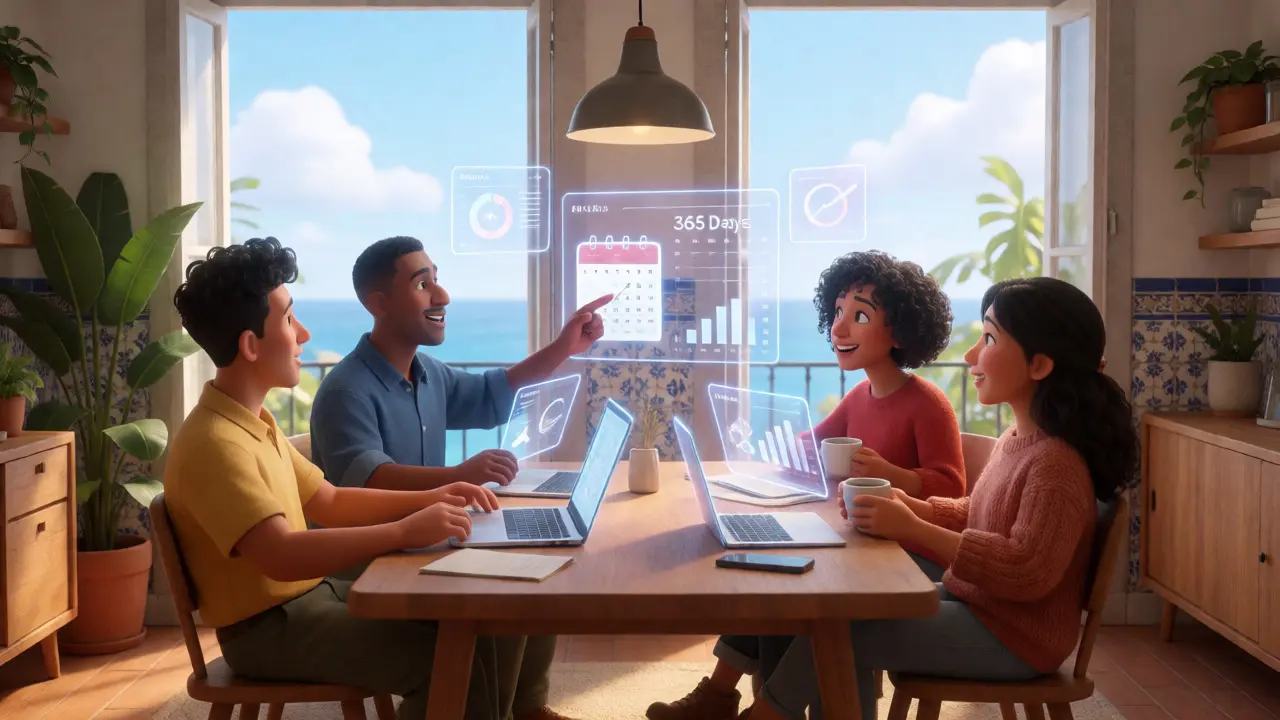
For those willing to relocate, the Non-Habitual Residence (NHR) program adds another layer of benefit. Although the original NHR scheme has evolved, its successor often retains favorable terms for qualifying professionals and investors. Digital nomads and crypto investors can potentially benefit from a 20% flat rate on Portuguese-sourced income and exemptions on many foreign earnings. When combined with the tax-free long-term capital gains rule, this creates a powerful synergy. You’re not just avoiding tax on your Bitcoin sales; you might also reduce the tax burden on other income streams while living in one of Europe’s most affordable countries.
It’s worth noting that residency requirements are strict. You typically need to spend at least 183 days per year in Portugal to become a tax resident. Planning your move requires precise timing, especially regarding when you buy and sell assets relative to your residency start date. Consulting with a local tax advisor before moving is essential to ensure you don’t accidentally trigger a taxable event during the transition.
Compliance and Documentation Essentials
While Portugal is friendly, it isn’t invisible. The Autoridade Tributária e Aduaneira (Portuguese Tax Authority) is improving its tracking capabilities. To stay compliant, you must keep meticulous records. Every transaction needs a timestamp, acquisition cost, and disposal value. Why? Because proving you held an asset for more than 365 days is entirely your responsibility. If you can’t prove the holding period, the default assumption might be short-term gains, subjecting you to the 28% tax.
- Track Acquisition Dates: Use blockchain explorers or exchange exports to verify exact purchase times.
- Categorize Correctly: Distinguish between occasional trading (Category G) and professional activity (Category B).
- Report Annually: File your IRS (Personal Income Tax) return by the standard deadline, usually in April.
- Use Specialized Software: Tools like CoinTracking or Koinly help generate reports specifically formatted for Portuguese compliance.
A common pitfall is ignoring small transactions. Even if you swap Bitcoin for Ethereum, this is currently a non-taxable event in Portugal under the crypto-to-crypto exemption. However, if you swap into a stablecoin and then to fiat, the chain of events matters. Keeping a clean audit trail ensures that when the tax authority asks questions, you have clear answers ready.
Risks and Future Outlook
No tax regime is static. While Portugal maintains its competitive edge, regulatory pressure from the European Union is increasing. The EU’s Markets in Crypto-Assets (MiCA) regulation is rolling out across member states, which could harmonize reporting standards further. Portugal aims to balance attracting crypto talent with complying with broader financial transparency goals. Currently, enforcement resources are limited, meaning many investors operate with some degree of comfort. However, relying on lax enforcement is risky. As infrastructure improves, undisclosed holdings could come under scrutiny.
Another consideration is the definition of "professional." There is no hard number defining how many trades make you a professional. It depends on frequency, volume, and intent. If you trade daily with significant capital, assume you might fall into Category B. Some investors mitigate this by using separate wallets for long-term holds and active trading, clearly separating their strategies to satisfy auditors.
Is Bitcoin completely tax-free in Portugal now?
Not completely. Bitcoin held for more than 365 days is generally exempt from capital gains tax. However, short-term gains (held less than a year) are taxed at a flat 28%, and passive income like staking is also taxed at 28%. Professional trading activities may face higher progressive rates.
Do I pay tax when swapping Bitcoin for Ethereum in Portugal?
Currently, crypto-to-crypto exchanges are not considered taxable events in Portugal. You do not pay tax immediately upon swapping Bitcoin for Ethereum or other cryptocurrencies. Tax liability is deferred until you convert the crypto to fiat currency or dispose of it in a taxable manner.
What defines a professional Bitcoin trader in Portugal?
There is no fixed threshold, but factors include high trading frequency, large volumes, use of professional tools, and whether trading constitutes your primary livelihood. Professional traders are taxed under Category B with progressive rates up to 53%, rather than the flat 28% capital gains rate.
How does the NHR program affect crypto taxes?
The Non-Habitual Resident (NHR) status can offer a flat 20% tax rate on certain Portuguese-sourced income and exemptions on foreign income. While capital gains are handled separately, NHR status can significantly reduce overall tax liability for individuals with diverse income sources alongside their crypto investments.
Are staking rewards taxed in Portugal?
Yes, staking rewards are classified as Category E income (Capital Income). They are subject to a flat 28% tax rate at the time they are received or realized. This applies regardless of how long you have held the underlying asset.

Comments
This is such a relief to read honestly 😭 I’ve been stressing out about my portfolio for months thinking the taxman was gonna take everything! The part about holding for over a year being tax-free just made my whole week 🙌✨ It feels like there’s actually hope for us little guys trying to build wealth without getting crushed by bureaucracy. Portugal seems like a dream right now!
While the summary is generally accurate, it is crucial to clarify the distinction between 'passive' and 'professional' trading under Category B. If your transaction volume exceeds certain thresholds or if you use automated tools, the Portuguese tax authority (AT) may reclassify you as a business entity. This triggers progressive rates up to 53%, which completely negates the benefit of the flat 28% rate. Additionally, the definition of 'securities' in the context of EEA vs non-EEA assets is nuanced; always consult a local accountant before assuming long-term exemption applies to altcoins.
It is morally bankrupt that we have to pay taxes on gains while corporations get subsidies. But hey, at least Portugal isn't France with their 30% PFU. Still, the government will find a way to squeeze you eventually. Don't trust the 'tax-free' label too much. They are watching. Always keep receipts. Do not let them catch you slipping. This is a trap for the naive who think they can beat the system. We all know how this ends for the common man.
The juxtaposition of fiscal policy and digital asset liquidity presents a fascinating dichotomy where regulatory arbitrage serves as the primary driver for capital migration rather than fundamental technological adoption. One must consider the epistemological implications of defining 'holding periods' in a decentralized ledger environment where timestamping is immutable yet jurisdictional enforcement remains fragmented across sovereign boundaries. The MiCA regulation's harmonization efforts likely represent a centralized attempt to impose order on this chaotic landscape, potentially stifling the very innovation that attracted investors to peripheral jurisdictions like Portugal in the first place. It is a delicate balance between attracting foreign direct investment through tax incentives and maintaining compliance with broader EU financial transparency directives which prioritize anti-money laundering protocols over individual investor autonomy. The friction between these competing interests will define the next decade of crypto-economic geography.
Whatever. America still has better infrastructure. You're just moving to a country with crumbling roads to save a few bucks on taxes. Typical Eurocrat nonsense. Enjoy the bureaucracy and the slow internet. We built Bitcoin. You're just taxing it. Get real.
I wouldn't be so sure about the 'tax-free' status lasting. The EU is tightening the screws behind closed doors. MiCA is just step one. Next thing you know, they'll implement a global minimum tax that overrides national exemptions. Keep your keys close and your documents closer. The state always finds a way to expand its reach when revenue drops. Don't believe the hype until you see the final legislation passed in Brussels.
The ambiguity surrounding the classification of 'professional trader' is deeply concerning and leaves taxpayers vulnerable to arbitrary audits. Without clear statutory definitions, the tax authorities retain excessive discretionary power to retroactively apply higher progressive rates. Furthermore, the reliance on self-reporting creates an uneven playing field where those with sophisticated legal representation can optimize their positions while ordinary individuals face disproportionate scrutiny. The transition from the old NHR scheme to the new regime also lacks sufficient clarity regarding grandfathering clauses for existing residents. Investors must exercise extreme caution and document every single transaction meticulously to mitigate the risk of unexpected liabilities.
oh great another article telling me i need to hire a lawyer to understand my own money. why cant we just trade freely?? the government is obsessed with tracking every move we make. its creepy. really creepy. i bet theyre already selling our data to advertisers. dont trust any of this. its all a setup to drain your wallet slowly. wake up people!!
Hey folks! Just wanted to say this guide is super helpful for beginners! 👍 Remember to start small and learn the ropes before moving big amounts. Portugal is lovely but make sure you check the latest rules since they change fast. Good luck everyone! 🚀
Oh wow @JohnLewis that point about Category B is terrifying 😰 I didn't realize how easily I could get flagged as a 'pro' just by trading often. I definitely need to look into separate wallets then! Thank you so much for the warning, I would have messed up big time without knowing this 🙏❤️
You absolutely CAN do this! Look, fear is just excitement without breath control. Yes, the rules are complex, but complexity is just opportunity disguised as confusion. Embrace the challenge! Every audit is a chance to prove your diligence. Every form filled is a victory over chaos. You are capable of mastering this. Believe in your ability to navigate these waters. Portugal is waiting for you with open arms and low taxes. Go get what is yours! 💪🔥
I appreciate the detailed breakdown. Keeping records manually is tedious but necessary. I use spreadsheets linked to blockchain explorers. It works for me.
Thank you for elucidating the nuances of the Portuguese tax code. Could you please elaborate further on the specific documentation required to substantiate the 'non-professional' status? It appears that subjective interpretation plays a significant role in determining whether one falls under Category G or B. I am concerned about the potential for inconsistent application by different tax officers. Any insights into best practices for maintaining a defensible position would be greatly appreciated.
To answer the previous query: maintain a log of your trading frequency and intent. If you are day-trading 50 times a month with high leverage, you are likely a professional. If you buy and hold for years, you are an investor. Documentation should include screenshots of exchange profiles, bank statements showing no other income source tied to trading, and perhaps a letter from an accountant attesting to your activity level. Consistency is key.
Money is just energy. Why do we even care about taxes? We are all connected. The universe provides. Stop worrying about numbers and start feeling the flow. Portugal is nice because the vibes are good. That is what matters. Not the tax code. The vibes. ✨
I want to encourage everyone reading this to view compliance not as a burden, but as a foundational skill for long-term success. By organizing your records now, you are building a framework that supports future growth. You are doing the right thing by seeking clarity. Stay motivated and remember that every expert was once a beginner navigating these same regulations. You have got this! 🌟