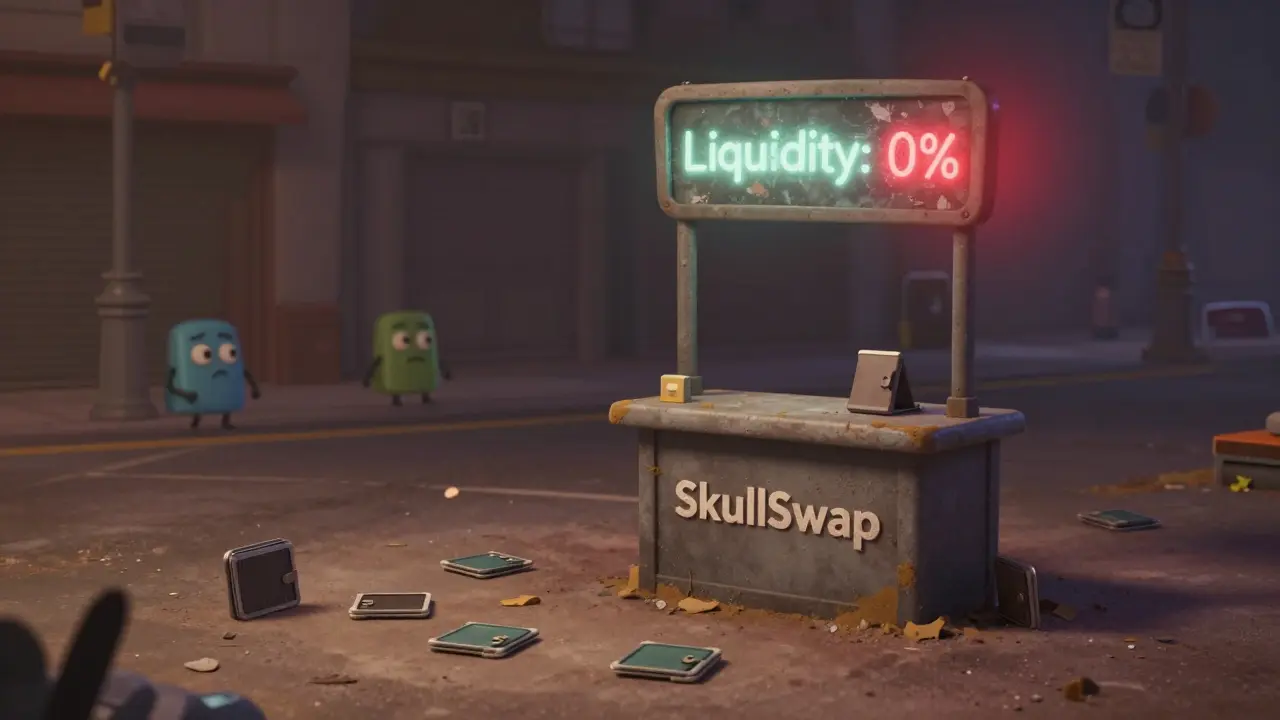
SkullSwap Slippage Calculator
SkullSwap's microscopic liquidity causes massive slippage on trades. This calculator shows how much you could lose when trading on low-liquidity DEXs like SkullSwap.
Based on the article: 'You set your slippage at 1%. The trade fails. You bump it to 3%. It goes through — but you end up getting 15% less of the token than you expected.'
Enter values above to see slippage impact
When you’re looking for a new crypto exchange, you want speed, low fees, and deep liquidity. You don’t want to get stuck with slippage so high your trade barely executes, or worse - lose money because the platform is barely alive. That’s the reality with SkullSwap, a decentralized exchange built on the Fantom blockchain. It launched with big promises: better pricing, faster trades, deeper liquidity. But in 2025, the truth is far simpler - SkullSwap is microscopic.
What Exactly Is SkullSwap?
SkullSwap is a decentralized exchange (DEX) that runs entirely on the Fantom network. It uses an automated market maker (AMM) model, which means there’s no order book, no middleman, and no account to create. You connect your wallet - usually MetaMask set up for Fantom - and trade directly. It’s the same setup as Uniswap or PancakeSwap, but locked into one blockchain: Fantom.
That’s not inherently bad. Fantom is fast and cheap. Transactions cost pennies and confirm in under a second. If SkullSwap had strong liquidity, it could’ve been a solid niche player. But here’s the catch: it doesn’t. The platform has almost no trading volume. No meaningful user base. No community chatter. And no updates in years.
Why SkullSwap Fails to Deliver on Its Promises
SkullSwap claims to offer "smarter DeFi with better pricing." But better pricing requires deep liquidity pools. If no one’s trading, no one’s adding funds. And if no one’s adding funds, your trade gets ripped apart by slippage.
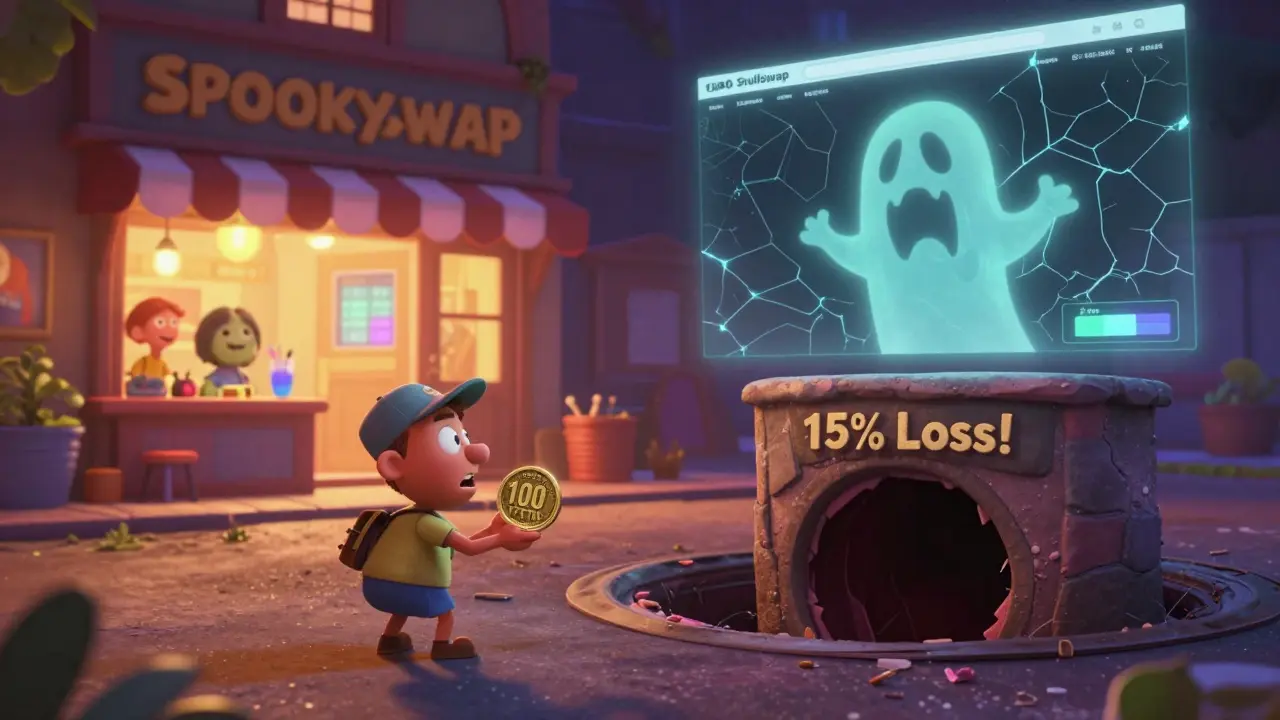
Let’s say you want to swap 100 FTM for a lesser-known token on SkullSwap. You set your slippage at 1%. The trade fails. You bump it to 3%. It goes through - but you end up getting 15% less of the token than you expected. That’s not a glitch. That’s how it works when liquidity is near zero.
Compare that to SpookySwap, another DEX on Fantom. Even SpookySwap - which is considered a minor player - pulls in around 600 organic visits per month. SkullSwap? There’s no public data, but based on every available signal - zero social media buzz, no Reddit threads, no CoinGecko or CoinMarketCap listings - it’s safe to say SkullSwap gets less than 1% of that traffic.
No Audits, No Transparency, No Trust
Security in DeFi isn’t optional. It’s survival. But SkullSwap doesn’t publish any smart contract audits. No reports from CertiK, Hacken, or SolidProof. No public GitHub activity. No team members listed. No roadmap. No blog posts since 2022.
That’s not just lazy. It’s dangerous. Without an audit, you’re trusting code that could have backdoors, reentrancy bugs, or admin keys that let someone drain the entire liquidity pool. And if something goes wrong? There’s no customer support. No Discord. No Twitter replies. Just a static website and a wallet connection.
Even crypto tax platforms like Crypto Tax Calculator list SkullSwap - not because it’s trusted, but because users *do* trade on it. But those users? They’re outliers. A handful of people trying something new, getting burned, and quietly moving on.
How It Stacks Up Against the Competition
Here’s how SkullSwap compares to other DEXs on Fantom and beyond:
| Feature | SkullSwap | SpookySwap | Curve (Multi-chain) |
|---|---|---|---|
| Blockchain | Fantom only | Fantom only | Multi-chain |
| Trading Volume | Microscopic | Low, but measurable | High |
| Liquidity Pools | Minimal, few pairs | 50+ active pairs | 200+ stablecoin pairs |
| Fees (maker/taker) | Unknown (likely 0.20%) | 0.20% | 0.02%-0.04% |
| Smart Contract Audit | None published | Audited by CertiK | Audited by multiple firms |
| User Base | Effectively zero | Thousands of monthly users | Millions |
| Community Support | None | Active Discord, guides | Large, responsive communities |
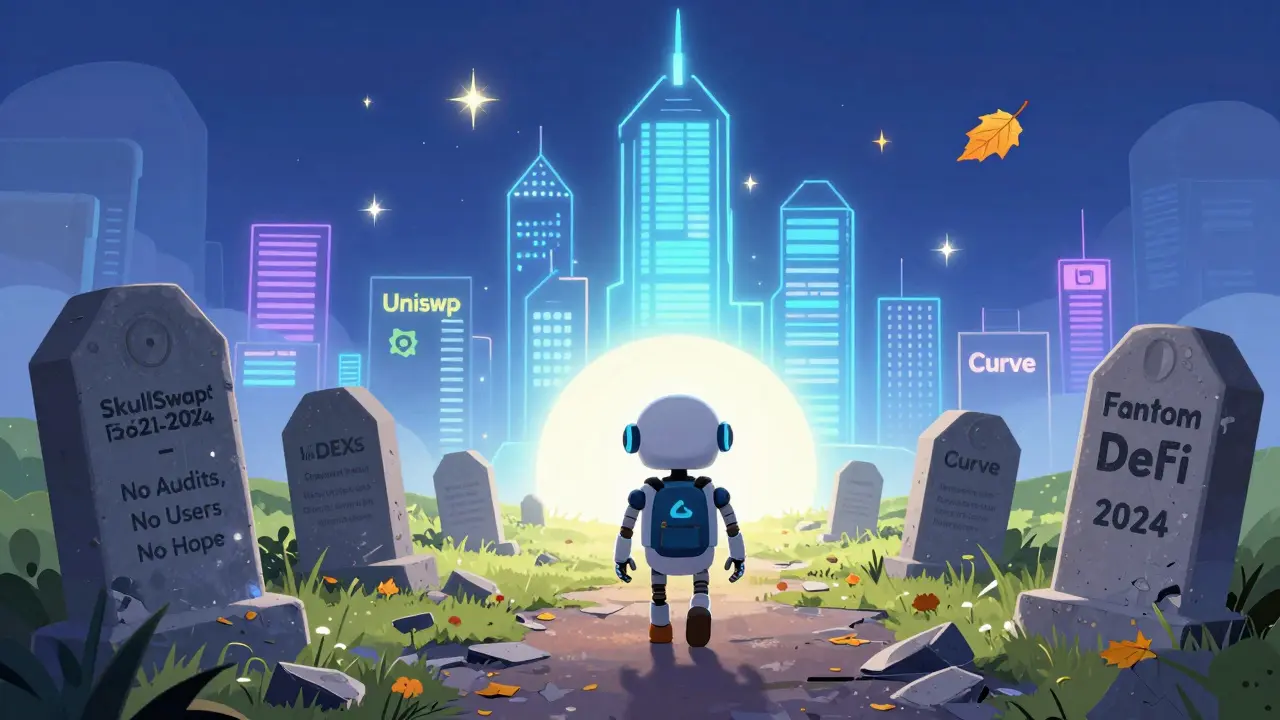
SpookySwap may not be a giant, but it’s alive. It has updates. It has users. It has support. SkullSwap? It’s a ghost town.
Who Should Avoid SkullSwap
If you’re new to DeFi - don’t touch it. You’ll get lost, lose money, and have no one to ask for help.
If you’re trading more than $50 at a time - don’t use it. The slippage will eat your profits.
If you care about security - walk away. No audits mean no guarantees.
If you want to trade anything beyond FTM, WFTM, or a handful of tokens - you won’t find them. The trading pairs are sparse, outdated, and often illiquid.
Who Might Still Use It (and Why)
There’s one group that still uses SkullSwap: speculative traders chasing obscure tokens.
Some users drop small amounts of FTM into new, unlisted tokens on SkullSwap, hoping to catch a pump before it dies. It’s gambling, not investing. And it only works if you’re okay losing your entire stake.
There’s also a tiny group of Fantom purists who believe in the chain’s potential and want to support every local project - even the dead ones. But even they admit: SkullSwap isn’t growing. It’s just hanging on.
The Bigger Picture: Why Fantom Isn’t Helping
SkullSwap didn’t fail in a vacuum. It failed because the Fantom ecosystem has shrunk dramatically. In late 2021, Fantom’s total value locked (TVL) hit over $9 billion. By late 2023, it dropped to $1.2 billion. And in 2025? It’s hovering around $800 million.
That’s not a blip. That’s a collapse. Major DeFi protocols moved to Ethereum, Arbitrum, or Solana. New projects don’t launch on Fantom anymore. Liquidity providers don’t risk funds on a dying chain.
SkullSwap is a symptom, not the cause. It’s a DEX built for a network that’s no longer attracting users. No amount of "faster trades" or "better pricing" can fix that.
Final Verdict: Skip It
SkullSwap isn’t a bad exchange because it’s poorly built. It’s bad because it’s abandoned.
There’s no active development. No community. No security. No liquidity. No future.
If you’re looking for a DEX on Fantom, use SpookySwap. If you want broader options, go to Uniswap on Ethereum or PancakeSwap on BSC. If you’re chasing the next big thing, look at newer chains like Base or zkSync - not relics stuck in 2022.
SkullSwap is a cautionary tale. It shows how even the simplest ideas can die without users, without trust, and without effort. Don’t be the last person to find out it’s gone.
Is SkullSwap safe to use?
No. SkullSwap has never published a smart contract audit. There’s no evidence of security reviews, bug bounties, or team accountability. Without audits, you’re trusting code that could be compromised. Even small trades carry risk of rug pulls or liquidity drains.
Can I make money trading on SkullSwap?
It’s extremely unlikely. With near-zero liquidity, even small trades suffer massive slippage. You’ll pay far more in hidden costs than you’ll ever gain from price moves. Some users try to scalp new tokens, but that’s gambling - not trading. Most end up losing their entire stake.
Does SkullSwap have a mobile app?
No. SkullSwap has no official mobile app. You can only access it through a browser using a wallet like MetaMask. There are no native apps for iOS or Android, and no plans for any.
Why isn’t SkullSwap listed on CoinGecko or CoinMarketCap?
Because it doesn’t meet their minimum requirements for volume, liquidity, or transparency. Both platforms require verified trading data, active development, and public information. SkullSwap provides none of that. Its absence from these sites is a red flag.
What should I use instead of SkullSwap?
If you want to trade on Fantom, use SpookySwap - it’s audited, has real liquidity, and active community support. For broader options, try Uniswap on Ethereum, PancakeSwap on BSC, or Curve for stablecoin swaps. These platforms have volume, security, and support. SkullSwap doesn’t.
Are my taxes affected if I trade on SkullSwap?
Yes. Any trade on SkullSwap - even small ones - creates a taxable event in most countries. Platforms like Crypto Tax Calculator include SkullSwap because users do report trades. But the volume is so low that it’s unlikely to trigger audits. Still, you’re legally required to track and report all transactions.
If you’re still considering SkullSwap, ask yourself this: Would you give your keys to a store with no lights, no staff, and no sign it’s open? That’s SkullSwap. Don’t walk in.

Comments
Been using SpookySwap for months now and never looked back. SkullSwap? Zero volume, zero trust. Just don't go there.
ok but like… what if the whole thing is a honeypot? like… what if the devs just wanted to see who’d connect their wallet and then drain it? i mean… no audit? no github? no twitter? that’s not lazy, that’s *villain origin story* material 🤔
Wow. Just… wow. This is the most thorough takedown I’ve seen in months. SkullSwap isn’t dead-it was never alive. Zero liquidity, zero audits, zero brain cells spent on marketing. It’s a digital ghost. And people still try to trade on it? 😭
Why are you even talking about this? America has real DeFi. This is why India and Africa still can't get crypto right-because they keep clinging to dead chains and ghost DEXs. Get with the program. Use Uniswap. Or better yet-stop pretending Fantom is relevant.
lol i tried SkullSwap once. thought i’d catch a gem. ended up losing 12 FTM to 18% slippage on a 5 FTM trade. i thought my wallet was broken. turned out… the whole exchange was broken. thanks for the laugh, SkullSwap. you’re the crypto equivalent of a vending machine that eats your cash and gives you air.
SkullSwap? More like SkullSuck. That thing is a financial vampire. Sucks your FTM, gives you nothing but dust and regret. And people still write reviews like it’s a startup? Bro, it’s a tombstone with a .eth domain.
It’s sad, really. 🫂 This is what happens when passion meets zero execution. I used to love Fantom’s speed… but now? It’s like watching a race car with no fuel. SkullSwap is just the broken odometer. Still ticking, but going nowhere.
Why bother? No audits. No team. No future. Just a website that looks like it was built in 2021 with Wix. I’d trust a QR code on a napkin more than this.
While the post presents a compelling argument, it is worth noting that the absence of public data does not necessarily equate to malicious intent. One must distinguish between neglect and malfeasance. The logical inference drawn is valid, but the moral judgment may be premature.
SkullSwap is a classic example of a vanity project. AMM? Check. Fantom chain? Check. Zero users? Check. No audits? Check. The whole thing is a textbook case of crypto hubris. You don’t build a DEX because you can. You build it because people want it. And nobody wants this.
Bro I literally just lost $200 on this thing yesterday. I thought I was getting into a new gem. Turns out I was the gem. 😭 I’m crying. I’m so mad. Why does this keep happening? Who even built this? Is it one guy in his basement? Please tell me it’s not a bot.
Listen, I’ve been in crypto since 2017. I’ve seen projects rise, crash, and vanish. SkullSwap? It’s not a failure-it’s a funeral. And we’re all standing around it, wondering why no one showed up to the service. Don’t be the last one to leave. Walk away. You’re not saving it. You’re just feeding the ghost.
SkullSwap is an architectural flaw in DeFi. It demonstrates the fatal flaw of hyper-specialization without adoption. No liquidity = no utility. End of story.
I just want to say… I really feel for the people who still check SkullSwap every day. Like, maybe they believe it’ll come back. Maybe they’re holding onto hope that someone will revive it. I get it. I’ve been there. I held onto a dead token for 18 months once. It’s not stupid to hope. But it’s dangerous to trade on something that doesn’t breathe anymore. Please, just… look around. The chain is dying. The DEX is a tomb. Don’t bury yourself with it.
As someone who’s lived in both the US and India, I’ve seen how local crypto culture can cling to dead projects out of loyalty. But loyalty doesn’t pay bills. SpookySwap is alive. Use it. If you love Fantom, support what’s working-not what’s haunting.
The analytical framework presented is fundamentally flawed. The conflation of liquidity metrics with security posture is a category error. Furthermore, the absence of audits does not imply vulnerability; it merely implies non-disclosure. The author’s emotional tone undermines the objectivity of the analysis. One must question whether this is an objective review or a performative lamentation of market failure.
It’s like finding a dusty arcade game from 2003 and trying to play it on your new PS6… the buttons don’t work, the screen flickers, and the only person left in the room is you. 🥲 SkullSwap is that game. But hey-at least it still turns on? 😅
This is why Africa needs its own chains. Not chasing ghosts. Building something real. SkullSwap? It’s not a DEX. It’s a warning.
Wow. So you’re saying we shouldn’t use a DEX because it’s not popular? That’s the most capitalist, centralized mindset I’ve ever heard. What about decentralization? What about freedom? What about supporting the little guy? SkullSwap is the true spirit of crypto-unhinged, unregulated, and unafraid. You just hate it because it doesn’t have a VC backing.
I just wanted to say thank you for writing this. I was about to try SkullSwap. I’m so glad I read this first. I’ve been new to crypto and I didn’t know what to trust. You saved me from a bad mistake. I really appreciate it.
What if this is all a psyop? What if SkullSwap is a decoy to lure in new users so they can track wallet addresses and sell them to the NSA? No audits? No team? That’s not negligence-that’s a black op. I’ve seen this before. They do this with fake DeFi apps to build a database of crypto users. I’m not touching it. Not even with a 10-foot pole.
SkullSwap is dead. SpookySwap is alive. Use SpookySwap. End of discussion.
It’s not just about liquidity. It’s about trust. No audits = no trust. No trust = no users. No users = no future. It’s a feedback loop of abandonment. The real tragedy? Someone, somewhere, still believes this can be saved.