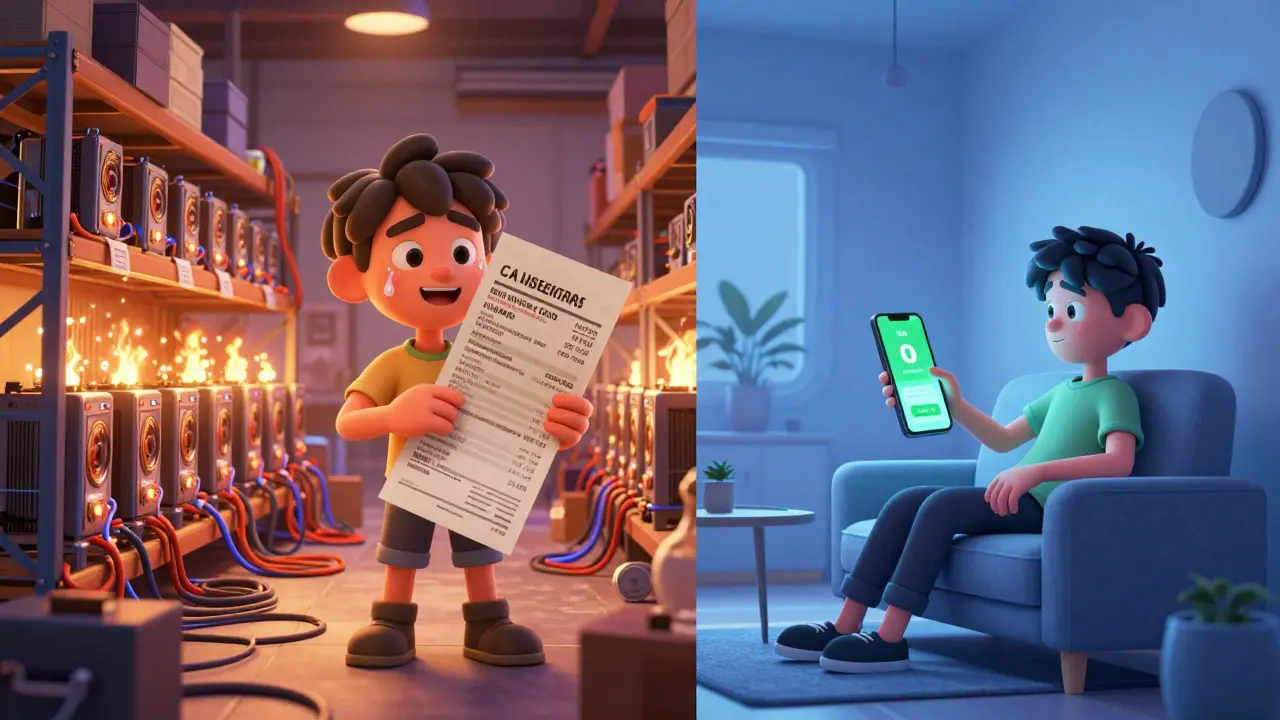
Imagine two ways to secure a digital vault. In the first method, you hire thousands of people to solve complex math puzzles using massive supercomputers that hum day and night, consuming enough electricity to power small nations. In the second method, you ask wealthy participants to lock up their own money as collateral, promising to act honestly or lose their savings. Both methods achieve the same goal: they keep the blockchain secure and transactions honest. But the cost, effort, and risk are worlds apart.
This is the core difference between mining and staking. For over a decade, mining was the only way to validate transactions on blockchains like Bitcoin. Then, Ethereum made a historic shift in September 2022, moving from energy-heavy mining to capital-efficient staking. This change, known as "The Merge," didn't just save energy; it fundamentally changed who can participate in securing the network and how much it costs them.
If you are looking to earn rewards from your crypto holdings, understanding this split is crucial. One path requires buying expensive hardware and finding cheap electricity. The other requires locking up your coins and trusting software to run smoothly. Let's break down exactly how these two systems work, what they cost, and which one might fit your situation better in 2026.
How Mining Works: The Proof-of-Work Model
Mining is based on a concept called Proof-of-Work (PoW). It was introduced by Satoshi Nakamoto in the original Bitcoin whitepaper in 2009. The idea is simple but resource-intensive. Miners compete to solve a cryptographic puzzle. The first one to solve it gets to add the next block of transactions to the blockchain and receives a reward in new cryptocurrency plus transaction fees.
To win this competition, you need speed. And speed requires power. Early on, anyone with a decent laptop could mine Bitcoin. Today, that is no longer true. The network has become so competitive that general-purpose computers are useless. Instead, miners use specialized machines called ASICs (Application-Specific Integrated Circuits).
An ASIC is a chip designed for one single task: calculating hashes for a specific blockchain. For example, the Bitmain Antminer S19 XP Hyd, released in mid-2022, delivers 255 terahashes per second while consuming 3,060 watts of power. These machines cost around $4,500 each. They are loud, hot, and have a short lifespan-usually 1.5 to 2 years before newer, faster models make them obsolete.
The beauty of PoW is its security. To attack the Bitcoin network, an attacker would need to control more than 50% of the total computing power. Given that Bitcoin miners spend roughly $10 billion annually on electricity and hardware, such an attack is economically prohibitive. As Nic Carter of Castle Island Ventures noted, this energy expenditure creates an unparalleled security guarantee.
How Staking Works: The Proof-of-Stake Model
Proof-of-Stake (PoS) flips the script. Instead of spending energy to prove you did work, you put up money to prove you have skin in the game. Validators are chosen to create new blocks based on how much cryptocurrency they hold and are willing to "stake" as collateral.
If a validator acts honestly, they earn rewards. If they try to cheat or double-spend, the protocol can "slash" their stake-meaning they lose a portion of their locked-up funds. This financial penalty aligns the validator's interest with the health of the network.
Ethereum’s transition to PoS in September 2022 is the most famous example. Before the switch, Ethereum used GPUs (graphics cards) for mining. Afterward, it required validators to lock up 32 ETH. At the time, this was worth nearly $60,000. However, you don't need to be a millionaire to participate. You can join pools or use liquid staking protocols like Lido, which allow you to stake fractional amounts.
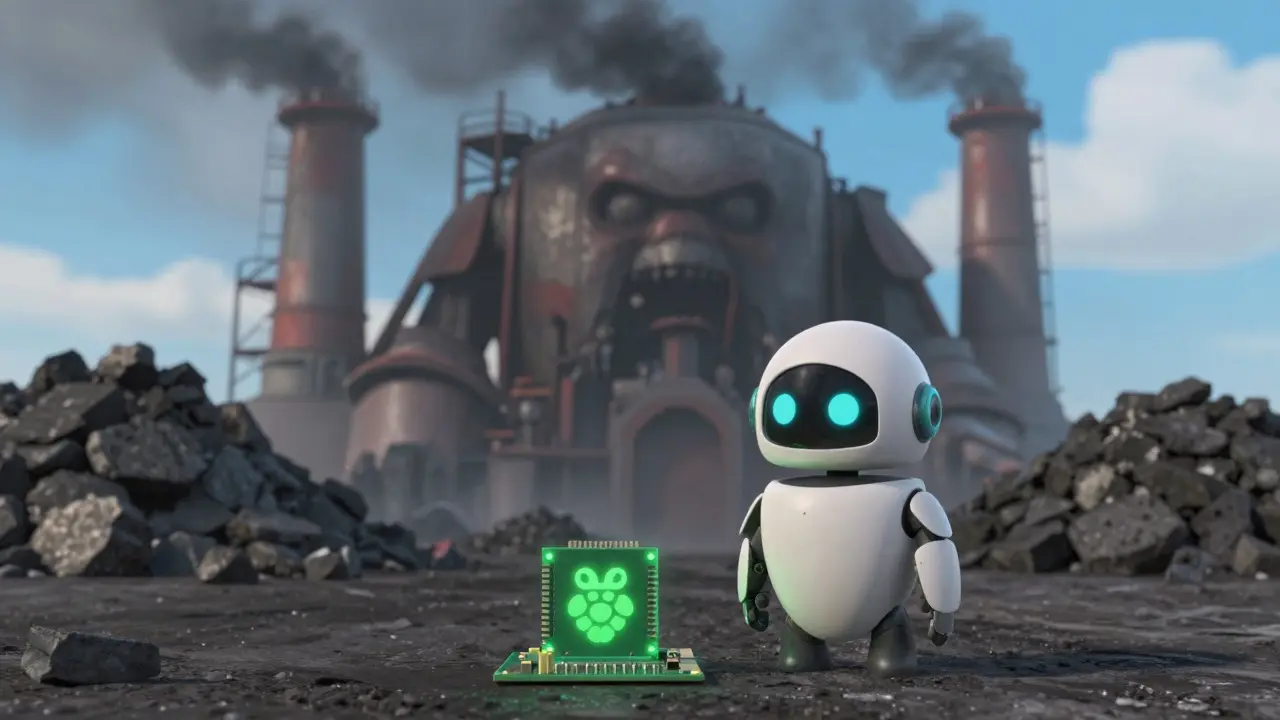
The hardware requirements for staking are minimal. A standard Raspberry Pi or even an old laptop with a stable internet connection is sufficient. The bottleneck isn't processing power; it's reliability. Your node needs to stay online 24/7. If it goes offline, you miss out on rewards, and if it stays offline too long, you might face penalties.
Energy Consumption: The Environmental Divide
The most dramatic difference between mining and staking is energy usage. This factor has driven much of the regulatory pressure and public debate surrounding cryptocurrencies.
| Network | Consensus Mechanism | Annual Energy Use (TWh) | Equivalent Country |
|---|---|---|---|
| Bitcoin | Proof-of-Work | ~120 TWh | Argentina / Norway |
| Ethereum (Post-Merge) | Proof-of-Stake | ~0.0026 TWh | N/A (Minimal) |
According to the Cambridge Bitcoin Electricity Consumption Index, Bitcoin consumes over 120 terawatt-hours (TWh) of electricity annually. That is more than the entire annual consumption of countries like Argentina or Norway. In contrast, Ethereum’s switch to staking reduced its energy footprint by 99.95%. It now uses less energy than a typical household in some developed nations.
This efficiency is why Gartner predicted that by 2025, 80% of new enterprise blockchain implementations would use PoS variants. Companies under ESG (Environmental, Social, and Governance) pressure find it difficult to justify the carbon footprint of PoW. While Bitcoin miners are increasingly turning to renewable energy-such as hydroelectricity in Canada or wind power in Texas-the sheer volume of energy remains a point of contention.
Cost and Accessibility: Who Can Play?
Let's talk about your wallet. How hard is it to get started?
Mining has become a professional sport. The barrier to entry is high. You need:
- Hardware: ASICs or high-end GPU rigs costing $2,000 to $12,000.
- Electricity: Rates below $0.08/kWh are often needed to break even. This means locating near cheap power sources like dams or stranded energy projects.
- Cooling & Space: Mining rigs generate immense heat. You need industrial fans, ventilation, or liquid cooling systems.
- Technical Skill: Setting up a pool, configuring BIOS settings, and maintaining hardware takes 40-60 hours of learning for beginners.
For the average person at home, mining Bitcoin is likely unprofitable. Reddit users frequently report net losses after accounting for hardware depreciation and electricity bills. One user documented losing $4,600 over 18 months despite earning $6,400 in Bitcoin, because his initial investment and power costs were higher.
Staking, on the other hand, is accessible to almost anyone with a smartphone.
- Capital: You need the cryptocurrency itself. For solo Ethereum validation, you need 32 ETH. For pooled staking, you can start with $10-$20.
- Hardware: Negligible. A $50-$200 microcomputer is enough for solo staking.
- Time: Exchange-based staking takes minutes. Solo staking setup takes 5-10 hours.
- Skill: Low. Most platforms handle the technical complexity for you.
This accessibility has led to an explosion in staking participation. Total value staked across all networks grew from $28 billion in early 2021 to nearly $300 billion by late 2023. Platforms like Coinbase and Lido have made it easy for retail investors to earn yields ranging from 3% to 8% APY, depending on the network.
Risks and Rewards: What Could Go Wrong?
No investment is without risk. Understanding the failure modes of each system is vital.
Mining Risks:
- Hardware Depreciation: ASICs lose 50-70% of their value within 12 months. If the coin price drops, your machine becomes e-waste quickly.
- Electricity Volatility: If power prices spike, your profits vanish overnight.
- Regulatory Bans: Countries like China have banned mining due to energy concerns, forcing miners to relocate or shut down.
Staking Risks:
- Slashing: If your validator misbehaves (e.g., signs two blocks at once), the protocol penalizes you. In Q1 2023, Ethereum slashed 1,832 validators. Fortunately, most slashing events are due to downtime or configuration errors, not malice.
- Liquidity Lockup: When you stake, your coins are locked. Withdrawing can take days or weeks. Ethereum’s exit queue once held 16,000 validators waiting to withdraw.
- Smart Contract Risk: If you use a liquid staking protocol (like Lido), you are trusting their code. Bugs or hacks can lead to losses, as seen in various DeFi exploits.
Despite these risks, many users prefer staking for its passive nature. Trustpilot reviews show staking platforms generally score higher (4.6/5) than mining hardware manufacturers (3.2/5), largely due to ease of use and consistent payouts.

Centralization Concerns: Is Power Concentrating?
A healthy blockchain should be decentralized. But both models face centralization pressures, just in different forms.
In mining, power concentrates among those who can afford the best hardware and cheapest energy. About 65% of Bitcoin’s hash rate is controlled by just 10 mining pools. While this doesn't necessarily mean collusion, it does mean a few entities have significant influence over block propagation.
In staking, power concentrates among those with the most capital. Critics point out that 31% of Ethereum’s staked supply is controlled by just three entities: Lido, Coinbase, and Kraken. Vitalik Buterin, Ethereum’s co-founder, argues that PoS is actually *more* resistant to centralization long-term because it’s easier for individuals to participate globally without physical infrastructure. However, the "rich get richer" dynamic is a valid concern that developers are actively trying to mitigate through sharding and other upgrades.
Which Should You Choose?
Your choice depends on your resources, goals, and tolerance for hassle.
Choose Mining if:
- You have access to extremely cheap electricity (below $0.05/kWh).
- You enjoy tinkering with hardware and servers.
- You believe in the long-term security model of Proof-of-Work.
- You want to mine coins that haven't yet moved to PoS (like Litecoin or Dogecoin).
Choose Staking if:
- You want a passive income stream with minimal maintenance.
- You care about environmental impact.
- You already hold PoS coins like Ethereum, Solana, or Cardano.
- You don't want to deal with noisy, hot hardware.
The trend is clear. As of 2026, the majority of new blockchain projects launch with Proof-of-Stake. The market is shifting toward capital efficiency over computational brute force. Whether you stake or mine, the key is to do your homework, understand the risks, and never invest more than you can afford to lose.
Is mining still profitable in 2026?
For individual home users, Bitcoin mining is rarely profitable unless you have free or very cheap electricity. The high cost of ASIC hardware and rising network difficulty mean most hobbyists lose money. However, large-scale operations with access to renewable energy sources continue to operate profitably.
Can I lose money by staking?
Yes. You can lose money through "slashing" penalties if your validator node goes offline or behaves incorrectly. Additionally, if the price of the cryptocurrency you are staking drops significantly, the value of your rewards may not offset the loss in principal. Smart contract bugs in liquid staking protocols also pose a risk.
What is the minimum amount to start staking Ethereum?
To run a solo validator node, you need exactly 32 ETH. However, you can stake smaller amounts through centralized exchanges (like Coinbase) or liquid staking protocols (like Lido or Rocket Pool). Some platforms allow you to start with as little as 0.01 ETH.
Does staking require a powerful computer?
No. Staking requires very little computing power. A low-cost device like a Raspberry Pi 4 or an old laptop with a stable internet connection is sufficient. The critical requirement is uptime, not processing speed.
Why did Ethereum switch from mining to staking?
Ethereum switched to reduce energy consumption by 99.95%, improve scalability, and lower barriers to entry for validators. The move, known as "The Merge," was part of a long-term roadmap to make the network more sustainable and efficient for future upgrades.