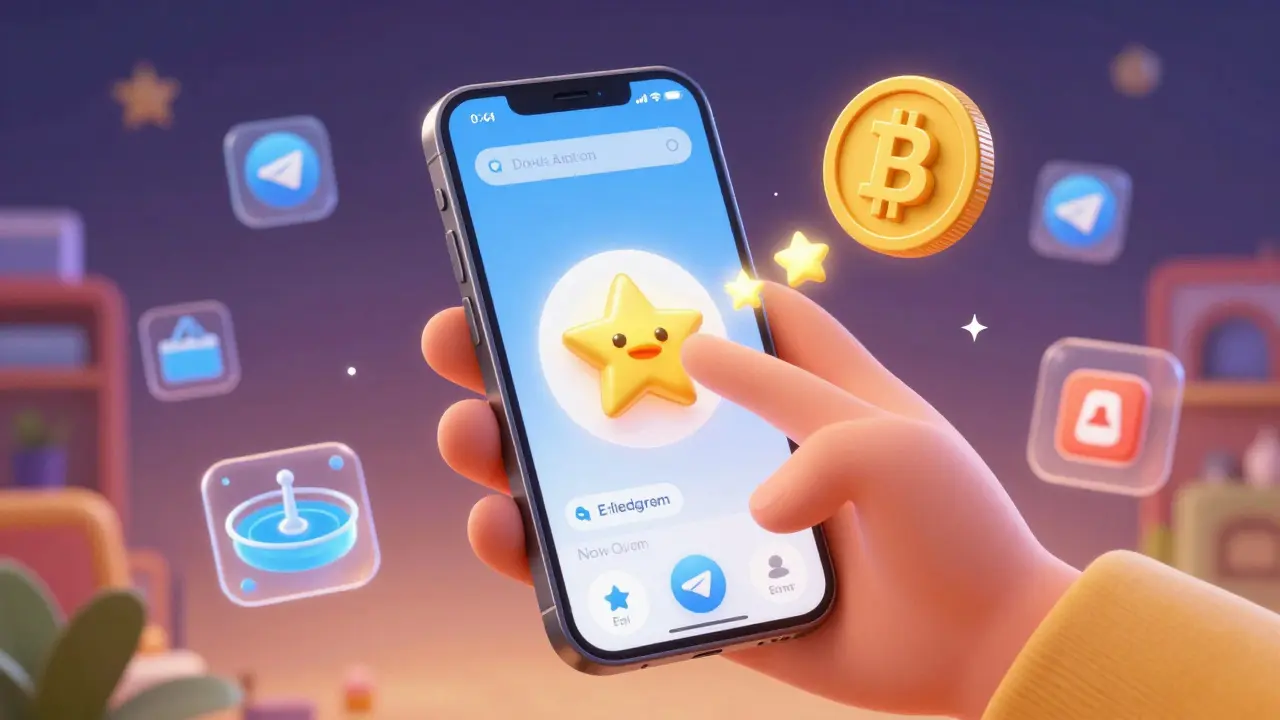
The DUCK coin isn’t just another meme token floating around in crypto. It’s the native currency of DuckChain, a blockchain platform launched on January 16, 2025, built to bring real blockchain functionality straight into Telegram - the messaging app with over 950 million users. Unlike most crypto projects that ask you to buy tokens first, DuckChain flips the script: you can interact with decentralized apps, send crypto, and pay gas fees using Telegram Stars, Telegram’s built-in digital currency. No exchange account? No problem.
How DuckChain works - no crypto wallet needed
DuckChain runs on Arbitrum Orbit, which means it’s fully compatible with Ethereum’s smart contract system (EVM). This lets developers bring existing Ethereum apps - like DeFi platforms, NFT marketplaces, and games - and drop them right into Telegram. You don’t need to download a separate app or switch wallets. Everything happens inside the Telegram interface as a Mini-App.
Here’s the kicker: when you swap tokens or interact with a smart contract, you don’t pay gas in DUCK. You pay in Telegram Stars. Those Stars get automatically converted into DUCK behind the scenes. This removes the biggest barrier for regular users - buying crypto on an exchange before they can even start. It’s like paying for a coffee with a gift card instead of cash. You never see the underlying currency, but it’s still what keeps the system running.
What DUCK is actually used for
Even though you don’t pay gas in DUCK directly, the token still does four important things:
- Gas backbone - Every transaction on DuckChain requires DUCK to be burned, even if you pay with Stars. This creates constant demand for the token.
- Governance - DUCK holders vote on changes to the network using the Quack AI protocol. This isn’t just a voting system - it uses AI to analyze voting patterns and suggest smarter proposals. Early holders got extra weight in votes through the AI DAO Genesis Members program.
- Staking rewards - You can lock up your DUCK to help secure the network and earn more DUCK over time. This helps reduce circulating supply and can support price stability.
- Ecosystem currency - DUCK is used to provide liquidity on decentralized exchanges built on DuckChain, pay for NFTs, and buy in-game items in Web3 games on the platform.
Technical edge: Why DuckChain isn’t just another TON project
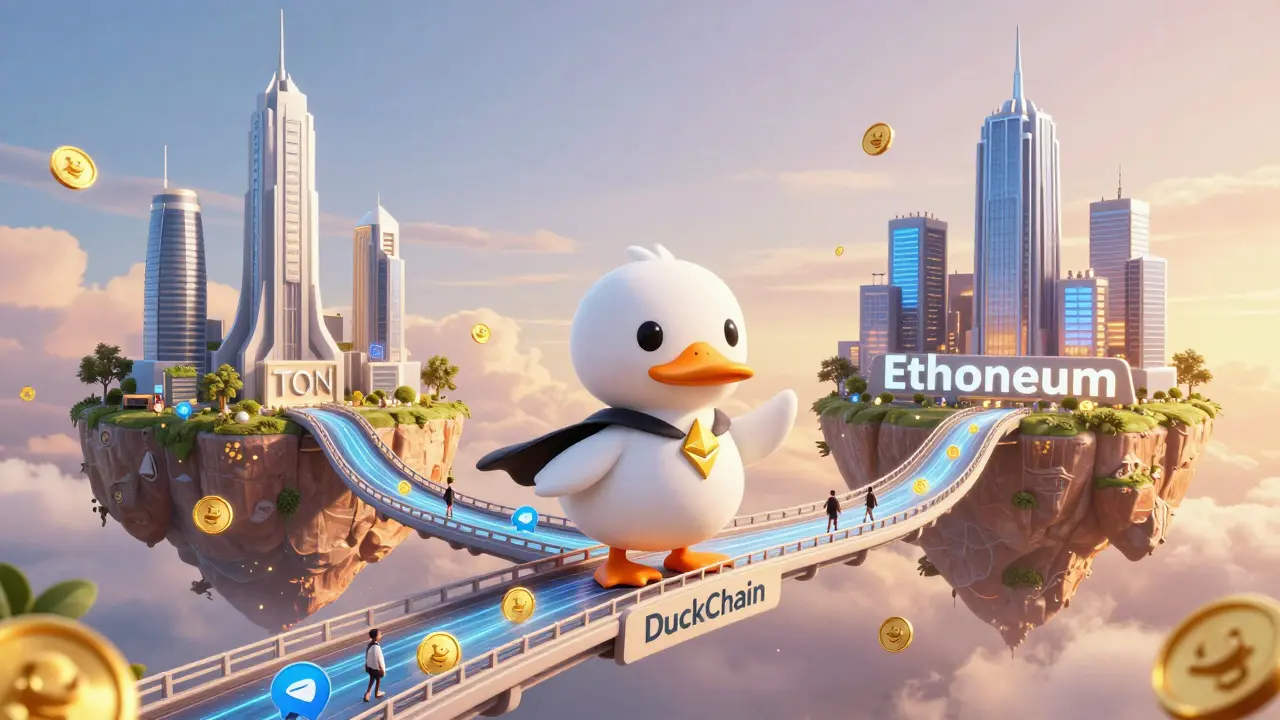
Telegram already has its own blockchain - Toncoin (TON). So why does DuckChain exist? Because TON doesn’t support Ethereum apps. If you want to use Uniswap, Aave, or a popular Ethereum-based game on Telegram, you can’t. TON is fast and cheap, but it’s locked in its own ecosystem.
DuckChain bridges that gap. It’s the only major EVM chain integrated into Telegram. That means:
- Developers can port Ethereum apps with minimal changes
- Users can access thousands of existing DeFi protocols without leaving Telegram
- It connects TON, Ethereum, and even Bitcoin through cross-chain bridges
This makes DuckChain less of a competitor to Toncoin and more of a complement - like adding a USB port to a laptop that only had Thunderbolt. It opens up a whole new category of apps.
Market performance: From Market performance: From $0.02 to $0.001
.02 to Market performance: From $0.02 to $0.001
.001
When DUCK launched on January 16, 2025, it exploded. It hit an all-time high of $0.02 per token, briefly giving DuckChain a $100 million valuation. That kind of hype drew in early traders and speculators.
By February 2026, the price had dropped to around $0.001043 USD. That’s a 95% decline from the peak. The market cap is now about $7.5 million, with roughly 7.2 billion DUCK tokens in circulation out of a fixed 10 billion supply.
Trading volume is modest - around $600,000 per day. That’s not nothing, but it’s far from the $200 million daily volume of Toncoin. The drop reflects a common pattern: hype fades fast if real usage doesn’t follow. Right now, DuckChain has 253,124 token holders, but we don’t know how many of them are actively using apps on the chain.
Who backs DuckChain? Institutional credibility matters
Unlike many crypto projects that launch with little more than a whitepaper, DuckChain has serious backing:
- $5 million from Arbitrum’s own investment fund - a major vote of confidence in the tech
- $10 million from a foundation focused on ecosystem growth
- Listings on 20+ top exchanges including OKX, KuCoin, Kraken, and MEXC
- The Quack AI governance protocol got its own listing on Binance - a rare win for a spin-off
This isn’t a team of anonymous devs. It’s a project with funding, infrastructure, and real partnerships. That doesn’t guarantee success, but it means they’re not going away overnight.

The big question: Will Telegram users actually use it?
DuckChain’s entire value hinges on one thing: adoption. Can 950 million Telegram users really start using blockchain apps without even realizing it? The tech is solid. The integration is seamless. But technology alone doesn’t move markets.
Right now, most users still treat Telegram like a messaging app. They don’t know what a smart contract is. They don’t care about EVM compatibility. DuckChain needs to make something so useful - like sending crypto to a friend, buying a digital collectible, or earning interest on a savings pool - that it becomes part of everyday use.
Think of it like Apple Pay. No one talks about NFC chips or tokenization. They just tap their phone to pay. DuckChain is trying to be the Apple Pay of crypto. If it succeeds, DUCK could become essential. If it doesn’t, it’ll be another footnote in crypto history.
What’s next for DUCK?
The next 12-24 months will be critical. DuckChain needs to:
- Launch at least 5-10 high-quality, easy-to-use apps on the platform
- Partner with Telegram to promote blockchain features in-app
- Grow developer activity - right now, there’s not enough public data on active dApps
- Prove that Telegram Stars can sustainably fuel gas fees without inflation
If those things happen, DUCK could rebound. If they don’t, the token will likely keep drifting lower.
Is DUCK a good investment?
There’s no clear answer. DUCK is a high-risk, high-potential asset. It’s down 95% from its peak, which means it’s priced for failure. But if Telegram users start using DuckChain apps at scale, the token could rebound hard. Only invest what you can afford to lose, and treat it like a long-term bet on blockchain adoption in messaging apps - not a quick flip.
Can I buy DUCK on Coinbase?
No, DUCK is not available on Coinbase as of February 2026. You can buy it on exchanges like OKX, KuCoin, Gate.io, MEXC, Bitget, and Kraken. Always check the listing on CoinMarketCap or CoinGecko before trading.
Do I need a wallet to use DUCK?
You don’t need a traditional crypto wallet like MetaMask to interact with DuckChain apps. Everything happens inside Telegram using your existing account. But if you want to hold DUCK long-term or stake it, you’ll need a wallet compatible with EVM chains - like Trust Wallet or Rabby.
How is DUCK different from Toncoin (TON)?
Toncoin is Telegram’s native blockchain - fast, cheap, and optimized for messaging and microtransactions. DUCK powers DuckChain, which is an Ethereum-compatible layer built on top of TON. TON can’t run Ethereum apps. DuckChain can. Think of TON as the highway, and DuckChain as the bridge that lets Ethereum vehicles drive on it.
Can I stake DUCK?
Yes, you can stake DUCK on the official DuckChain staking portal. Staking helps secure the network and earns you additional DUCK rewards. The annual percentage yield (APY) varies, but it’s typically between 5% and 12%. Rewards are paid out daily, and there’s no lock-up period.
Final thoughts
DUCK isn’t a coin you buy because it’s cheap. It’s a bet on whether Telegram can become a super app for crypto - without making users learn how wallets work. The tech is real. The backing is strong. The user adoption? Still unproven. If you’re curious, keep an eye on how many people start using DuckChain apps in Telegram over the next six months. That’s the real signal - not the price chart.