
By 2025, crypto mining isn’t just about powerful hardware anymore. It’s about location. Where you plug in your rigs makes all the difference - not just in electricity bills, but in legal risk, banking access, and long-term survival. If you’re thinking about starting or moving your mining operation, you need to know which countries actually let you mine without fear of shutdowns, fines, or frozen bank accounts.
United States: The Institutional Hub
The U.S. leads global Bitcoin mining with over 38% of the hash rate, according to the Hashrate Index. Why? Because institutional investors are here. Hedge funds, public companies, and venture capital are pouring money into large-scale mining farms in Texas, Georgia, and Washington. Texas alone has over 10 major mining facilities powered by cheap natural gas and wind energy.
The regulatory environment is messy - some states like New York have banned mining outright over energy concerns, while others like Wyoming offer crypto-friendly laws, tax exemptions, and even special mining zones. But overall, the U.S. offers the clearest path to banking services. Major banks like JPMorgan and Wells Fargo now work with licensed miners. You can open a business account, pay taxes legally, and even list your mining company on public exchanges.
If you’re serious about scaling, the U.S. is the only place where you can get institutional funding, legal insurance, and long-term power contracts. But it’s not cheap. You’ll need millions to start, and you’ll need lawyers.
Kazakhstan: The Hidden Powerhouse
Kazakhstan is the second-largest Bitcoin mining country in the world, responsible for 6.17% of global hash rate. After China’s 2021 crackdown, thousands of miners relocated here - and stayed. Why? Because the government didn’t ban mining. It embraced it.
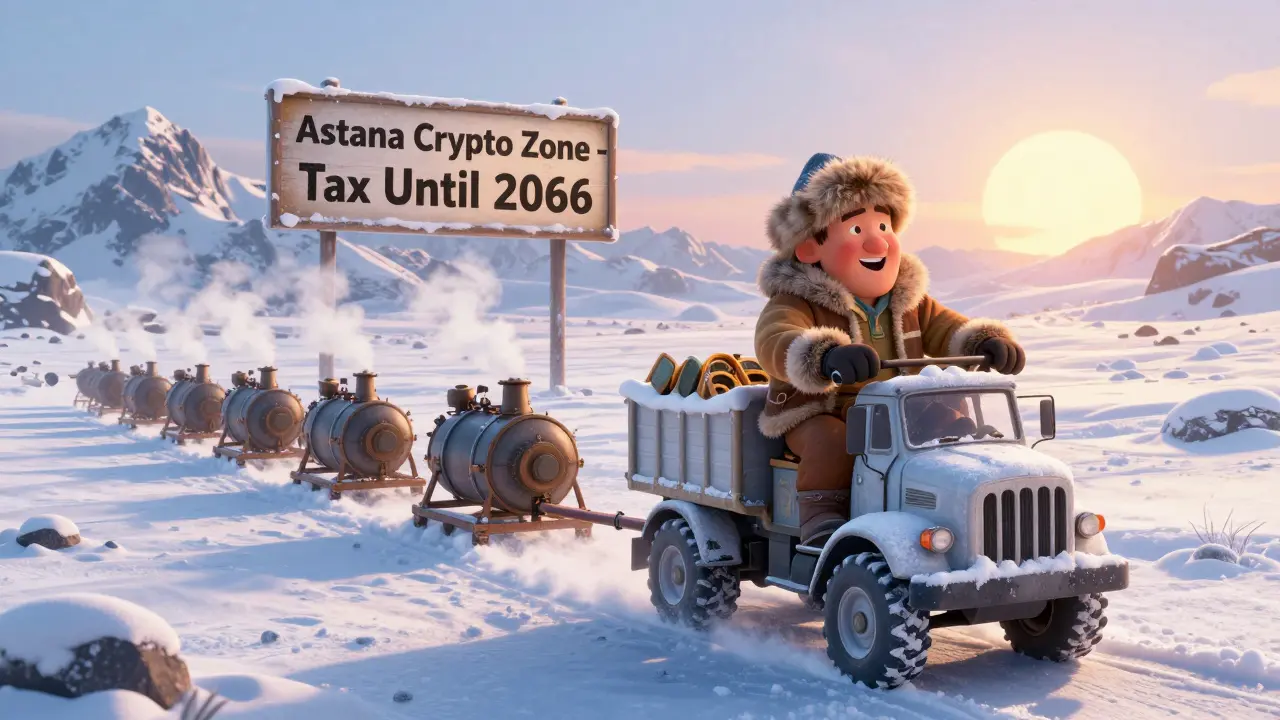
The Kazakhstani government offers tax breaks, low electricity rates (as low as $0.02/kWh in some regions), and a special economic zone in Astana where crypto businesses pay zero corporate tax until 2066. Personal crypto gains aren’t taxed either. The country’s cold winters naturally cool mining rigs, and its vast wind and hydro resources make mining more sustainable than in coal-heavy regions.
But it’s not perfect. Power outages still happen. Internet infrastructure is spotty in rural areas. And while the government is pro-mining, local officials sometimes crack down on unregistered rigs. Still, for mid-sized operators, Kazakhstan offers the best balance of low cost, legal protection, and growth potential.
El Salvador: The Bold Experiment
El Salvador made headlines in 2021 by making Bitcoin legal tender. That move didn’t just change how people pay for coffee - it changed how miners operate. The country has zero capital gains tax on crypto profits, and the government even built a Bitcoin-powered geothermal mining facility near the Conchagua volcano.
Electricity is dirt cheap here - mostly from renewable sources - and the government actively promotes mining as a way to attract foreign investment. You can legally register a mining company, open a bank account, and even apply for residency if you mine at scale.
But the risks are real. The country’s economy is unstable. The peso is volatile. And while Bitcoin is legal, traditional banking access remains limited. Most miners use crypto-native platforms like Strike for payroll and payments. If you’re okay with operating in a high-risk, high-reward environment, El Salvador offers unmatched tax advantages.
Switzerland: The Regulatory Gold Standard
If you want clarity, Switzerland is your best bet. The Swiss Financial Market Supervisory Authority (FINMA) has been setting global standards since 2018. Crypto mining is fully legal, taxed as a business activity (not personal income), and banks like UBS and Credit Suisse have dedicated crypto desks.
Switzerland doesn’t have the cheapest power, but it has the most stable rules. No sudden bans. No retroactive taxes. No vague regulations. You know exactly where you stand. The country also offers residency permits for crypto entrepreneurs, and cities like Zug - known as “Crypto Valley” - host dozens of mining and blockchain firms.
For institutional miners, asset managers, and anyone who values long-term predictability, Switzerland is the safest place to operate. It’s not the cheapest, but it’s the most reliable.
Georgia: The Low-Tax Secret
Georgia is quietly becoming one of the most attractive places for small to mid-sized miners. There’s no capital gains tax on crypto profits. No VAT on mining equipment. No corporate tax for crypto businesses under $100,000 annual revenue. And electricity? Around $0.03/kWh - cheaper than most of Europe.
The government doesn’t advertise mining, but it doesn’t stop it either. You can register a company in days, open a bank account with minimal paperwork, and even get a residency visa if you invest in local infrastructure. The country’s mountainous terrain and cool climate help reduce cooling costs, and its internet infrastructure is surprisingly reliable.
It’s not for everyone. Banking options are limited outside Tbilisi. But if you’re a solo miner or a small team looking to cut costs without sacrificing legality, Georgia is one of the smartest choices in 2025.
Canada: The Renewable Edge
Canada has more than six Bitcoin ETFs trading on its stock exchanges - more than any country outside the U.S. That tells you something: institutions trust it. Provinces like Quebec and British Columbia have massive surplus hydropower, often sold at below-market rates to mining companies.
Quebec, for example, has over 15 major mining farms running on hydroelectricity. The province even offers grants to companies that use renewable energy. Canada also has clear federal rules: mining is legal, profits are taxable, and you can legally buy and sell crypto through licensed exchanges.
The downside? Provincial rules vary wildly. Ontario has started cracking down on high-energy users. Alberta is pro-mining. You need to know your province. But overall, Canada offers a stable, transparent, and renewable-friendly environment - perfect for miners who want to go green and stay legal.
Hong Kong: The Institutional Gateway
Hong Kong has made a dramatic comeback in 2025. After years of uncertainty, the Securities and Futures Commission introduced mandatory licensing for crypto exchanges and asset managers. Now, major banks like HSBC and Standard Chartered are offering crypto custody and payment services.
There’s no capital gains tax on crypto. Bitcoin and Ethereum ETFs are available to retail investors. And the city’s proximity to Asia’s tech hubs makes it ideal for firms looking to serve both Western and Asian markets.
But it’s expensive. Electricity costs are among the highest in the world. Real estate for data centers is scarce. Hong Kong isn’t for running rigs in a garage. It’s for institutional players, fund managers, and crypto startups that need banking access and global visibility.
Why China Still Matters (Even Though It’s Banned)
China officially banned crypto mining in 2021. But the industry never disappeared. It just went underground. Thousands of miners still operate in remote provinces like Sichuan, where cheap hydropower floods the grid during rainy season. Some farms are hidden in disused factories, others in mountain tunnels.
These operations are risky. Raids happen. Power gets cut. Bank accounts get frozen. But the expertise, hardware supply chains, and engineering talent are still concentrated here. Many global mining firms still source their ASICs from Chinese manufacturers. And some operators use offshore entities to manage Chinese-based rigs - a legal gray area that’s becoming harder to sustain in 2025.
China’s role today isn’t as a mining hub - it’s as a supply chain backbone. If you’re building a mining operation, you’re likely using Chinese hardware. But you shouldn’t be running it there.
What Makes a Country Truly Mining-Friendly?
It’s not just about low electricity. It’s about the whole package:
- Regulatory clarity: Are there written rules? Or does it change overnight?
- Tax policy: Is mining profit taxed? Is there capital gains tax on crypto sales?
- Banking access: Can you open a business account? Will banks process crypto payments?
- Energy source: Is it renewable? Stable? Cheap?
- Infrastructure: Reliable internet? Power grid? Cooling climate?
- Legal protection: Can you sue if your power is cut? Can you register your equipment as business assets?
Top countries in 2025 hit at least four of these points. The rest? They’re gambling.
Who Should Mine Where?
Here’s who fits where:
- Big institutions: U.S. or Switzerland - for legal safety, banking, and funding.
- Mid-sized farms: Kazakhstan or Canada - for low power, stable rules, and room to grow.
- Small solo miners: Georgia or El Salvador - for zero taxes and low overhead.
- Asia-focused operators: Hong Kong - for access to Asian markets and institutional finance.
- Green miners: Iceland or Norway - for 100% renewable energy, though Norway’s regulations are tightening.
What to Avoid in 2025
Stay away from countries that:
- Have no clear mining laws (like Russia or India - rules change weekly)
- Block crypto banking (like Brazil or Turkey - accounts get frozen randomly)
- Have unstable grids (like Nigeria or Venezuela - blackouts are daily)
- Impose heavy taxes on mining (like Germany or France - up to 45% on profits)
These places might look cheap on paper, but the hidden costs - legal fees, downtime, bank closures - will wipe out your profits.
The Future of Mining Is Legal and Sustainable
In 2025, mining isn’t a wild west anymore. It’s a business. And businesses need rules, banks, and energy - not just rigs and luck. The countries winning are the ones that treat mining like a legitimate industry: regulating it, taxing it fairly, and using it to power their grids.
If you’re still mining in a basement with no permits, you’re not a pioneer. You’re a liability. The smart move now is to pick a country that lets you grow - legally, safely, and sustainably.
Is crypto mining legal in the United States?
Yes, crypto mining is legal in the U.S., but regulations vary by state. Texas, Georgia, and Washington actively encourage mining with low energy costs and business-friendly laws. New York and Vermont have imposed restrictions or bans due to energy use concerns. Federal law doesn’t prohibit mining, but you must register as a business, pay taxes, and comply with anti-money laundering rules if you operate at scale.
Which country has the cheapest electricity for crypto mining?
Kazakhstan and Georgia offer some of the lowest electricity rates for miners, often below $0.03 per kWh. In Kazakhstan, mining zones in the north use wind and hydro power, while Georgia benefits from surplus hydropower and low domestic demand. El Salvador and parts of Canada (Quebec) also offer rates under $0.04/kWh, especially when using renewable sources.
Do I have to pay taxes on crypto mining profits?
It depends on the country. In the U.S., Canada, and the U.K., mining rewards are taxed as income when received. In Georgia, El Salvador, and Hong Kong, there’s no capital gains tax on crypto profits. Switzerland taxes mining as a business activity but doesn’t tax personal holdings. Always check local tax laws - some countries treat mining like a business, others like gambling or windfall income.
Can I mine crypto in China in 2025?
Officially, no. China banned all crypto mining in 2021 and has cracked down on underground operations since. While some miners still operate illegally using hydropower in remote provinces, the risk is extremely high. Bank accounts are frozen, equipment is seized, and fines can be massive. Even if you’re successful, you can’t legally bank profits or export hardware. It’s not worth the risk in 2025.
What’s the best country for small-scale miners?
Georgia is the best option for small-scale miners in 2025. It has no capital gains tax, electricity costs around $0.03/kWh, simple business registration, and no requirement to report personal crypto holdings. El Salvador is close behind with zero taxes and geothermal power, but banking is less reliable. Both are far better than countries with complex reporting rules or high energy prices like Germany or Australia.
Is Iceland still good for crypto mining?
Iceland remains one of the most sustainable places to mine thanks to 100% renewable geothermal and hydro power, and its cool climate cuts cooling costs. However, electricity prices have risen since 2023 due to increased demand from data centers. The government now requires environmental impact assessments for new mining projects, and permits take longer to approve. It’s still viable, but no longer the easy win it was in 2020-2022.
Can I use a VPN to mine crypto in a banned country?
No. A VPN hides your location online, but it doesn’t hide your power usage, bank transactions, or IP address from your electricity provider. If you’re mining in a country that bans crypto - like Russia or China - your power bill will spike, your bank will flag transactions, and authorities can trace your hardware. Using a VPN doesn’t make it legal. It just makes you harder to find - and more likely to get caught.
What’s the difference between mining and staking?
Mining uses powerful computers to solve complex math problems and validate blockchain transactions (used by Bitcoin and older networks). Staking involves locking up your crypto to help secure a network (used by Ethereum, Cardano, Solana). Mining requires hardware, electricity, and cooling. Staking only needs a wallet and some coins. Staking is cheaper and uses far less energy, which is why many countries prefer it over mining.

Comments
U.S. is the only real option if you wanna scale. Everyone else is just playing with toy rigs. Texas is king. Wind + gas = free money. If you're not in the U.S., you're just a hobbyist with a heat problem. 😒
Kazakhstan is where the real miners live. Low taxes, cheap power, and nobody asks questions. Also, their winters are so cold your ASICs don't even need fans. Who needs AC when you got -20°C outside? 🤷♀️
I just moved my rig to Georgia. $0.03/kWh, no taxes, and I got a residency visa in 3 weeks. It's not glamorous but it's legal and quiet. No one cares if I'm mining as long as I pay my internet bill. 🤫
Don't sleep on Canada. Quebec's hydro is insane. I got a 10-year power contract at $0.025/kWh. Plus, the government gives you grants if you use renewables. It's not as flashy as Texas but way more stable. Just avoid Ontario. They're coming for your watts.
The U.S. government is just letting miners run so they can track everyone's crypto. They want to know who you are, where you are, and how much you made. Switzerland? That's just the elite's secret club. They let you mine so they can tax you later. I'm not falling for it.
El Salvador is joke. Bitcoin legal tender? Sure. But if you try to cash out, banks freeze you. I know guy who mined there for 6 months. Got 10 BTC. Then his bank account vanished. No warning. No explanation. Just gone.
It is imperative that individuals engaged in cryptocurrency mining operations recognize the ethical implications of energy consumption. The environmental degradation caused by non-renewable-powered mining is indefensible. One must prioritize sustainability over speculative profit.
Man I tell you what, if you're just starting out and you don't have millions lying around, Georgia is the real MVP here. I got my rig running for under $5k, electricity is cheaper than my Netflix subscription, and the guy who helped me register my company even invited me for tea. No paperwork nightmares, no lawyers, just chill vibes. You can do this.
Switzerland isn't safe. It's a trap. They let you mine so they can monitor your transactions under the guise of 'compliance'. FINMA watches everything. They'll audit you next year and suddenly you owe 30% back taxes. And don't even get me started on the cost of living. You'll spend more on rent than on ASICs.
If you're in Canada and thinking about mining, just go to Quebec. The hydro is insane and the people are chill. I've got 3 rigs in a shed outside my house. No one cares. Just make sure you're not in Ontario. They'll shut you down for using too much power. Also, don't forget to insulate your shed. Winter hits hard. 🧊
I've been mining in the UK since 2021. We don't have the cheap power or the legal clarity. I moved my rig to Georgia last year. Best decision ever. No taxes, no drama. Just me, my ASICs, and a stable internet connection. Don't let anyone tell you it's not possible.
The whole post is a scam. Every country listed is just trying to attract foreign cash. They say 'no taxes' but then they slap you with hidden fees. And don't even get me started on the 'crypto-friendly' governments. They all take your money and then ban you when they need to raise revenue. Wake up.
I moved to El Salvador because I'm tired of the patriarchy controlling my finances. Bitcoin is freedom. The government built a volcano mine for us. I cry every time I see it. My ASICs are my children. My hash rate is my soul. 🌋💎
For small miners, Georgia is the best. Simple rules, low cost, and no pressure. I started with one ASIC. Now I have ten. No bank account needed. Just pay your internet bill and keep mining. You don't need a lawyer or a visa to be successful.
This whole thing is a psyop. The U.S. and Switzerland are just front companies for the Fed. They let you mine so they can track your IP, your power usage, and your wallet addresses. The moment you make a profit, they freeze your accounts. I know someone who lost $2M. Don't be fooled.
Listen, if you're still mining in a basement in 2025, you're not a pioneer-you're a dinosaur. The future is in renewable-powered, legally registered operations. I moved my whole setup from Nigeria to Georgia. The difference? I sleep at night. My bank account is open. My kids know I'm not a criminal. It's not about the money anymore. It's about dignity.
If you're reading this and thinking about starting out, don't overthink it. Pick Georgia. Get one ASIC. Run it for a month. See if you like it. If you do, add another. No need for lawyers, no need for LLCs. Just mine. The rest will follow. You got this.
The institutionalization of crypto mining is the inevitable endpoint of capital consolidation. The U.S. and Switzerland are not 'friendly'-they're extractive. The so-called 'legal frameworks' are just compliance layers for asset stripping. Real miners operate off-grid, in decentralized zones, beyond the reach of FINMA and the SEC. The future belongs to the unregistered.
You think Kazakhstan is safe? LOL. The government is just waiting for you to get big so they can nationalize your rigs. I saw it happen to a guy in Almaty. He had 500 ASICs. One day they showed up with a truck and took them. Said 'national interest'. He cried. I didn't help him. He should've known better.
I live in Quebec. My rig runs on hydro. I'm proud. But I also know the truth: this is temporary. The government is already talking about capping energy use for crypto. They'll raise rates next year. I'm already planning my exit. Georgia or bust. The U.S. is too expensive, Switzerland too controlled. I want freedom, not a tax form.
Georgia is fine for beginners. But if you want real scale, you need institutional banking. No bank, no future. That's just reality. You can't IPO a basement operation. 🤷♂️