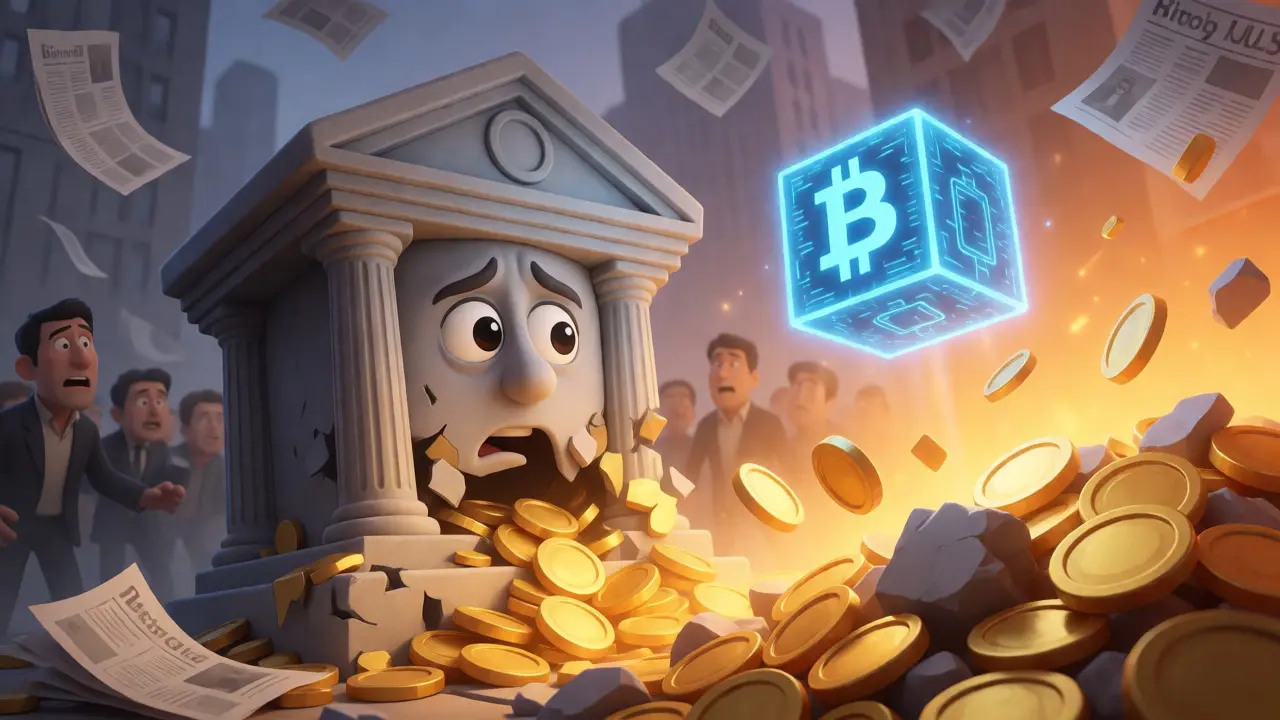
You might think Bitcoin appeared out of thin air in 2009, a sudden miracle born from code. But it wasn't magic. It was a reaction. A direct, angry response to a global financial system that had just collapsed under its own weight. When Bitcoin launched on January 3, 2009, it wasn't just another tech experiment; it was the first time someone actually solved the problem of digital scarcity without trusting a bank.
Why does this matter today? Because every crypto project you see now-Ethereum, Solana, meme coins-they all stand on the shoulders of this one giant leap. If you want to understand why your digital wallet exists, or why people talk about "decentralization" like it's a religion, you have to go back to the start. Let’s look at how Bitcoin became the first cryptocurrency ever created and what really happened behind the scenes.
The Pre-Bitcoin Era: Why Digital Money Failed Before
Before Bitcoin, digital money existed, but it was broken. Think of trying to send an email that could be copied infinitely. Without a central authority to verify who owned what, you’d end up with double-spending. You spend a dollar online, but because the network doesn’t know you spent it, you can spend that same dollar again. This is the "double-spend problem," and for decades, it killed every attempt at digital cash.
There were attempts. In 1983, cryptographer David Chaum invented eCash, a system using encrypted tokens to allow anonymous transactions. He even launched Digicash in 1995. It worked technically, but it failed commercially because it still relied on banks to issue the money. If the bank went bust, your digital cash vanished. Then came Wei Dai’s "b-money" in 1998 and Nick Szabo’s "bit gold." These were brilliant theoretical frameworks. They proposed using computational work to create value. But they lacked one crucial thing: a working, decentralized network where everyone agreed on the truth without a boss.
This gap is where Bitcoin stepped in. It didn't invent cryptography; it combined existing ideas-hashing, public-key cryptography, and proof-of-work-into a single, functional protocol that no single entity controlled.
Satoshi Nakamoto and the Whitepaper That Changed Everything
On Halloween 2008, while the world was reeling from the collapse of Lehman Brothers, a person (or group) using the name Satoshi Nakamoto posted a paper titled "Bitcoin: A Peer-to-Peer Electronic Cash System" to a niche mailing list called Cypherpunks. The document was short, dense, and revolutionary. It outlined a way to transfer money directly between people, skipping banks entirely.
Nakamoto’s genius wasn't just in the math; it was in the timing. The 2008 financial crisis had shattered trust in traditional finance. Banks were failing, governments were printing trillions to save them, and ordinary people lost their savings. Nakamoto offered an alternative: money that couldn't be inflated by a government and couldn't be seized by a bank.
Who was Satoshi? To this day, nobody knows for sure. Some say it was a single eccentric coder; others believe it was a small team. What we do know is that after handing over control of the source code to other developers in 2011, Satoshi disappeared. No interviews, no social media, no public appearances. This mystery adds to Bitcoin’s allure, making it feel less like a corporate product and more like a natural phenomenon.

The Genesis Block: A Timestamp in Stone
On January 3, 2009, the first block of the Bitcoin blockchain was mined. This is known as the Genesis Block. Unlike subsequent blocks, which reference the previous block’s hash, the Genesis Block has no parent. It is the root of the tree.
Embedded within this block is a message that serves as both a timestamp and a political statement. Nakamoto included the headline from The Times newspaper: "Chancellor on brink of second bailout for banks." This wasn't just random data. It proved the block was mined after that date, and it signaled Bitcoin’s purpose: to provide an alternative to a banking system on the brink of failure.
The mining process itself relies on SHA-256, a cryptographic hash function that secures the network. Miners compete to solve complex mathematical puzzles. The winner gets to add the next block and receives newly created Bitcoin as a reward. This mechanism ensures security through energy expenditure, making it prohibitively expensive to cheat the system.
From Pizza to Powerhouse: Bitcoin's Early Growth
For the first year, Bitcoin had no price. It was worthless. Who would pay real money for something that only nerds understood? That changed on May 22, 2010. Programmer Laszlo Hanyecz paid 10,000 bitcoins for two Papa John's pizzas. Today, those pizzas are worth hundreds of millions of dollars. At the time, though, it was just a fun way to prove Bitcoin could actually buy things.
That transaction kicked off the market. By March 2010, Bitcoin had a recorded price of $0.003. Soon after, the first exchange, Mt. Gox, launched. Despite its eventual dramatic collapse due to hacking and mismanagement, Mt. Gox handled over 70% of all Bitcoin trades in its prime. It was messy, but it showed demand was real.
Growth wasn't linear. Bitcoin hit $1 in early 2011, spiked to $30, then crashed back to $2. Volatility was-and remains-a core feature. But each cycle brought more attention. The dark web marketplace Silk Road, which exclusively accepted Bitcoin, drove early adoption among privacy-focused users. By November 2013, Bitcoin crossed the $1,000 mark, signaling that it had moved beyond a hobbyist toy into a recognized asset class.

Why Bitcoin Still Matters in 2026
Fifteen years later, Bitcoin isn't just surviving; it's institutionalized. Major financial firms offer ETFs, and countries like El Salvador have adopted it as legal tender. But the core promise remains unchanged: censorship-resistant money. You don't need permission to open a Bitcoin account. You don't need a credit check. You just need internet access.
While thousands of other cryptocurrencies exist, none have replicated Bitcoin's network effect or security budget. Its supply is capped at 21 million coins, creating artificial scarcity similar to gold. This deflationary model contrasts sharply with fiat currencies, which lose purchasing power over time due to inflation. For many, Bitcoin is no longer just "digital gold"; it's a hedge against monetary policy mistakes.
| Date | Event | Significance |
|---|---|---|
| Oct 31, 2008 | Whitepaper Published | Introduced peer-to-peer electronic cash concept. |
| Jan 3, 2009 | Genesis Block Mined | Official launch of the Bitcoin network. |
| May 22, 2010 | Pizza Transaction | First real-world purchase using Bitcoin. |
| Nov 28, 2013 | $1,000 Price Point | Mainstream media attention peaks. |
| Aug 2017 | SegWit Activation | Improved scalability and transaction efficiency. |
Common Misconceptions About Bitcoin's Origin
People often get the story wrong. Here are three myths debunked:
- Myth: Bitcoin was invented to replace the US Dollar immediately. Reality: It started as a niche experiment for cypherpunks who valued privacy. Adoption by institutions took over a decade.
- Myth: Satoshi Nakamoto is Craig Wright. Reality: While Australian computer scientist Craig Wright claimed to be Satoshi, he failed to provide cryptographic proof when challenged by the community. Most experts remain skeptical.
- Myth: Blockchain was invented with Bitcoin. Reality: The concept of chained blocks existed earlier. Bitcoin’s innovation was combining it with proof-of-work consensus to solve double-spending without a central server.
Understanding these nuances helps you see Bitcoin not as a get-rich-quick scheme, but as a robust infrastructure layer for value transfer.
Who created Bitcoin?
Bitcoin was created by an unknown person or group using the pseudonym Satoshi Nakamoto. Their true identity remains one of the biggest mysteries in modern technology.
When was Bitcoin launched?
The Bitcoin network officially launched on January 3, 2009, when the genesis block was mined. However, the whitepaper describing the technology was published in October 2008.
Was Bitcoin the first digital currency?
No, there were earlier attempts like DigiCash and Bit Gold. However, Bitcoin was the first to successfully solve the double-spending problem without relying on a central authority, making it the first truly decentralized cryptocurrency.
What was the first Bitcoin transaction?
The first commercial transaction occurred on May 22, 2010, when programmer Laszlo Hanyecz bought two large pizzas for 10,000 bitcoins.
Why is the supply of Bitcoin limited?
The protocol caps the total supply at 21 million coins to create scarcity. This design choice mimics precious metals like gold and aims to protect against inflation caused by unlimited money printing.
Comments
It wasn't just a reaction to the crash, it was a calculated move by the same guys who broke it. Satoshi is likely a pseudonym for a consortium of banks trying to create a digital ledger they could eventually control once the public got used to it.
The mystery surrounding Nakamoto is precisely what fuels the hype machine. If we knew who it was, the illusion of decentralized perfection would shatter immediately. We need the myth more than we need the truth right now.
hey everyone! really cool read. i think its awesome how far we came from those pizza days. keep learning and growing fam! 🚀
people still dont get it bitcoin isnt money its energy 🌍⛓️ the proof of work mechanism is literally burning fossil fuels to secure a network that serves no real utility outside speculation 💸📉 its sad really
To view Bitcoin merely as a financial instrument is to miss the profound philosophical shift it represents in human interaction with value. The genesis block's timestamp serves not only as a cryptographic anchor but as a historical marker indicating the precise moment when humanity decided to decouple trust from institutional authority. This separation allows for a form of economic sovereignty that was previously unimaginable, where an individual's wealth is defined not by their relationship to a bank but by their possession of private keys. It is a radical reimagining of social contract theory applied to economics, suggesting that consensus can be achieved without coercion or hierarchy. The implications extend beyond mere price action, touching upon the very nature of ownership and privacy in a digital age. We are witnessing the birth of a new paradigm where code replaces law, and mathematics replaces faith. This transition is neither quick nor painless, requiring a fundamental restructuring of how societies perceive security and exchange. As we move further into this era, the initial skepticism will likely fade, replaced by an acceptance of this new reality as inevitable. The beauty lies in its simplicity: a fixed supply, a transparent history, and a permissionless entry point for anyone with internet access. It challenges us to rethink what we consider 'real' value in an increasingly virtual world.
Love this breakdown!! 🙌 The pizza story always gets me 😂 Imagine spending $400k on dinner lol. Keep sharing these gems! ✨💎
Great overview. One thing to add is the importance of the halving events. They aren't just technical updates; they're psychological triggers that drive market cycles. Understanding supply shocks is key to grasping why the price behaves the way it does over four-year periods. 📈🔒
You call it decentralization but I see centralization of mining power. The same few entities control the hash rate. When the grid fails or regulations change those big miners pull out and the whole thing collapses like a house of cards built on sand. You are all sleeping while the wolves circle.
Nice summary. Just a note on the Mt Gox part - it handled a huge chunk of volume but also highlighted the risks of custodial solutions. Self-custody became a major lesson from that era. Overall solid piece though.
I appreciate the emphasis on the emotional context of 2008. It helps explain why people were so desperate for an alternative back then.
The article presents a sanitized version of history that ignores the sheer luck involved in Bitcoin's survival. For years it was essentially worthless and used primarily by criminals on the dark web which drove adoption more than any ideological belief in decentralization. The narrative of 'solving double spending' is technically accurate but practically irrelevant to the average user who cares about volatility and transaction fees. By framing it as a moral imperative against banks you ignore the fact that most users today hold Bitcoin solely for speculative gain rather than actual utility. The comparison to gold is flawed because gold has industrial uses and cultural weight accumulated over millennia whereas Bitcoin relies entirely on network effect and momentum which can evaporate instantly if sentiment shifts. Furthermore the environmental cost mentioned briefly is understated given the current global push for ESG compliance among institutional investors. Until there is a clear path to sustainability that doesn't rely on cheap energy markets the long term viability remains questionable despite the ETF approvals.
This gave me chills honestly 😭 remembering when I first heard about it. So much growth since then! 🌱❤️
What a beautifully woven tapestry of technological evolution and human resilience. It reminds us that innovation often springs from crisis, turning despair into opportunity for those willing to look beyond the horizon. The journey from eCash failures to a global asset class is truly inspiring for anyone seeking meaning in chaos. 🌟
Most people don't realize that the 'problem' Bitcoin solved was never actually a problem for the banking system. Banks love inefficiency because it creates jobs and fees. Bitcoin threatens the rent-seeking behavior of the financial elite which is why they attack it. The real issue isn't technology it's power dynamics. Those who understand this know that the war isn't over it's just beginning.
Good post. I prefer keeping my opinions to myself but this is well researched.
the timing of the whitepaper during lehman collapse is such a perfect storm moment imo its like destiny or something idk feels deeper than just coding
Thank you for providing this comprehensive analysis. It is noteworthy that the distinction between theoretical frameworks like Bit Gold and the practical implementation of Bitcoin is clearly articulated. This clarity assists readers in understanding the incremental nature of technological progress.
whatever. another crypto fanboy essay. the tech stack is bloated garbage anyway. jargon heavy nonsense to confuse normies. 🇺🇸🦅
It is wonderful to see such a balanced perspective on such a polarizing topic. Your explanation of the pre-Bitcoin era provides essential context that many newcomers lack. This kind of educational content is vital for fostering informed discussion within the community. Well done.
why do we even care about old tech? life is short. embrace the chaos. forget the history books. feel the vibe. 🌀✨
Interesting history. In India many people started buying BTC after seeing news about El Salvador. Good to know origin story.
Really enjoyed reading this mate. The bit about the Times headline is one of my favourite pieces of trivia. Cheers for putting it together so nicely!