
Imagine sending $1,000 to a friend using digital cash - but somehow, that same $1,000 gets spent again five minutes later, to someone else. This isn’t a glitch in your bank app. It’s the double-spend problem, and it’s the reason blockchain technology had to be invented in the first place. Before Bitcoin, digital money had no reliable way to stop people from copying and reusing the same funds. Physical cash can’t be duplicated. A dollar bill in your pocket can’t also be in someone else’s. But a digital file? It’s just data. Copy it, and you’ve got two copies. That’s the core challenge blockchain had to solve.
What Is Double-Spending and Why Does It Matter?
Double-spending happens when someone tries to spend the same digital token more than once. In a centralized system like PayPal or a bank, this is easy to stop. The company tracks who has what and blocks duplicate transfers. But in a decentralized network - with no central authority - there’s no single entity to check balances. That’s where blockchain steps in. Bitcoin’s breakthrough wasn’t just about digital money. It was about proving that a distributed network of strangers could agree on who owns what, without trusting anyone. It did this by linking transactions into blocks, then chaining those blocks together with cryptographic proof. Every new block confirms the ones before it. The more blocks added on top, the harder it becomes to change anything below. Without this system, online payments wouldn’t be secure. You couldn’t buy a coffee with Bitcoin and trust that the seller actually got paid. Merchants would be at constant risk of fraud. That’s why every blockchain network must have a solid double-spend prevention mechanism - or it simply won’t work.How Proof-of-Work Prevents Double-Spending
Bitcoin uses Proof-of-Work (PoW). Miners compete to solve a hard math puzzle. The first one to solve it gets to add the next block of transactions and earns a reward. This process takes about 10 minutes on average. Why does this stop double-spending? Because changing a past transaction means redoing every block after it. To do that, an attacker would need more than half of all the mining power on the network - a so-called 51% attack. That’s not just hard. It’s astronomically expensive. In 2026, Bitcoin’s network has over 700 exahashes per second of computing power. To overpower it, you’d need to spend billions on hardware and electricity. And even then, the community could respond by changing the rules. But PoW isn’t perfect. It’s slow. Each confirmation takes time. For small purchases, one confirmation might be enough. For bigger ones - say, a $10,000 transfer - most wallets and exchanges wait for six confirmations. That’s about an hour. Some services even wait for 12 confirmations for maximum safety. The trade-off is clear: security comes at the cost of speed.Proof-of-Stake and Deterministic Finality
Ethereum switched from Proof-of-Work to Proof-of-Stake (PoS) in 2022. Instead of miners, PoS uses validators. These are users who lock up their own ETH as collateral to propose and vote on new blocks. If they act dishonestly - like trying to confirm a double-spend - they lose their staked ETH. That’s called slashing. PoS introduces something PoW never had: deterministic finality. In PoW, finality is probabilistic. The more blocks you wait for, the safer you are. In PoS, once a block reaches a certain number of votes from validators, it’s declared final. There’s no going back. Ethereum’s Casper protocol marks blocks as final after two epochs - roughly 13 minutes. That’s faster than waiting for six Bitcoin confirmations. This matters because apps like DeFi platforms, NFT marketplaces, and automated loans can’t afford to wait. If a loan repayment isn’t final, a user could reverse it after the fact. That’s why Ethereum’s shift to PoS didn’t just save energy. It made blockchain applications more reliable.
Attack Vectors: Race Attacks and Latency Gaps
Even with solid consensus, double-spending can still happen - not by breaking the blockchain, but by exploiting timing. A race attack is when a fraudster sends two conflicting transactions at the same time. One goes to the merchant. The other goes to a different part of the network. If the merchant accepts the transaction before it’s confirmed, and the network ends up choosing the second one, the merchant gets nothing. This isn’t theoretical. In 2024, a major cryptocurrency exchange reported losing $470,000 in a race attack because their system accepted payments after just one confirmation. They didn’t realize that on their network, the average confirmation time was 30 seconds - long enough for a clever attacker to slip in a conflicting transaction. Latency is the hidden enemy. If your wallet or app doesn’t wait long enough for consensus to spread across the network, you’re vulnerable. That’s why experts say: don’t trust a single confirmation. Always check how many blocks have been built on top of your transaction.Layer 2 and the Finality Trap
Layer 2 solutions like Lightning Network for Bitcoin or Optimism for Ethereum were built to make transactions faster and cheaper. But they introduced a dangerous assumption: that the underlying blockchain will finalize correctly. In 2025, security researchers at Trail of Bits found two major Layer 2 clients - Juno and Pathfinder - that didn’t properly check for finality. They assumed a block was final after five blocks passed. But on Ethereum, finality doesn’t work that way. A block might look confirmed, but still be reversible for up to 13 minutes. Those clients were treating a 5-block delay like finality. That’s like thinking your bank transfer is done because the money left your account - not because it reached the recipient. The fix? Both projects released updates. Juno v0.4.0 and Pathfinder v0.6.2 now correctly detect Ethereum’s finality epochs. But the damage was done. Developers who ignored finality checks lost funds. Users got scammed. And the lesson stuck: Layer 2 doesn’t mean less security - it means more responsibility.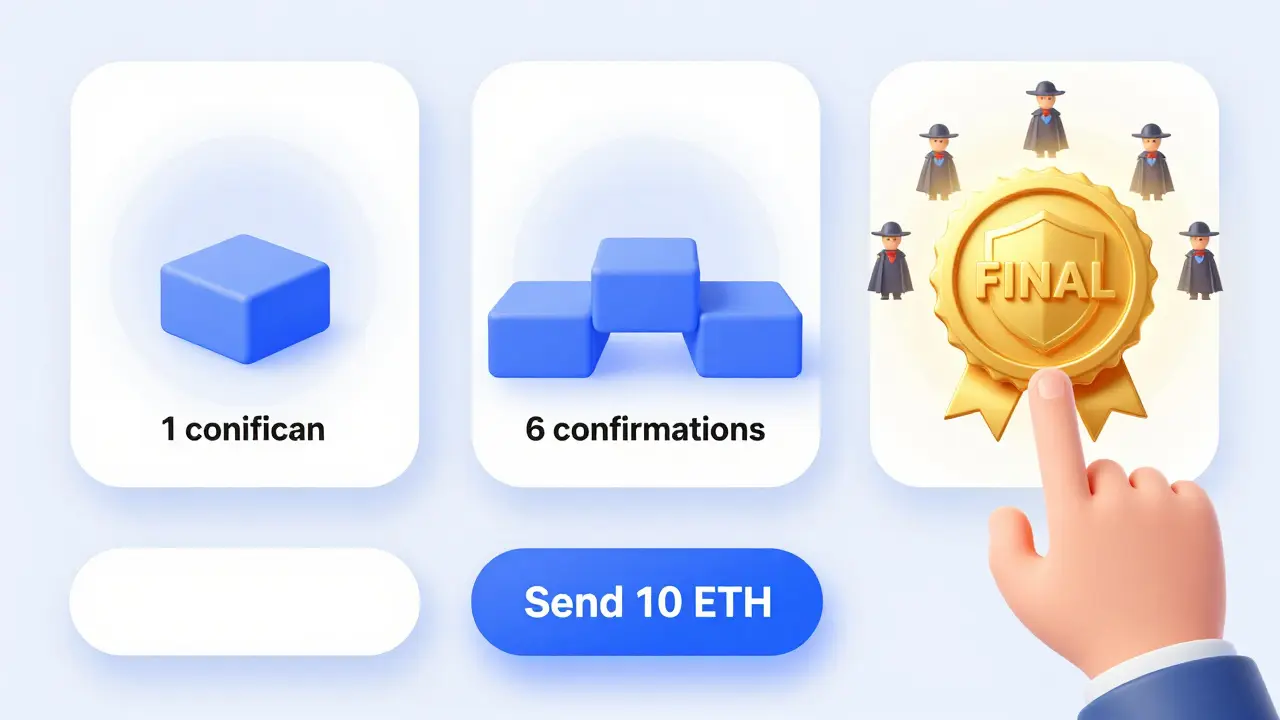
Real-World Impact: DeFi, Exchanges, and Smart Contracts
Decentralized finance (DeFi) runs on smart contracts - self-executing code that handles loans, trades, and insurance. These contracts can’t afford uncertainty. If a swap on Uniswap isn’t final, someone could reverse it and steal your tokens. If a loan repayment isn’t final, the lender could claim they never got paid. In 2025, a major DeFi protocol lost $2.3 million because its contract accepted a transaction after only three confirmations on a PoW chain. The attacker double-spent the funds, and the contract didn’t wait long enough to catch it. The protocol had to shut down for three days to fix the logic. Exchanges face the same problem. When you deposit Bitcoin, the exchange doesn’t credit your account until it’s sure the transaction is final. Most use 3-6 confirmations. High-value deposits? 12 or more. That’s not paranoia. It’s standard practice. Even NFT marketplaces rely on finality. If you buy an NFT and the seller reverses the transaction after you’ve received it, you’re out of luck. That’s why top marketplaces now require finality before releasing assets.What You Need to Know as a User or Developer
If you’re just sending crypto:- Wait for at least 3 confirmations for everyday transactions.
- For anything over $1,000, wait for 6 or more.
- Don’t assume a transaction is final just because it shows up in your wallet.
- Never use block height or time delays as a proxy for finality.
- Use the network’s official finality mechanism - Ethereum has
finalizedBlockin its JSON-RPC API. Bitcoin hasconfirmations. - Test your app under attack conditions. Simulate a race attack. See if your system catches it.
- Read the documentation of every blockchain you integrate with. Finality works differently on Solana, Polygon, and Bitcoin.
Finality Isn’t Optional - It’s the Foundation
Double-spend prevention isn’t a feature. It’s the bedrock. Without it, blockchain is just a slow database with a fancy name. Every innovation - from DeFi to NFTs to tokenized real estate - depends on this one idea: once a transaction is confirmed, it can’t be undone. The good news? Modern blockchains have gotten better. Ethereum’s PoS finality is faster and more reliable than Bitcoin’s probabilistic model. Newer chains like Solana and Aptos use novel consensus methods that achieve finality in seconds. But with speed comes complexity. And complexity brings risk. The rule hasn’t changed since 2009: if you don’t verify finality, you’re gambling. Whether you’re sending $5 or $5 million, always ask: Is this really final?What is blockchain finality?
Blockchain finality is the point at which a transaction is permanently recorded on the blockchain and cannot be reversed without massive computational or economic effort. In Proof-of-Work systems like Bitcoin, finality increases with each new block added on top. In Proof-of-Stake systems like Ethereum, finality is deterministic - once a block is validated by enough validators, it’s declared final and immutable.
How many confirmations are safe for Bitcoin transactions?
For small payments under $1,000, 3 confirmations (about 30 minutes) are usually enough. For larger transactions, 6 confirmations (about 60 minutes) is the industry standard. High-value transfers, like real estate or corporate payments, often require 12 or more confirmations to reduce risk to near zero. Each confirmation adds another layer of security by building more blocks on top of the transaction.
Can you double-spend on Ethereum after it switched to Proof-of-Stake?
Technically, yes - but it’s practically impossible. Ethereum’s Proof-of-Stake system uses deterministic finality. Once a block is finalized (after about 13 minutes), reversing it would require controlling over two-thirds of all staked ETH and bribing validators to collude. The cost would exceed $10 billion, and the attackers would lose their entire stake. This makes double-spending economically irrational.
Why do Layer 2 networks have finality risks?
Layer 2 networks like Optimism or Lightning rely on the main blockchain (Layer 1) to finalize transactions. But if the Layer 2 app incorrectly assumes finality based on block height or time delays instead of the network’s official finality signal, it can accept transactions that are still reversible. This mistake has led to millions in losses. Always use the Layer 1’s native finality API - never guess.
Is Proof-of-Stake more secure than Proof-of-Work against double-spending?
Yes, in practice. Proof-of-Stake makes double-spending attacks far more expensive and self-defeating. Attackers must stake real value, and any attempt to cheat results in losing that stake. In Proof-of-Work, attackers need expensive hardware and electricity, but they don’t lose their own money. With PoS, the attacker’s own funds are on the line - creating a stronger economic deterrent. Additionally, PoS achieves finality faster, reducing the window of vulnerability.


Comments
lol i just sent 0.5 btc and thought it was done when i saw it in my wallet 😅 turns out i was like 5 minutes early. never again.
confirmations are real.
I’ve been using crypto for years and I still forget how wild it is that we’re trusting math instead of banks. Like, imagine if your paycheck could disappear because someone else copied it and sent it to a different account. That’s what we’re avoiding here.
It’s not just about Bitcoin - it’s about trust. We built a whole system where strangers validate each other’s transactions, and it works. Not perfectly, but well enough.
And honestly? The fact that Ethereum now has deterministic finality is a game-changer. No more waiting for six blocks. 13 minutes and it’s locked. That’s huge for DeFi.
I remember when I first tried to swap tokens on Uniswap and got scared because it said ‘1 confirmation.’ I sat there for 20 minutes refreshing. Now I know better.
But Layer 2s? Still sketchy. I saw a guy lose $20k because his wallet thought 5 blocks = final. Nah. That’s like thinking your car is parked because the engine’s off.
Finality isn’t a feature. It’s the whole damn point. Without it, crypto’s just digital confetti.
The concept of finality is fundamental. Without it, blockchain loses its purpose.
PoW is slow but reliable. PoS is fast but needs strict adherence to finality signals. Both work if you respect the rules. Most failures? Human error.
this whole thing feels like magic. like, how do we just... trust a computer? i mean, i got scammed once on a fake nft site and now i'm scared to even send 5 bucks. why can't we just go back to cash?
I’ve been building on Ethereum since 2021 and the shift to PoS was night and day.
Before, I’d have to delay user payouts for an hour just to be safe. Now? 13 minutes and it’s final. That’s the difference between a prototype and a real product.
Also, the idea that Layer 2s can assume finality based on block height? That’s like building a bridge and assuming the foundation is solid because the first three pillars are up.
Biggest mistake devs make? Treating confirmation counts like finality. They’re not the same. Ethereum’s JSON-RPC has a finalizedBlock call for a reason. Use it.
finally someone explained this without jargon. i used to think crypto was just gambling. now i get why the tech matters. thanks.
I love how this post breaks down the nuance. Most people think ‘Bitcoin = slow’ and ‘Ethereum = fast’ and call it a day. But it’s deeper.
Finality isn’t just about speed - it’s about economic security. PoW makes double-spending expensive because you need hardware. PoS makes it expensive because you need to burn your own stake.
And honestly? That’s genius. You’re not just paying for compute - you’re paying with your skin in the game.
Also, the race attack example with the exchange losing $470k? That’s not a blockchain flaw. That’s a UI/UX flaw. The system worked. The human didn’t.
We need better warnings. ‘Waiting for 3 confirmations’ should be a big red flashing banner, not a tiny number next to a ‘complete’ button.
The real issue isn’t the tech - it’s the assumption that Layer 2 = instant. It doesn’t. It just hides the wait.
Use the official finality API. Always. Even if it adds 5 seconds. That’s the cost of not being a sucker.
Finality is the silent guardian of trust in decentralized systems. Its absence renders innovation meaningless.
oh please. you act like PoS is some holy grail. what about the 51% attacks on smaller PoS chains? you think ethereum is immune?
the truth? it’s all just centralized mining pools in disguise. you’re just trusting a few rich validators now instead of a few rich miners. same power structure. same problems.
and don’t even get me started on how ‘finality’ is just a soft vote. what if 67% of validators get hacked?
crypto’s not magic. it’s just a new way to lose your money.
I mean, if you’re not using the finalizedBlock API on Ethereum, you’re basically gambling with your users’ money.
It’s not that hard. Just call it.
Also, ‘6 confirmations’ on Bitcoin? That’s 2020 thinking. Use the fee market. If it’s confirmed in 2 blocks with high fee? You’re good. Context matters.
I just tried to explain this to my cousin who thinks crypto is ‘fake money.’
She said, ‘So if I send you $100, and then send the same $100 to someone else, what stops it?’
I said: ‘Imagine if every dollar bill had a timestamped, unchangeable digital fingerprint that every person on Earth could see. And if you tried to copy it, the whole network would reject it and you’d lose your house.’
She paused. Then said: ‘…so it’s like a public spreadsheet with consequences?’
Yup. That’s blockchain.
I’ve been saying this for years: blockchain finality is controlled by a few big players. Who’s to say the government won’t just freeze all final blocks?
They already track your crypto. What’s next? Reversing transactions ‘for your safety’?
It’s not security. It’s surveillance with a blockchain logo.
Finality isn’t a feature. It’s the minimum requirement.
Ah yes, the classic ‘wait for confirmations’ advice. As if users aren’t already overwhelmed by ‘gas fees’ and ‘wallet connect’ and ‘slippage tolerance.’
Meanwhile, the average person just wants to buy a coffee with crypto.
So we give them a 12-step safety checklist.
Good luck. I’ll be over here with my debit card.
i thought 1 conf was enough until i lost $300 on a scam site. now i wait 6. its a pain but i rather be safe than broke. also why does my wallet say 'confirmed' when its not? that's misleading as hell.
I’ve been helping new crypto users for years.
The number one mistake? Thinking ‘I see it in my wallet = done.’
It’s not. It’s like seeing your order confirmation email - the food hasn’t arrived yet.
And Layer 2s? They’re like delivery apps. They make it look fast, but if the restaurant never got the order? You’re still hungry.
Always check the underlying chain. Use the API. Don’t guess.
And if you’re a dev? Test your finality logic with a race attack simulation. Seriously. Do it. Your users will thank you.
they say ‘finality’ like it’s sacred. what if the validators are all owned by the same corporation? what if the ‘decentralized’ network is just a shell for Wall Street?
they’re not protecting us. they’re locking us in.
the real double-spend? Your freedom.
PoS finality is faster but more fragile. PoW is slower but harder to manipulate. One relies on economics, the other on physics. Both work. Most devs don't understand the difference.
why do we even need this? why can't we just have a bank app that works? i'm tired of learning all this. i just want to send money without a lecture.
Finality is the backbone. Ignore it, and you're not a developer. You're a liability.
I just want to say thank you to whoever wrote this. I’ve been in crypto for 3 years and this is the clearest explanation I’ve ever read.
Especially the part about Layer 2s. I used to think they were just ‘faster Bitcoin.’ Now I get it - they’re like a fast lane on a highway… but if the highway itself isn’t paved right? You’re gonna crash.
Also, the 13-minute finality on Ethereum? That’s wild. I used to wait an hour. Now I can sleep through it.
You don’t need to be a genius to use crypto safely. Just follow three rules:
1. Wait for more than 1 confirmation.
2. Don’t trust time or block count - trust the network’s official finality signal.
3. If it feels too easy? It probably is.
That’s it. You’re good.