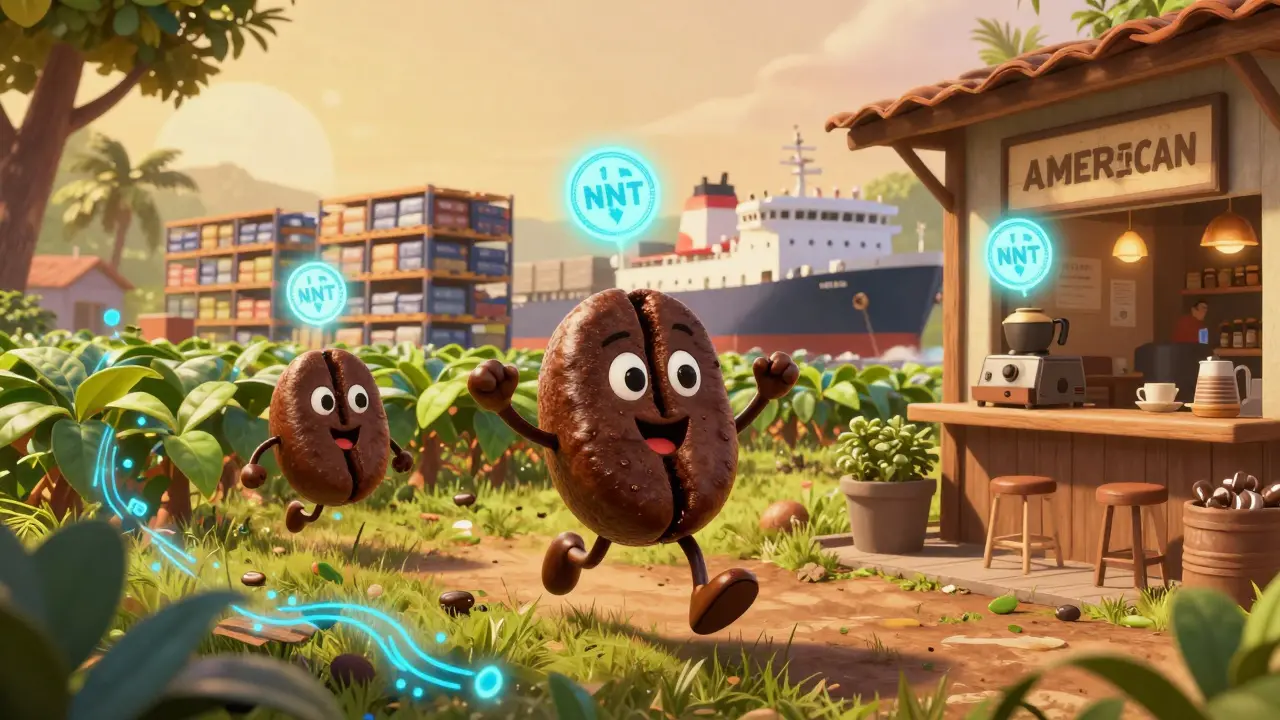
Blockchain NFTs are changing how we track products from farm to shelf. Forget paper logs, scattered spreadsheets, or unreliable audits. With NFTs on a blockchain, every step of a product’s journey becomes a permanent, verifiable record. This isn’t science fiction-it’s already happening in coffee farms in Colombia, pharmaceutical warehouses in Germany, and luxury handbag factories in Italy.
What Exactly Is an NFT in a Supply Chain?
An NFT, or Non-Fungible Token, is a unique digital certificate stored on a blockchain. Unlike cryptocurrencies like Bitcoin, which are interchangeable, each NFT is one-of-a-kind. In supply chains, that uniqueness becomes powerful. When a batch of organic coffee beans leaves a farm in Guatemala, an NFT is created for it. That NFT holds all the details: where the beans were grown, who harvested them, when they were processed, what certifications they carry, and even the carbon footprint of their transport. As the beans move through exporters, roasters, distributors, and finally to your local store, each handoff gets recorded on that same NFT. No one can delete or alter those records. If someone tries to fake a shipment, the blockchain will show the mismatch. Consumers can scan a QR code on the coffee bag and see the full history-no middleman needed.Why This Beats Traditional Tracking Systems
Traditional supply chains rely on paper bills of lading, email confirmations, and manual data entry. These systems are slow, error-prone, and easy to manipulate. A 2024 study by the World Economic Forum found that over 30% of food safety recalls took more than a week to trace back to source-too late to stop harm. With NFTs, tracing a contaminated batch of spinach from a supermarket in Auckland back to the farm in California takes under 20 seconds. The data is live, encrypted, and shared across all authorized parties. There’s no single point of failure. No one company controls the ledger. Everyone sees the same truth. This isn’t just about safety. It’s about trust. Consumers now expect to know if their chocolate is child-labor-free, if their wool is sustainably sourced, or if their medicine is real. Brands that can prove it with NFTs gain loyalty. Those that can’t? They lose credibility.Real-World Examples That Work
In the wine industry, a producer in Marlborough, New Zealand, now attaches an NFT to every bottle. The NFT records the vineyard plot, harvest date, fermentation temperature, and even the exact truck that shipped it to Tokyo. Buyers in Japan scan the label and see the full story. Sales jumped 22% in six months. In pharma, a Swiss company uses NFTs to track insulin vials. Counterfeit insulin kills an estimated 100,000 people yearly, mostly in developing countries. With NFTs, pharmacies can verify each vial’s origin before dispensing. If a vial’s NFT shows it was never scanned at the distributor’s warehouse, it’s flagged as fake-before it reaches a patient. Even fast fashion is getting a makeover. A Dutch brand now tags each jacket with an NFT that tracks the cotton’s origin, dyeing process, and shipping route. Customers can see if the dye was water-safe and if the factory paid fair wages. It’s not marketing fluff-it’s blockchain-backed fact.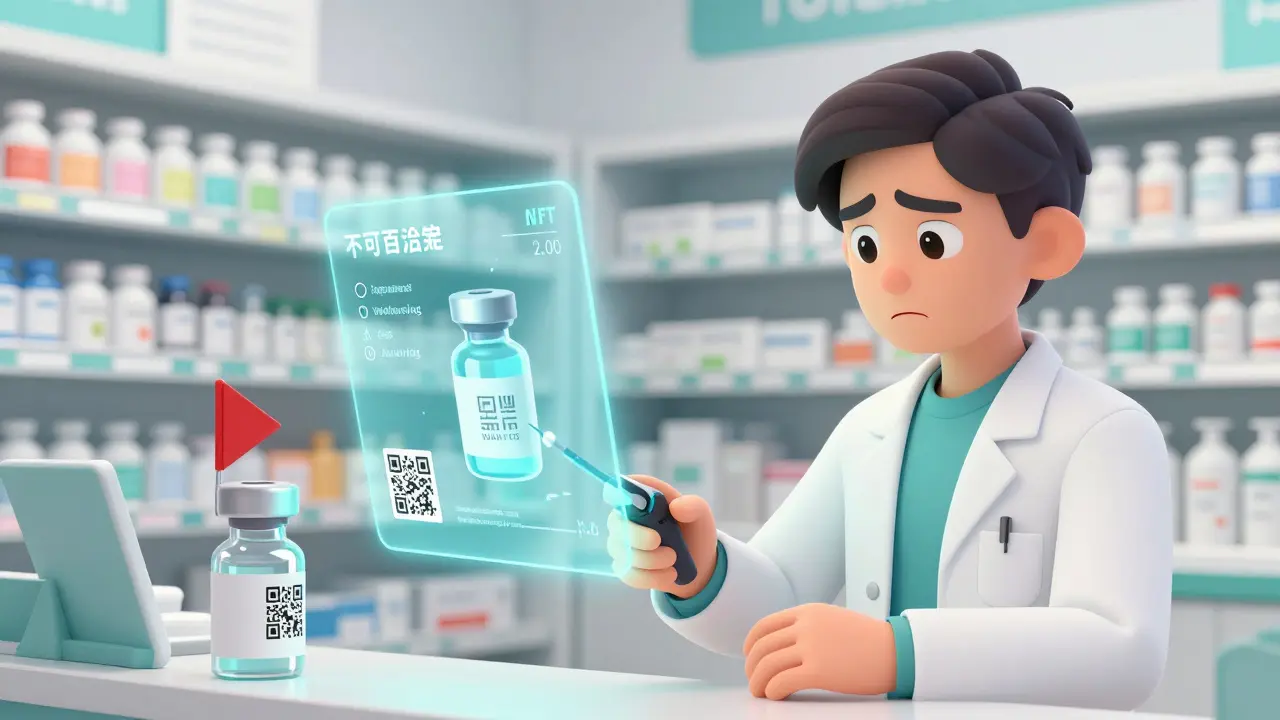
How It Works Behind the Scenes
The system uses three core parts: NFTs, smart contracts, and blockchain networks. Each product gets an NFT at its origin. That NFT is like a digital passport. It stores metadata-text, images, even sensor data-linked to the physical item. Smart contracts are self-executing rules on the blockchain. For example: if a shipment of fish arrives at a port and the temperature sensor in the container shows it was above 4°C for more than 2 hours, the smart contract automatically flags the shipment as spoiled and notifies the buyer. No human needed. The blockchain itself can be public (like Ethereum) or private (like Hyperledger Fabric). Public chains are transparent and open to anyone-great for consumer-facing transparency. Private chains are controlled by a group of trusted companies-better for sensitive data like pricing or supplier contracts. Many systems now use a hybrid: sensitive data is hashed (converted into unreadable codes), while verification keys remain public.Challenges and Limitations
This isn’t magic. There are real hurdles. First, data quality. If a farmer doesn’t input accurate harvest data, the NFT is wrong from day one. Blockchain doesn’t fix bad input-it just makes it permanent. Training staff to use these systems correctly is critical. Second, integration. Most companies still use old ERP systems from SAP or Oracle. Connecting those to blockchain platforms isn’t plug-and-play. It takes months of work, and not every vendor supports it. Third, energy use. Public blockchains like Ethereum used to be power-hungry. But since the 2022 “Merge,” Ethereum now uses 99.95% less energy. Most new NFT supply chain projects use low-energy chains like Polygon, Solana, or Algorand. Fourth, adoption. One company can’t do it alone. If your supplier uses paper, and your distributor uses Excel, the NFT chain breaks. Industry-wide cooperation is needed-and that’s slow.
Who’s Leading the Way?
Large corporations are moving first. Walmart, Nestlé, and Unilever have all piloted NFT supply chain projects. But smaller players aren’t left behind. Platforms like VeChain, Chronicled, and IBM Food Trust now offer “NFT-as-a-service.” You don’t need a blockchain team. Just plug in your existing inventory system, and the platform handles the rest. The European Union is pushing hard. Starting in 2025, all food products sold in the EU must provide digital provenance records. That’s forcing thousands of exporters to adopt NFT tracking-even if they didn’t want to. In Asia, manufacturers in Vietnam and Bangladesh are using NFTs to prove compliance to Western buyers. A single NFT can replace dozens of audit reports.What’s Next?
The next wave combines NFTs with IoT sensors. Imagine a pallet of medicine that automatically updates its NFT when the temperature drops, when it’s loaded onto a plane, or when it enters a new country. AI then analyzes that data to predict delays before they happen. Zero-knowledge proofs are another breakthrough. They let you prove something is true without revealing what it is. For example: you can prove a garment was made in a fair-wage factory without showing the factory’s name or payroll details. Privacy and transparency, together. By 2028, experts predict over 60% of high-value goods-pharmaceuticals, luxury items, organic food-will use NFT-based tracking. The cost of entry is falling fast. What once required $500,000 in tech investment now costs under $20,000 with cloud-based tools.How to Get Started
If you’re thinking about trying this:- Start small. Pick one product line, not your whole inventory.
- Choose a platform that integrates with your current ERP. Don’t build from scratch.
- Train your frontline staff. The person scanning the barcode matters as much as the coder.
- Communicate with customers. Let them know they can verify authenticity-make it part of your brand story.
Can NFTs really prevent fake products in supply chains?
Yes. NFTs create a digital fingerprint tied to each physical item. If a product is copied, its NFT won’t match the original blockchain record. This has already stopped counterfeit insulin in Switzerland and fake luxury handbags in Hong Kong. The NFT doesn’t stop theft-it makes theft obvious.
Do I need to understand blockchain to use NFT tracking?
No. Most platforms today offer simple dashboards and QR code scanners. Your warehouse team just needs to know how to scan a label and upload a photo. The blockchain works in the background. Think of it like using Wi-Fi-you don’t need to know how radio waves work to check email.
Are NFT supply chain systems expensive to implement?
It depends. Building a custom system from scratch can cost $300,000+. But using a cloud-based platform like VeChain or IBM Food Trust starts under $20,000 for a pilot. Many small businesses now pay $50-$200 per month per product line. That’s cheaper than hiring a third-party auditor every quarter.
What happens if the blockchain goes down?
Blockchains don’t go down like websites. They’re distributed across hundreds or thousands of computers worldwide. Even if one server fails, the data lives on others. The only risk is if the entire network is attacked-but that’s never happened to a major blockchain like Ethereum or Polygon. NFT records are designed to survive outages.
Can NFTs track perishable goods like food?
Absolutely. NFTs can link to IoT sensors that record temperature, humidity, and location in real time. If a shipment of berries hits 10°C for 4 hours, the NFT updates automatically. Retailers get alerts before the product spoils. This cuts food waste by up to 40% in pilot programs.
Is this just for big companies?
No. Platforms now offer subscription models for small farms, artisans, and local makers. A coffee roaster in Wellington can track 100 bags a month for $150. It’s no longer a luxury-it’s becoming a baseline for credibility.
Comments
So let me get this straight-we’re using blockchain to track coffee beans but still can’t figure out how to fix the damn postal system? 🤡
Next they’ll put NFTs on my socks so I can prove I wore them once.
I just scanned my coffee bag. Saw the farmer’s face. Felt something I haven’t felt in years. Hope this sticks.
This is the most dangerously romanticized techno utopianism I’ve seen since the dot com bubble
Blockchain doesn’t fix human laziness it just makes your mistakes immortal
And yes I know you think you’re revolutionary but you’re just repackaging the same old snake oil with a new acronym
You people are so obsessed with digital certificates you forgot the whole point of supply chains is to move stuff not perform blockchain theater
My uncle runs a small dairy in Wisconsin and his entire operation runs on a clipboard and a prayer
Now you want him to pay $200 a month to prove his milk isn’t imaginary?
Meanwhile the real problem-corporate consolidation and wage suppression-gets buried under a pile of NFT metadata
This is the future of decentralized provenance and it’s already live in production
VeChain + IoT + smart contracts = end-to-end traceability at enterprise scale
Companies are seeing 30-40% reduction in fraud and 22% lift in consumer trust metrics
Stop thinking in terms of tech and start thinking in terms of ROI
Every dollar spent here is a dollar saved in recalls audits and brand erosion
Let’s be real-this is just another way for corporations to extract more data from consumers under the guise of transparency
Who owns the blockchain ledger?
Who controls the smart contracts?
Who gets to decide what data gets hashed and what gets buried?
It’s not transparency-it’s controlled narrative with extra steps
Y’all are missing the point
This isn’t about coffee or insulin or handbags
This is about RECLAIMING TRUST
For decades we’ve been sold lies wrapped in branding
Now someone gives you a QR code and you see the truth
From soil to shelf
From sweat to shelf
From lie to truth
That’s not tech that’s healing
That’s not blockchain that’s dignity
The UK’s Food Standards Agency is already testing this for seafood traceability
Bottom line: if you’re not on this train by 2026 you’re not just behind-you’re irrelevant
And yes the integration headaches are real but so is losing market share to competitors who are
Think of it as digital hygiene not a luxury
I don’t care if it’s blockchain or QR codes or smoke signals
If it helps me know my food didn’t come from a slave labor camp then I’m all in
But please stop calling it innovation
This is just basic ethics with better tech
Just did a demo with a local roaster-scanned a bag and saw the exact hour the beans were picked
And the wind speed that day
And the name of the picker
And the fact they got paid 3x the Fair Trade rate
My wife cried
Not because it’s tech
Because it’s truth
And we haven’t had that in food since the 80s
PS: no emojis needed this is real
NFTs on the blockchain? More like NFTs on the surveillance grid
Who’s really behind these platforms?
Big Pharma? Big Ag?
They’re not giving you transparency
They’re giving you a digital leash
And soon your fridge will auto-scan your groceries and report your habits to the cloud
Wake up people this is the new data colonialism
This is actually happening and it’s wild 🚀
My cousin works at a wine exporter in NZ
They started with 50 bottles
Now they’re scaling to 50k
Customers are literally buying based on the NFT story
It’s not marketing
It’s meaning
And yeah the tech is cool but the human part? That’s the magic
The philosophical underpinning here is worth considering
If we outsource authenticity to a distributed ledger are we not outsourcing moral responsibility?
Does the permanence of the record absolve us of the obligation to question its creation?
Perhaps the real innovation isn’t the blockchain-it’s the humility to accept that truth requires more than data
In India we are starting pilot with spice exporters
Small farmers using simple phones to upload harvest data
No blockchain expertise needed
Just a photo and a location tag
Buyers in Germany now trust them more than big suppliers
Proof that good tech doesn’t need to be complex
This is a disgrace to American manufacturing!
Why are we letting foreign companies dictate our supply chain standards?
China and the EU are pushing this to undermine U.S. sovereignty!
And you’re all just nodding along like sheep!
Blockchain? More like Bolshevik Ledger!
Wake up, patriots!
I’m not a tech guy but I scanned my sneakers last week
Turns out the cotton was grown by a woman in Georgia who got paid $20/hour
Her kid’s in college now
That’s the kind of story you can’t fake
And yeah I’ll pay a little more for that
Simple as that
This is the quiet revolution no one’s talking about
Not flashy AI
Not crypto moonshots
But a farmer in Colombia getting paid fairly
A mother in Vietnam knowing her child’s factory isn’t toxic
A grandmother in Germany trusting her insulin
That’s the real win
And it’s beautiful
I’ve been following this for years and the real breakthrough isn’t the NFT itself it’s the convergence of immutable ledger technology with real-time sensor data and decentralized identity protocols that allow for verifiable attribution without centralized authority which fundamentally shifts power dynamics from corporate gatekeepers to end consumers and local producers which enables micro-transparency at scale which was previously impossible due to legacy ERP systems and data silos and the fact that public blockchains now operate with negligible energy consumption post-merge makes this not just feasible but economically viable for SMEs which is why adoption is accelerating faster than projected and why we’re seeing regulatory alignment from the EU to ASEAN and why this is not a trend but a structural shift in how value chains are governed and perceived and I think we’re on the cusp of something that will redefine consumer trust for the next century
Oh sure let’s trust a digital token more than we trust the FDA or the USDA
Meanwhile the real issue is that 80% of food fraud happens because companies lie on their own labels
So now we’re gonna let them write their own truth on a blockchain?
And you call that transparency?
That’s just lying with more steps and a fancy website
The notion that blockchain solves trust is naive
It solves verification not integrity
Garbage in garbage out
And the only people benefiting are the platform vendors charging subscription fees
Meanwhile the farmer still gets paid pennies
And the consumer still pays premiums
It’s just a new layer of abstraction on top of the same broken system
They say this will end fake products
But what about fake data?
What if the farmer just types in fake coordinates?
What if the truck driver just scans the code without checking the temp?
Blockchain doesn’t care
It just records the lie
And now everyone thinks it’s true
That’s not transparency
That’s digital delusion
Let’s talk about the elephant in the room
Who’s auditing the auditors?
Who’s making sure the NFT isn’t just a pretty lie?
And why are all the case studies coming from companies with deep pockets?
What about the smallholder farmers in Ghana or Cambodia?
They don’t have QR code scanners
They have phones with cracked screens
And they’re being left behind in this ‘revolution’
I just want to say-thank you.
This is the first time I’ve felt hopeful about technology in years.
Not because it’s flashy.
But because it’s honest.
And that matters more than anything.
NFTs for coffee? That’s not innovation. That’s capitalism with a glow-up.