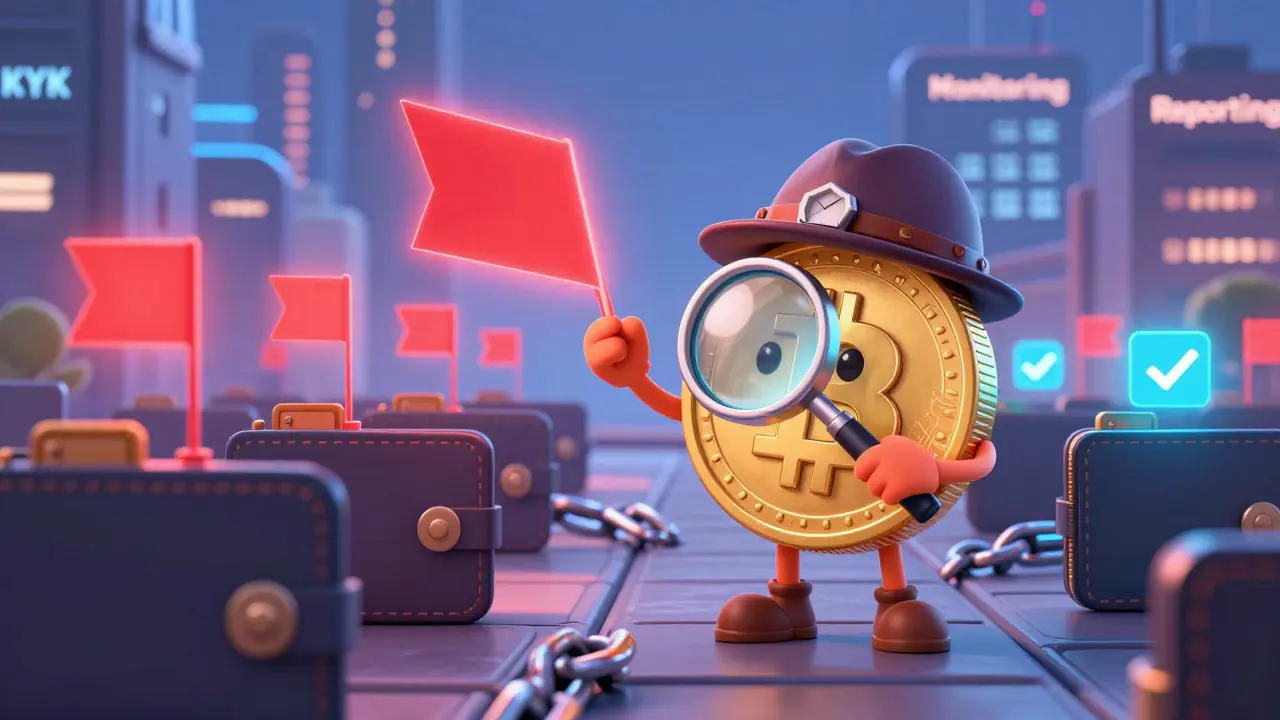
Crypto Transaction Risk Assessment Tool
Transaction Risk Assessment
Enter transaction details to see if they might trigger AML monitoring. This tool is based on industry practices described in the article.
Risk Assessment Results
When you buy Bitcoin or trade Ethereum on a crypto exchange, you might think it’s just you and the market. But behind the scenes, there’s a whole system working to make sure that money from drug deals, scams, and hacks doesn’t get cleaned and turned into legal cash. That system is called AML - anti-money laundering. And every major crypto exchange today has to follow it, or face massive fines, shutdowns, or even criminal charges.
Why Crypto Exchanges Need AML
Cryptocurrencies were built on anonymity. Bitcoin addresses don’t show names. Transactions look like random strings of letters and numbers. That made them attractive to criminals - until regulators stepped in. In 2019, U.S. regulators - FinCEN, the SEC, and the CFTC - made it official: crypto exchanges are financial institutions. That meant they had to follow the same rules as banks under the Bank Secrecy Act. No more gray area. No more excuses. If you run a crypto exchange and you’re serving users in the U.S., Europe, or other regulated regions, you must stop money laundering. Or pay the price. The cost of failing? Real. In 2021, one derivatives exchange paid $100 million to settle AML violations. Three founders of another crypto firm each paid $10 million in fines to avoid jail time. This isn’t a warning. It’s a warning shot across the bow.The Three Pillars of Crypto AML
Crypto exchanges don’t guess at AML. They follow a clear structure set by the Financial Action Task Force (FATF), the global watchdog for financial crime. There are three pillars:- Know Your Customer (KYC) - Collecting and verifying user identity before they can trade.
- Transaction Monitoring - Watching every coin movement for signs of criminal behavior.
- Reporting Suspicious Activity - Alerting authorities when something looks wrong.
How KYC Works in Practice
Before you can deposit $10,000 in Bitcoin, you’ll be asked for your government ID - passport, driver’s license, or national ID card. You’ll take a selfie. Some platforms even require you to blink or turn your head to prove you’re real. This is called liveness detection. It stops people from using stolen photos or deepfakes. That ID gets checked against global databases. Is this person on a sanctions list? Are they a Politically Exposed Person (PEP) - like a government official - who needs extra scrutiny? Is their name spelled differently in another language? Systems use phonetic matching to catch "Ivan Petrov" and "Iwan Petrow" as the same person. Exchanges also scan news sources 24/7. If your name pops up in an article about a crypto scam, your account gets flagged. You might get a message: "We need to verify your recent activity." That’s not a glitch. It’s AML working.Transaction Monitoring: Watching Every Coin Move
KYC is just the start. Once you’re in, the system watches everything you do. Imagine you deposit $5,000 in Bitcoin. A week later, you send $200 to 25 different wallets. Then you withdraw $4,000 in USDT to a new address. That’s classic layering - a money laundering technique where funds are broken into small pieces and moved around to hide their origin. AI systems catch this. They learn your normal behavior. If you usually trade $100 a week and suddenly send $50,000 to a wallet linked to a darknet market, the system raises a red flag. It doesn’t automatically block you - but it alerts the compliance team to investigate. Exchanges use two main approaches: allow lists and deny lists. Allow lists are strict. Only wallets that passed KYC can receive or send funds. It’s like a bank only letting you send money to approved accounts. Some exchanges use smart contracts to enforce this automatically. Deny lists are more common. The system checks every transaction against known bad addresses - wallets linked to hacks, ransomware, or darknet markets. If your Bitcoin ever touched a blacklisted address, even once, your transaction gets blocked or flagged. For Bitcoin, this means checking the entire history of each Unspent Transaction Output (UTXO). For stablecoins like USDT, it’s simpler - just check if the sender or receiver is on the list.
Real-Time Tools Behind the Scenes
This isn’t done by hand. Exchanges use layered tech:- Risk scoring engines - Assign each user a risk level (low, medium, high) based on location, transaction history, and behavior.
- API integrations - Connect to third-party AML providers like Chainalysis, Elliptic, or TRM Labs that track blockchain flows.
- Dynamic dashboards - Compliance teams see live alerts, investigate cases, and file reports in minutes.
- Automated reporting - Suspicious Activity Reports (SARs) are filed with regulators like FinCEN automatically when thresholds are hit.
Global Rules, Local Challenges
Here’s the messy part: AML rules aren’t the same everywhere. The European Union’s 5AMLD requires exchanges to collect more data than the U.S. Bank Secrecy Act. Japan demands stricter identity verification than Singapore. Some countries ban crypto entirely. A global exchange like Binance or Kraken must run 10 different compliance engines at once. That’s why big exchanges hire teams of lawyers, data scientists, and compliance officers. Not just one person. Whole departments. They train staff every quarter. New laws come out. New scams emerge. Systems must adapt - fast.What Happens When Something Looks Suspicious?
If the system flags your activity, here’s what usually happens:- You get an email: "We need to verify a recent transaction. Please provide documentation."
- You reply with a utility bill or bank statement.
- Compliance reviews it. If it checks out, your account is cleared.
- If it doesn’t, they freeze your funds and file a report.
- If law enforcement asks, they hand over your data.
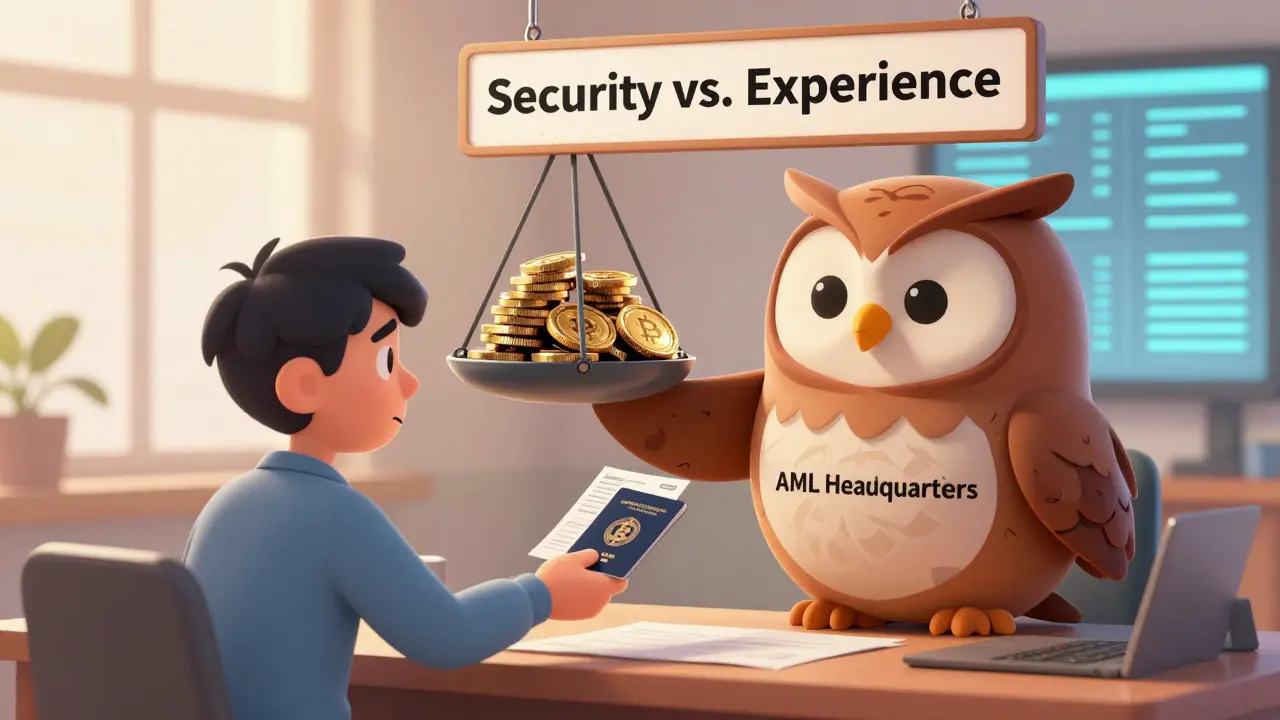
The Balance: Security vs. Experience
AML isn’t perfect. It can be slow. It can block legitimate users. A student sending crypto to pay rent might get flagged because their wallet once received a tiny amount from a compromised address. That’s why top exchanges are improving. They use behavioral analytics to distinguish between real threats and false positives. They let low-risk users bypass extra checks. They’re building faster, smarter systems. The goal isn’t to make life harder for users. It’s to make crypto safer. Without AML, criminals would flood the market. Regulators would shut everything down. And honest users would lose trust.What’s Next for AML in Crypto?
The next wave is decentralized finance (DeFi). Most DeFi protocols don’t do KYC. That’s a problem. Regulators are already pushing for rules that apply to smart contracts and non-custodial wallets. Some projects are experimenting with privacy-preserving compliance - like zero-knowledge proofs that prove you’re not a sanctioned person without revealing your identity. Others are building on-chain identity layers that work across platforms. But for now, if you’re using a centralized exchange - and most people are - AML is already here. It’s not going away. It’s getting smarter.Final Thought: AML Isn’t the Enemy
Crypto was meant to be free from banks. But freedom without responsibility leads to chaos. AML doesn’t kill innovation. It protects it. It keeps exchanges open. It keeps users safe. It stops criminals from turning stolen crypto into luxury cars and private jets. The exchanges that do AML right don’t just survive. They thrive. Because users trust them. Regulators trust them. And that’s the real value of compliance - not just avoiding fines, but building something that lasts.Do all crypto exchanges have to follow AML rules?
Yes, if they operate in regulated regions like the U.S., EU, UK, Japan, or Australia. These exchanges are legally required to follow AML rules under laws like the Bank Secrecy Act or 5AMLD. Unregulated platforms may not comply, but they risk being blocked by banks, payment processors, and other services - making them unusable for most people.
Can I avoid KYC on crypto exchanges?
You can use peer-to-peer (P2P) platforms or decentralized exchanges (DEXs) that don’t require KYC. But these come with big risks: no chargebacks, no customer support, and high chances of scams. Also, if you later try to cash out to a bank or regulated exchange, they’ll ask where your crypto came from - and if you can’t prove it, your funds may be frozen.
How do exchanges know if a wallet is linked to crime?
Exchanges use blockchain analytics firms like Chainalysis and Elliptic that track the history of every Bitcoin and Ethereum transaction. These companies map out which wallets have been used in hacks, ransomware, darknet markets, or scams. That data is turned into deny lists that exchanges check in real time. Even if your wallet was never used for crime, if your Bitcoin passed through a bad address once, it can trigger a flag.
Why do I have to send my ID again if I’ve used the exchange before?
Regulators require periodic re-verification, especially if your activity changes. If you suddenly start sending large amounts, or if your address is linked to a new jurisdiction, the system flags you for review. This isn’t about distrust - it’s about staying compliant with laws that change constantly. Your data isn’t stored longer than needed, and it’s encrypted.
What happens if my account gets flagged by AML?
You’ll usually get a notification asking for more info - like proof of income, source of funds, or explanation for unusual activity. If you respond quickly and honestly, most cases are resolved within 2-5 days. If you ignore it or can’t provide details, your account may be frozen. In serious cases, the exchange will file a Suspicious Activity Report (SAR) with authorities, which could lead to an investigation.

Comments
Honestly, I didn’t realize how much work goes into this until I got flagged for sending $200 to my cousin’s wallet. Turns out his old address got flagged from some 2018 hack. Took three days to prove I wasn’t laundering drug money. But hey, at least my crypto isn’t frozen forever. 😅
So let me get this straight - you’re telling me the same people who told us ‘crypto is freedom’ now want to turn every exchange into a bank with extra steps? Cute.
Okay but can we talk about how wild it is that my grandma’s wallet got flagged because she bought BTC in 2017 and sent it to a friend who later got scammed? She’s 72. She doesn’t even know what a UTXO is. And now she’s got a ‘suspicious activity’ notice? I cried. This system isn’t protecting users - it’s punishing the innocent out of sheer automation. Someone needs to fix this.
Ugh. I swear, every time I try to move crypto, I get treated like a criminal. I’m not laundering money - I’m just trying to pay rent! And now I have to send my utility bill AGAIN? Like, I’ve been verified since 2021. Can we PLEASE stop treating law-abiding people like suspects? This isn’t security - it’s harassment wrapped in compliance.
AML is just regulatory theater. It doesn’t stop crime - it just pushes it to DeFi and mixers. You’re not solving the problem. You’re making it harder for honest people.
I get why this stuff matters. I really do. But sometimes it feels like the system’s trying to protect us from ourselves. I just wish they’d make the process less scary. Like, maybe a simple chat option instead of sending documents into the void? Just saying.
LOL you guys act like this is new. Banks have been doing this since the 80s. Crypto just got dragged into the real world. Deal with it. Also, why are you surprised? You knew this was coming when you bought BTC.
Okay so I just got flagged for sending 0.001 BTC to a friend’s wallet… and I’m supposed to prove it wasn’t from a darknet market? But my wallet was used in 2019 for a donation to a charity that got hacked. So now I’m guilty by association? That’s not justice. That’s… like… blockchain karma. 😅
It’s not about ‘freedom’ - it’s about accountability. If you’re not willing to prove you’re not a criminal, then you don’t deserve access to the financial system. This isn’t oppression. It’s maturity. Grow up.
So you’re telling me a $100M fine is the price of doing business… but a 19-year-old student gets locked out of their account for 5 days because their wallet touched a tainted UTXO? That’s not AML. That’s capitalism with a side of irony.
Yawn. I read the whole thing. Still think crypto should be unregulated. Just sayin’.
While I deeply admire the intention behind these systems, I must express that the emotional toll on ordinary users - particularly those with limited technical literacy - cannot be overstated. We must not conflate compliance with compassion. Perhaps, in our pursuit of security, we risk alienating the very people we seek to protect? 🌱
USA rules. Europe? Overbearing. Asia? Chaotic. But here? We do AML right. No whining. No excuses. If you can’t handle it, go back to your decentralized fantasy land. 😎🇺🇸