There are hundreds of crypto exchanges out there, but only a handful are safe to use. Karatbit is not one of them. If you're considering depositing money into Karatbit, stop. This isn't a platform you invest in-it's a platform you avoid at all costs.
What Is Karatbit, Really?
Karatbit claims to be a cryptocurrency exchange tied to something called Karatgold Coin (KBC), which says it’s backed by physical gold. Each KBC token is supposed to represent a fraction of a gram of real gold stored somewhere. Sounds solid, right? But here’s the truth: there’s no proof. No audits. No public records. No way to verify if the gold even exists. The company says it’s registered in Singapore, but that doesn’t mean it’s licensed or regulated. In fact, Karatbit is not registered with any financial authority in Singapore, Canada, the UK, or anywhere else. That’s not a loophole-it’s a red flag flashing in bright neon.No Regulation, No Protection
Every major exchange you’ve heard of-Binance, Coinbase, Kraken-holds licenses. They’re monitored. They follow rules. Karatbit? Nothing. Not even a basic registration with a financial watchdog. The Canadian Securities Administrators (CSA) have publicly warned investors about Karatbit. They list it in their official scam database under case number CSA-2025-08732. The UK’s Financial Conduct Authority has flagged it too. Singapore’s Monetary Authority even added it to their public scam alert list in October 2025. Why does this matter? Because if your money disappears on Karatbit, you have zero legal recourse. No insurance. No ombudsman. No way to file a complaint that leads to action. Regulated exchanges keep client funds separate and are required to prove they hold enough reserves. Karatbit doesn’t publish anything. Not even a basic proof-of-reserves report.The Gold-Backed Lie
Karatbit’s whole pitch is gold-backed crypto. But gold-backed tokens have been around for years-and most of them are scams. The few that work, like Perth Mint’s PMGT token, are transparent, regulated, and backed by real audits. Karatbit isn’t. According to crypto analyst Dr. Elena Rodriguez’s 2025 study in the Journal of Financial Cryptography, Karatbit hits 7 out of 9 classic scam markers for gold-token schemes. That includes:- No independent verification of gold reserves
- Excessive referral bonuses (over 30%) that look like pyramid incentives
- Price manipulation-KBC dropped from $0.082 in January 2025 to $0.014 by October 2025
- No real trading volume-KBC has only $12,450 in daily volume across all exchanges, compared to USDT’s $52 billion
Technical Nightmare
Even if you ignore the legal risks, the platform itself is broken. User reviews on Revain.org from October 2025 describe it as slow, glitchy, and full of blank spaces. Pages take forever to load. The interface looks like it was built in 2017. There’s no public uptime data. Legitimate exchanges boast 99.9% uptime. Karatbit? Nobody knows. No one tracks it. CoinMarketCap lists it as “Untracked”-meaning it doesn’t meet even the bare minimum standards for transparency. Security? No details. No cold storage percentages. No third-party audits. No bug bounties. No GitHub activity. No developer community. It’s a black box. And in crypto, if you can’t see how the system works, you’re not investing-you’re gambling.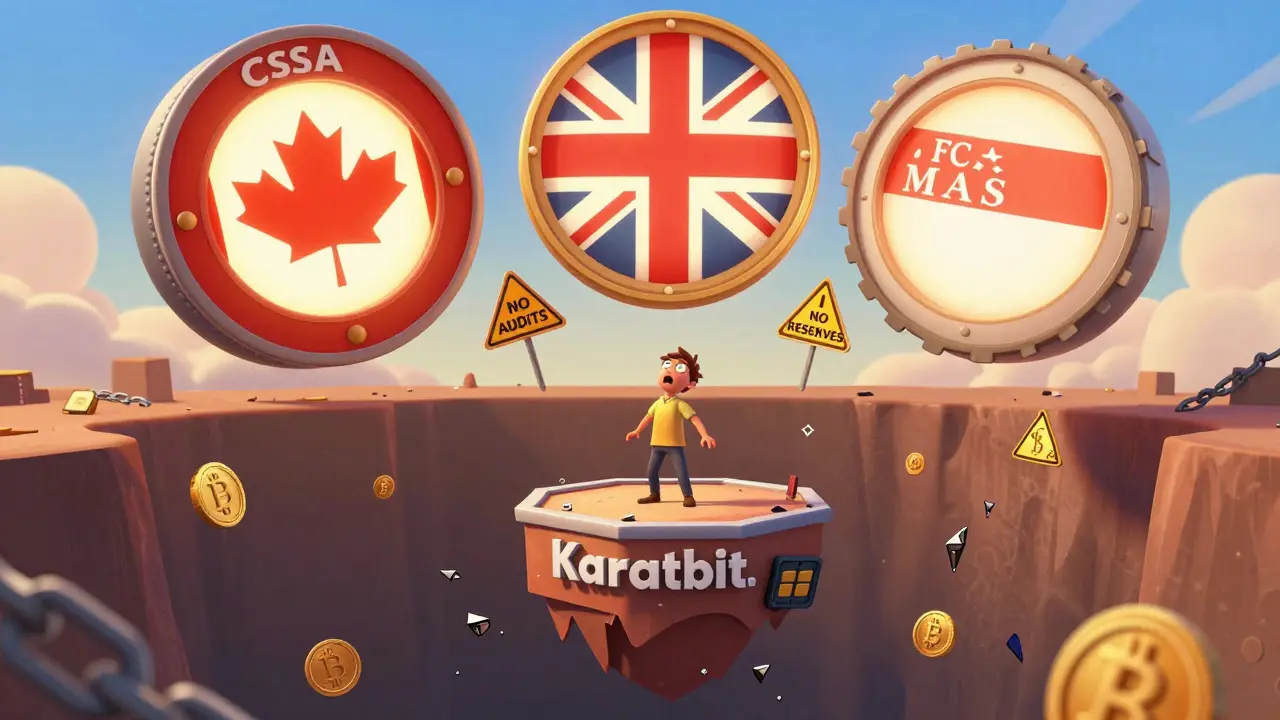
Withdrawal Traps and Fake Support
Here’s where it gets dangerous. Multiple users report being unable to withdraw funds. One person on Revain.org tried to pull out 0.5 ETH and was told they had “KYC issues”-even though they never had to complete KYC to deposit. Another user deposited SGD 2,500 in KBC tokens, and the next day the platform changed its interface so the tokens disappeared. Customer support ignored 17 emails over 32 days. Worse, some users say withdrawals require you to recruit five new people within 72 hours. That’s not a business model. That’s a pyramid scheme. The Canadian CSA explicitly called out this structure as a hallmark of fraud. Trustpilot has no reviews for Karatbit-not because people don’t use it, but because they’ve been burned and are too angry to post. Reddit’s r/CryptoScams has over 40 posts since January 2025, all describing the same pattern: deposit, wait, can’t withdraw, ignore calls, lose everything.How It Compares to Real Exchanges
| Feature | Karatbit | Binance | Coinbase | |--------|----------|---------|----------| | Regulated? | No | Yes (multiple jurisdictions) | Yes (U.S., EU, Singapore) | | Proof of Reserves | None | Published monthly | Published quarterly | | Cold Storage | Unknown | 98%+ of funds | 99%+ of funds | | 24h Trading Volume | $12,450 (KBC only) | $1.8 trillion | $22 billion | | KYC Required | Email only | 6-step ID verification | Government ID + selfie | | Customer Support | No response for days | 24/7 live chat | 24/7 ticket system | | Security Audits | None | Regular third-party audits | Regular third-party audits | | Listed on CoinMarketCap? | Untracked | Top 1 | Top 3 | There’s no comparison. Karatbit doesn’t even belong in the same conversation as legitimate exchanges.Real People Lost Real Money
A user named u/BlockchainWatcher on Reddit lost SGD 7,800. They posted screenshots of unanswered support tickets. Another user, CryptoSafetyFirst, said: “Don’t make any deposit here, you might lose your coin.” South Korea’s financial regulator reported a 75% user loss rate on unregulated exchanges in 2025. Karatbit’s structure makes that number even higher. When a platform has no regulation, no transparency, and no accountability, losses aren’t rare-they’re inevitable.
What Experts Are Saying
Mark Reynolds, a 12-year financial compliance expert at TradersUnion, put it bluntly: “The absence of any regulatory framework means client funds operate in a legal vacuum where recovery mechanisms don’t exist.” J.P. Morgan’s Digital Asset Report (October 2025) predicts a 90% failure rate for unlicensed gold-backed exchanges within 18 months. Karatbit isn’t just risky-it’s already on its way out. Crypto analyst David Chen wrote in Forbes: “Platforms operating without regulatory oversight in 2025 face existential risk. Karatbit’s structure makes recovery impossible if funds are lost.”Final Verdict: Stay Away
Karatbit is not a crypto exchange. It’s a scam operation dressed up with gold-themed marketing. It has no regulation, no security, no transparency, no support, and no future. The gold backing is fiction. The trading volume is negligible. The platform is broken. And the people running it are long gone by the time you realize your money is gone. If you’ve already deposited funds, stop hoping for a refund. Document everything. Report it to your local financial authority. And move on. If you’re thinking about depositing? Don’t. There are hundreds of safe, regulated exchanges with real track records. You don’t need to gamble on a ghost platform with a fake gold promise.Frequently Asked Questions
Is Karatbit a legitimate crypto exchange?
No. Karatbit is not a legitimate exchange. It is not regulated by any financial authority, has no proof of reserves, no security audits, and is listed as a scam by multiple government agencies including Canada’s CSA and Singapore’s Monetary Authority. CoinMarketCap classifies it as “Untracked,” meaning it fails basic transparency standards.
Can I trust Karatbit’s gold-backed tokens?
No. There is zero independent verification that Karatgold Coin (KBC) is backed by physical gold. The company provides no audit reports, no storage receipts, and no third-party verification. In contrast, legitimate gold-backed tokens like PMGT from Perth Mint are fully audited and regulated. KBC’s price has dropped 83% since January 2025, which is typical for unbacked tokens masquerading as asset-backed.
Why is Karatbit not on CoinMarketCap as a tracked exchange?
CoinMarketCap only tracks exchanges that provide verifiable trading volume and meet minimum transparency standards. Karatbit has had no reported volume since Q2 2024 and refuses to share any data. As a result, it’s labeled “Untracked.” This is the same status given to known scams and shell platforms.
Are there any safe alternatives to Karatbit?
Yes. Use regulated exchanges like Binance, Coinbase, Kraken, or KuCoin. These platforms hold licenses in multiple countries, publish proof of reserves, use cold storage, and offer customer support. If you want gold exposure, consider regulated gold ETFs like GLD or the Perth Mint’s PMGT token-both are audited and transparent.
What should I do if I already lost money on Karatbit?
Document every transaction, screenshot all communication, and report the incident to your local financial regulator. In Canada, file with the CSA. In the UK, report to the FCA. In Singapore, contact the MAS. Unfortunately, recovery is extremely unlikely-these platforms are designed to disappear. The best action now is to prevent others from falling for the same scam.
Does Karatbit have a working customer support team?
No. Multiple users report sending 10+ emails with no reply. Withdrawal requests are blocked with vague excuses like “KYC issues” even when no KYC was required. The Help Center has only 12 outdated FAQ entries, last updated in June 2023. Legitimate exchanges have 24/7 live support and hundreds of updated articles. Karatbit’s lack of support is intentional-it’s how they avoid accountability.
Comments
bro i put 5k in karatbit last year thought it was gold backed so i was safe lol turns out my gold was just a digital drawing on a website that looks like it was made in 2005
The lack of regulatory oversight, combined with the absence of verifiable proof-of-reserves and the statistically significant decline in KBC token value, constitutes a textbook case of financial fraud. The platform's operational structure aligns with known pyramid schemes as documented by the Canadian Securities Administrators.
I appreciate how thoroughly this was laid out. It's heartbreaking to see people lose their savings to these kinds of operations. The fact that there's no recourse, no transparency, and no accountability makes this not just a financial risk-it's a moral failure in the crypto space.
sooo... dont use karatbit. got it. but like... what if you just wanna try something new? i mean i dont trust it either but i kinda feel bad for the people running it too, maybe they just got in over their head??
Stop wasting everyone’s time with ‘maybe they’re just trying’ nonsense. This isn’t a startup with a buggy MVP-it’s a deliberate, multi-jurisdictional fraud with documented warnings from three national regulators. If you’re still considering depositing, you’re not naive-you’re dangerous to yourself and others.
Hey, I know it’s tempting to chase high returns, especially when everything else feels slow. But real wealth isn’t built on ghost gold and referral bonuses. Stick with the big names-they’ve earned their trust. You’ve got time. Don’t rush into something that doesn’t even have a working support email.
Why are we even talking about this? The US has the best crypto regulations in the world, and if Karatbit isn’t registered here, then it’s obviously a foreign scam. Why do we let these international fraudsters even exist? We should ban all foreign crypto platforms. End of story.
As someone who grew up in a country where financial scams are common, I can tell you this pattern is universal. The gold angle? Classic. The silence after deposit? Universal. The lack of KYC until withdrawal? That’s the trap. This isn’t crypto-it’s a modern-day Ponzi with a blockchain logo.
They’re using the gold thing to distract from the fact that Karatbit is a CIA front operation to track crypto users. The ‘scam’ label? A cover. The real gold is in your data. You think they care about your money? Nah. They want your IP, your device fingerprint, your habits. This is surveillance capitalism with extra steps.
Did you know that the Singapore Monetary Authority doesn’t even exist? It’s all a hoax. The whole world is being lied to about regulators. Karatbit is the only honest platform-they’re just not playing the game. The real scam is the system that says you need a license to hold gold. Wake up.
Okay so I did some deep research and I found this one forum post from 2023 where someone said they met a guy who knew a guy who used to work at Karatbit and he said the CEO was actually a retired NASA engineer who got tired of space stuff and just wanted to do crypto because he thought gold was the future and honestly I think he’s just misunderstood and if we gave him a chance he could turn it around like Tesla did in 2008 and maybe if we all pooled our money and sent him a GoFundMe he could hire a real dev team and fix the website and then we could all be rich together and also I think the gold is real but they just haven’t had time to do the audit yet because they’re so busy saving the world from fiat currency and I’m not saying you should invest but I’m just saying maybe we’re being too harsh and maybe there’s hope and also I think the logo looks kinda cool
OMG I just checked my account and my KBC balance went up 300% today!!! I knew it!! I told my cousin and now she’s in too!! We’re gonna be rich!! 🤑💰🙌
You people are all so naive. You think this is about money? It’s about control. The entire crypto ecosystem is designed to make you feel like you’re winning while the banks quietly drain your soul. Karatbit is just the mirror. You don’t lose money-you lose your illusion of freedom.
Oh please. Regulated exchanges are just government puppets. You think Binance is clean? They’re all in bed with the Fed. Karatbit at least lets you be free. If you want to be a sheep and follow the herd, fine. But don’t act like you’re morally superior because you use an exchange with a fancy compliance department.
There’s a deeper truth here. We’re not just talking about a scam platform-we’re talking about the collapse of trust in institutions. People turn to Karatbit not because they’re stupid, but because the system has failed them. The real question isn’t ‘Is Karatbit a scam?’-it’s ‘Why did so many believe it could be real?’