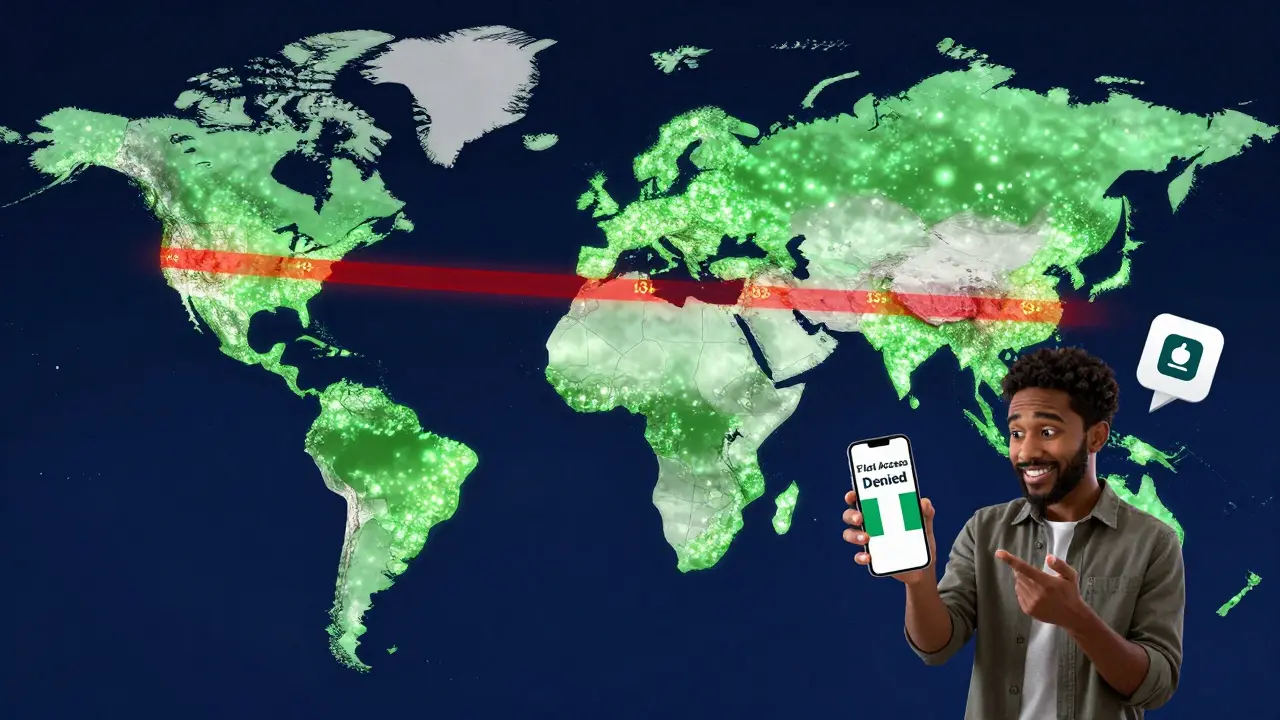
Why Coinbase Blocks Access in Some Countries
If you've ever tried to sign up for Coinbase and got an error saying your country isn't supported, you're not alone. Millions of people around the world face this exact issue. The reason isn't random. It's not because Coinbase doesn't want to serve you. It's because Coinbase has to follow strict laws - and those laws change depending on where you live.
Coinbase is a U.S.-based company, publicly traded on NASDAQ, and it operates under heavy regulation. That means it can't offer its full service everywhere. The platform must comply with U.S. sanctions from the Office of Foreign Assets Control (OFAC), European rules like MiCA, and local banking laws in every country it touches. If it doesn't, it risks fines, lawsuits, or even losing its license to operate in the U.S. entirely.
That’s why Coinbase splits its services into two parts: the Coinbase App (which lets you buy and sell crypto with real money like dollars, euros, or pesos) and the Coinbase Wallet (a non-custodial wallet that works almost anywhere). The App is heavily restricted. The Wallet? Not so much.
Where You Can Use the Coinbase App (Fiat On-Ramps)
The Coinbase App lets you deposit and withdraw fiat currency using bank transfers, debit cards, Apple Pay, Google Pay, and PayPal. But this service is only available in 48 countries as of early 2026. These include:
- United States
- United Kingdom
- Germany
- France
- Canada
- Singapore
- Japan
- Australia
- Most of the European Economic Area (EEA)
In these places, you can deposit up to $50,000 per day if you're fully verified. Transaction fees are low - around 0.5% for bank transfers. In Germany, for example, SEPA transfers clear in under two hours. In the U.S., ACH deposits take 1-3 business days. These are the markets where Coinbase has full licenses from regulators like BaFin (Germany), FCA (UK), and state-level money transmitter licenses.
Where the Coinbase App Is Blocked - And Why
Now, here’s where it gets messy. Coinbase blocks the App in 63+ countries. Some of these are obvious - like Russia, Iran, North Korea, and Syria - because they’re on the U.S. OFAC sanctions list. But others? They don’t make sense at first glance.
Take Pakistan. There’s no U.S. sanction against Pakistan. Yet, Coinbase doesn’t allow fiat deposits there. Why? Because local banks refuse to process crypto-related transactions. Coinbase doesn’t want to risk its U.S. banking relationships by working with intermediaries that might be flagged as high-risk. Same with the Philippines. Over 80% of crypto users there want to buy Bitcoin with pesos - but Coinbase only offers the Wallet. That forces users to use local exchanges like PDAX, which charge 3.5% in fees - more than seven times what Coinbase charges in the U.S.
Colombia, Nigeria, Egypt, and Bangladesh are all in the same boat. People there use crypto to protect savings from inflation or send remittances. But Coinbase won’t let them deposit pesos, naira, or taka. The company says it’s following the law. Critics say it’s avoiding messy markets.
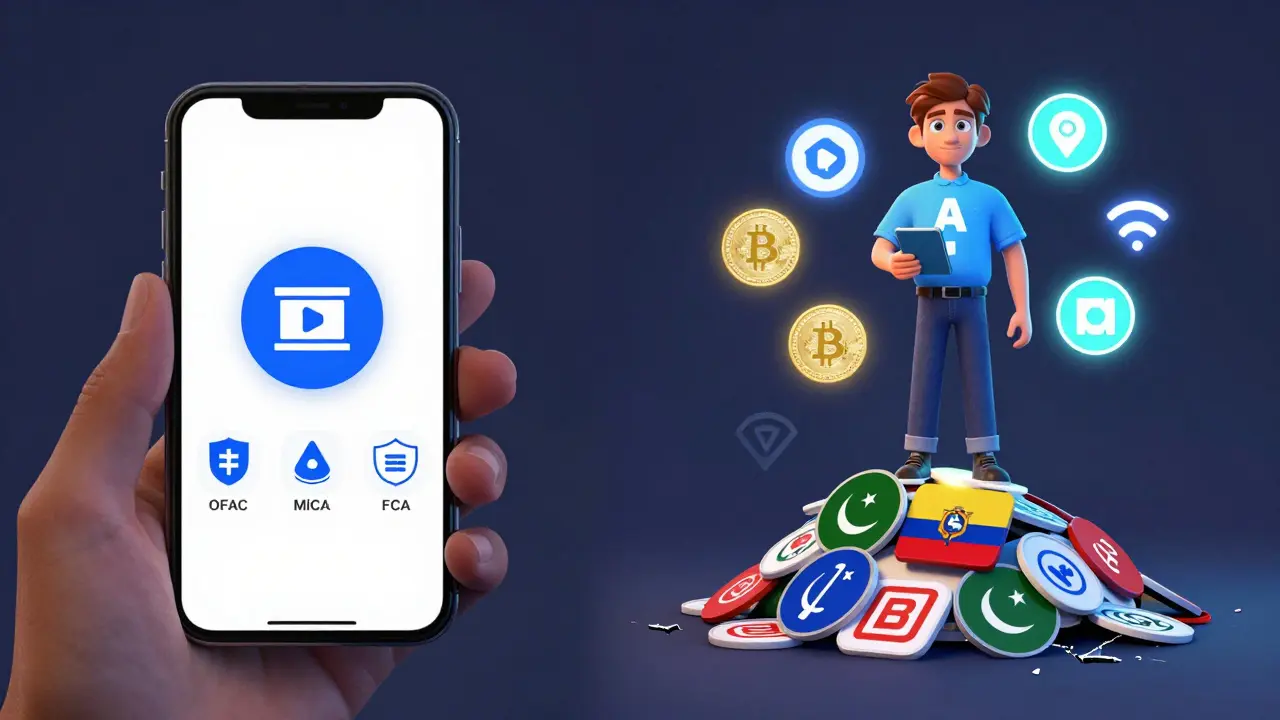
Coinbase Wallet: Global Access (Almost)
While the App is blocked in dozens of countries, the Coinbase Wallet (the non-custodial one) works in nearly every country - except those on the OFAC sanctions list. That means if you’re in Pakistan, Nigeria, or even Venezuela, you can still download the Wallet app, connect to decentralized apps (dApps), store Ethereum, Bitcoin, Solana, and over 5,500 other tokens, and even stake your crypto.
But here’s the catch: you can’t buy crypto with a credit card. You can’t sell crypto for cash. You can’t link your bank account. You need to already own crypto - and get it from somewhere else. That’s why users in restricted countries often turn to P2P platforms like Binance Peer-to-Peer, where they trade cash for crypto directly with other people. But those trades often come with 5-10% premiums because of risk and lack of regulation.
Wallet doesn’t care if you’re in a sanctioned country - as long as you don’t try to connect a bank. That’s why it’s the workaround for millions. But it’s not a full solution. It’s a partial one.
Why Some Countries Are Partially Blocked
Not all restrictions are all-or-nothing. Take the United Arab Emirates. Coinbase doesn’t let you deposit AED via bank transfer. But it does allow Apple Pay and Google Pay. Why? Because UAE banks won’t touch crypto transactions, but Apple and Google’s payment systems are seen as lower risk. So Coinbase carved out a narrow exception.
India is another gray area. Coinbase blocked fiat access in 2022 after the Reserve Bank of India warned banks not to deal with crypto firms. In early 2025, Coinbase tried to register with the RBI as a compliant exchange. That effort stalled. So now, Indian users can use the Wallet, but not the App. Some users report being able to deposit via UPI after using third-party gateways - but that’s not official. It’s a loophole, and Coinbase doesn’t guarantee it will keep working.
Even within Europe, things get complicated. MiCA (Markets in Crypto-Assets) came into full effect in 2025. That meant Coinbase had to restructure its European operations. Users in Malta, Iceland, Liechtenstein, and Hungary now deal with Coinbase Luxembourg S.A. instead of Coinbase Europe Limited. The service is the same - but the legal entity behind it changed. And some features? Like Cardano staking - got blocked in 12 EU countries because of MiCA’s transitional rules. So even if you’re in a “supported” country, you might still be missing out on certain tokens.
How Coinbase Enforces These Rules
Coinbase doesn’t guess where you are. It checks:
- Your IP address
- Your government-issued ID (passport, driver’s license)
- Your proof of address (utility bill, bank statement)
- Your device location (if you allow it)
If any of these don’t match - like if you’re in Colombia but using a VPN to connect from the U.S. - your account can be frozen. There are real cases of users losing thousands of dollars this way. One Reddit user in the UAE lost $2,300 after using a VPN to access the App. Coinbase’s terms say they can terminate accounts without warning if they suspect compliance violations.
New accounts in high-risk countries (like Colombia, Pakistan, or Kenya) face 24-72 hour holds on all transactions - even if you’re fully verified. That’s not a glitch. It’s a compliance buffer.

How This Compares to Other Exchanges
Coinbase isn’t alone in blocking countries - but it’s one of the strictest.
| Exchange | Fiat Access Countries | Global Wallet Access | OFAC Compliance |
|---|---|---|---|
| Coinbase | 48 | Yes (except OFAC list) | Strict |
| Binance | 120+ | Yes | Variable |
| Kraken | 55 | Yes | Strict |
| MetaMask | None (wallet only) | 195+ | None |
Binance offers fiat access in far more countries - including Pakistan, Nigeria, and Bangladesh. But it’s also under investigation in over 15 countries. Kraken is more regulated than Binance but still lags behind Coinbase in the U.S. and EU. MetaMask? It doesn’t offer fiat at all - but it works everywhere. That’s the trade-off: convenience vs. compliance.
The Human Cost of These Restrictions
Behind every blocked country is a real person trying to survive.
In Nigeria, where inflation hit 33% in 2025, people use crypto to save money. In the Philippines, remittances from overseas workers make up 9% of GDP - and many send crypto to families who can’t open bank accounts. In Pakistan, where the rupee lost 40% of its value in two years, Bitcoin became a lifeline.
MIT researchers found that Coinbase’s geo-blocks prevent 12.7 million unbanked people from accessing crypto as a financial tool. That’s not a bug - it’s a feature of a company built for regulation, not inclusion.
And yet, 68% of negative reviews on Trustpilot mention geographic restrictions. A Colombian user wrote: “I have a valid ID, a home address, a bank account - but Coinbase says I can’t use it. Binance lets me deposit COP in minutes.”
What’s Next? The Road Ahead
Coinbase is caught between two worlds. On one side: U.S. regulators demanding total control. On the other: a global user base that wants access.
The SEC lawsuit against Coinbase (filed in June 2023) is still ongoing. If Coinbase loses its defense that it’s not a securities exchange, it could mean even more countries get blocked. India might be next. Brazil is watching closely. And the EU’s MiCA rules are still being interpreted - which means more changes are coming.
For now, if you’re outside the U.S. or EU, your best bet is to use the Coinbase Wallet and find a local P2P platform to buy crypto. It’s not perfect. But it’s the only way around the wall.
Don’t expect Coinbase to change soon. It’s not a startup anymore. It’s a $30 billion company with $6.2 billion in regulatory reserves. Its job isn’t to serve everyone. It’s to survive the regulators - and that means leaving millions behind.
Why can't I use the Coinbase App in my country?
Coinbase blocks the App in your country because it doesn’t have the legal permissions to handle fiat currency (like USD, EUR, or pesos) there. This is due to U.S. sanctions, local banking laws, or lack of regulatory approval. Even if your country isn’t officially sanctioned, Coinbase may still block access to avoid legal risk with its U.S. banking partners.
Can I use Coinbase Wallet in a restricted country?
Yes - as long as your country isn’t on the U.S. OFAC sanctions list (like Russia, Iran, or North Korea), you can download and use Coinbase Wallet. It lets you store, send, and receive crypto, and interact with decentralized apps. But you can’t buy or sell crypto with real money using the Wallet - that requires the App, which is blocked.
Is there a way to bypass Coinbase’s geo-blocks using a VPN?
Technically, yes - but it’s risky. Coinbase actively detects and blocks VPN usage. If caught, your account may be frozen or permanently terminated. There are documented cases of users losing thousands of dollars this way. It’s not worth the risk. Coinbase’s terms clearly state that using a VPN to access services is a violation.
Why does Coinbase allow Apple Pay in the UAE but not bank transfers?
Because UAE banks refuse to process crypto-related payments, but Apple Pay and Google Pay are seen as lower-risk payment channels. Coinbase has negotiated limited access through these platforms - but not with local banks. This is a workaround, not a full solution.
How does Coinbase know where I live?
Coinbase checks multiple sources: your IP address, the country listed on your government ID, your proof of address (like a utility bill), and your device’s GPS location (if enabled). If these don’t match, your account will be flagged. Even small mismatches - like using a U.S. passport while living in India - can trigger restrictions.
Are there any countries where Coinbase works fully but is not listed?
No - Coinbase publishes its official list of supported countries. If your country isn’t on it, you won’t get full access. Some users report temporary access after using third-party payment gateways, but these are not official, not guaranteed, and can stop working at any time.
What’s the difference between Coinbase and Binance in terms of country access?
Coinbase prioritizes compliance over reach - so it only operates where it has legal approval. Binance takes a more flexible approach, offering services in over 120 countries, including places where regulators are hostile. But that also means Binance faces more legal trouble. Coinbase is safer for U.S. and EU users. Binance is more accessible globally - but less secure.
Comments
I can't believe people still act surprised that Coinbase blocks countries. It's not about fairness-it's about liability. One lawsuit from the SEC and boom, they're bankrupt. This isn't a charity. It's a publicly traded company with fiduciary duty to shareholders. Stop crying about 'inclusion' when your country's banking system is a dumpster fire.
We're living in a world where your access to financial freedom depends on whether your passport was issued in a country the U.S. deems 'trustworthy'. 🤦♂️ It's not crypto anymore-it's digital colonialism. The irony? The same people who scream 'decentralize everything' are the ones who built this gated garden. We built the tools. They built the walls. And now we're all just fighting over who gets to sit inside the fence.
Let me break this down for the Americans who think this is just 'regulation'. India has over 100 million crypto users. We're not some backwater economy-we're the third-largest economy in Asia. Coinbase blocks us because they don't want to deal with the paperwork, the tax complexity, the RBI's shifting stance. Meanwhile, Binance lets me buy BTC with UPI in 45 seconds. Do you know what that means? It means a single mom in Pune can send $50 to her brother in Dubai without waiting 3 days or paying 10% in fees. Coinbase doesn't care about the people. They care about their quarterly earnings report. And frankly? I'm tired of being treated like a second-class citizen because my country doesn't have a seat at the G7 table.
The real issue isn't Coinbase. It's the U.S. government. If you think this is about compliance, you're naive. This is about control. The dollar is the world's reserve currency. Crypto threatens that. So they created a system where you can own crypto-but only if you're in a country they've approved. It's not about risk. It's about power. And they'll keep blocking countries until the entire world is forced to play by their rules. Or until someone builds a better alternative.
I live in the UK and I’ve used Coinbase for years. But I’ve also used Binance and Kraken. Let’s be real: Coinbase is the most overpriced, slowest, least flexible platform out there. They charge 0.5%? Binance does 0.1%. They block Nigeria? Binance supports 120+ countries. And yet people still use Coinbase because they think it’s ‘safe’. Safe? It’s just bureaucratic. I’d rather risk a shady P2P trade than pay extra for a bank-approved middleman.
I’ve lived in 7 countries. I’ve used Coinbase in the U.S., Canada, and Germany. I’ve used Binance in India, Nigeria, and Thailand. And here’s what I’ve learned: the most regulated platform is the least useful. Coinbase is the luxury sedan. Binance is the off-road truck. If you’re on a paved highway with no obstacles? Sure, take the sedan. But if you’re trying to get to the village where the power’s out and inflation’s at 50%? You need the truck. The world doesn’t run on SEC compliance. It runs on people trying to survive.
I’m Nigerian. My mom sent me $300 last month via crypto because her bank froze her account. I used Binance P2P. Coinbase? Blocked. They say it’s 'risk'. But what’s riskier? Using crypto to send money to your family… or watching your savings evaporate because your currency is collapsing? They call it compliance. I call it cruelty. And the fact that people defend this? That’s the real tragedy.
Just wanted to say I use the Coinbase Wallet in Colombia. I got my Bitcoin from a local P2P trader. It works. I can send to anyone. I can stake. I can use dApps. The App is blocked? Fine. I don’t need it. I just need to hold and move value. The Wallet does that. Don’t make it harder than it is.
Hey, just a heads up for anyone in Canada: Coinbase Canada still has that weird 3-day hold on new accounts even if you're fully verified. It's not a glitch. It's their 'compliance buffer'. Took me 3 tries to get through it. Just be patient. And don't use a VPN. I tried once. Got a 72-hour freeze. Not worth it.
I find it deeply concerning that a company with $6.2 billion in regulatory reserves would systematically exclude 12.7 million unbanked individuals under the guise of 'legal compliance'. This is not a business decision. This is a moral failure masked by legalese. The SEC did not mandate that Coinbase abandon the Global South. The board chose to. And now they are monetizing exclusion. One must ask: who benefits? Not the users. Not the unbanked. Not even the shareholders. Only the lawyers.
I don’t understand why anyone is surprised. Coinbase is a U.S. corporation. They answer to U.S. courts. If they let someone in Nigeria deposit Naira, they risk losing their U.S. banking access. That’s not greed. That’s survival. You want global access? Use a non-custodial wallet. Or move to a country that doesn’t have sanctions against crypto. Simple.
I’ve been tracking this since 2022. And I’m telling you-this is just phase one. The real move? They’re building a digital passport system. You’ll need to be 'verified' by the U.S. government just to use crypto. They’re already testing it with KYC on-chain. Next year, you’ll need a U.S.-approved ID to even open a wallet. This isn’t about regulation. It’s about control. And they’re not stopping at crypto. 🚨
Let’s not pretend this is about law. It’s about money. Coinbase doesn’t block Pakistan because of sanctions. They block it because they can’t charge 3.5% fees like PDAX does. They want the 0.5% fee from rich people in Germany. Not the 0.1% from poor people in Bangladesh. They’re not protecting the system. They’re protecting their profit margin. And they’re fine with starving millions of people of financial access to do it.
I’ve been using the Coinbase Wallet in Egypt for two years. I bought my first Bitcoin from a guy on Telegram who met me in a coffee shop. I sent it to my wallet. I staked it. I used it to pay for a freelancer in Poland. No bank. No ID. No permission. That’s what crypto was supposed to be. Coinbase App? It’s just another bank with a logo.
The fact that people still think Coinbase should 'change' to serve every country is naive. They’re not a nonprofit. They’re a NASDAQ-listed company. If they expanded to every country, their legal costs would skyrocket. Their insurance premiums would explode. Their compliance team would triple. And their stock price? Plummet. This isn’t cruelty. It’s economics. You want inclusion? Build your own exchange.
I’m from India. We’ve been waiting for Coinbase to reapply for registration since 2023. They didn’t. Why? Because they know they’d have to disclose their backend banking partners. And those partners? They’re all U.S.-based. And if the RBI finds out they’re indirectly funding crypto in India? They’ll shut them down. So Coinbase chose silence. And we’re stuck with P2P premiums. It’s not a tech problem. It’s a political one.
There’s a quiet truth here: the people who get blocked aren’t the ones complaining. The people complaining are the ones who still have access. The real users-the ones in Nigeria, Pakistan, Colombia-are too busy trying to feed their families to argue on Reddit. We’re not debating ethics. We’re surviving. And Coinbase? They’re just watching from their Silicon Valley offices, counting their fees.
If you’re frustrated with Coinbase’s restrictions, stop blaming them. Blame the system. The U.S. financial infrastructure is built on gatekeeping. Crypto was supposed to break that. But instead, it got absorbed into it. Now we have crypto with KYC, crypto with AML, crypto with U.S. sanctions. We didn’t decentralize finance. We just rebranded it. And the people who suffer? They’re still on the outside.
Just a quick tip for anyone in the Philippines: if you use the Coinbase Wallet and connect to MetaMask, you can swap tokens on PancakeSwap using USDT you bought on PDAX. It’s not perfect. But it works. And it’s cheaper than paying 3.5% on PDAX alone. Just make sure you have enough gas. And don’t send from the App. It’ll get flagged.
I’ve been using crypto since 2017. I’ve seen exchanges come and go. Coinbase isn’t evil. It’s just a product of its environment. The real villain? The U.S. regulatory framework. It’s not designed for global access. It’s designed for control. And until that changes, no exchange will truly serve everyone. We need global standards. Not U.S.-centric ones.
The notion that Coinbase should 'expand' to every country ignores the fact that their entire business model relies on U.S. banking relationships. If they enable fiat access in Nigeria, their correspondent bank in New York may freeze their account. That’s not hypothetical. It’s happened to Kraken. It’s happened to Bitstamp. Coinbase is not choosing exclusion. They are being forced into it by the architecture of the global financial system. The solution isn’t to shame them. It’s to rebuild the system.
I’m replying to myself because I need to say this: if you think Binance is better, you’re living in a fantasy. They’re under investigation in 15 countries. Their CEO is a fugitive. Their compliance is a joke. Coinbase is the lesser evil. At least they’re not running a shell game. They’re just being honest: 'We can’t serve you because the law says we can’t.' Binance? They say 'We can serve you'… then disappear when the regulators show up.