
Trading on a decentralized exchange feels like a breath of fresh air when you realize you don't have to trust a CEO or a corporate board with your funds. But not all DEXs are created equal, and not every network deployment is a winner. When you look at SushiSwap is a decentralized exchange (DEX) that uses an automated market maker (AMM) model to let users swap tokens and earn yield without a middleman. Also known as a fork of Uniswap, it has evolved into a massive multi-chain hub. But here is the catch: using it on SushiSwap Arbitrum review depends entirely on which "flavor" of Arbitrum you are using. If you're on the main Arbitrum network, you're in a liquidity goldmine; if you're on Arbitrum Nova, you might find yourself in a digital ghost town.
The Core Engine: How it Actually Works
At its heart, SushiSwap doesn't use an order book where buyers and sellers wait for a match. Instead, it uses a mathematical formula called the constant-product AMM model (x·y = k). This means the pool keeps the balance of two tokens constant, and the price shifts automatically based on how much of a token is bought or sold. If you've ever wondered why the price slips slightly on a large trade, that's the math at work.
When you trade, you pay a fixed 0.3% fee. Now, here is the part that attracts the "yield farmers": 0.25% of that fee goes directly to the people providing the liquidity. The remaining 0.05% is used to keep the lights on and support the protocol. It's a simple loop: traders get their tokens, and liquidity providers get a cut of every transaction.
Arbitrum One vs. Arbitrum Nova: A Tale of Two Cities
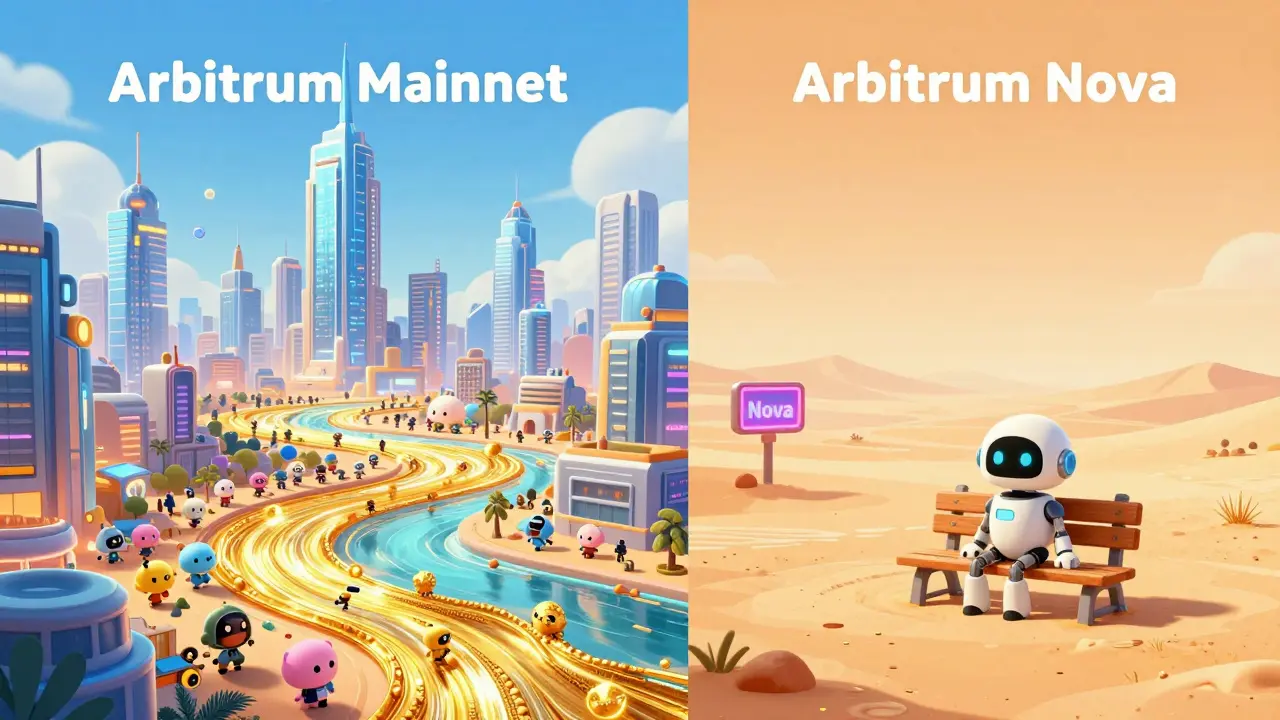
This is where most users get confused. Arbitrum is a Layer-2 scaling solution for Ethereum, but it has different implementations. The experience on these two is night and day.
On the primary Arbitrum network, SushiSwap is a powerhouse. We're talking about deep liquidity pools, like ETH/USDC, which often exceed $100 million. This means you can move significant amounts of money without the price jumping wildly (low slippage). It's fast, the fees are pennies compared to Ethereum mainnet, and the token selection is vast with over 100 ERC-20 tokens available.
Then there is Arbitrum Nova. As of April 2026, Nova is... quiet. Really quiet. The 24-hour trading volume often dips below $7,000, and the total value locked (TVL) is barely $400,000. To put that in perspective, most of the activity is concentrated in just one pair: MOON/WETH. If you try to swap a large amount on Nova, you'll likely hit a wall of high slippage, making it impractical for anything other than tiny, experimental trades.
| Feature | Arbitrum (Mainnet L2) | Arbitrum Nova |
|---|---|---|
| Liquidity Depth | Very High (e.g., $100M+ ETH/USDC) | Very Low (<$500k TVL) |
| Daily Volume | Substantial | Extremely Low (~$6,900) |
| Token Variety | 100+ ERC-20 Tokens | Limited (Approx. 6 coins) |
| Best Use Case | Active Trading & Yield Farming | Experimental Low-Cost Swaps |
Making Money: Staking and Lending
Trading isn't the only way to use the platform. If you hold SUSHI tokens, you can take them to the "SushiBar" and stake them. This gives you xSUSHI, which represents your share of the staking rewards. It's essentially a way to turn your governance tokens into a passive income stream.
For those who want more than just simple staking, there is Kashi. This is SushiSwap's lending and leverage arm. It allows you to lend out your tokens to earn interest or borrow against your assets to open margin positions. It's a more advanced tool, so if you aren't comfortable with the risk of liquidation, you might want to stick to the basic swap interface.

The Trade-offs: What to Watch Out For
Is it all sunshine and low fees? Not exactly. The biggest hurdle is the learning curve. Because this is a non-custodial exchange, there is no "forgot password" button. If you lose your private keys or send funds to the wrong address, those assets are gone forever. There is no customer support team to call to reverse a transaction.
Another issue is the uneven development. While the main Arbitrum side is thriving, the lack of a visible roadmap for Nova makes it feel like a secondary priority. For a regular person, this means you have to double-check which network you are connected to in your wallet before hitting "Swap," or you might end up in a pool with no liquidity.
Final Verdict: Who is this for?
If you are an experienced DeFi user who wants fast, cheap trades on the Arbitrum network, SushiSwap is a top-tier choice. The interface is clean, the liquidity is deep on major pairs, and the multi-chain flexibility is a huge plus. It's a legitimate alternative to centralized giants like Binance because you keep total control of your keys.
However, if you are a complete beginner, be careful. The lack of "training wheels" means one wrong click can be costly. And if you're specifically looking at Arbitrum Nova, treat it as a sandbox for testing rather than a place to manage your main portfolio.
What is the difference between SushiSwap on Arbitrum and Arbitrum Nova?
Arbitrum (main) has high liquidity, hundreds of tokens, and high trading volume, making it suitable for serious traders. Arbitrum Nova has very low liquidity and volume, supporting only a handful of coins, making it more of an experimental environment.
How do I earn passive income on SushiSwap?
You can earn income in three main ways: by providing liquidity to pools to earn a share of the 0.3% trading fees, by staking SUSHI tokens at the SushiBar to earn xSUSHI, or by lending assets through the Kashi platform.
Are my funds safe on SushiSwap?
Because SushiSwap is non-custodial, you hold your own keys, which removes the risk of an exchange-wide collapse (like FTX). However, you are exposed to smart contract risks and the risk of impermanent loss if you are providing liquidity.
What is slippage and why does it matter on Arbitrum Nova?
Slippage is the difference between the expected price of a trade and the actual price at which it executes. On Nova, because the liquidity pools are so small, even a modest trade can move the price significantly, leading to high slippage and a worse deal for the trader.
Can I recover funds sent to the wrong address?
No. Since SushiSwap is a decentralized protocol governed by smart contracts, there is no central authority or customer support team that can reverse transactions or recover lost funds.

Comments
The AMM mechanics here are spot on but it is worth mentioning that if you are looking for maximum capital efficiency you should really be looking at concentrated liquidity pools instead of the standard x*y=k model. On Arbitrum One, the depth is definitely there for a reason since the gas fees are basically negligible compared to L1. For those of you just starting out, always double check your RPC settings before swapping to make sure you aren't accidentally hitting Nova if you're moving size. This is a great way to keep your slippage low and your yields optimized!
I totally agree with the point about Arbitrum One being a goldmine. It's such a relief to have those low fees without sacrificing the security of the mainnet. For anyone confused about the 'flavors', just think of Nova as a specialized side-lane for specific games or social apps, while One is the main highway for serious trading. Hope this helps some of the newer folks!
obviousy anyone who uses Nova for big swaps is just asking to get rekt lol 😂 the slippage is literally insane there!! just stick to the main L2 if u actually want your money 🚀💰
the constant product formula is basic stuff and honestly barely worth explaining in detail because any half decent trader knows that the x*y=k model is basically a relic of 2020 and we should be discussing the actual impact of MEV bots on these L2 pools since that is where the real money is being drained from liquidity providers who think they are just earning passive income while actually getting slaughtered by impermanent loss and toxic flow
Oh honey, imagine thinking a fork of Uniswap is a 'massive hub' in 2026. 🙄 It's all just a giant game of musical chairs played by whales and the 'decentralization' is just a fairy tale to keep the retail sheep providing the exit liquidity. 🐑💸 Just follow the money trail if you're not blind.
just keep it simple guys. stick to the main network and you'll be fine. no need to overcomplicate things
Wow, a 0.3% fee. Truly a revolutionary amount of money. I'm sure the protocol is just swimming in that 0.05% they keep for 'lights'. 🙄
The lack of professionalism in these discussions is appalling. One must maintain a certain level of decorum when discussing financial instruments. The disparity between the two Arbitrum implementations is simply a failure of strategic deployment by the SushiSwap team.
Listen, the US is where the real liquidity is anyway. If you aren't using the main Arbitrum chain, you're basically playing with toys. Get with the program!
this is such a vibe!! just keep swimming in that liquidity pool baby!!! 🌊✨
The TVL on Nova is irrelevant because it was never designed for high-volume trading of general assets. It is for specific use cases and calling it a ghost town shows a lack of understanding of the Arbitrum ecosystem architecture.
The central banks are just using these L2s to track our every move before the great reset happens it is all a trap designed by the globalists to fleece the patriots of this land
definitely agree with the mainnet L2 choice!! keeps things smooth 😊🙌
I've noticed a lot of people struggle with the difference between the two networks. If you're feeling overwhelmed, just take it slow and maybe start with a very small amount on Arbitrum One to get the hang of the interface.
This is all just a front for the shadow government to implement a social credit system via smart contracts. The jargon is there to confuse you while they steal your sovereignty. Wake up and move your funds to cold storage before the grid goes down!
It is fascinating how we seek stability in a digital void. The ebb and flow of liquidity is almost like a tide, reminding us that nothing in this decentralized world is ever truly permanent, yet there is beauty in the chaos of the AMM.
I think we can all agree that keeping things simple is the best way to avoid mistakes! Happy trading everyone! 🌟
it just feels better when the fees are low and you can actually trade without losing half your profit to the network
It is encouraging to see such a detailed breakdown of the current state of these networks. I believe this will greatly assist newcomers in making an informed decision regarding their liquidity provision.
Good info. Just use the main one.
If you're doing LPing on the ETH/USDC pair, just keep an eye on the volatility. The 0.25% fee is nice, but the impermanent loss can eat that alive if you aren't careful with your entry point.
I concur with the assessment that the primary network is superior for liquidity, however, one must be diligent in monitoring the slippage settings manually!!
You people just love following the herd. You'll all be crying when the liquidity migrates to a new protocol and you're left holding the bag in a dead pool because you didn't have the intuition to leave early.