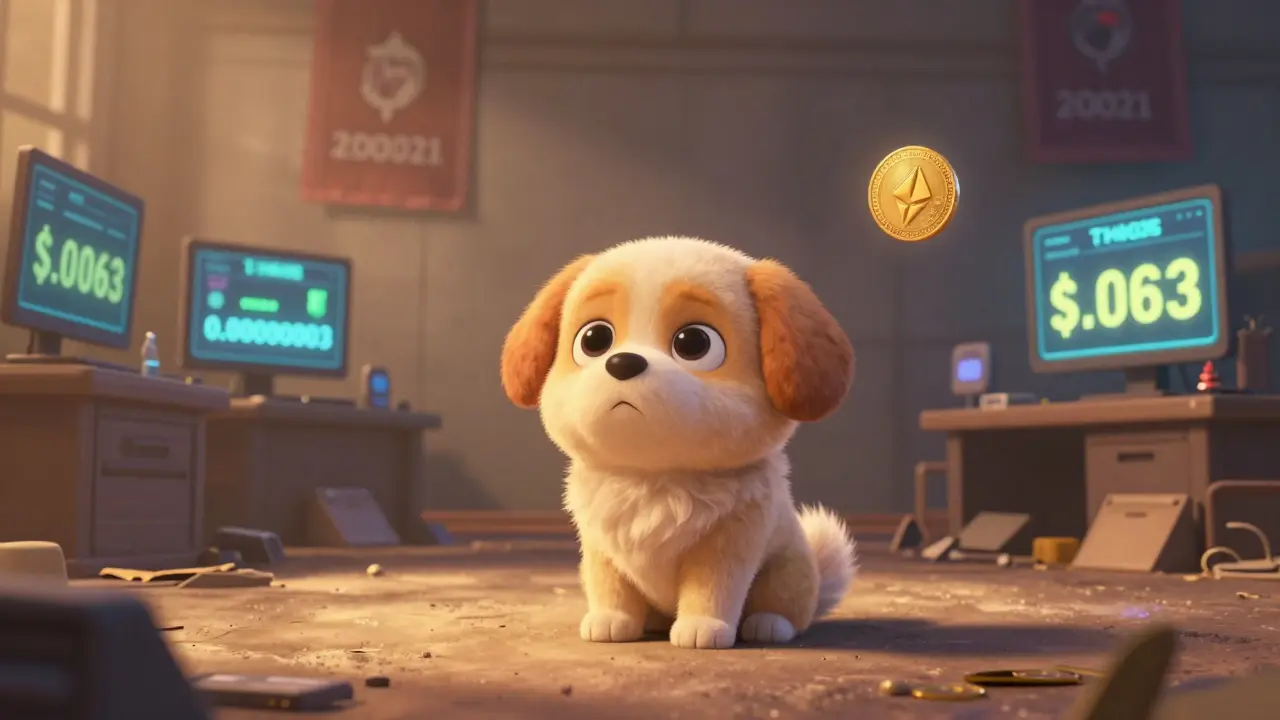
Marvin Inu (MARVIN) isn’t a revolutionary blockchain project. It doesn’t have a unique technology, a real-world use case, or a team building something meaningful. It’s a meme coin-a cryptocurrency created for fun, fueled by internet culture, and sustained only by speculative hype. And right now, that hype is almost gone.
Launched in 2021, Marvin Inu was designed to ride the wave of Dogecoin and Shiba Inu’s popularity. Its branding leans hard into cuteness: a fluffy, cartoonish dog, playful marketing, and a name that sounds like a pet. But behind the cute visuals is a token with almost no trading activity, a market cap under $400,000, and prices that vary wildly across platforms-sometimes even showing $0.
How Marvin Inu works (technically)
Marvin Inu runs on the Ethereum blockchain as an ERC-20 token. That means it doesn’t have its own network. Instead, it piggybacks on Ethereum’s security and infrastructure, just like Chainlink or Uniswap. This isn’t a bad thing-many successful tokens do the same. But unlike those projects, Marvin Inu adds no new functionality. It doesn’t offer staking, lending, governance, or rewards. It’s just a token with a fixed supply of 420.69 billion units, and no plan to burn or mint more.
Because it’s on Ethereum, you can only trade Marvin Inu on decentralized exchanges (DEXs), primarily Uniswap V2. You can’t buy it on Coinbase, Binance, or Kraken. That’s a red flag. Most legitimate projects list on major exchanges early. Marvin Inu never made it past the DEX stage, which limits access to only those who know how to connect a wallet, swap ETH for tokens, and handle gas fees. For most people, that’s too much friction.
Price chaos: Why no one agrees on what MARVIN is worth
The price of Marvin Inu is a mess. CoinGecko says it’s around $0.063. Coinbase says it’s $0.00000003. Binance shows less than $0.000001. Crypto.com lists it at $0.000000501. CoinPaprika says it’s $0.00 with zero volume.
This isn’t a glitch. It’s a symptom of extreme illiquidity. There are so few buyers and sellers that every single trade swings the price wildly. A $100 purchase on Uniswap could double the price overnight-or crash it. That’s why different platforms report different values. They’re pulling data from the same thin, unreliable market.
The 24-hour trading volume? Around $1,900 at best. That’s less than what a single large trade on Bitcoin moves in seconds. For comparison, Dogecoin trades over $1 billion daily. Marvin Inu doesn’t even register on the same radar.
Market performance: A coin in freefall
Marvin Inu’s all-time high was $0.00000552. Today, it’s trading at a fraction of that-about 98.7% lower. That’s not a correction. That’s collapse. The token has lost nearly all value since its peak.
Over the past week, it’s dropped 5.9%. Ethereum-based tokens as a whole rose 12.7% in that same period. Marvin Inu didn’t just fall behind-it got left in the dust. Even during broader crypto rallies, it shows no reaction. That tells you everything: no community momentum, no investor interest, no reason to believe it will bounce back.
Technical indicators paint a mixed picture. The 14-day RSI is neutral at 52.91. But the 50-day moving average ($0.073) is above the 200-day ($0.061), suggesting a short-term uptrend. Yet, that’s misleading. The price is so low and volatile that minor fluctuations look like trends. The Fear & Greed Index says “Greed,” but that’s likely just a few traders gambling on a dead coin.
Why Marvin Inu isn’t worth investing in
Here’s the hard truth: Marvin Inu has none of the qualities that make crypto investments viable.
- No utility - It doesn’t pay dividends, enable governance, or power any app.
- No adoption - No merchants accept it. No wallets prioritize it. No tools integrate with it.
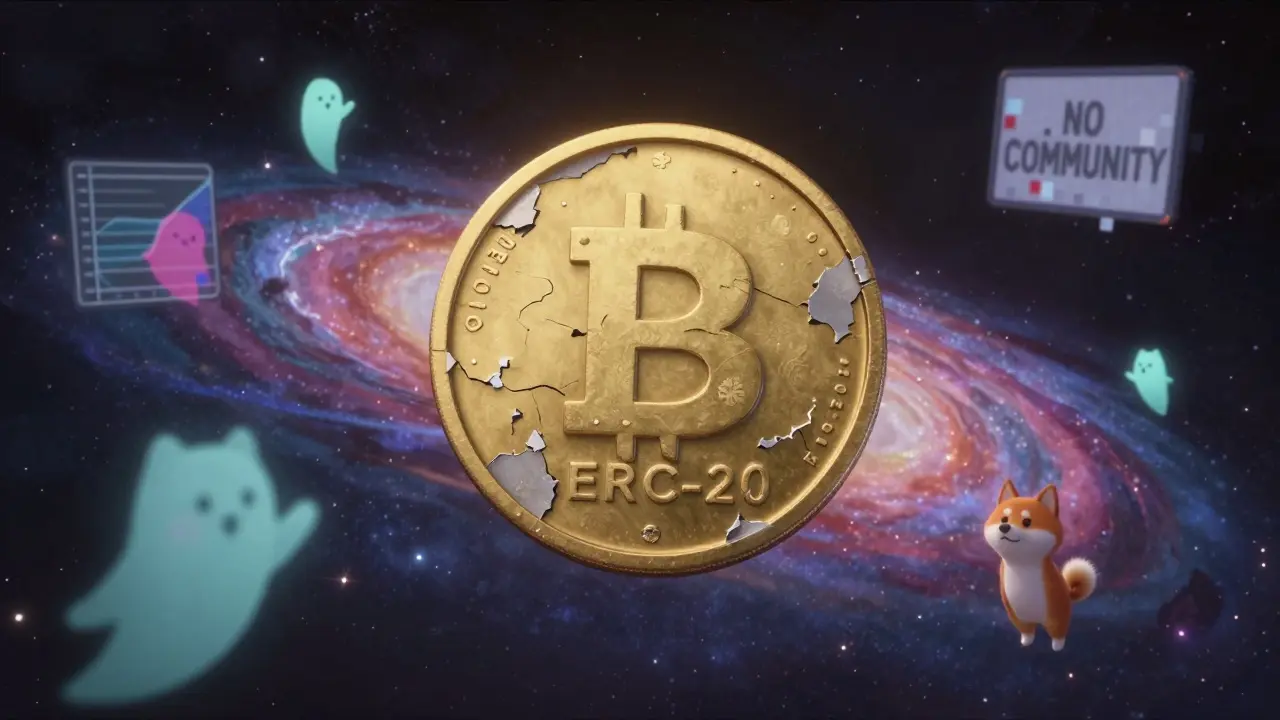
- No community - There’s no active Discord, no trending Twitter threads, no Reddit buzz. Just silence.
- No liquidity - You can’t easily buy or sell it without moving the price.
- No exchange presence - You can’t trade it on any major platform.
It’s not a scam in the traditional sense-there’s no evidence of a rug pull or stolen funds. But it’s also not an investment. It’s a digital collectible with no value. Think of it like a trading card from a game that no one plays anymore. You can own it, but no one else wants it.
What makes Marvin Inu different from other meme coins
Most meme coins fail. But some, like Dogecoin or Shiba Inu, survived because they built real communities. Dogecoin became a cultural phenomenon. Shiba Inu launched a decentralized exchange, a wallet, and even a blockchain. Marvin Inu did none of that.
It never launched a tokenomics update. Never did airdrops. Never partnered with influencers. Never even created a website with real content. Its whitepaper? Nonexistent. Its team? Anonymous. Its roadmap? Empty.
It’s not even trying. It’s just sitting there, a relic of a 2021 meme trend that moved on without it.
Who still trades Marvin Inu?
Only two kinds of people:
- Speculators chasing a miracle - hoping it’ll “moon” again, despite zero evidence.
- Scam bots - automated programs that create fake volume to lure in new buyers.
There are no long-term holders. No institutions. No developers. No users. Just noise.
Final verdict: Should you buy Marvin Inu?
No.
If you’re looking to invest in crypto, Marvin Inu is one of the riskiest options you can find. There’s no path to recovery. No catalyst. No reason to believe it will ever gain traction. Even if you buy it at $0.00000001, the chances of selling it for more are near zero.
It’s not a coin you own. It’s a coin you gamble with. And the odds are stacked against you.
If you’re curious, you can find it on Uniswap V2. But treat it like a lottery ticket-not an asset. And don’t invest more than you’re willing to lose completely.
Is Marvin Inu (MARVIN) a scam?
Marvin Inu isn’t a scam in the way that rug pulls or fake teams are. There’s no evidence the creators stole funds or vanished. But it’s also not a legitimate investment. It’s a dead project with no development, no community, and no utility. It’s better described as an abandoned meme coin rather than a scam.
Can I buy Marvin Inu on Coinbase or Binance?
No. Marvin Inu is not listed on any major centralized exchange like Coinbase, Binance, or Kraken. The only place you can trade it is on decentralized exchanges, specifically Uniswap V2 on the Ethereum network. This requires a crypto wallet like MetaMask and some ETH for gas fees.
Why do different websites show different prices for MARVIN?
Because there’s almost no trading activity. With only $1,900 traded in 24 hours across all platforms, every single trade affects the price dramatically. Some platforms pull data from one small liquidity pool, others from another. The result? Wildly inconsistent numbers. Some even show $0 because there are no recent trades.
What’s the total supply of Marvin Inu?
Marvin Inu has a fixed supply of 420.69 billion tokens. Unlike many crypto projects, there’s no mechanism to burn tokens or mint new ones. All tokens are already in circulation, so the fully diluted valuation equals the current market cap.
Is Marvin Inu based on its own blockchain?
No. Marvin Inu is an ERC-20 token built on the Ethereum blockchain. It uses Ethereum’s network for transactions, security, and smart contract execution. It doesn’t have its own blockchain, validators, or consensus mechanism.
What’s the outlook for Marvin Inu in 2026?
The outlook is extremely negative. Technical analysis tools predict a continued decline, with some forecasting prices falling to $0.072782 by March 19, 2026. But given the token’s near-zero volume and lack of any development activity, even this prediction is speculative. There’s no reason to believe Marvin Inu will recover. It’s effectively a dead project.
Comments
LMAO this coin is a digital ghost 🤡💀. I checked Uniswap last week and the price was $0.00000001 - then a guy bought 500k MARVIN and it jumped to $0.00000045. Then vanished again. It’s not a coin. It’s a glitch with a mascot.
I feel bad for the devs who put effort into the cute dog design. At least they had a sense of humor. Most meme coins are just ugly PNGs with ‘HODL’ slapped on. Marvin Inu’s art was cute. Shame no one showed up to the party.
Let’s break this down properly. ERC-20 tokens aren’t inherently bad - look at UNI or AAVE. But Marvin Inu has zero utility, zero community, zero liquidity, and zero reason to exist beyond being a placeholder in someone’s wallet. The 420.69 billion supply? That’s not a feature - it’s a joke. With that many tokens, even a $1 trade moves the price 200%. That’s not volatility - that’s market manipulation by accident. And the fact that no major exchange lists it? That’s not a coincidence. It’s a death sentence. If you’re holding this, you’re not investing. You’re collecting digital dust.
I find it fascinating how society treats speculative assets as if they are rational investments. Marvin Inu is not a failure. It is a mirror. It reflects our collective obsession with the idea of wealth, not its substance. The price discrepancies across platforms? They are not errors. They are symptoms of a system that values perception over reality. We are all complicit.
You people still trading this? Wow. You’re not broke. You’re just stupid. This isn’t a meme coin. It’s a graveyard. I’ve seen rug pulls. This isn’t even that. This is a corpse that forgot to decompose. Someone bought this with their rent money. I’m not mad. I’m just disappointed in humanity.
The fact that CoinGecko still lists this at $0.063 is proof that centralized data aggregators are fundamentally broken. This isn’t a market inefficiency - it’s a systemic failure of information integrity. The price on Binance is $0.000001? That’s probably the correct one. The rest? Either outdated or manipulated by bots. The 24-hour volume of $1,900? That’s less than what I spent on coffee last week. This isn’t crypto. It’s a ghost in the machine.
I used to think meme coins were harmless fun. Then I saw a 72-year-old man in my Reddit group buy $3,000 of this. He thought it was ‘the next Doge.’ I don’t hate the guy. I pity him. You don’t need to be a genius to understand this coin is dead. But you do need to be willing to admit you’re wrong. That’s the real challenge.
The ERC-20 architecture imposes inherent limitations on token velocity and composability. Marvin Inu’s non-burning supply model exacerbates dilutionary pressures in a low-liquidity environment. The lack of on-chain governance mechanisms renders any residual utility functionally inert. The price discrepancies across aggregators are indicative of fragmented order book liquidity - a classic sign of terminal market decay. This is not a speculative opportunity. It is a necrotic asset class.
I read this whole thing. Honestly? Too polite. This isn’t a ‘dead project.’ It’s a digital landfill. Someone spent time designing a cartoon dog. That’s cute. But then they did absolutely nothing else. No roadmap. No team. No website. No socials. Just a token with a funny name and a billion units. That’s not a meme. That’s negligence dressed up as art. And now people are still trading it? Please. The only thing growing here is the number of people who need to be told ‘no’.
Just don’t buy it. 🤷♀️
You know who’s behind this? The same people who made Dogecoin. They’re running a multi-layered psyop. Marvin Inu isn’t dead - it’s a honeypot. The low price? Designed to lure retail. The price discrepancies? To confuse the algorithms. The lack of exchange listings? To keep it away from regulators. This is Phase 2 of a larger crypto manipulation campaign. I’ve seen the pattern before. This coin will spike. And when it does, you’ll be the one holding the bag.
I used to own some MARVIN. Not because I thought it’d go up. Just because I liked the dog. It sat in my wallet for two years. I forgot it existed. Then I checked last month - still there. Worth less than the gas fee to move it. Funny thing? I still smile when I see it. Sometimes, the value isn’t in the price. It’s in the weird little things we keep around for no reason.
Look - I get it. You want to believe in something. You want to think there’s still magic in crypto. But Marvin Inu? It’s not a gamble. It’s a confession. You’re not betting on a coin. You’re betting on the idea that maybe, just maybe, this time, the universe will surprise you. And that’s okay. But don’t call it investing. Call it hope. And if you’re gonna hope, at least hope for something that has a heartbeat.
In India, we have many meme coins like SafeMoon, DogeZilla. But this Marvin Inu is different. It has no community, no energy. Even in meme culture, there must be life. This is like a silent movie in 2024. No one is watching. No one cares. It is not worth time.
Just delete it and move on
I’ve held Dogecoin since 2013. I’ve seen memes turn into movements. Marvin Inu? It never even got to the meme phase. It was a sticker on a fridge that no one noticed. It’s not dead. It was never alive.
The entire premise of meme coins is that they’re supposed to be stupid on purpose. Marvin Inu doesn’t even achieve that. It’s not ironic. It’s just lazy. The name? A pun on a cartoon dog. The supply? A joke number. The team? Ghosts. The website? A placeholder. This isn’t satire. It’s a PowerPoint slide from a 2021 hackathon that got abandoned after lunch. And now people are trading it like it’s a hedge fund? The absurdity is beautiful. And terrifying.
I think it’s sweet that someone made a cute dog coin. I don’t get why people get so angry about it. It’s not hurting anyone. If you want to buy it for fun, go ahead. If you want to laugh at it, do that too. Not everything has to be a portfolio allocation. Sometimes a coin is just a joke. And that’s okay.
Let me tell you what really happened here. In 2021, someone created this token as a joke between friends. They didn’t expect anyone to take it seriously. But then a bot picked it up on a DEX aggregator, and suddenly it had a price. Then another bot. Then a guy on Reddit bought 10k tokens because he thought ‘420.69 billion’ sounded cool. Then a YouTube video titled ‘MARVIN INU: THE NEXT 1000X?’ went viral. The team? Never responded. Never updated. Never even claimed the Twitter. So now we have a token that’s been alive for years - not because of any project, but because of the collective hallucination of a few hundred people who refuse to let go. It’s not a failure. It’s a cultural artifact. Like a viral TikTok that won’t disappear. It’s not worth anything. But it exists. And that’s weirder than any blockchain.
The very existence of Marvin Inu is a philosophical indictment of capitalism’s descent into performative absurdity. The token’s zero utility, its phantom liquidity, its spectral market cap - these are not flaws. They are features. They are the logical endpoint of a financial system that has replaced value with narrative, and narrative with aesthetic. The cartoon dog is not a mascot. It is a totem. A pagan idol erected in the temple of speculation. To hold MARVIN is to worship at the altar of the void. And yet… I cannot look away.
I live in Australia. We’ve got a lot of meme coins here. But Marvin Inu? It’s the one that made me laugh so hard I cried. Then I checked the price again. Still $0.00000001. I still have 2 million of them. I call them my ‘digital confetti.’ I’ll never sell. I’ll just let them sit. Maybe in 20 years, someone will dig them up and say ‘Wow, this was the last meme coin before AI took over.’ And I’ll be like - ‘Yep. That was mine.’
I bought MARVIN because I thought it was a joke… then I realized I was the joke. I cried. Then I bought more. Now I have 30 million. I don’t know why. I just can’t stop. I check the price every 10 minutes. I’ve started dreaming about Uniswap. My therapist says I need to let go. I told her it’s not a coin. It’s a feeling. She didn’t understand. She doesn’t get crypto. She doesn’t get me.