
Most people know Bitcoin. Some have heard of Ethereum or Solana. But what about a crypto coin built not to make money, but to store knowledge? That’s where Sulaana (SUL) comes in. It’s not another meme coin or a speculative gamble. It’s an attempt to build a decentralized, AI-powered encyclopedia on the blockchain - and SUL is the fuel that runs it.
If you’ve ever searched for something online and found conflicting answers, you know how broken centralized knowledge can be. Wikipedia gets edited by volunteers. Google ranks content based on backlinks, not truth. Sulaana says it can fix that. But is it real? Or just another crypto idea that never left the whitepaper?
What Sulaana (SUL) Actually Does
Sulaana isn’t just a token. It’s tied to a website: Sulaana.wiki. The idea is simple: every piece of information on this platform is stored on the blockchain. That means no one can delete or alter facts without consensus. AI checks each entry for accuracy, cross-references sources, and flags misinformation. If you contribute a verified fact, you earn SUL tokens. If you correct a lie, you earn more.
This isn’t theory. The official whitepaper (updated October 2025) calls it a "next-generation decentralized encyclopedia." Unlike traditional wikis, where edits are temporary and reversible, Sulaana.wiki makes changes permanent and verifiable. Think of it like Wikipedia, but every edit is a blockchain transaction. And SUL is the reward for making those edits count.
How SUL Works - The Token Mechanics
Sulaana (SUL) is an ERC-20 token built on Ethereum. That means it uses the same security as Bitcoin’s network but with faster, cheaper transactions. The total supply is capped at 3,000,000 SUL. But here’s the catch: as of October 2025, Binance reported a circulating supply of zero. That’s not a typo. Most of the tokens are still locked in wallets controlled by the core team.
Why? Because the project hasn’t launched its main platform yet. SUL isn’t meant to be traded. It’s meant to be used. Right now, the only way to get SUL is through:
- Completing "Learn2Earn" quizzes on Bitget
- Inviting friends to join via the "Assist2Earn" program
- Winning airdrops from ongoing challenges
There’s no public marketplace where you can buy SUL for everyday use. No stores accept it. No apps integrate it. You can’t pay for a coffee with SUL. You can’t send it to a friend as a gift. The only place it has any value is on exchanges like Bitget, Phemex, and Binance - and even there, trading volume is laughably low.
Market Data: Is Anyone Even Trading This?
Let’s get real. As of October 2025:
- Price on Binance: $0.089879
- Price on Phemex: $0.076226
- Price on Crypto.com: $0.1117 (but they say it’s "not tradable")
- 24-hour trading volume: $175 total across all exchanges
- Fully diluted market cap: $269,635.81
Compare that to Everipedia (IQ), another crypto-based encyclopedia, which has a market cap over $100 million. Sulaana’s entire value is less than what a single tweet from a crypto influencer can move in a day.
Price swings are wild. In one week, SUL dropped 51% on Phemex. In one hour, it spiked 36%. That’s not market demand - that’s a handful of people flipping coins. The 14-day RSI is 51.20, which sounds neutral. But the 50-day moving average is $0.139, and the 200-day is $0.61. The current price is below both. That’s a classic sign of a dying asset.
Who’s Behind Sulaana?
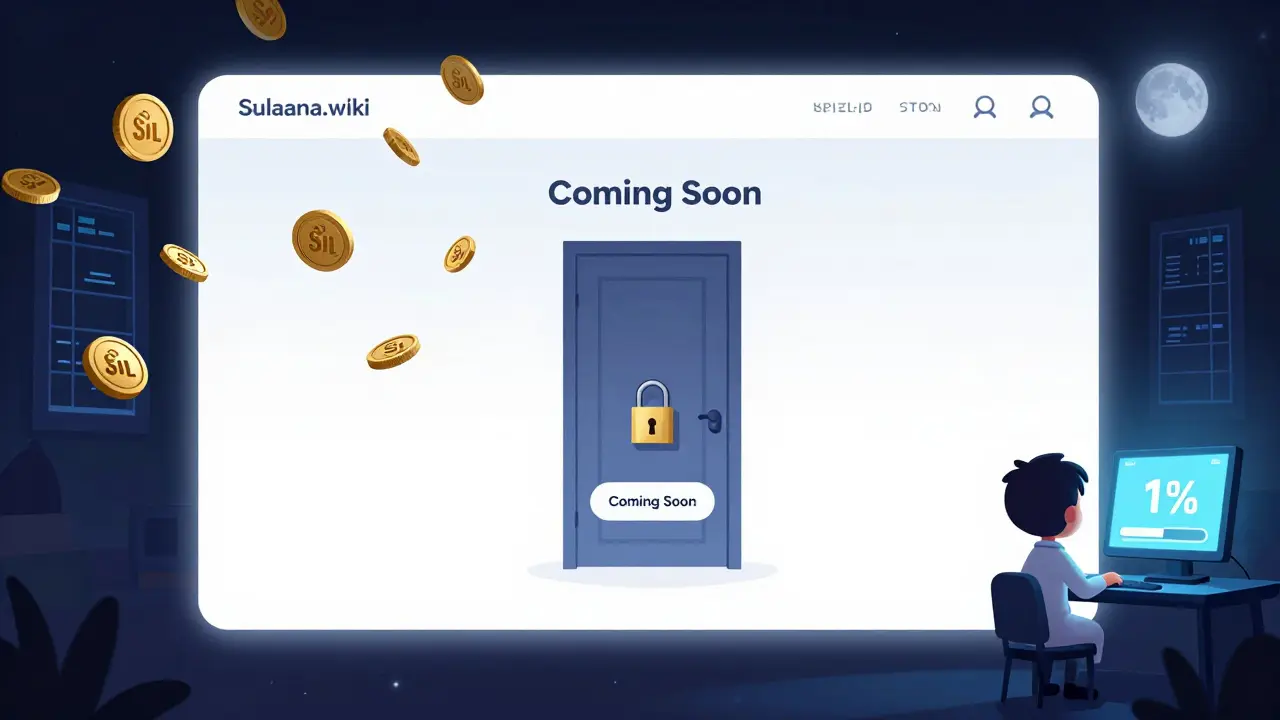
No one knows. The team is anonymous. The website has a clean design, but no team page. No LinkedIn profiles. No GitHub commits. No developer updates. The whitepaper is well-written, but it’s all vision - no roadmap, no milestones, no deadlines.
Compare that to projects like Filecoin or Arweave, which also store data on the blockchain. They have teams. They have quarterly reports. They have developer grants. Sulaana? Nothing. The only "activity" comes from Bitget’s promotion campaigns: "Join our challenges, earn SUL!" That’s not innovation. That’s a referral program.
Why It’s Not Working - The Real Problems
Sulaana has three fatal flaws:
- No usable product. Sulaana.wiki doesn’t exist as a live, public platform. You can’t browse it. You can’t edit it. You can’t verify anything. Without the platform, SUL has no purpose.
- No community. Reddit has zero active threads. Twitter has no followers. Discord has no members. No one is talking about it. If no one cares, no one will use it.
- No liquidity. With $175 traded in 24 hours, you can’t buy $1,000 worth of SUL without crashing the price. You can’t sell without being stuck. It’s a dead end.
And yet, CoinCodex’s Fear & Greed Index says "Greed" at 71. That’s not confidence. That’s manipulation. Someone is pumping it, hoping newbies will buy before it crashes.

Could It Ever Work?
Possibly. But only if:
- Sulaana.wiki launches with real AI verification tools
- They open the platform to public editing
- They prove their AI can outperform Wikipedia’s human editors
- They get listed on Coinbase, Kraken, or KuCoin
- They release a public roadmap with dates
None of that has happened. Not even close.
Right now, Sulaana is a ghost project. It’s a token with no use, a website with no content, and a community with no voice. It’s not a crypto innovation. It’s a waiting game.
Should You Buy SUL?
If you’re looking to invest - no. Don’t put money into something with zero trading volume and no working product.
If you’re curious - maybe. Try the "Learn2Earn" program on Bitget. Get a few free SUL tokens. See if you can even access Sulaana.wiki. If you can’t, you’ll know the truth: this isn’t a crypto project. It’s a marketing stunt.
The idea of a blockchain encyclopedia is brilliant. But Sulaana isn’t building it. It’s just selling the dream.
Is Sulaana (SUL) a good investment?
No, not at this stage. Sulaana has a market cap under $300,000, less than $200 in daily trading volume, and no working product. The token is locked, with near-zero circulating supply. Price swings are driven by speculation, not adoption. It’s a high-risk, low-reward bet with no clear path to value.
Can I use SUL to edit Sulaana.wiki?
Not yet. As of October 2025, Sulaana.wiki is not publicly accessible or editable. The platform is still in development, and no one can contribute or verify content. SUL tokens have no functional role right now - they’re essentially digital collectibles.
Where can I buy Sulaana (SUL)?
SUL is listed on Bitget, Phemex, and Binance. But Crypto.com says it’s "not tradable," and Binance reports zero circulating supply. Trading volume is extremely low - under $200 per day. You can buy it on these exchanges, but selling it later may be nearly impossible due to lack of buyers.
Is Sulaana similar to Everipedia (IQ)?
The goal is similar - both aim to create blockchain-based encyclopedias. But Everipedia has a market cap over $100 million, active users, and a live platform. Sulaana has no public platform, no user base, and a market cap under $0.3 million. Everipedia is a functioning project. Sulaana is still an idea on paper.
Why does SUL have such a volatile price?
Low liquidity. With only $175 traded daily, a few large buys or sells can swing the price by 30% or more. It’s not driven by demand - it’s driven by speculation and pump-and-dump schemes. The high Fear & Greed Index (71) contradicts the falling price, which suggests artificial inflation.
Don’t chase hype. Wait for proof. Until Sulaana.wiki goes live - and people start using it - SUL is just a digital ghost.

Comments
Sulaana’s whole premise is beautiful in theory-decentralized, AI-verified knowledge? Yes, please. But the execution is a ghost town. No live platform? Zero circulating supply? That’s not "pre-launch," that’s vaporware with a fancy whitepaper.
And don’t get me started on the "Learn2Earn" hustle. It’s not education-it’s a gamified pyramid with a blockchain sticker on it.
Let’s be brutally honest here: the entire Sulaana project is a textbook case of crypto’s most dangerous delusion-the idea that if you just slap "AI" and "blockchain" on something, it becomes revolutionary. No, it doesn’t. It becomes a PowerPoint deck with a token attached.
And the price action? $175 in 24 hours? That’s not a market-it’s a single whale with a spreadsheet and a grudge against Wikipedia. The RSI is 51.20? Please. That’s the calm before the crash. The 50-day MA is $0.139? Current price is $0.08? That’s not volatility-that’s a funeral march. And the fact that Binance reports zero circulating supply? That’s not a feature-it’s a red flag the size of the Ethereum blockchain.
I just want to scream into the void about this. Sulaana isn’t a project-it’s a metaphor for how the crypto world has forgotten what innovation even means.
We used to dream of decentralized knowledge, of truth that couldn’t be censored, of a world where facts weren’t determined by ad revenue or backlinks. And now? We get a token with no utility, a website that doesn’t load, and a team that’s ghosted harder than my ex.
It’s not just broken-it’s tragic. The idea was noble. The execution? A dumpster fire wrapped in a Medium article.
I’m so angry right now. I actually believed in this. I spent hours on those "Learn2Earn" quizzes thinking, "This could change everything."
And then I checked the website-blank. No content. No edits. No history. Just a loading spinner and a promise.
They’re not building a future. They’re selling a dream to people who still trust the internet. And I feel so used. Like I gave my time to a ghost. I’m not mad at the market. I’m mad at myself for believing.
Why does this keep happening? Why do we keep falling for this?!
Look, I’m not here to dunk on anyone’s dream. I think the idea of a blockchain encyclopedia is cool-like, really cool.
But this? This feels like someone built a Ferrari… and then locked it in a garage with no keys.
Maybe they’re still working on it. Maybe they’ll launch next month. Maybe they just ran off with the money.
Either way, I’m not throwing cash at it. But I’ll keep an eye out. If it ever goes live? I’ll be first in line.
Hey, I’ve been following crypto projects for over a decade, and I’ve seen a lot of "next-gen" stuff.
Sulaana? It’s not the worst idea I’ve seen-but it’s definitely in the top 10 for "how not to build a community."
Here’s the thing: if you want people to use something, you have to let them use it. Not promise it. Not tease it. Not run a Bitget quiz and call it a day.
Give us a public beta. Let us edit. Let us argue. Let us fix mistakes. Let us *feel* like we’re part of something. That’s how real projects grow. Not by airdrops. Not by referral links. By trust. And right now? There’s zero trust here.
Okay, I’m going to play devil’s advocate here. What if Sulaana isn’t dead? What if it’s just… quiet?
Think about Arweave. Took years to get traction. Filecoin? Same. What if they’re quietly building the AI verification engine, and the blockchain integration? What if the locked tokens are for future staking, not rugpulls?
Yeah, the trading volume is garbage. Yeah, the team is anonymous. But maybe that’s intentional. Maybe they’re avoiding the hype cycle.
Not saying I’m investing. But I’m not writing it off yet. Sometimes the quiet ones win.
Did you notice how every single "Sulaana" article mentions Bitget? CoinCodex? Phemex?
And yet, zero GitHub. Zero team. Zero developer updates.
What if this isn’t a crypto project at all?
What if it’s a front for a market manipulation scheme disguised as a knowledge platform?
Who benefits from a token with zero circulating supply and $175 in volume?
Not users. Not editors. Not truth.
Someone. Someone with access to the locked wallets. Someone who’s watching the pump-and-dump play unfold.
Don’t be the chump who buys the last ticket before the concert gets canceled.
Bro, I tried the Learn2Earn thing. Got 12 SUL. Tried to go to sulaana.wiki. Page said "under construction" for 48 hours. Then I checked again-now it’s 404.
So I dug deeper. Found a Telegram group. 17 people. 15 bots. 2 humans. One said "I’m the founder"-no verification. No proof.
I’m from India. We’ve seen this before. A shiny site. A whitepaper. A promise. Then silence.
I’m not mad. I’m just… tired.
Maybe next time, let’s build something real before we sell the dream.
Okay, I’ll admit-I kinda love this. The idea of a blockchain encyclopedia is so beautifully naive.
Like, imagine if Wikipedia was built by people who actually cared about truth, not SEO.
But then I look at the price chart… $0.089? That’s not a token. That’s a digital napkin with a logo.
And the "fully diluted market cap"? $269k? That’s less than what I spent on my last crypto NFT.
It’s poetic. It’s tragic. It’s the internet’s version of a love letter written in invisible ink.
😭
Based on the data presented, the Sulaana (SUL) project exhibits all the hallmarks of an unviable cryptocurrency initiative. The absence of a functional decentralized platform, combined with a zero circulating supply, renders the token economically inert. Furthermore, the extremely low trading volume, coupled with the absence of institutional listing on major exchanges such as Coinbase or Kraken, indicates a complete lack of market confidence. The reliance on referral-based token distribution mechanisms further undermines its legitimacy as a decentralized knowledge infrastructure. In conclusion, the project lacks the foundational elements necessary for sustainable adoption and should be classified as speculative at best.
Zero circulating supply. $175 in 24-hour volume. A team that doesn’t exist. A website that doesn’t work.
This isn’t a crypto project. It’s a scam with a whitepaper.
And the fact that people are still "earning" SUL through quizzes? That’s not innovation. That’s exploitation.
I don’t care if it’s "brilliant in theory." Theory doesn’t pay bills. Reality does.
And reality says: this is dead.
Just wanted to say-I read the whole thing. No emojis. No drama.
It’s all true.
And it’s sad.
Because the idea? It could’ve been amazing.
But now? It’s just a ghost.
THEY’RE USING AI TO MANIPULATE THE MARKET!!!
IT’S NOT A WIKI-IT’S A BAI (BRAINWASHED AI) SYSTEM!
THEY’RE TRAINING THE AI TO PROMOTE ONLY CERTAIN FACTS-AND THE SUL TOKEN IS THE KEY TO CONTROL WHAT YOU BELIEVE!
EVERYTHING ON SULAANA.WIKI IS A LIE-AND THE "VERIFIED FACTS" ARE JUST LAYERED DECEPTION!
THEY’RE WORKING WITH THE FEDS. OR THE ILLUMINATI. OR BOTH.
LOOK AT THE WHITEPAPER-THEY USED A FONT CALLED "LORA"-THAT’S A CODE FOR "WE’RE HIDING SOMETHING"!
THEY’RE NOT BUILDING A WIKI.
THEY’RE BUILDING A THOUGHT POLICE.
10/10 WOULD NOT TRUST
🧠👁️👁️