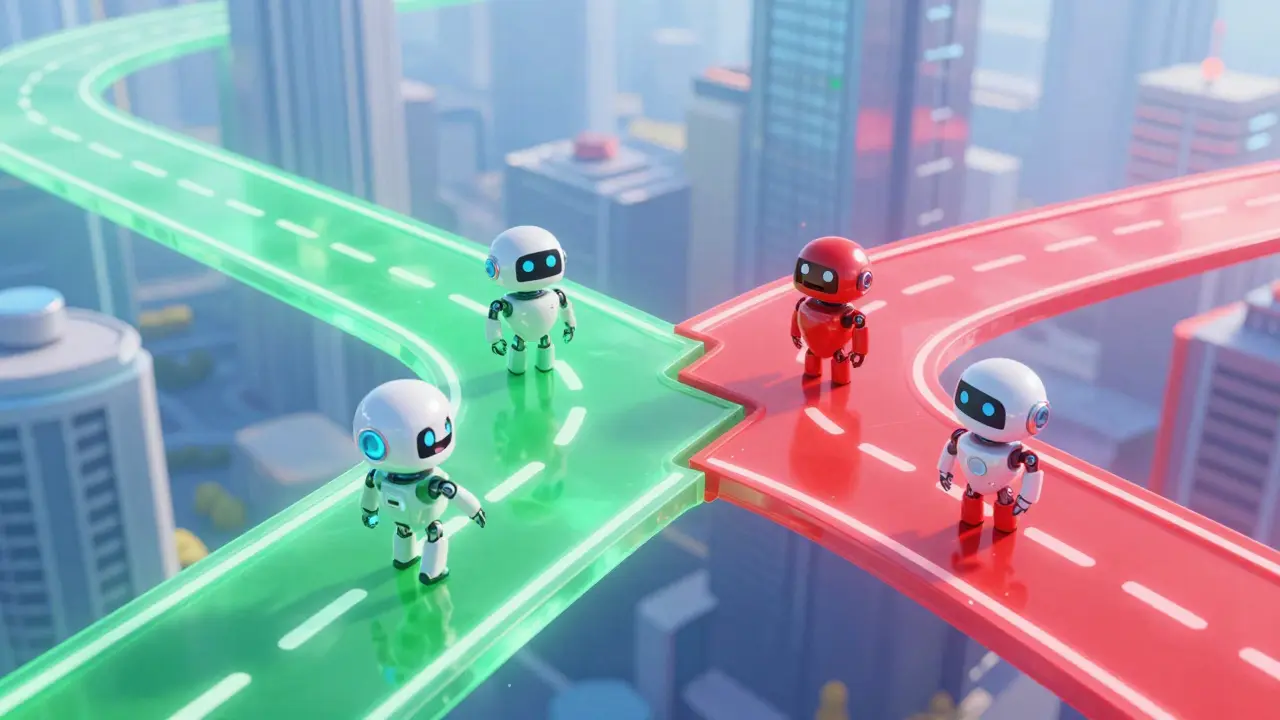
You’ve probably seen the news headlines screaming about a "fork" in Bitcoin or Ethereum. If you’re new to crypto, it sounds like a terrifying glitch-a moment where the internet breaks. But here’s the truth: a blockchain fork is not a bug; it’s a feature. It is the fundamental way decentralized networks evolve without a CEO calling the shots.
Imagine a road that suddenly splits into two paths. In traditional software, the company decides which path to take. In blockchain, the community votes with their nodes. Sometimes everyone agrees on the direction (a smooth upgrade). Other times, they disagree so strongly that the chain literally splits in two, creating a new currency out of thin air. Understanding this mechanism is crucial if you want to protect your assets and understand where the market is heading.
The Core Concept: What Is a Blockchain Fork?
At its simplest, a fork is a divergence in the blockchain’s transaction history. Because blockchains are distributed ledgers maintained by thousands of computers (nodes) around the world, every node must follow the same set of rules-known as the protocol-to agree on what is valid. When those rules change, the network has to update.
If all nodes update at once and agree on the new rules, the chain continues seamlessly. This is often called a "consensus fork." However, if some nodes stick to the old rules while others adopt the new ones, the blockchain splits. From that point forward, two separate chains exist, each with its own history up to the split point and its own future trajectory.
This process is necessary because blockchains are immutable. You cannot just patch a security hole or add a new feature quietly behind the scenes. Every change requires global consensus. The fork is the physical manifestation of that decision-making process.
Soft Fork vs. Hard Fork: The Critical Difference
Not all forks are created equal. The distinction between a soft fork and a hard fork determines whether your wallet stays compatible and whether a new coin is born. Let’s break down the technical differences in plain English.
| Feature | Soft Fork | Hard Fork |
|---|---|---|
| Compatibility | Backward-compatible | Not backward-compatible |
| Rule Change | Tightens existing rules | Changes or relaxes rules |
| New Chain Created? | No (single chain remains) | Yes (two separate chains) |
| Node Requirement | Non-upgraded nodes still validate | Nodes must choose one version |
| Risk Level | Lower risk of split | Higher risk of community division |
A soft fork is a backward-compatible update to the blockchain protocol. Think of it like tightening traffic laws. If the speed limit was 100 km/h and you lower it to 80 km/h, cars driving at 90 km/h are now illegal. But cars that don’t know about the new rule (non-upgraded nodes) can still see the valid cars (those driving under 80) and accept them. The chain doesn’t split; it just becomes stricter. Soft forks are generally safer and less controversial because they don’t force a permanent separation.
In contrast, a hard fork is an irreversible divergence in the blockchain protocol that creates two incompatible chains. Using the traffic analogy, imagine changing the rule so that cars must drive on the left side of the road instead of the right. Cars that don’t update their software will continue driving on the right, while updated cars drive on the left. They can no longer interact safely. The road splits. One group follows the old rules, the other follows the new ones. This results in two separate cryptocurrencies.
Why Do Forks Happen? The Four Main Drivers
Forks aren’t random accidents. They are deliberate actions driven by specific needs within the ecosystem. Here are the four primary reasons why a fork occurs:
- Scalability and Performance: As more people use a blockchain, it gets congested. Transactions slow down, and fees skyrocket. Developers may propose a fork to increase block size or improve efficiency. For example, the debate over Bitcoin’s block size limit led directly to the creation of Bitcoin Cash.
- Security Fixes: Sometimes a critical vulnerability is discovered. A hard fork might be required to patch the hole immediately, especially if the exploit allows for double-spending or theft. The DAO hack on Ethereum is a famous case where a fork was used to reverse transactions and save user funds.
- Ideological Differences: Blockchains are built on philosophy. Some believe in strict immutability (the code is law), while others believe in flexibility (human intervention is okay when things go wrong). These philosophical clashes often result in contentious hard forks.
- Feature Upgrades: To stay competitive, blockchains need new features. Adding smart contract capabilities, changing consensus mechanisms (like moving from Proof-of-Work to Proof-of-Stake), or improving privacy often requires a fork to implement these changes across the network.

Real-World Examples: Lessons from History
Theory is helpful, but real-world examples show how forks impact wallets and markets. Let’s look at three major cases that shaped the industry.
Bitcoin Cash (BCH) - The Scaling War
In August 2017, the Bitcoin community was divided over how to handle growing transaction volumes. One group wanted to keep the 1MB block size limit to preserve decentralization. Another group argued for larger blocks to make Bitcoin faster and cheaper for everyday payments. This disagreement resulted in a hard fork. Bitcoin (BTC) remained the original chain, while Bitcoin Cash emerged as a new chain with an 8MB block size. Holders of BTC at the time of the fork also received BCH in a 1:1 ratio.
Ethereum (ETH) vs. Ethereum Classic (ETC) - The Immutability Debate
In 2016, a project called The DAO was hacked, stealing $50 million worth of Ether. The Ethereum community faced a tough choice: let the theft stand and uphold the principle of immutability, or fork the chain to recover the funds. Most of the community voted to fork. The result was Ethereum (ETH), which reversed the hack, and Ethereum Classic (ETC), which continued on the original chain without reversing the transactions. ETC became a symbol of "code is law," while ETH prioritized user protection.
The Merge (Ethereum) - A Successful Hard Fork
Not all hard forks create new coins. In September 2022, Ethereum executed "The Merge," a massive hard fork that transitioned the network from Proof-of-Work to Proof-of-Stake. This was a coordinated upgrade where nearly all nodes agreed to switch to the new consensus mechanism. No new chain was created; instead, the existing Ethereum chain evolved. This demonstrates that hard forks can also be unifying events when there is broad consensus.
How Forks Impact Your Wallet and Assets
If you hold cryptocurrency, forks are directly relevant to your financial health. Here’s what you need to know before a fork happens.
Airdrops and Duplicate Coins
When a hard fork creates a new cryptocurrency, holders of the original coin usually receive an equivalent amount of the new coin. This is called an airdrop. For example, if you held 10 BTC before the Bitcoin Cash fork, you would have received 10 BCH. However, this isn’t automatic in your wallet. You often need to move your coins to a wallet that supports both chains to claim the new assets.
Wallet Compatibility
Not all wallets support every forked coin. If you leave your coins on an exchange, the exchange decides whether to support the new chain. If you hold coins in a self-custody wallet, you must ensure the wallet software is updated to recognize the new chain. Failing to do so could mean losing access to your assets on one of the chains.
Market Volatility
Forks introduce uncertainty. Traders often sell off coins before a fork to avoid the hassle of managing two different assets, causing price drops. After the fork, prices can swing wildly as speculation mounts about the value of the new coin. Historical data shows price movements of 15-30% during major fork periods. Always be prepared for volatility.
The Future of Forks: Governance and Automation
As blockchain technology matures, the way we handle forks is evolving. Early forks were chaotic and driven by public arguments on forums. Today, projects use formal governance structures to manage upgrades.
Projects like Bitcoin use Bitcoin Improvement Proposals (BIPs), and Ethereum uses Ethereum Improvement Proposals (EIPs). These are formal documents that outline proposed changes, allowing developers and users to review and vote on them before implementation. This reduces the likelihood of accidental splits and ensures that forks are well-tested.
Additionally, Layer-2 solutions are reducing the need for main-chain forks. By building scaling solutions on top of existing blockchains, developers can experiment with new features without risking a split in the base layer. This modular approach makes the ecosystem more stable and resilient.
However, regulatory challenges remain. Governments are still figuring out how to classify forked assets. Are they securities? Commodities? Currency? Until clear regulations emerge, forks will continue to operate in a gray area, requiring users to stay informed and cautious.
Practical Checklist: Preparing for a Fork
If you hear rumors of an upcoming fork involving your holdings, don’t panic. Follow this checklist to stay safe:
- Verify the Source: Only trust official announcements from the core development team. Scammers often spread fake news to steal coins.
- Check Wallet Support: Ensure your wallet supports both the old and new chains. If not, consider moving your coins to a compatible wallet before the fork date.
- Secure Your Keys: Never share your private keys or seed phrase. Legitimate forks never require you to send coins to a specific address to "claim" rewards.
- Monitor Market Sentiment: Be aware of potential price swings. Decide in advance whether you want to hold, sell, or trade the new asset.
- Understand the Tax Implications: In many jurisdictions, receiving a forked coin is considered taxable income. Consult a tax professional to understand your obligations.
Do I automatically get coins after a hard fork?
Not automatically. While you are entitled to the new coins based on your balance at the time of the fork, you must use a wallet that supports the new chain to access them. If your wallet doesn't support the fork, you may need to export your private key to a compatible wallet to claim the assets.
Is a soft fork safer than a hard fork?
Generally, yes. Soft forks are backward-compatible, meaning non-upgraded nodes can still participate in the network. This reduces the risk of a permanent split. Hard forks require all nodes to choose a side, which can lead to community fragmentation and the creation of competing chains.
What happens to my coins if I don't upgrade my node?
It depends on the type of fork. In a soft fork, non-upgraded nodes can still validate transactions, so your coins remain safe on the main chain. In a hard fork, if you don't upgrade, you will continue following the old chain. You may miss out on the new chain's benefits or assets unless you manually migrate.
Can a fork destroy the value of my cryptocurrency?
Yes, indirectly. While a fork itself doesn't delete your coins, it can cause market confusion and volatility. If the community splits significantly, the network effect weakens, potentially lowering the price of both the original and new coins. Additionally, scams targeting confused users during forks can lead to personal losses.
Are all forks meant to create new cryptocurrencies?
No. Many forks are simply upgrades to improve the existing network. For example, Ethereum's "The Merge" was a hard fork that changed how the network reached consensus but did not create a new coin. The goal was to enhance efficiency and sustainability, not to split the community.
Comments
finally someone explained this without making my head spin
i always thought forks were just bugs but its actually how the network grows
thanks for breaking it down so clearly
the traffic analogy is surprisingly accurate for understanding soft vs hard forks
most people miss that a soft fork is backward compatible which means the chain doesnt split
it just tightens the rules like lowering a speed limit
if you dont update your node you can still see the valid transactions because they are a subset of what was previously allowed
hard forks are different because they change the rules in a way that old nodes cant understand
imagine changing from driving on the right to the left
cars that dont update will crash into updated cars
so the network has to split into two separate realities
this is why btc and bch exist as separate chains now
one group wanted larger blocks for scalability while the other prioritized decentralization
neither side could compromise so the protocol diverged
its not a bug its a feature of decentralized governance
but it does create confusion for retail holders who might not realize they have coins on both chains
you need to check your wallet support carefully before any major upgrade event
why do we even need these complicated systems when central banks work fine
this whole crypto thing is just chaos waiting to happen
forks are basically civil wars in code
nobody should trust a system where the rules change based on votes
youre missing the point entirely
central banks print money whenever they want with no accountability
blockchain forces transparency through code
yes forks are messy but thats democracy in action
better than a silent bailout by some unelected committee
democracy in code sounds nice until your wallet loses half its value overnight
i prefer stability over ideological purity
let the professionals handle the economics not a bunch of anonymous devs
the audacity to call it stable when inflation erodes purchasing power daily
at least with a hard fork you know exactly what happened and why
ethereum classic proved that code is law works
ethereum proved that human intervention saves users
both models have merit depending on your philosophy
but pretending central banking is superior is delusional
from a technical perspective the merge was a masterclass in coordination
moving eth from pow to pos required a massive state transition
yet there was no chain split because consensus was high
this shows that hard forks dont always mean fragmentation
they can be evolutionary steps if the community aligns
layer 2 solutions are reducing the need for mainnet forks anyway
rollups handle scaling so the base layer stays secure and simple
its a cleaner architecture overall
india is leading in blockchain adoption despite regulatory uncertainty
we understand the tech better than western markets
forks are just opportunities for innovation here
stop complaining and start building :)
i had such a bad experiance with the bch fork back in 2017
my exchange didnt support it so i lost out on the airdrop
it was so frustrating trying to figure out which wallet to use
people say its easy but it really isnt for normal users
hope things get simpler in the future
it is indeed unfortunate that user experience suffers during these events
however the underlying technology remains robust
one must exercise caution and verify sources meticulously
never share private keys under any circumstances
security is paramount in decentralized ecosystems
perhaps future interfaces will abstract away these complexities
everyone is too lazy to read the whitepapers
thats why they lose money
if you cant handle a fork you dont deserve the gains
stay in your lane and buy stocks
oh wow another lecture from the self appointed guru 😒
maybe try being helpful instead of judgmental
not everyone is a dev you know
we just want our savings to grow without reading 100 page docs 🙄
its amazing how much passion people put into this space
whether you love or hate forks they drive innovation
the dao hack taught us valuable lessons about smart contract security
the btc cash split showed us the limits of block size debates
each event shapes the ecosystem for the better
keep learning and stay safe out there friends