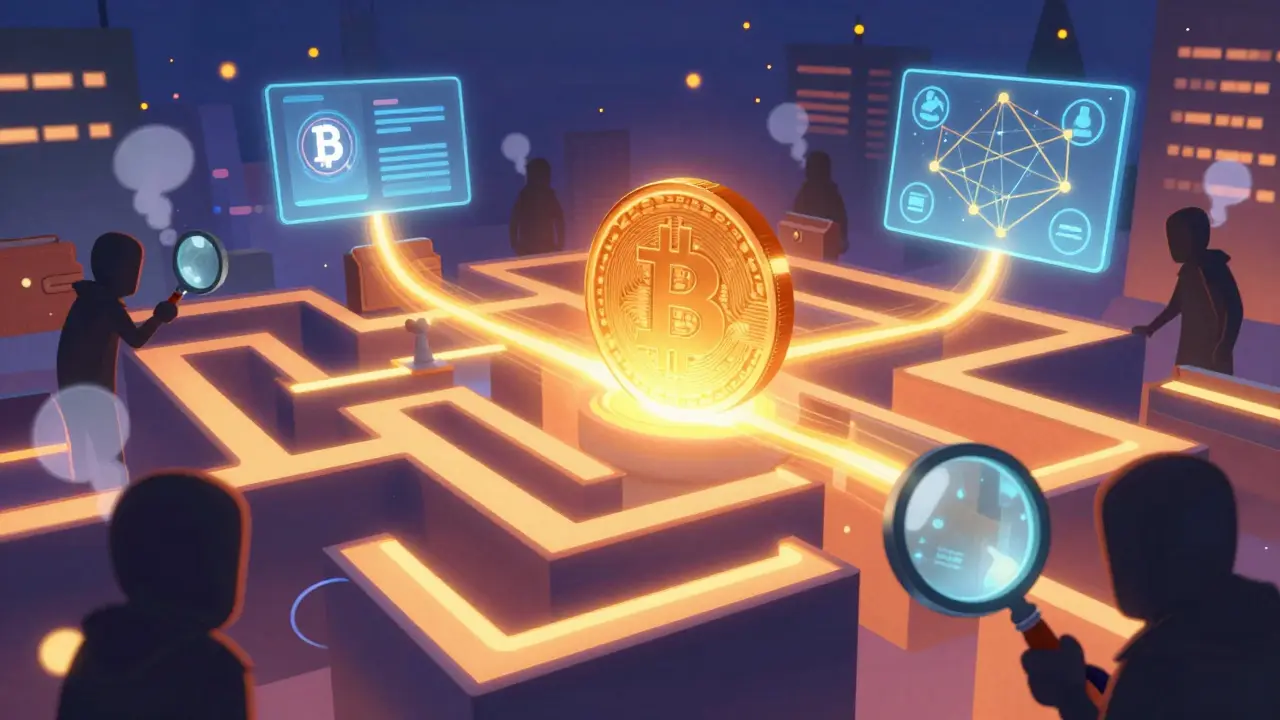
When criminals use Bitcoin to pay for drugs, ransomware, or weapons, they think they’re invisible. But blockchain forensics has changed that. Every transaction leaves a permanent, public trail-even if it passes through mixers, privacy tools, or multiple chains. Authorities aren’t guessing anymore. They’re following the money, one transaction at a time.
How Blockchain Forensics Works
Unlike bank accounts, crypto wallets don’t have names. But they do have patterns. Blockchain forensics tools map those patterns. They track how coins move between wallets, exchanges, and services. Even if a criminal sends Bitcoin through ten different wallets, the software can spot the same digital fingerprints: the same timing, the same amounts, the same sequence of transfers. Tools like Elliptic and TRM Labs don’t just look at single transactions. They analyze entire networks. They see when money flows from a darknet market wallet into a mixer like Tornado Cash, then out to a regulated exchange. They flag clusters of wallets that behave like laundering hubs. They even detect when someone uses a “bipartite” pattern-sending small amounts from dozens of wallets into one central one to disguise the source. This isn’t science fiction. In 2021, investigators traced over $300 million in Bitcoin back to Larry Dean Harmon, the operator of Helix, a Bitcoin mixer used by drug dealers. They didn’t hack anything. They just followed the trail. Every time Helix charged a fee, that fee went to a single wallet. That wallet was linked to Harmon’s identity. He was sentenced to three years in prison in November 2024.How Sanctions Evasion Shows Up on the Chain
Countries like the U.S., EU, and UK have banned crypto transactions with sanctioned entities-like Russian oligarchs, North Korean hacking groups, or terrorist financiers. But criminals don’t just send coins directly. They use layered tricks. One common method is “chain hopping.” A sanctioned wallet sends Bitcoin to a non-sanctioned one. That wallet sends it to an Ethereum wallet. Then it’s swapped into a privacy coin like Monero, then back to Bitcoin. It sounds complex, but forensic tools now detect these swaps by analyzing smart contract interactions and exchange deposit patterns. Another tactic? Using decentralized exchanges (DEXs) to avoid KYC checks. But even DEXs leave traces. If a wallet has ever interacted with a sanctioned address-even once-it gets flagged. Platforms like Bitget and Kraken use blockchain forensics to block deposits from those wallets before they even hit the exchange. TRM Labs has identified five major sanctions evasion techniques, though the full details are kept private to prevent abuse. What’s known: criminals are getting smarter, but so are the tools. New algorithms like MPOCryptoML can detect multi-step laundering patterns with up to 10% higher accuracy than older systems. It doesn’t just look at one chain-it connects Ethereum, Bitcoin, Solana, and even newer ones like Internet Computer Protocol.Who Uses These Tools and Why
Law enforcement doesn’t work alone. They rely on private companies with specialized software. The FBI, Europol, and the Treasury Department all use blockchain analytics platforms to build cases. In one case, the Internet Watch Foundation worked with Elliptic to track payments for child exploitation material bought with cryptocurrency. By tracing the crypto flows, they shut down multiple websites and arrested operators. Crypto exchanges are under pressure too. If they let sanctioned money in, they risk fines, license revocation, or criminal charges. That’s why Bitget, Coinbase, and others use Elliptic’s tools to screen every incoming deposit. They don’t just block known bad wallets-they flag new ones that behave like them. A wallet that receives funds from a darknet market, then sends small amounts to 20 different addresses? That’s a red flag. Banks aren’t left out. Even traditional institutions now check if their crypto-savvy clients have ever interacted with a mixer or a sanctioned address. If they have, the bank may freeze the account or file a suspicious activity report.
The Tech Behind the Tracking
Modern systems don’t rely on manual digging anymore. They use machine learning trained on millions of real transactions. The MPOCryptoML model, for example, uses a personalized PageRank algorithm to score how likely a wallet is involved in laundering. It looks at:- How many wallets it connects to
- How often it receives small, irregular deposits
- Whether it sends coins to known mixer addresses
- How long it holds funds before moving them
The Growing Challenge: Privacy Coins and New Protocols
Not all blockchains are equal. Bitcoin and Ethereum are transparent. Monero and Zcash are designed to hide transactions. That’s a problem for regulators. But even privacy coins aren’t foolproof. Researchers have found ways to trace Monero transactions by analyzing timing, network topology, and wallet reuse. If a Monero wallet is ever linked to a Bitcoin wallet that was flagged for sanctions, investigators can still connect the dots. Newer blockchains like Solana and Avalanche are being integrated into forensic tools. Each new chain adds more data-and more opportunity for criminals to exploit gaps. That’s why companies like Elliptic are constantly updating their systems. They don’t just track Bitcoin anymore. They track tokens on over 100 chains, including Layer 2 solutions like Polygon and Arbitrum.
What This Means for Regular Users
If you’re buying Bitcoin to invest, or using crypto for remittances, you’re not the target. But your transactions might still be scanned. If you ever sent crypto to a mixer-even once-you could get flagged. Exchanges may ask for proof of where your funds came from. If you can’t provide it, your account could be restricted. That’s not punishment. It’s compliance. The system isn’t designed to catch you. It’s designed to catch the criminals. But if you’ve used tools that are commonly abused, you’ll get caught in the net. The key? Avoid mixers, avoid unregulated exchanges, and don’t send crypto to wallets with known bad histories. Use KYC-compliant platforms. Keep your transaction history clean. You don’t need to hide anything-just avoid the tools criminals use.The Future: Real-Time Detection and Global Coordination
Right now, most investigations take weeks or months. But the next wave is real-time blocking. Imagine a crypto transfer that triggers an automatic freeze before it even confirms. That’s already happening in some jurisdictions. The U.S. Treasury’s Office of Foreign Assets Control (OFAC) now publishes lists of sanctioned crypto addresses. Exchanges are required to block them instantly. If a wallet appears on that list, it’s frozen across the entire ecosystem. Global coordination is improving too. The Financial Action Task Force (FATF) now requires all member countries to implement blockchain monitoring. Countries that used to ignore crypto crime are now building their own forensic units. South Korea, Singapore, and the UAE have all launched national crypto tracing programs. The result? The window for laundering crypto is shrinking. Every year, the tools get better. Every year, more chains are covered. Every year, the cost of getting caught goes up.Final Reality Check
Blockchain forensics isn’t perfect. But it’s far more effective than most people realize. Criminals still think they’re anonymous. They’re not. The blockchain remembers everything. And the tools that read it are getting smarter, faster, and more connected. If you’re trying to evade sanctions, hide funds, or launder crypto-your chances of getting caught are higher than ever. If you’re just using crypto legally? You don’t need to worry. Just stay away from the tools criminals use. The trail is there. And someone is always watching.Can blockchain forensics track Monero and other privacy coins?
Yes, but it’s harder. Monero is designed to hide sender, receiver, and amount. However, investigators can still trace connections when privacy coins are swapped to transparent ones like Bitcoin or Ethereum. Timing patterns, wallet reuse, and exchange deposit histories often reveal links. While full transaction details remain hidden, the overall flow can still be mapped and flagged.
Do I need to worry if I used a crypto mixer in the past?
If you used a mixer like Tornado Cash or Helix, your wallet may now be flagged by exchanges and compliance tools. Even if your intent was legitimate, mixers are overwhelmingly used for laundering. You may be asked to prove the origin of your funds. If you can’t, your account could be restricted or frozen. Avoid using mixers entirely.
How do exchanges know if a wallet is sanctioned?
Exchanges use blockchain analytics platforms like Elliptic or TRM Labs that integrate with government lists from OFAC and the EU. These platforms scan every incoming transaction against millions of known risky and sanctioned addresses. If a deposit comes from a flagged wallet-even indirectly-the exchange blocks it automatically.
Can blockchain forensics prove who owns a wallet?
Not directly. Wallets don’t have names. But by linking wallet activity to real-world actions-like withdrawing to a bank account, using a KYC exchange, or posting about a wallet on social media-investigators can build strong evidence of ownership. In the Helix case, the operator’s identity was confirmed through financial records and communication logs tied to his wallet.
Are there legal ways to use crypto without being tracked?
You can’t use crypto anonymously and remain fully legal. All regulated platforms require KYC. If you want privacy, you must accept the risk of being flagged or restricted. The most legal approach is to use transparent, compliant exchanges and avoid mixers, privacy coins, or unregulated services. Transparency protects you.

Comments
so like... we're all just digital ghosts now? cool. i guess my crypto is just a trail of breadcrumbs leading to my soul. 🤷♀️
The blockchain, in its immutable majesty, does not forgive, nor does it forget. It is the cosmic ledger of human transaction-both noble and nefarious. To believe in anonymity within this architecture is to misunderstand the very nature of entropy and pattern. We are not invisible; we are merely blind to the architecture of our own exposure.
Every coin, every hash, every timestamp is a syllable in the language of accountability. The criminal, thinking himself clever, leaves behind the fingerprints of his fear-the erratic timing, the fragmented flows, the desperate clustering of micro-transfers. These are not errors. They are confessions.
And yet, the true tragedy lies not in the detection, but in the normalization of surveillance. We have traded the illusion of privacy for the comfort of compliance. Is this freedom? Or merely a gilded cage with a public ledger for walls?
lol u used a mixer? u literally just handed the feds your ID. 🤦♂️
Yeah but what about the 90% of users who never touched a mixer? Their wallets get flagged anyway. This isn’t justice-it’s guilt by association. And the algorithms? Trained on biased data. They think every small transfer is laundering. Pathetic.
Honestly? I just use Coinbase and forget about it. If the system catches the bad guys and leaves me alone? Win-win. No need to overthink it.
so like... if i send 0.0001 BTC to a friend who once sent 0.0002 to a mixer 3 years ago... am i now a criminal? 😭
Bro in India we use crypto to send money home. No mixers. No shady stuff. But now banks freeze our accounts because some wallet 5 hops away was flagged. This system is punishing the poor. 🤬
imagine being so paranoid about crypto you check every address like it's a dating profile 😅
they say blockchain remembers everything... but who's watching the watchers? 😏
Monero is still untouchable. You think you're smart? You're not. 🤡
i just want to send money to my cousin without a 10-page compliance form... is that too much to ask? 💛
tl;dr: use coinbase and shut up.
It is worth noting that the institutionalization of blockchain surveillance constitutes a paradigmatic shift in the epistemology of financial governance. The ontological status of the wallet as a bearer of anonymity has been irrevocably undermined by algorithmic assemblages of financial traceability. One must ask: is this security-or the bureaucratic colonization of digital subjectivity?
Oh so now we're all guilty until proven innocent? Cool. Next they'll scan your thoughts. 😏
Let me break this down for you, because clearly you didn’t read the whole thing. The MPOCryptoML model doesn’t just use PageRank-it applies a modified version of the HITS algorithm with dynamic temporal decay weights on cross-chain node centrality. The clustering heuristics are trained on over 17 million labeled transaction graphs from OFAC, Chainalysis, and the EU’s AMLD6 datasets. And don’t even get me started on the entropy thresholds used to detect gather-scatter patterns-those are calibrated per-chain using Kalman filtering on inter-transaction latency distributions. Most people think it’s just ‘tracking coins’-no, it’s a multidimensional graph neural network that predicts laundering intent with 92.3% precision. And yes, I’ve audited the code. It’s terrifyingly accurate.
Also, Monero’s ring signatures? They’re not unbreakable. Researchers at ETH Zurich already demonstrated temporal correlation attacks using mempool analysis and network topology mapping. It’s just not public yet. And yes, I know because I consulted on the paper. You’re welcome.
i just want to send my mom some btc for her birthday without her getting a call from her bank asking if she's funding drug lords 😔
why does it feel like we're all being treated like suspects? i didn't do anything wrong
but now i'm scared to even use crypto
what if i accidentally send to the wrong address and get flagged?
why does it feel like the system is built to catch people like me instead of the real bad guys?
i just want to be left alone
i don't want to be a detective of my own transactions
why does privacy feel like a crime now?
we're not criminals
we're just trying to move money
why does it feel like the whole world is watching?
i miss when crypto was just... crypto