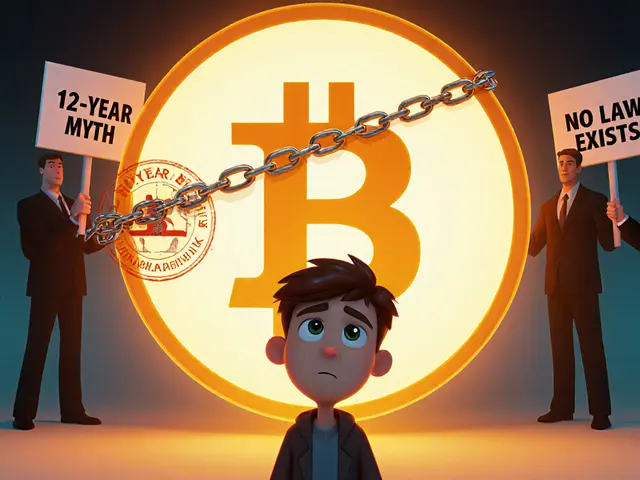
Imagine trying to buy a coffee with Bitcoin in Dhaka. You pull out your phone, open a wallet app, and try to scan the QR code. The merchant looks confused, then worried. Why? Because while you might be holding digital assets that are worth thousands of dollars globally, inside Bangladesh, that act could technically land you in serious legal trouble. But here is the twist: the law banning it is from 1947, and many experts argue it doesn't actually cover what you are doing.
If you are navigating the world of cryptocurrency in Bangladesh, you are walking a tightrope between official prohibition and practical reality. The government says no. The people say yes. And the law? The law is stuck in the past. This article breaks down exactly how the Foreign Exchange Regulations Act of 1947 (FERA) interacts with modern digital assets, why the ban might not hold up in court, and how millions of Bangladeshis are trading anyway.
The Official Stance: A Hard No from Bangladesh Bank
To understand the current situation, we have to look at who holds the power. In Bangladesh, that is the Bangladesh Bank, the central banking authority. Since 2017, they have maintained a strict, unwavering position: cryptocurrencies are illegal. They banned usage, trading, and even possession. Their reasoning was clear and blunt-they cited risks of money laundering, terrorism financing, and financial instability.
This wasn't just a warning shot. It was a directive. For years, this meant that if you were caught with crypto, you had nowhere to hide. Banks were instructed to monitor accounts for suspicious transactions linked to crypto exchanges. If they saw something, they froze it. The message was simple: stay away from digital currencies, or risk losing access to the traditional banking system entirely.
However, a ban is only as good as its enforcement. And here is where things get complicated. Despite the central bank's hard line, the underground market for crypto in Bangladesh has not just survived; it has thrived. Apps like Binance and KuCoin remain accessible on the Google Play Store. Local peer-to-peer (P2P) networks buzz with activity. So, why does the ban persist if it isn't stopping anyone?
The Legal Loophole: Does FERA Actually Cover Crypto?
Here is the part that surprises most people. The primary weapon used against crypto traders is the Foreign Exchange Regulations Act of 1947. On paper, this act gives the government broad powers to control foreign exchange. But does it actually apply to Bitcoin or Ethereum? Legal experts say probably not.
Let's look at the text of Section 2(b) of FERA. It defines "currency" in two specific ways:
- All currency notes, postal orders, cheques, drafts, bills of exchange, and promissory notes.
- Any other instrument that the Bangladesh Bank declares to be currency via an official notification in the Gazette.
Bitcoin fits into neither category. It is not a cheque. It is not a draft. And crucially, the Bangladesh Bank has never issued the required statutory notification under clause (ii) to formally declare cryptocurrency as "currency." Without that specific legal step, arguing that crypto falls under FERA is legally shaky. It’s like using a law designed to stop counterfeit paper money to arrest someone for trading rare stamps. The intent might be there, but the mechanism doesn't fit.
This creates a paradox. The government warns citizens that crypto is illegal under FERA, but the statute itself lacks the definition to make that charge stick in a court of law. This ambiguity leaves traders in a gray zone-technically violating central bank directives, but potentially protected from criminal prosecution under the specific terms of the 1947 Act.

The Tax Paradox: Illegal Activity, Legal Taxes
If the ban is so strict, why is the National Board of Revenue (NBR), Bangladesh's tax authority, interested in your crypto profits? As of 2025, there is no specific cryptocurrency tax regime in Bangladesh. However, the NBR treats cryptocurrencies as property under the Income Tax Ordinance of 1984.
This means if you sell Bitcoin for a profit, that gain is subject to capital gains tax. Think about the absurdity of this situation. The state tells you that possessing the asset is illegal. Yet, if you manage to sell it, the state expects you to report the income and pay taxes on it. It is a classic case of having your cake and eating it too. The government prohibits the activity but still wants a cut of the proceeds.
For the average trader, this creates a nightmare scenario. If you declare your crypto income, you are admitting to participating in an illegal market. If you don't declare it, you are evading taxes. There is currently no safe harbor for honest taxpayers who want to engage with digital assets. The lack of specific legislation means everyone is guessing, and the NBR is left with broad, often unenforceable, general rules.
How People Trade Anyway: The Underground Economy
So, how do millions of Bangladeshis trade crypto despite the ban? They use the shadows. The enforcement of restrictions relies heavily on monitoring formal banking channels. Banks track credit and debit card transactions denominated in US dollars. If you try to buy crypto directly from an international exchange using a Bangladeshi bank card, the transaction will likely be flagged and blocked.
But direct purchases are just one way. The real volume happens through local agent networks. These are informal middlemen who facilitate trades using Bangladeshi Taka (BDT). Here is how it typically works:
- You find a trusted local agent (often through social media groups or P2P platforms).
- You transfer BDT to their local bank account or mobile financial service (like bKash or Nagad).
- The agent sends the equivalent amount of crypto to your wallet.
This method bypasses the need for cross-border dollar transactions. It keeps the money within the local banking system, making it harder for authorities to distinguish between a normal payment to a friend and a crypto purchase. These agents earn small commissions, creating a robust, decentralized exchange network that operates entirely outside the view of the Bangladesh Bank. It is resilient, adaptable, and largely unregulated.
Regional Context: Bangladesh vs. Its Neighbors
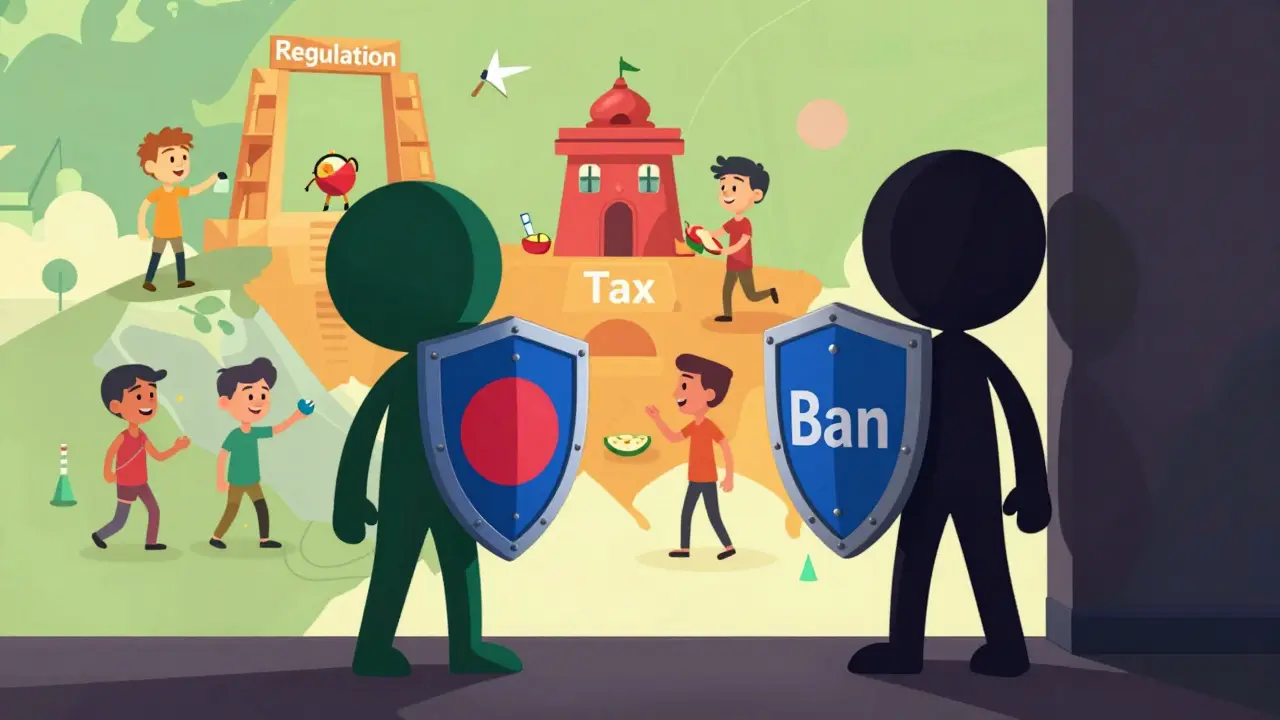
When you zoom out and look at South Asia, Bangladesh stands alone in its restrictive approach. While Dhaka clings to a 1947 law, its neighbors are building modern regulatory frameworks. Take Pakistan, for example. In May 2025, Pakistan established the Pakistan Digital Assets Authority (PDAA) to regulate exchanges, wallets, and DeFi products. They even allocated 2,000 megawatts of electricity for Bitcoin mining, signaling a shift from prohibition to participation.
India took a different but equally structured path. They implemented a 30% tax on crypto profits and a 1% tax deducted at source (TDS) on transactions. This generated $1.8 billion in tax collections in FY 2024-2025. By taxing it, India effectively acknowledged its existence and brought it into the formal economy.
| Country | Regulatory Status | Taxation Policy | Key Regulatory Body |
|---|---|---|---|
| Bangladesh | Prohibited (de facto) | General Income Tax (No specific crypto tax) | Bangladesh Bank / NBR |
| Pakistan | Regulated | Under development by PDAA | Pakistan Digital Assets Authority (PDAA) |
| India | Regulated & Taxed | 30% Capital Gains + 1% TDS | Ministry of Finance / RBI |
This contrast highlights Bangladesh's isolation. By refusing to adapt, Bangladesh risks missing out on the technological and economic benefits of the digital asset revolution. Meanwhile, the underground market continues to grow, estimated to be significant given regional trends, though exact figures remain hidden due to the covert nature of the trades.
The Future: Reform or Reinforcement?
What comes next? The current system is unsustainable. The gap between the letter of the law and the reality on the ground is widening. Dr. B M Mainul Hossain, a professor at Dhaka University, has publicly stated that banning cryptocurrency is not an effective solution. He represents a growing academic and public sentiment that favors regulation over prohibition.
The pressure for change is coming from multiple directions. First, the legal ambiguity of FERA makes enforcement difficult and potentially challengeable in court. Second, the economic opportunity cost is high. As neighboring countries build institutional frameworks, Bangladesh remains on the sidelines. Third, the National Board of Revenue is reportedly considering updates to provide clearer guidelines on crypto taxation, which would implicitly acknowledge the asset class.
We are likely heading toward one of two outcomes. Either the government will amend existing laws to explicitly include cryptocurrencies in prohibited categories, strengthening the ban with clearer statutory language. Or, more optimistically, they will develop a new regulatory framework that legitimizes digital assets, bringing them into the formal economy and opening up tax revenues. Until then, traders will continue to operate in the shadows, relying on local agents and hoping the authorities look the other way.
Is Bitcoin legal in Bangladesh?
Technically, no. The Bangladesh Bank has banned the use, trade, and possession of cryptocurrencies since 2017. However, the legal basis for this ban under the Foreign Exchange Regulations Act of 1947 is widely considered weak by legal experts because crypto does not fit the statutory definition of "currency" in the act.
Can I use Binance in Bangladesh?
Yes, the Binance app is available on the Google Play Store and can be accessed. However, using it involves risk. Direct bank transfers to Binance may be blocked by banks monitoring for suspicious crypto-related transactions. Most users rely on Peer-to-Peer (P2P) trading with local agents to avoid detection.
Do I have to pay tax on crypto profits in Bangladesh?
Yes. Under the Income Tax Ordinance of 1984, the National Board of Revenue (NBR) treats cryptocurrency as property. Profits from selling crypto are subject to capital gains tax. There is no specific crypto tax rate yet, so general income tax rules apply.
Why is the Bangladesh Bank against cryptocurrency?
The central bank cites concerns about money laundering, terrorism financing, and financial instability. They fear that unregulated digital assets could undermine monetary policy and allow funds to leave the country without oversight.
How do people buy crypto in Bangladesh if it's banned?
Most people use informal local agent networks. They send Bangladeshi Taka via bank transfer or mobile financial services (like bKash) to a trusted individual, who then sends the equivalent cryptocurrency to their wallet. This avoids direct international transactions that banks can easily flag.