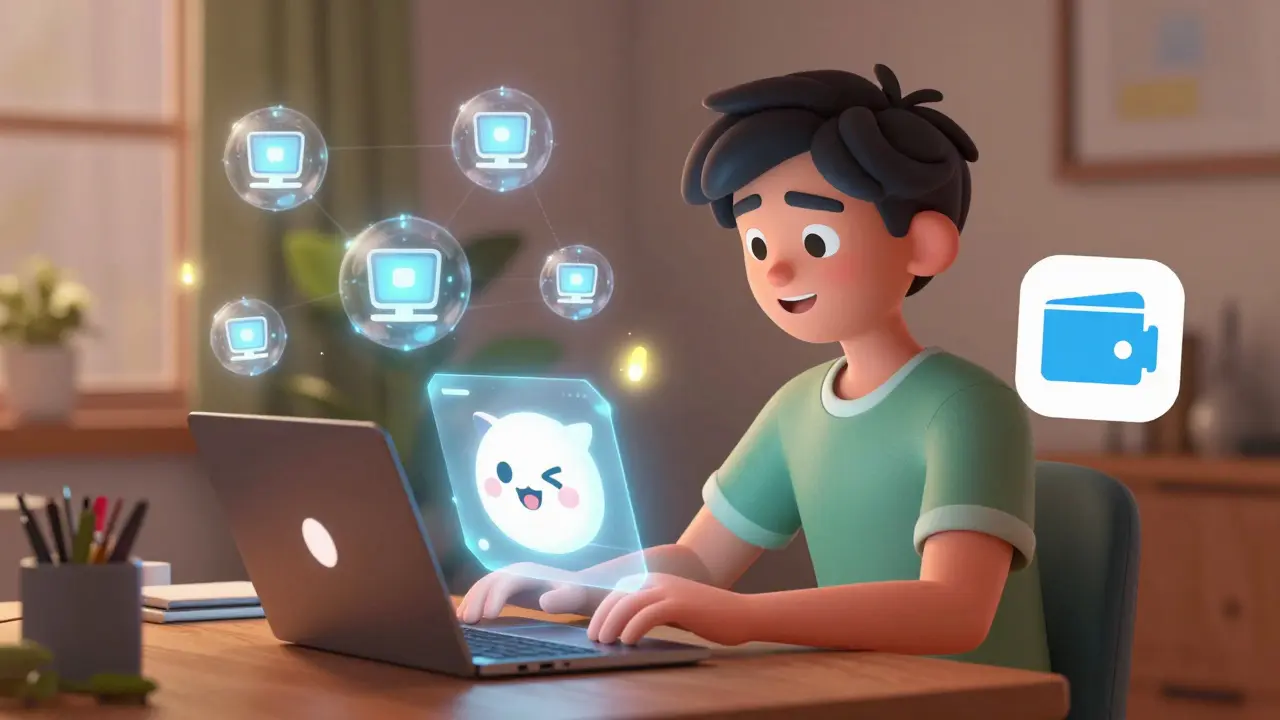
Most apps you use every day - Facebook, Instagram, Uber - run on servers owned by companies. Those companies control everything: your data, your money, even whether you can use the app. DApps change that. They don’t rely on a single company. Instead, they run on blockchains - networks of thousands of computers all working together. No one owns them. No one can shut them down. And you, the user, keep control of your own data and money.
What Makes a DApp Different?
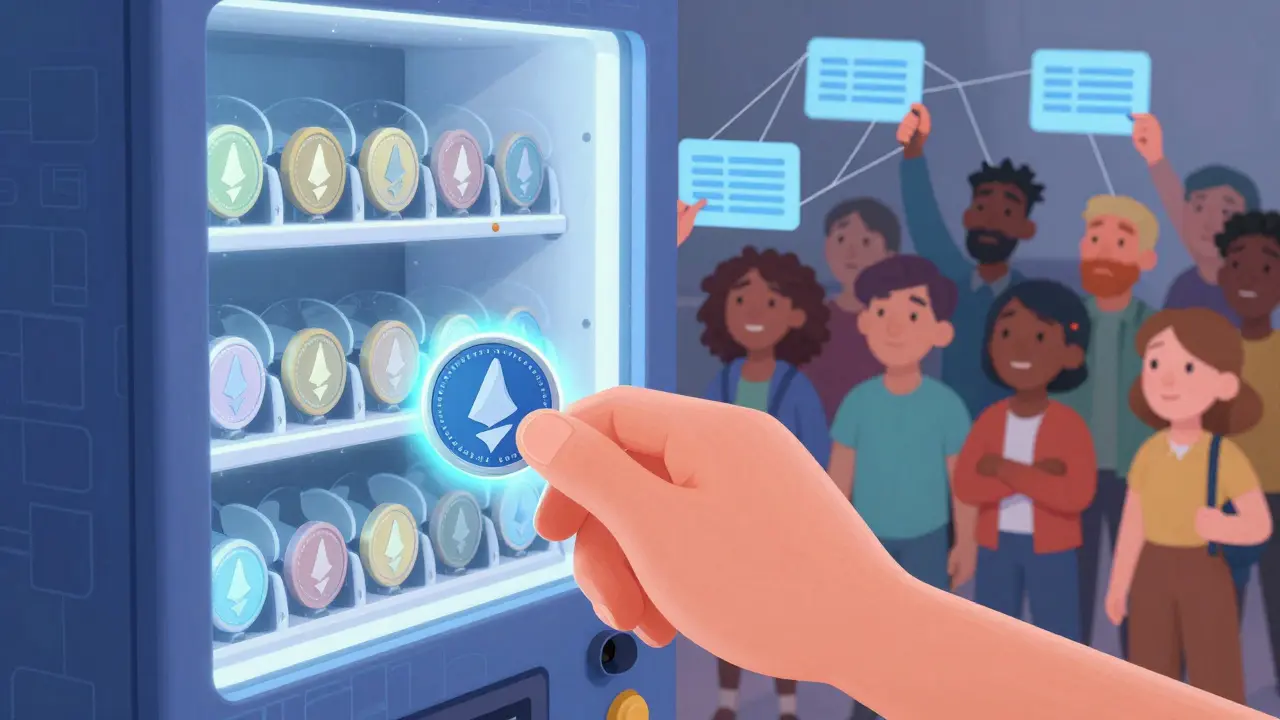
A regular app talks to a server. That server stores your info, runs the logic, and decides what happens. A DApp? It talks to a blockchain. The logic isn’t on a server. It’s in smart contracts - pieces of code stored directly on the blockchain. These contracts run automatically when certain conditions are met. No middleman. No human approval. If you send $100 to a DApp to buy a token, the code checks your wallet balance, confirms the transaction, and sends the token - all in seconds.Think of it like a vending machine. You put in cash, pick your snack, and the machine gives you the item. No clerk. No store manager. Just rules written into the machine. Smart contracts work the same way. They’re programmed to follow rules, and once they’re on the blockchain, they can’t be changed. That’s what makes them trustworthy.
How DApps Are Built: Frontend + Smart Contracts
A DApp looks like any other app. You open it in your browser or phone. You click buttons. You see a dashboard. But behind the scenes, it’s completely different. The user interface (what you see) is usually built with regular web tools - HTML, JavaScript, React. But instead of connecting to a company’s server, it connects to a blockchain through a wallet like MetaMask.The real magic happens in the smart contracts. Most DApps run on Ethereum, which uses the Ethereum Virtual Machine (EVM). This is like a global computer that every node on the Ethereum network runs. When you interact with a DApp, your action gets turned into a transaction. That transaction is sent to the EVM, where the smart contract executes it. Every node checks the result. If they all agree, it’s added to the blockchain. That’s how trust is built - not by a company saying "it’s safe," but by thousands of computers independently verifying the same thing.
How Transactions Get Verified: Proof of Stake
Before 2022, Ethereum used Proof of Work (PoW), where miners solved complex math problems to add blocks. It was slow and used massive amounts of electricity. In September 2022, Ethereum switched to Proof of Stake (PoS) - a system called "The Merge." Now, instead of mining, validators lock up (or "stake") ETH to help verify transactions. If they act honestly, they earn rewards. If they cheat, they lose their stake.This change made DApps on Ethereum much more efficient. Energy use dropped by over 99%. Transaction speeds improved. And because validators have real money at risk, the network became more secure. Today, every time you swap tokens on Uniswap or lend crypto on Aave, you’re using a system where trust comes from economic incentives, not brute-force computing.
Why DApps Are Powerful - and Where They Fall Short
DApps offer real advantages. First, they’re transparent. Every transaction is on a public ledger. You can look up any wallet’s history. Second, you own your data. No company is collecting your browsing habits or selling your info. Third, they’re censorship-resistant. If a government tries to block a DApp, it can’t - because there’s no single point to shut down.But they’re not perfect. Scalability is still a problem. Ethereum’s base layer can only handle 15-30 transactions per second. Visa handles 24,000. That’s why DApps like Uniswap and OpenSea use Layer 2 solutions - side networks like Optimism and Arbitrum - that bundle hundreds of transactions into one on-chain update. These can hit 2,000-4,000 TPS, making them usable for real applications.
Then there’s the user experience. You need a wallet. You need to understand seed phrases. You need to pay gas fees - small amounts of ETH to process transactions. In May 2022, gas fees spiked to $50 per transaction. That made small trades impossible. Even today, fees average $1-$2. For a $5 purchase, that’s too much. The Dencun upgrade in March 2024 cut Layer 2 costs by 90%, which is a big step forward.
Security Risks: The Dark Side of Smart Contracts
Smart contracts are code. And code has bugs. In 2022, the Wormhole bridge hack stole $320 million because of a flaw in the contract’s validation logic. In 2023, over $1.8 billion was lost across DApps due to hacks and exploits, according to Immunefi. These aren’t random errors - they’re often simple mistakes: missing checks, poor input validation, or logic flaws that hackers find and exploit.Unlike a bank, where you can call customer service to reverse a mistake, DApp transactions are final. If you send ETH to the wrong address? Gone. If you approve a malicious contract? Your funds can be drained. There’s no undo button. That’s why experienced users always check contract addresses, use trusted interfaces, and never sign random approval requests.

Where DApps Actually Work - and Where They Don’t
DApps shine in areas where trust, transparency, and automation matter most. In DeFi (decentralized finance), platforms like Aave and Compound let you lend and borrow crypto without banks. In 2023, Uniswap processed over $1.1 trillion in trades. In supply chains, VeChain tracks luxury goods from factory to store, proving authenticity with blockchain records. NFTs like CryptoPunks - digital collectibles - prove ownership on-chain, with one collection valued at over $1.3 billion.But they fail where speed and low cost are critical. Real-time multiplayer games? Too slow. Video streaming? Too expensive. Online shopping with small purchases? Gas fees kill it. DApps aren’t meant to replace every app. They’re meant to replace apps where central control is the problem - finance, identity, ownership, and voting.
The Future: What’s Coming Next
The biggest hurdle for DApps isn’t technology - it’s usability. Most people still don’t understand seed phrases or gas fees. That’s changing. EIP-4337, rolled out in 2023, introduces "account abstraction." This lets users log in with email or social accounts instead of managing private keys. Wallets are getting smarter. Soon, you might not even know you’re using a DApp.Ethereum’s full sharding upgrade - planned for 2025 - could push throughput to 100,000 transactions per second. That’s more than Visa. And with Layer 2s now handling most traffic, costs are falling. The DApp market is growing fast - from $5 billion in 2021 to $19.4 billion in 2023, and projected to hit $58.9 billion by 2026.
Still, experts warn that 70% of current DApps won’t survive. Many are just crypto gimmicks. The winners will be the ones that solve real problems - not just add blockchain for show. The goal isn’t to replace the internet. It’s to fix its broken trust model.
Who Uses DApps Today?
Most DApp users are technical. CoinGecko’s 2023 report found 78% have programming experience. That’s not a surprise. Using a DApp still feels like using a tool, not a service. But that’s changing. As wallets get simpler, as fees drop, and as more people see real value - like earning $47,000 in passive income from Aave’s liquidity pools - adoption will grow. The next wave won’t be crypto enthusiasts. It’ll be regular people who just want to own their money, their data, and their digital stuff - without asking permission.Are DApps the same as cryptocurrencies?
No. Cryptocurrencies like Bitcoin and Ethereum are digital money. DApps are software applications that run on blockchains - often using cryptocurrencies to function. For example, Uniswap is a DApp that lets you trade ETH and other tokens. The token is the currency; the DApp is the platform that lets you use it.
Can I use DApps without a crypto wallet?
Not yet, not easily. Most DApps require a wallet like MetaMask to sign transactions and prove you own your funds. But new systems like account abstraction (EIP-4337) are making it possible to log in with email or social media. This is still early, but it’s the direction everything is heading.
Why are DApp transaction fees so high sometimes?
Fees go up when the blockchain is busy. On Ethereum, everyone competes to have their transaction processed first. During NFT drops or major token launches, demand spikes and fees can jump to $50 or more. Layer 2 networks like Arbitrum and Optimism solve this by handling transactions off-chain and batching them onto Ethereum, cutting costs by 90% or more.
Are DApps safe to use?
They can be, but only if you’re careful. The blockchain itself is secure, but smart contracts can have bugs. Always check the contract address, use trusted DApp interfaces, and never approve random transactions. Never share your seed phrase. Treat your wallet like a bank account - because it is.
What’s the difference between Ethereum and other blockchains for DApps?
Ethereum is the oldest and most used platform for DApps, with over 56% of all active DApps. It has the largest developer community and the most tools. But it’s slower and more expensive than newer chains like Solana or BNB Chain, which offer faster speeds and lower fees. The trade-off is security and decentralization - Ethereum’s network is larger and more battle-tested.
Can I build my own DApp?
Yes, but it’s not easy. You need to learn Solidity (Ethereum’s smart contract language), understand blockchain basics, and know how to connect a frontend to a wallet. Development takes 3-6 months for a basic DApp and costs $50,000-$500,000. Most fail within 18 months due to lack of users or funding. Start by building on testnets, using tools like Remix IDE and Hardhat, and joining developer communities on Discord or GitHub.
Comments
bro this is actually the first time i’ve understood how dapps work without my brain hurting 😅 i used to think it was just crypto magic but the vending machine analogy? chef’s kiss. now i get why people are so hyped.
okay but let’s be real-90% of dapps are just scammy token farms with a fancy frontend. you think this ‘trustless’ system is safe? last year over $1.8B vanished because people clicked ‘approve’ without reading. lol.
they don’t want you to know this but the ‘merge’ was just a distraction. the feds are secretly running 70% of the validators. they control the chain through backdoors in the evm. you think gas fees are high now? wait till they start charging for ‘thought transactions’.
easy to say dapps are good but in india, internet is slow and data is expensive. how i pay $2 fee for $5 trade? not make sense. need better tech for poor people.
oh wow, so we’re supposed to believe that a decentralized system is more secure than a bank? how quaint. America built the internet for a reason. Let’s not replace it with some hacker’s weekend project.
let’s not romanticize this. smart contracts aren’t magic-they’re brittle, poorly audited, and written by 19-year-olds who learned solidity from a youtube video last week. the fact that people are risking life savings on code that hasn’t been reviewed by a single professional is the real tragedy here. and don’t even get me started on the ‘account abstraction’ hype train-it’s just wallet UX lipstick on a pig.
i tried using a dapp last month and it was wild. i lost $12 on gas and didn’t even get the nft. but i still think it’s cool. maybe one day it’ll be easy for everyone.
soooo… dapps are basically the crypto version of ‘trust me bro’? 🤡 i’m just waiting for the first one to be used to sell fake diplomas from ‘stanford blockchain university’ 😭
the technology is promising. but for adoption to grow, we must focus on education and simplicity. users need clear guidance, not technical jargon. start with small use cases and build trust slowly.
they say ‘no one owns it’ but who really controls the validators? who wrote the code? who gets to upgrade the contracts? this isn’t freedom-it’s just a new kind of control. and don’t tell me about decentralization. i’ve seen the wallets. they’re all connected to the same 5 dev teams.
really appreciate this breakdown. i was skeptical but now i see how dapps could help people in places with corrupt banks. if we can fix the fees and make wallets less scary, this could change everything. keep going!
It is imperative to note that the foundational architecture of blockchain-based decentralized applications remains fundamentally incompatible with the regulatory frameworks of sovereign nations. The notion of ‘censorship resistance’ is not a virtue-it is an existential threat to civil order and financial integrity.
bro i was skeptical too but i started using aave last year and now i make more from lending than my day job. yeah gas was wild at first but after dencun? it’s like $0.10 per swap. you don’t need to be a coder. just use trusted apps, keep your seed phrase safe, and you’re golden. this is the future and it’s already here.
interesting read. i’ve used a few dapps and the transparency is refreshing. even if it’s not perfect, it’s a step in the right direction. hope the UX keeps improving.
they call it innovation but it’s just chaos with a blockchain sticker. people lose money because they’re too lazy to read contracts. that’s not freedom-that’s negligence. and the ‘dencun upgrade’? more marketing spin. the problems are still there.
usa built the internet, america built the financial system, and now you want to replace it with some guy’s github repo? get real. dapps are a toy for rich tech bros. real people need banks, not crypto wallets.
YES! finally someone gets it 😊 the fact that you own your data? that’s LIFE-CHANGING. i used to hate how facebook sold my pics, now i just use a dapp to post and no one owns it. 🌟 also, dencun was a game changer, low fees = more people 💪
you think you’re safe? every dapp you use is secretly tracking your wallet activity and selling it to hedge funds. they don’t need your name-they have your entire financial history. and you’re just sitting there approving everything like a sheep. wake up.
the real issue isn't the tech its the people who think they can just click approve and be rich. if you dont know what a smart contract is you shouldnt be touching dapps. its not rocket science but you need to care enough to learn
we’re not just building apps-we’re rewriting the soul of capitalism. dapps are the first step toward a post-scarcity, post-hierarchy world where value is created by community, not corporate greed 🌌✨ your wallet isn’t just a tool-it’s your digital soul. and yes, i cried when i first sent my first tx. it was beautiful.