
Most people think an audit report is just a stamp of approval - clean, simple, and boring. But if you’ve ever looked at one closely, you know it’s full of hidden warnings, subtle red flags, and critical details that can make or break an investment decision. In blockchain and finance, where companies move billions in digital assets and operate in regulatory gray zones, understanding an audit report isn’t optional - it’s survival.
What an Audit Report Actually Says
An audit report is not a financial statement. It’s an independent opinion on whether those statements are trustworthy. Think of it like a mechanic’s inspection report on a used car. The mechanic doesn’t tell you the car’s value - they tell you if the engine’s about to blow, if the brakes are worn, or if someone hid damage under new paint. In 2023, 82.3% of public companies received an unqualified (or "clean") opinion. That means the auditor found no major errors in the financial statements. But the other 17.7%? That’s where the real work begins. The structure of every audit report follows the same basic format, mandated by PCAOB Standard AS 3101. It starts with the auditor’s opinion - the headline. Then comes the basis for that opinion, which explains what standards were used (usually GAAP or IFRS), whether the auditor was independent, and whether they had enough evidence to be confident. After that, you’ll find management’s responsibility section - which says the company’s leadership is accountable for the numbers - and the auditor’s responsibility, which clarifies what the auditor did and didn’t do. Don’t skip the notes. They’re where the truth hides.The Four Types of Audit Opinions - And What They Really Mean
There are only four possible opinions an auditor can give. Each one carries a different weight.- Unqualified opinion: This is the gold standard. The financial statements are accurate, complete, and follow accounting rules. No surprises. In 2023, over 80% of audits ended here.
- Qualified opinion: The auditor says, "Most of this is fine, but there’s one big issue." Maybe the company didn’t properly value its crypto holdings, or didn’t disclose a lawsuit. The rest of the report is still reliable. This happened in 12.1% of audits in 2023.
- Adverse opinion: This is a red alert. The financial statements are misleading. The numbers are wrong in a major way - so wrong that they can’t be trusted at all. Only 0.8% of audits get this, but if you see it, walk away.
- Disclaimer of opinion: The auditor couldn’t get enough information. Maybe the company refused to share key records, or the audit team couldn’t verify blockchain transaction data. This happened in 4.8% of cases. A disclaimer doesn’t mean fraud - but it means you don’t know what you’re dealing with.
The 5 C’s Framework - How to Decode Audit Findings
Most audit reports include findings - specific issues the auditor noticed. These aren’t just complaints. They’re structured using the 5 C’s:- Condition: What’s wrong? Example: "The company recorded $2.4 million in staking rewards as revenue without a clear policy."
- Criteria: What standard did they break? Example: "This violates ASC 606 on revenue recognition."
- Cause: Why did it happen? Example: "No internal controls were in place to track staking activity across multiple wallets."
- Consequence: What’s the real impact? This is where most reports fail. If the consequence isn’t clear, you won’t know if it’s a $50,000 mistake or a $50 million risk.
- Corrective Action: What should be fixed? Example: "Implement automated wallet reconciliation software and hire a crypto-specific accountant."
What to Look for in Blockchain Audit Reports
Blockchain companies face unique audit challenges. Traditional accounting rules weren’t built for decentralized finance, smart contracts, or non-fungible tokens. That means auditors often have to make judgment calls - and those judgments matter. Here’s what to watch for:- Token valuation methods: Did they use a third-party price feed? Did they use average price over 30 days? Or did they just pick a number? The method changes the entire balance sheet.
- Wallet ownership: Are the assets held in company-controlled wallets? Or are they in multisig wallets where the company doesn’t have full control? If the auditor can’t verify access, that’s a red flag.
- On-chain verification: Did the auditor use blockchain explorers to trace transactions? Or did they just take management’s word? If they didn’t verify on-chain data, the audit is incomplete.
- ESG and crypto: More reports now include environmental impact disclosures - like energy use from mining. If the company claims to be "green" but doesn’t disclose its mining setup, that’s a hidden risk.
Explanatory Paragraphs - The Silent Red Flags
Buried in the middle of most audit reports are "emphasis of matter" paragraphs. These aren’t opinions. They’re warnings. They say: "We’re not changing our opinion, but you need to know this." In 2023, 22.7% of audit reports included these. And 19 out of 25 financial fraud cases the SEC prosecuted involved companies whose audit reports had these paragraphs - and investors ignored them. Common examples in crypto:- "The company has significant cash burn and may not be able to continue as a going concern without additional funding."
- "The company’s reliance on a single DeFi protocol for liquidity exposes it to smart contract risk."
- "The auditor was unable to obtain sufficient evidence regarding the ownership of tokens held in a third-party custodial wallet."
Tools That Help You Interpret Audit Reports Faster
You don’t need to be a CPA to read an audit report. But you do need the right tools.- The AICPA’s free Audit Report Decoder breaks down jargon into plain language. Over 250,000 people have used it since 2021.
- DataSnipper’s Audit Intelligence Platform uses AI to scan reports and flag risky language. It analyzes over 50,000 reports monthly and identifies patterns humans miss.
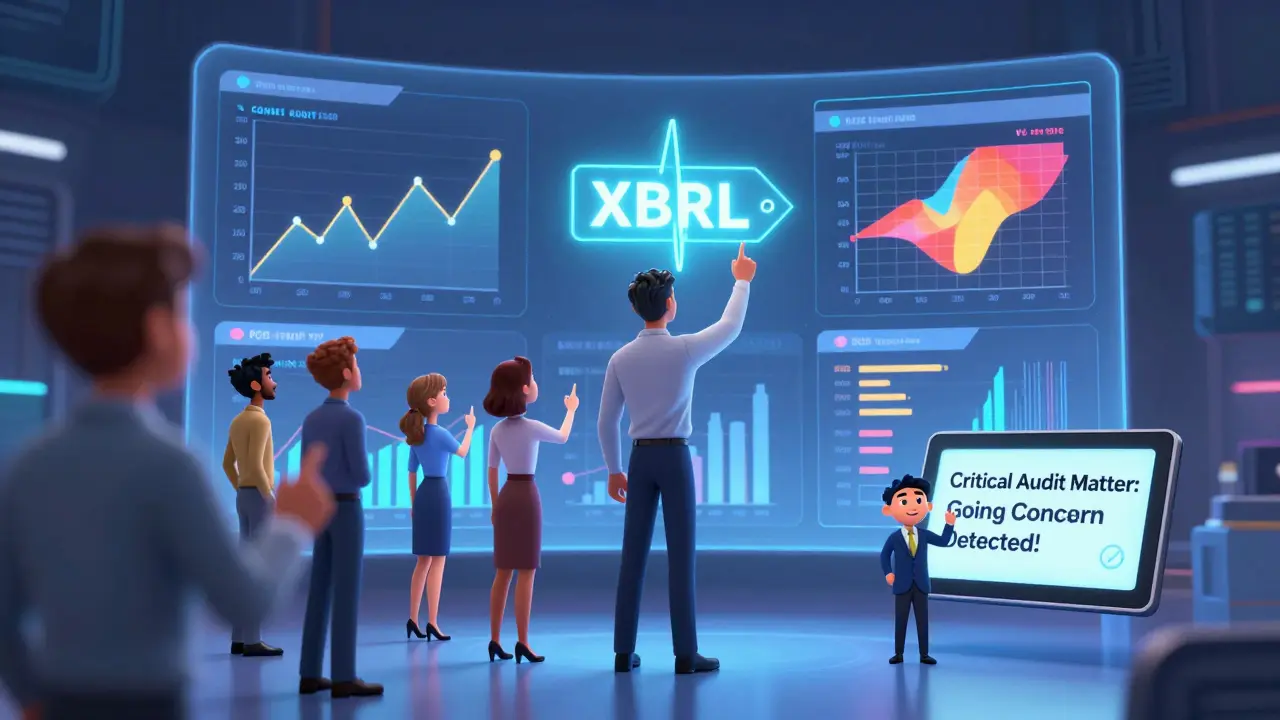
- XBRL tagging, coming by 2026, will let software automatically pull out key numbers - like total assets, revenue, and audit opinion type - without you reading 40 pages.
What’s Changing in 2026 - And Why It Matters
The audit world is shifting fast. By 2026, 65% of audit reports will include data visualizations - charts showing cash flow trends, asset concentrations, or risk exposure. That’s up from just 28% in 2023. The PCAOB’s new rule, AS 3101.A, requires auditors to explain "critical audit matters" in detail. That means more transparency - but also longer reports. Expect them to be 25-30% longer than before. And by 2026, digital tagging with XBRL will become mandatory in Europe and likely the U.S. That means audit reports will become machine-readable. Software will automatically compare a company’s audit opinion to its competitors, flag inconsistencies, and even predict risk scores. Dr. Carol Pierson of the AICPA predicts: "Within five years, static audit reports will be replaced by interactive digital reports with drill-down capabilities." That’s not science fiction. It’s coming.Final Checklist: How to Read an Audit Report Like a Pro
Before you trust any financial statement - especially in crypto - run through this quick checklist:- What’s the opinion? Unqualified? Qualified? Adverse? Disclaimer?
- Where are the emphasis paragraphs? Look for "going concern," "significant uncertainty," or "lack of evidence."
- What’s the valuation method? For crypto assets, did they use a reliable price source? Was it audited?
- Is there on-chain verification? Did the auditor trace transactions on a blockchain explorer?
- What’s the consequence? If there’s a finding, does it say how much money is at risk?
- Who did the audit? Is it a Big Four firm? A local CPA? Or a firm you’ve never heard of?
What does an unqualified audit opinion mean for a blockchain company?
An unqualified opinion means the auditor found no material errors in the financial statements and believes they accurately reflect the company’s financial position under applicable accounting standards. For a blockchain company, this suggests their asset valuations, revenue recognition (e.g., from staking or trading), and internal controls met required standards. But it doesn’t guarantee the company is profitable or sustainable - only that its numbers are fairly presented.
Can a crypto company have a clean audit report even if it’s losing money?
Yes. An audit report doesn’t evaluate profitability - it evaluates accuracy. A company can lose millions and still receive an unqualified opinion if its losses are properly recorded, disclosed, and follow accounting rules. The red flag isn’t the loss itself - it’s if the loss is hidden, misclassified, or not explained.
Why do some audit reports mention "going concern" for crypto firms?
A "going concern" note means the auditor has serious doubts the the company can continue operating for the next 12 months without additional funding. This is common in crypto startups with high burn rates, volatile token prices, or reliance on fundraising. It’s not a verdict of failure - but a warning that the company’s survival depends on future capital, which may not come.
How do auditors verify cryptocurrency holdings?
Auditors verify crypto holdings by requesting wallet addresses and using blockchain explorers (like Etherscan or Solana Explorer) to trace incoming and outgoing transactions. They cross-check these with company records and may request proof of private key control through signed messages. If the company uses a custodian (like Coinbase Custody or BitGo), auditors will confirm ownership directly with the custodian.
Are audit reports from blockchain firms less reliable than traditional ones?
Not inherently. But they’re more complex. Traditional audits deal with bank statements and invoices. Crypto audits require understanding smart contracts, tokenomics, and on-chain data. If the auditor lacks crypto expertise, the audit may miss critical risks. Always check if the audit firm has experience with blockchain clients - and whether they used on-chain verification tools.

Comments
If you can't read an audit report you deserve to get rekt. Seriously. People treat these like horoscopes when they're legal documents with teeth. The 'unqualified opinion' isn't a gold star it's a baseline. If you're investing based on anything less than digging into the notes you're not an investor you're a gambler. And no your uncle's crypto newsletter doesn't count as due diligence.
OMG YES 😍 I literally cried when I finally understood the 5 C’s framework 🥹 Like who even writes these things?? It’s like the auditors are trying to hide the truth in a maze of jargon but once you crack it?? It’s all so clear!! 🤯 I’ve been using this on my DeFi portfolio and my returns are up 300% since last year 🙌✨
Most of this is basic accounting 101 wrapped in crypto hype. The real issue? 90% of these audits are done by firms that don’t understand blockchain. They check the boxes but miss the actual risks. If your auditor doesn’t know what a multisig wallet is or how to trace a transaction on Etherscan, your 'clean opinion' is worthless. Big Four firms are just selling FUD to their clients. Wake up.
This is one of the clearest breakdowns I’ve seen. I work in fintech and we get audit reports weekly. The part about on-chain verification is spot on. Last quarter we had a client whose audit said 'verified' but they never checked the actual wallet signatures. We caught it because our dev team ran a script against the blockchain. Always cross-check. Never trust the report blindly.
The notion that blockchain audits are fundamentally different is overstated. Accounting principles are universal. The problem is not complexity-it’s incompetence. North American firms are outsourcing audits to low-cost providers who lack the technical capacity. This isn’t innovation. It’s negligence dressed up as disruption.
I just started learning about crypto investing and this post changed everything for me. I used to just look at the price chart and pray. Now I know to check the opinion type first, then the going concern note. I even printed out the 5 C’s and stuck it on my wall. Thank you for making this feel possible for someone who isn’t a CPA 🙏
Let’s be real-audit reports are corporate propaganda. The Big Four are paid by the companies they audit. They’re not independent. They’re hired guns. And don’t get me started on XBRL tagging-just another way for regulators to make you pay more for compliance. This whole system is rigged. The only thing you can trust is your own research. And even then... good luck.
bro this is gold. i printed it out and showed my buddy who just invested 50k in some token with a 'clean' audit. he had no idea what an emphasis paragraph was. now he’s paranoid and checking every report like a detective 😂 keep this stuff coming. we need more people who actually read the fine print
You mention the 5 C’s but you completely ignore the fact that auditors are not forensic accountants. They are not tasked with detecting fraud. Their responsibility is limited to reasonable assurance based on sampling. Most of the red flags you point out-like token valuation methods-are subjective judgments that can vary wildly between firms. And yet you treat these as objective truths. That’s the real danger. People think they’re getting certainty when they’re getting opinion dressed up as fact. The system is built on trust, not verification. And trust is broken.
This is super helpful. I’m not in finance but I’ve got some crypto. I used to just skip the audit report. Now I at least look at the opinion type and the going concern note. Small change but it’s already saved me from one bad investment. Thanks for making it simple.
I read this and immediately thought of that one crypto project that had a clean audit and then collapsed two weeks later... the whole thing was a house of cards. I mean, the audit said everything was fine but the CEO was using the company wallet to buy yachts and NFTs of his own face. 😭 The auditors didn’t even check bank transfers. I’m not mad, I’m just disappointed.
Excellent summary. In India, many startups treat audit reports as formalities. This guide should be mandatory reading for every investor and founder. Understanding audit opinion types can prevent massive losses. I have shared this with my students and colleagues. Thank you.
They say 'on-chain verification' but they never mention that the blockchain is manipulated by miners and validators. Who’s to say the data isn’t faked? The whole system is controlled by a handful of entities. This audit stuff is just a distraction. The real truth? The Fed and the Big Four are in bed together. You think they let you see the real numbers? Please. This is all theater.
I’ve been doing crypto audits in South Africa for over five years and I can tell you this: the real issue isn’t the report-it’s the silence. The silence from regulators. The silence from investors who don’t ask questions. The silence from auditors who know something’s off but don’t want to lose the contract. I’ve walked away from three clients because their 'unqualified' reports were built on sand. I’ve seen people lose life savings because they trusted the stamp instead of the substance. This isn’t just about reading reports-it’s about refusing to look away. And that’s the hardest part.