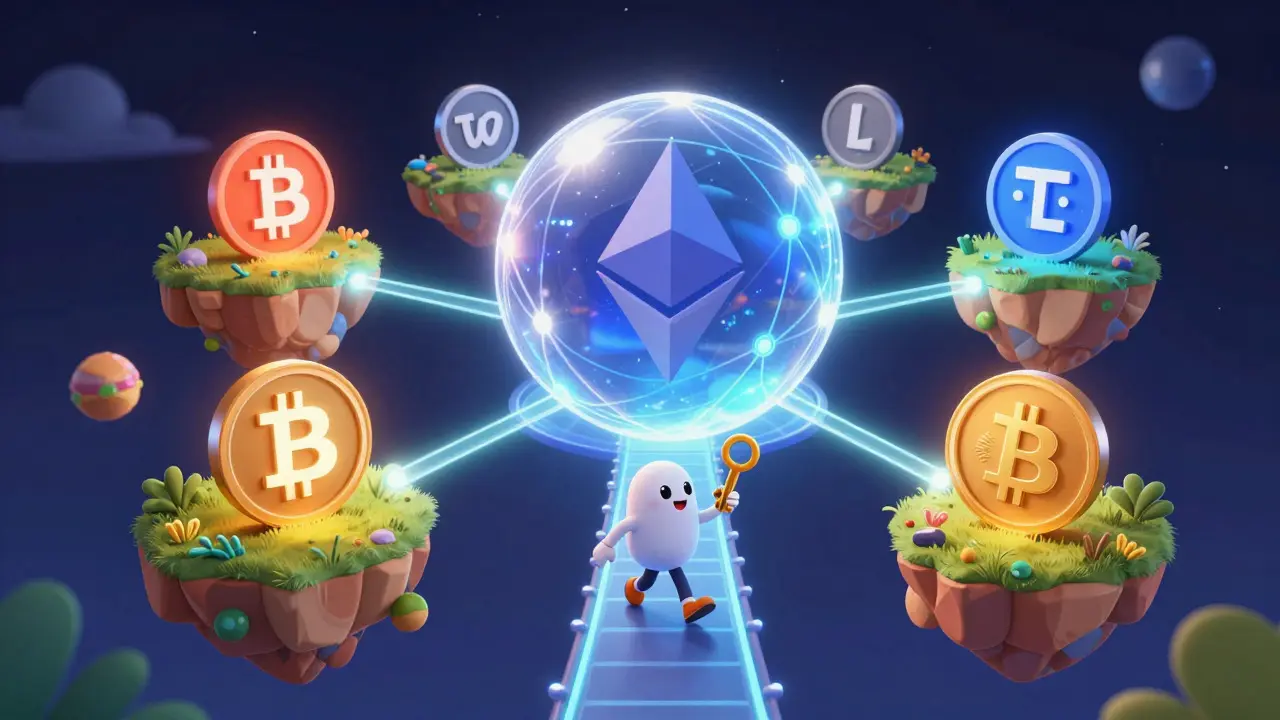
Imagine swapping Bitcoin for Ethereum without wrapping your assets or trusting a centralized exchange to hold your keys. That is the core promise of THORChain, a decentralized and autonomous cross-chain liquidity network that enables native cryptocurrency swaps across multiple blockchain networks without requiring wrapped assets or centralized intermediaries. Unlike traditional bridges that create synthetic tokens, THORChain uses its native settlement asset, RUNE, to facilitate direct exchanges between chains like Bitcoin, Ethereum, BNB Chain, Dogecoin, Litecoin, and Bitcoin Cash.
If you are looking at the BEP20 version specifically, you are likely interacting with the protocol via the BNB Smart Chain, where it was initially launched through an Initial DEX Offering on Binance DEX in 2019. The mainnet went live in January 2021, and by 2025, the platform had processed up to 100,000 swaps in a single day at peak performance. But does this technical capability translate into a safe and profitable experience for everyday users? Let's break down how it works, what it costs, and whether the risks are worth it in the current market climate.
How THORChain Actually Works Under the Hood
Most people assume that moving crypto from one chain to another requires a "bridge" that locks your asset on one side and mints a fake version on the other. THORChain rejects this model. Instead, it operates as a leaderless vault manager. When you send an asset to the network, the protocol observes the deposit, processes the swap logic, and executes the outbound transaction using the RUNE token as the universal settlement layer.
The architecture relies on Tendermint and the Cosmos SDK, utilizing Threshold Signature Schemes (TSS) for security. This means no single validator controls the funds; instead, a group of validators must sign off on transactions collectively. The consensus mechanism is Proof-of-Bond, where validators must stake RUNE tokens as collateral. If they try to cheat the system, their bonded RUNE is slashed, which discourages malicious behavior.
For users on the BNB Chain (BEP20), the process looks straightforward:
- You connect your wallet (like Trust Wallet or MetaMask configured for BSC) to the THORChain interface.
- You select your input asset (e.g., BNB) and output asset (e.g., BTC).
- You set a slippage tolerance and submit the transaction.
- The network calculates the price based on liquidity pools paired with RUNE.
- You receive the native output asset directly in your wallet, minus fees.
Crucially, there is no registration, no KYC (Know Your Customer) check, and no custodial holding period. You maintain self-custody throughout the entire process. This is a major differentiator from centralized exchanges like Coinbase or Binance, where you must deposit funds before trading.
Key Features and Technical Specifications
To understand if THORChain fits your needs, you need to look at its specific capabilities compared to other cross-chain solutions. The protocol supports native assets including BTC, ETH, DOGE, BNB, BCH, and LTC. As of late 2025, expansion talks included potential integrations with Solana and Avalanche, though these were not yet fully live for all users.
| Feature | THORChain | Wrapped Token Bridges | Centralized Exchanges (CEX) |
|---|---|---|---|
| Custody Model | Self-Custody | Self-Custody (but bridged risk) | Custodial |
| Asset Type | Native Assets | Wrapped/Synthetic Tokens | Native or Exchange-Specific |
| KYC Required | No | No | Yes |
| Settlement Asset | RUNE | Various | N/A |
| Max TPS (Theoretical) | 10,000 - 1,000,000 | Dependent on Source Chain | High (Internal Ledger) |
| Security Risk | Smart Contract / Validator | Bridge Hacking | Exchange Hack / Insolvency |
The whitepaper claims scalability up to 10,000 transactions per second (TPS), with an ambitious long-term target of 1 million TPS. In practice, throughput depends on the congestion of the source and destination chains. For example, if the Bitcoin network is congested, your swap might take longer to confirm, even if THORChain itself is fast.

Costs, Fees, and Slippage: What You'll Pay
One of the most common complaints about decentralized exchanges (DEXs) is hidden costs. On THORChain, you pay two types of fees: the network gas fee (for the blockchain you are sending from, e.g., BNB for BEP20 transfers) and the THORChain protocol fee. The protocol fee is typically a percentage of the swap amount, which goes toward rewarding liquidity providers and validators.
Slippage is another critical factor. Because THORChain uses liquidity pools rather than an order book, large trades can move the price significantly. If you are swapping a small amount of BNB for ETH, slippage might be negligible. However, if you are moving thousands of dollars, you should set a tight slippage tolerance (e.g., 1-2%) to avoid getting a bad rate. The interface allows you to preview the exact amount you will receive before confirming, which helps mitigate this risk.
It is also worth noting that the RUNE token plays a dual role here. It acts as the settlement asset, meaning every swap involves converting your asset to RUNE internally and then back to the target asset. This creates constant demand for RUNE, which theoretically drives its price up as usage increases. However, it also means that volatility in RUNE can affect the stability of the liquidity pools.
Security Track Record and Recent Incidents
No review would be honest without discussing the elephant in the room: security. THORChain has faced challenges. In 2021, shortly after mainnet launch, the protocol suffered a hack due to a bug in the code. While the team patched it quickly and no user funds were lost, it raised early concerns about maturity.
A more recent controversy occurred in February 2025 when hackers who stole ETH from the Bybit exchange used THORChain to launder their stolen funds. They swapped the ETH into other assets to obscure the trail. This incident did not indicate a flaw in THORChain’s security per se, but it highlighted a reputational risk. Critics argued that the protocol’s permissionless nature made it a haven for illicit activity. The community and developers responded by enhancing monitoring tools and working with data providers to flag suspicious flows, but the stigma lingered.
As of 2026, the protocol has implemented several security improvements, including stricter validation rules and better integration with blockchain analytics firms. Still, if you are risk-averse, you should consider diversifying your exposure. Don’t keep all your life savings in a single DeFi protocol, just as you wouldn’t keep all your cash in one bank.

User Experience and Community Sentiment
From a user perspective, the THORChain interface is clean and functional. It doesn’t have the flashy UI of some newer dApps, but it gets the job done. Web traffic analysis suggests the platform receives around 61,766 organic monthly visits, with 99% of that traffic coming from search engines rather than paid ads. This indicates a strong organic interest, likely driven by its unique value proposition in the cross-chain space.
Community sentiment is mixed. On one hand, power users love the ability to swap native assets without giving up custody. On the other hand, casual users often find the concept of "bonding" and "threshold signatures" confusing. The lack of customer support is a trade-off for decentralization-if something goes wrong, there is no help desk to call. You are on your own, which empowers you but also exposes you to mistakes like sending to the wrong address.
In terms of market positioning, RUNE traded at approximately $1.21 in October 2025, down from its all-time high of around $20 in 2021. Analysts like CoinCodex projected a rise to $1.50 by late 2025, representing a modest 23% increase. Other platforms like WalletInvestor suggested a wider range of $1.57 to $11.04 for 2025, reflecting the high uncertainty in crypto markets. The Fear & Greed Index showed a 'Greed' rating of 64 during this period, suggesting optimistic but cautious sentiment.
Who Should Use THORChain (and Who Shouldn't)?
THORChain is not a one-size-fits-all solution. Here is a quick guide to help you decide if it fits your profile:
- Ideal for: Experienced DeFi users who prioritize self-custody, want to swap between major chains (BTC, ETH, BNB, DOGE, LTC, BCH) without wrapping, and are comfortable managing their own gas fees and slippage settings.
- Good for: Traders who need access to native assets for yield farming or lending on other chains and want to avoid the counterparty risk of centralized exchanges.
- Not ideal for: Beginners who are unfamiliar with wallet management, gas fees, or smart contract risks. The learning curve is steeper than using a simple app like Robinhood or Coinbase.
- Avoid if: You require instant customer support, prefer regulated environments, or are sensitive to the reputational risks associated with past money laundering incidents.
If you fall into the "ideal" category, THORChain offers a powerful tool for navigating the fragmented crypto landscape. Just remember to start small, verify addresses twice, and keep an eye on the RUNE price, as it underpins the entire system.
Is THORChain safe to use in 2026?
THORChain has improved its security since the 2021 hack and the 2025 Bybit laundering incident. It uses Threshold Signature Schemes and Proof-of-Bond consensus to secure funds. However, as with all DeFi protocols, smart contract risks remain. It is recommended to only invest amounts you can afford to lose and to stay updated on protocol announcements.
What is the difference between THORChain and a regular bridge?
A regular bridge wraps your asset, creating a synthetic token on another chain. THORChain swaps your native asset directly using RUNE as a settlement layer. This means you end up with the actual native coin on the destination chain, not a wrapped version, reducing reliance on the bridge's integrity.
Do I need KYC to use THORChain?
No, THORChain is a decentralized protocol and does not require any Know Your Customer (KYC) checks or account registration. You only need a compatible wallet connected to the supported blockchain networks.
Which coins can I swap on THORChain?
As of 2026, THORChain supports native swaps for Bitcoin (BTC), Ethereum (ETH), BNB, Dogecoin (DOGE), Litecoin (LTC), and Bitcoin Cash (BCH). Expansion to other chains like Solana and Avalanche has been discussed but may vary in availability.
Why is the RUNE token important for THORChain?
RUNE is the settlement asset for all cross-chain swaps. It also secures the network through the bonding mechanism, where validators stake RUNE to prevent attacks. Increased usage of THORChain generally drives demand for RUNE, linking the protocol's success to the token's price.

Comments
One must observe with a critical eye the sheer audacity of this protocol. It is not merely a swap; it is a mechanism for obfuscating capital flows, a digital smokescreen for those who wish to evade the watchful gaze of regulatory bodies. The 'self-custody' narrative is a seductive lie, designed to lure the unwary into believing they hold the keys when, in truth, the validators are the true gatekeepers. Consider the Bybit incident; it was not an accident, but a testament to the inherent vulnerability of permissionless systems. The TSS technology is just a fancy term for shared liability, where if one link breaks, the whole chain suffers. We see here a repeat of the same old tricks: decentralization as a shield against accountability. The RUNE token is not a settlement asset, but a speculative bubble waiting to burst, driven by hype rather than utility. Do not be fooled by the clean interface; behind the scenes, it is a labyrinth of complex code that has yet to be fully stress-tested by time. The expansion to Solana and Avalanche is nothing more than a marketing ploy to keep the lights on. True security comes from regulation, not from anonymous validators staking their own tokens. This platform is a ticking time bomb, disguised as innovation. One should tread carefully, or better yet, avoid it entirely.
I actually appreciate the breakdown of how the native swaps work compared to wrapped assets. It makes sense why some people prefer keeping custody over using a CEX, especially after seeing what happens with exchange insolvencies. The fee structure seems reasonable too, as long as you aren't moving massive amounts that would cause high slippage.
Oh, the horror! 😱
Another day, another 'decentralized' solution that promises the world but delivers nothing but risk. Who needs KYC? Apparently, the money launderers do! And let us not forget the 'security improvements' that were clearly insufficient. It’s all very dramatic, isn’t it? The validators signing off collectively? Please. Just wait until one of them sneezes and your funds vanish into the ether. 🙄
Honestly, the UI looks a bit dated compared to the new dApps, but I guess function beats form. 🤷♀️
The part about RUNE volatility affecting the pools is something most reviews skip. It’s a huge hidden risk factor. If RUNE dips hard, your swap rate could get ugly fast. Not exactly a 'safe harbor' for my portfolio, but interesting tech nonetheless. 💅✨
You guys are so complicated! 📢
Just use it! It works! No KYC is awesome! Swap your BNB for BTC and go home happy! Don't overthink the validators or the TSS stuff, just click the button! It's easy! 🚀🔥
Listen up, folks.
If you are swapping large sums, set your slippage tolerance tight. Like, really tight. 1-2% max. You think you're saving fees by leaving it wide open? Nope. You're donating to the liquidity providers. Check the preview amount before you hit confirm. It's not optional. The interface shows you the exact output, so use it. Don't be lazy. Verify the address twice. Send to the wrong chain and good luck getting it back. There is no customer support. That's the price of freedom. Stay sharp.
Great point about the slippage, Abigail. I've seen people lose significant value just because they didn't adjust the tolerance during high volatility periods. It's a small setting that makes a big difference. Also, worth noting that the gas fees on BSC are still low enough to make frequent swaps viable without eating into profits too much.
Self-custody is a myth. You are trusting code. Code breaks. Validators cheat. RUNE crashes. It's all a gamble. Stop pretending it's safe. Use a regulated exchange or hold cold storage. This is just a casino with extra steps.
There is a philosophical tension here between absolute autonomy and systemic stability. THORChain offers a pure expression of decentralized trust, removing the intermediary entirely. However, this purity comes at the cost of resilience. In traditional finance, the 'intermediary' often acts as a shock absorber for errors and fraud. Without it, every mistake is final. The Threshold Signature Scheme is an elegant cryptographic solution, but it relies on human honesty among the validator set. It is a fascinating experiment in social contract theory applied to blockchain infrastructure. We are essentially betting on the collective rationality of anonymous strangers. Whether that bet pays off remains to be seen, but the intellectual journey is certainly compelling.
So, we're basically trusting a group of randoms to sign our transactions correctly, huh?
And if they don't, we just hope the slashing penalty scares them next time. Sounds like a solid plan, I'm sure. Nothing says 'secure' like 'we'll punish you later if you mess up now'. Brilliant.
One must consider the broader implications of such a system. The integration of native assets across disparate chains represents a significant leap in financial interoperability. However, the reliance on RUNE as a universal settlement layer introduces a single point of failure that is often overlooked. Should the RUNE market experience extreme volatility, the entire ecosystem could suffer cascading effects. It is a bold architectural choice, but one that demands careful monitoring and perhaps even diversification strategies from the user base. The future of cross-chain communication hinges on these foundational decisions being robust enough to withstand the pressures of mass adoption.
honestly i think the whole thing is rigged anyway. look at the rune price history. down 90%. why? because the insiders know its going to crash. the bybit hack was just a coverup to wash out the retail investors. they wanted the liquidity for themselves. tss is just a fancy word for 'collusion'. dont fall for it. the real money is in the short side. wake up sheeple. 👁️
"No customer support." Oh, how convenient. So if I send my life savings to the wrong address, I can just meditate on my losses? Nice. Really helpful tip there. Thanks for the insight. 🙃
For anyone starting out, just remember to double-check everything! 🔍
It's super important to verify the network you're sending from and to. I made a mistake once and lost some gas fees, so now I always triple-check. But otherwise, it's a cool tool to have in your wallet! 💖✨