
When you hear about a DAO making a decision-like funding a new project, changing its treasury rules, or upgrading its smart contract-it might seem like magic. But behind every vote is a carefully designed system that decides who gets to vote, how much they can vote, and why their vote matters. Not all DAO voting is the same. In fact, the way votes are counted can make the difference between a fair, balanced organization and one controlled by a few wealthy holders.
Why Voting in DAOs Matters More Than You Think
Unlike traditional companies where CEOs or boards make top-down decisions, DAOs rely on community votes. This sounds democratic, but without the right rules, it can go wrong. Imagine a DAO where the person with 10,000 tokens gets the same vote as someone with 10 tokens. That’s linear voting. It’s simple, but it lets whales-those with massive token holdings-override everyone else. If one address owns 60% of the tokens, they can pass any proposal, no matter how unpopular. That’s not decentralization. That’s centralized control with a blockchain logo.The real challenge isn’t just counting votes. It’s making sure the vote reflects true community consensus, not just who has the most money. That’s why different voting mechanisms exist. Each one tries to solve a different problem: preventing whale dominance, encouraging thoughtful participation, or letting experts speak for others.
Quadratic Voting: The Math That Stops Whales
One of the most clever systems is Quadratic Voting a governance mechanism where the cost of votes increases quadratically with the number of votes cast, making large-scale manipulation prohibitively expensive while allowing individuals to express strong preferences. Here’s how it works: if you want to cast one vote, you spend one token. Two votes? That costs four tokens. Three votes? Nine tokens. Five votes? Twenty-five tokens. The cost grows as the square of the number of votes.This isn’t just a rule-it’s a mathematical barrier. A whale who wants to swing a vote with 100 tokens would need to spend 10,000 tokens to cast 100 votes. That’s 100 times more expensive than in linear voting. Most whales won’t do that. Instead, they’re forced to spread their tokens across multiple proposals, or risk losing value.
But there’s a catch. If someone creates 10 fake identities (Sybil attacks), each with 10 tokens, they could cast 100 votes using only 100 tokens total. That’s why Quadratic Voting a governance mechanism where the cost of votes increases quadratically with the number of votes cast, making large-scale manipulation prohibitively expensive while allowing individuals to express strong preferences needs identity verification. Projects like LimeChain a blockchain development firm known for its research and implementation of decentralized governance systems including quadratic voting and conviction voting have shown that without proof of unique human identity, the system can be gamed. Some DAOs are testing zero-knowledge proofs a cryptographic method that allows one party to prove to another that a statement is true without revealing any information beyond the truth of that statement to verify identities without exposing personal data.
Conviction Voting: Let Time Decide
Another powerful system is Conviction Voting a governance mechanism where voting power increases over time as a voter maintains their support for a proposal, rewarding sustained commitment over impulsive or tactical voting. Instead of voting once and moving on, you lock in your vote-and the longer you keep it, the more weight it gains.Think of it like a plant growing. At first, your vote counts as one. After a week, it counts as two. After a month, three. It keeps growing, but slower and slower, until it hits a max. If you change your mind and vote against it, your old vote loses value immediately. This stops last-minute vote brigading. It also forces people to think: Do I really believe in this? If you’re just trying to swing a vote because you heard it’s trending, you’ll lose.
According to Brian D. Colwell a researcher and analyst focused on decentralized governance, particularly on accountability mechanisms in DAO voting systems, this system creates real accountability. Your vote isn’t free. It’s tied to your time and your belief. If the proposal fails, you didn’t just lose a vote-you lost the opportunity cost of locking your tokens.
But it’s not perfect. Tracking vote duration over time adds complexity to the smart contract. It needs constant monitoring. And if users don’t understand how the system works, they’ll just ignore it. That’s why educational tools matter as much as code.

Liquid Democracy: Delegate, But Don’t Disappear
Not everyone has time to read every proposal. That’s where Liquid Democracy a governance system where token holders can delegate their voting power to trusted representatives, who can be overridden at any time, combining direct and representative democracy comes in. You can give your vote to someone else-maybe a developer, a researcher, or someone who reads every proposal. But here’s the twist: you can take it back anytime. You can even delegate to different people for different proposals.This is great for participation. Retail investors who don’t have time can still have a voice. Experts get more influence because they’re trusted. But it creates a new problem: delegation concentration. If 10,000 people delegate to one person, that person becomes a de facto whale. Some DAOs have seen a handful of addresses hold over 70% of delegated votes. That’s not decentralization-it’s just a new kind of power center.
DAOs like Colony a platform for building decentralized organizations that implements reputation-based governance and hybrid voting models including liquid democracy and conviction voting try to fix this by limiting how much delegation one address can receive. Others let users set expiration dates on delegations so power doesn’t get stuck.
Token-Based Quorum and Multisig: Safety Nets for Big Decisions
Not every vote needs to be fancy. For routine stuff-like paying a contractor or updating a website-simple majority voting works fine. But for big moves-like changing the treasury, upgrading core code, or burning tokens-you need more.Token-Based Quorum Voting a governance mechanism requiring a minimum percentage of token holders to participate before a vote is valid, ensuring decisions reflect broad community consensus means a vote only counts if enough people show up. Say the quorum is 15%. If only 10% vote, the proposal fails, no matter the ratio. This stops small, vocal groups from making sweeping changes. But it can also block urgent fixes if no one votes.
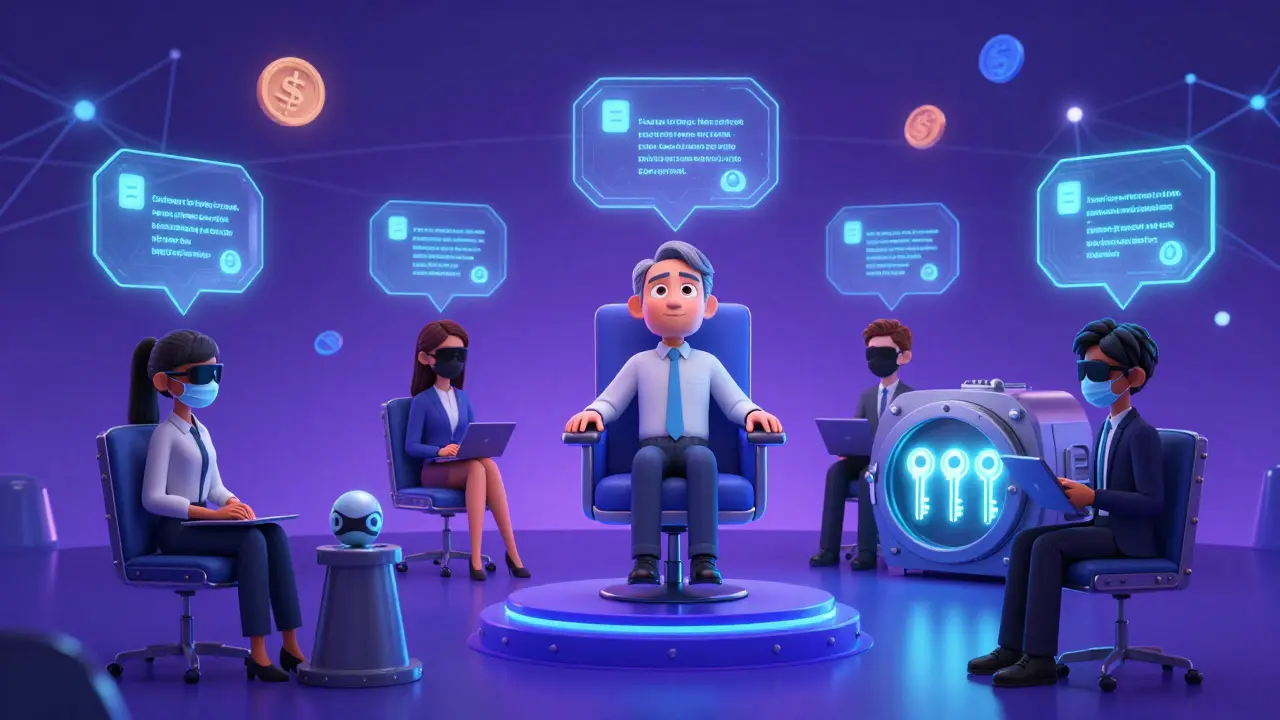
Multisig Voting a governance mechanism requiring multiple predefined parties to approve a transaction before execution, commonly used for treasury management and critical protocol changes is like a bank vault that needs three keys. Maybe three core team members, or three community-elected stewards, all need to sign off. It’s slow, but safe. It’s used in DAOs like Aave a decentralized finance protocol that uses multisig for emergency treasury controls and critical upgrades for high-risk actions. But if one signatory goes offline or refuses to sign, the DAO can get stuck.
Hybrid Systems: The Real Future of DAO Voting
No single system works for everything. That’s why the smartest DAOs now mix them.Take a proposal to upgrade the protocol. They might use Quadratic Voting a governance mechanism where the cost of votes increases quadratically with the number of votes cast, making large-scale manipulation prohibitively expensive while allowing individuals to express strong preferences to measure how strongly members feel. Then, they add a Multisig a governance mechanism requiring multiple predefined parties to approve a transaction before execution, commonly used for treasury management and critical protocol changes layer so no vote executes without three trusted validators. For smaller decisions-like hiring a designer-they use Conviction Voting a governance mechanism where voting power increases over time as a voter maintains their support for a proposal, rewarding sustained commitment over impulsive or tactical voting to avoid rushed calls.
This is the trend: one DAO, multiple voting rules. The key is matching the mechanism to the risk. High-risk? Use heavy checks. Low-risk? Keep it simple.
What’s Next? AI, Privacy, and Cross-Chain Voting
DAOs are still young. New ideas are popping up fast.One big direction is zero-knowledge proofs a cryptographic method that allows one party to prove to another that a statement is true without revealing any information beyond the truth of that statement. Imagine voting without anyone knowing who you voted for. Your vote counts, but your privacy stays. That could help in places where regulators pressure DAOs to reveal identities.
Another is AI-powered proposal summaries. Instead of reading 20 pages of technical jargon, an AI gives you a one-paragraph breakdown: "This proposal increases gas fees by 12%, benefits developers, and reduces treasury reserves. 68% of voters support it with high conviction."
And then there’s cross-chain voting. Right now, most DAOs live on one blockchain. But what if you hold tokens on Ethereum, Polygon, and Solana? Shouldn’t you be able to vote in one DAO from all chains? Projects are testing bridges that let you lock your tokens on one chain and vote on another.
Final Thoughts: It’s Not About the Vote-It’s About the Trust
The real challenge in DAO governance isn’t coding the smart contract. It’s building trust. People need to believe their voice matters. They need to feel safe from manipulation. They need to know that the system won’t be hijacked by the richest or the loudest.That’s why the best DAOs don’t just pick a voting mechanism-they design a culture around it. They educate. They test. They iterate. They let members experiment with different rules and see what sticks.
If you’re part of a DAO, don’t just vote. Understand how the vote works. Ask: Who does this system protect? Who does it exclude? The answer might change how you vote next time.
What’s the difference between linear voting and quadratic voting?
Linear voting gives each token one vote. If you have 100 tokens, you get 100 votes. Quadratic voting makes voting expensive: 1 vote costs 1 token, 2 votes cost 4 tokens, 3 votes cost 9 tokens. This stops whales from dominating because it costs exponentially more to cast many votes. It lets small holders express strong opinions without being drowned out.
Can I delegate my vote in any DAO?
Not automatically. Liquid democracy (delegated voting) only works if the DAO’s smart contract supports it. Some DAOs, like those built on Colony or Snapshot, allow delegation. Others, especially older ones, only allow direct voting. Always check the governance documentation before joining.
Why do some DAOs use multisig for treasury decisions?
Multisig acts as a safety net. If a proposal passes by vote but requires spending funds, multisig ensures multiple trusted parties must approve the transaction. This prevents a single hacker or rogue member from draining the treasury-even if they control 99% of the votes. It’s a human layer on top of automation.
Is conviction voting slow? Should I use it?
Yes, it’s slower than snapshot voting because votes gain weight over time. But that’s the point. It filters out impulsive votes and rewards long-term commitment. Use it for major decisions-like protocol upgrades or treasury changes-not for minor fixes. It’s ideal for DAOs with active, engaged members who want to avoid last-minute manipulation.
What’s the biggest flaw in current DAO voting systems?
The biggest flaw is low participation. Most DAOs have voter turnout under 5%. That means a tiny fraction of members make decisions for everyone. No voting mechanism fixes that. Only education, incentives, and simpler interfaces can. The system might be perfect, but if no one shows up, it doesn’t matter.

Comments
Let’s be real - linear voting is just feudalism with a blockchain logo. The fact that we still debate this in 2025 is embarrassing. Quadratic voting isn’t perfect, but at least it forces whales to ask themselves: ‘Is this worth 10,000 tokens?’ Not all of us have a wallet with six zeros. And yes, identity verification is non-negotiable. Sybil attacks aren’t theoretical - they’re already happening on Discord servers with 500 bot accounts.
Conviction voting is the future of DAO governance because it aligns incentives with long term commitment not short term manipulation
So we’re just pretending that people who don’t read 20-page whitepapers deserve a voice? Conviction voting sounds noble until you realize most voters don’t even know what ‘conviction’ means. They just vote because they saw a meme. This whole system is built on the delusion that decentralization = democracy. It’s not. It’s just capitalism with extra steps.
Love this breakdown. Seriously. Quadratic voting is genius. And conviction? That’s like voting with your soul. I’ve been in DAOs where people vote once and vanish - this fixes that. Also, AI summaries? YES PLEASE. I don’t have time to read all the docs. Just give me the TL;DR with vibes.
Quadratic voting is cool but honestly? Most people don’t get it. I tried explaining it to my cousin. He said ‘so if I want to vote 5 times I need 25 tokens? That’s like paying $500 to say I like pizza.’ And he’s not wrong. We need simpler metaphors. Maybe ‘vote points’ instead of ‘token cost.’ Also, delegate voting is the real MVP for busy folks. Just don’t let one person get 80% of the power. That’s not liquid - that’s a dictatorship with a DAO badge.
It’s fascinating how we’ve elevated governance to a philosophical art form while ignoring the most basic truth: humans are lazy, selfish, and easily manipulated. Quadratic voting? Conviction? Liquid democracy? These are just pretty words for ‘let’s pretend we’re not all just trying to get rich.’ The real solution isn’t in code - it’s in psychology. And we’re not ready for that.
Let me be blunt: DAOs are a scam waiting to happen. Multisig? It’s a Band-Aid on a hemorrhage. If the core team holds the keys, it’s not decentralized - it’s a private club with a fancy frontend. And ‘token-based quorum’? You need 15% participation? In practice, it’s 2% - and those 2% are usually the same five people who show up for every vote. This isn’t governance. It’s performance art for crypto bros.
One thing people forget: low turnout isn’t about apathy. It’s about complexity. If you have to understand quadratic math and zero-knowledge proofs just to vote on a proposal to pay a designer… most people will just scroll past. The solution isn’t more mechanisms. It’s one clear, simple interface. Maybe even a voting app that looks like TikTok. If it’s not intuitive, it won’t be used.
Everyone’s obsessed with ‘fixing’ voting. But the real problem? No one’s fixing participation. You can have the most perfect voting system ever invented - if 95% of token holders never log in, it’s meaningless. The answer isn’t more math. It’s rewards. Gas fees? Pay people in ETH to vote. Time? Pay in NFTs. Attention? Pay in memes. If you want engagement, you have to make voting fun. Not a chore.
quadratic voting is cool but i think its overrated like yeah it stops whales but what about the people who just buy 1000 accounts on a free trial and vote that way also why do we need so many systems its like a car with 7 gears and 3 clutches
I just don’t trust any of this. Who decides which voting system to use? Who audits it? What if the devs secretly code a backdoor? I’ve seen too many DAOs ‘vote’ to give themselves millions. It’s all theater. I’m done. 🤷♀️
There’s a quiet tragedy here. We built these systems to escape hierarchy - and yet, every new mechanism just recreates it in a different form. Quadratic voting? Still favors those with capital. Conviction? Favors those with time. Liquid democracy? Favors those with influence. The real revolution isn’t in code. It’s in culture. And we’re not building that. We’re just rearranging the deck chairs on the Titanic.
Why are we pretending that voting solves anything? The real power isn’t in the vote - it’s in who writes the proposal. Who drafts the language. Who controls the forum. Who moderates the discussion. That’s where decisions are made. Voting is just the final step in a performance. And if you think your vote matters… you’re not wrong. You’re just not the one who matters.
I’ve been in DAOs for years. The best ones? They don’t overcomplicate it. They use simple voting for small things. Multisig for big money. And they talk. Like, actually talk. In voice channels. In weekly calls. They build trust before they build code. The mechanism is secondary. The relationship is everything.
Conviction voting is inefficient. It introduces latency. Latency kills innovation. In fast-moving ecosystems like DeFi, waiting 30 days for a vote to gain weight is catastrophic. We need speed. We need clarity. We need a system that doesn’t treat governance like a slow-burn novel.
Hybrid systems are the only way forward - but let’s be honest: most DAOs don’t have the engineering talent to pull this off. We’re talking about multi-layered smart contracts with dynamic weighting, time-based logic, identity verification, and cross-chain sync. That’s not ‘community governance.’ That’s a Fortune 500 IT department with a crypto wallet. Most DAOs are run by two devs and a Discord bot. Stop pretending this is scalable.
Zero knowledge proofs for voting could be revolutionary but the tech is still too new and expensive to implement widely also i think we should focus on making the user interface better than adding more complex layers
From India, I’ve seen how democracy works (or doesn’t) in real life. Voting isn’t about math. It’s about inclusion. If your system makes someone feel like their voice doesn’t matter because they’re not rich or tech-savvy… you’ve already lost. The best DAOs aren’t the ones with the fanciest algorithms. They’re the ones where a 17-year-old student from Mumbai feels heard. That’s the real win.
Hybrid governance is the future - but we need to stop calling it ‘voting.’ It’s orchestration. Each mechanism is an instrument. Quadratic for intensity, Conviction for duration, Liquid for delegation, Multisig for safety. The DAO is the symphony. And if the conductor doesn’t know how to balance them… it’s just noise.
AI summaries sound amazing but what if the AI is biased? What if it’s trained on data from only one region? We can’t outsource understanding to a bot. We need education - not automation. Maybe DAOs should have mandatory 10-minute video tutorials before each vote. Not a wall of text. A real explainer. Like, for real.
Why is no one talking about the emotional toll? I’ve been in DAOs where people cry over votes. They feel betrayed. They feel powerless. They feel like their life savings is being decided by strangers on a forum. This isn’t finance. It’s therapy with a blockchain. We need mental health protocols. Not more voting mechanisms.