
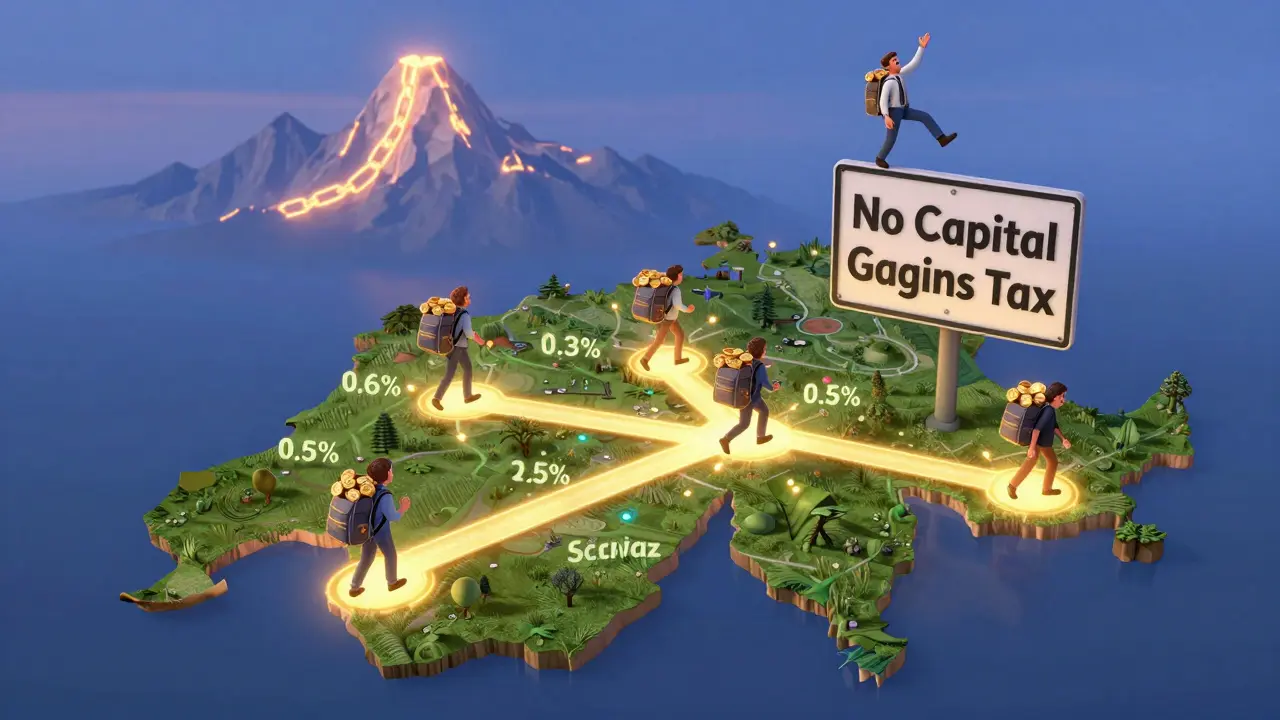
Switzerland doesn’t tax your crypto profits - but it does tax your crypto holdings. That’s the quiet secret behind why so many crypto investors live here. If you own Bitcoin, Ethereum, or any other digital asset, the Swiss government doesn’t care how much you made selling it. What they care about is how much you still have on December 31st each year. This isn’t a loophole. It’s the law. And it’s one of the most investor-friendly systems in the world.
How Switzerland Classifies Crypto
Switzerland doesn’t treat crypto like cash. The Federal Tax Administration (FTA) calls it crypto-based assets - the same category as stocks and bonds. This matters because it means crypto is part of your personal wealth, not your income. That distinction changes everything. Whether it’s Bitcoin, Dogecoin, or a new DeFi token, if you hold it privately, it’s treated as an asset. Not a currency. Not a payment tool. Just something you own.The FTA breaks crypto into three types: payment tokens (like BTC and ETH), utility tokens (used to access services), and security tokens (backed by rights like dividends). Payment tokens get the simplest treatment. They’re included in your wealth tax but exempt from capital gains tax. Security tokens? They’re treated like shares - same rules as stocks. Utility tokens vary depending on how they’re used. If it’s just a key to a platform, it’s treated like a payment token. If it gives you a share of profits, it’s treated like a security.
What You Must Declare
Every year, by December 31st, you must list every crypto asset you own. No exceptions. Even if you bought $500 worth of a tiny altcoin in 2020 and never touched it, you still declare it. The FTA publishes official year-end prices for major coins like Bitcoin, Ethereum, Litecoin, and Ripple. You use those numbers to convert your holdings into Swiss francs.But what if your coin isn’t on the FTA list? Then you use the price from the exchange where you last traded it. If you never traded it? You use the original purchase price in CHF. That’s it. No fancy formulas. No market averages. Just the cost you paid or the last known price. This keeps things simple - but only if you’ve kept good records.
How Much Tax Do You Pay?
Wealth tax isn’t federal. It’s cantonal. Switzerland has 26 cantons, and each sets its own rate. Most charge between 0.3% and 1% per year on your total net wealth - including your crypto, real estate, savings, and investments. Zurich might charge 0.6%, while Geneva could charge 0.8%. The more you own, the higher the rate, but it’s never progressive like income tax.Let’s say you hold 2 Bitcoin worth CHF 150,000 at year-end. If you live in a canton with a 0.7% wealth tax rate, you pay CHF 1,050. That’s it. No matter if Bitcoin jumped 300% that year. No matter if you sold half of it in March. The tax is only on what’s left on December 31st.
Capital Gains? Exempt - Unless You’re a Pro
Here’s the real kicker: if you’re a private investor, you pay zero capital gains tax on crypto profits. Ever. Sell your Bitcoin for a CHF 1 million profit? No tax. Trade ETH for SOL and make CHF 50,000? No tax. This applies to all private assets - crypto, stocks, even art. Switzerland doesn’t tax wealth growth. Only wealth存量.But if you’re a professional trader? That’s a different story. The FTA uses Circular No. 36 to define who counts as a professional. If you trade full-time, use leverage, have a business structure, or trade more than 10 times a month, you’re likely classified as a trader. Then your crypto gains are taxed as income - at your regular income tax rate, which can be 10% to 40% depending on your canton and income level. Businesses that hold crypto as part of their operations? Same thing. Profits are taxable. Losses are deductible.

Staking, Mining, and DeFi - What’s Taxed?
New crypto activities? Switzerland already has answers. Mining is treated as a business activity. If you run a mining rig, your earnings are taxable income. You pay income tax on the value of the coins you mine when you receive them. Same goes for running a node or validating transactions for rewards.Staking and DeFi yield? It’s trickier. If you earn interest or rewards from staking ETH or lending on Aave, the FTA treats those as income - not capital gains. You pay income tax on the value of the tokens received when they hit your wallet. If you later sell those tokens, you don’t pay capital gains tax on the profit - because you already paid income tax on the original value.
DeFi swaps? If you swap one token for another, it’s not a taxable event. Only when you sell for CHF or fiat does it trigger a capital gain - but again, private investors don’t pay it. Only professionals do.
Why This System Works
Switzerland’s system isn’t perfect - but it’s predictable. You know exactly what you owe. No surprises. No retroactive rules. No sudden tax hikes on crypto profits. The rules haven’t changed since 2019, and they’re not changing in 2025. That’s why companies like Coinbase, Kraken, and Ledger chose Switzerland as their European base. Investors from Germany, France, and the UK move here not just for the quality of life - but for the tax clarity.Experts from Koinly and Ark-fid.ch confirm: Switzerland remains one of the top three countries globally for private crypto investors. The FTA doesn’t create new crypto taxes. They apply existing rules - fairly and consistently. No blockchain-specific tax. No digital asset levy. No NFT-specific rules. Just wealth tax on what you own.
What Investors Actually Do
Real investors don’t just rely on theory. They act. Many choose to live in cantons with the lowest wealth tax rates - like Schwyz or Zug. Some spread assets across family members to stay under higher tax brackets. Others time their sales so they don’t trigger any unintended classification as a trader. A few even keep a separate wallet for trading (to show intent) and another for long-term holding (to prove it’s private wealth).But the biggest challenge? Getting accurate prices for obscure tokens. If you hold a token not listed by the FTA, you need to track every transaction on your exchange. If you used multiple platforms? You need records from each. No receipts? You default to your original purchase price. That’s why most Swiss crypto owners use tools like Koinly or CoinTracker to auto-import trades and calculate year-end values.
What’s Not Taxed
You don’t pay tax on:- Buying crypto with CHF
- Transferring crypto between your own wallets
- Receiving crypto as a gift from family (if below CHF 20,000)
- Using crypto to buy goods or services (unless you’re a business)
- Profits from selling crypto as a private person
And you don’t pay VAT on crypto transactions - unless you’re selling a service paid in crypto. Then it’s treated like any other payment.
What Could Change in 2026
Nothing major. The Swiss government has no plans to introduce capital gains tax on crypto. They’ve made it clear: their goal is to attract and retain digital asset businesses and investors. The DLT Act of 2021 and the FTA’s 2024 updates show they’re doubling down on stability, not tightening.But watch for one thing: if staking rewards become too common, the FTA might require more detailed reporting. Right now, you just declare the value of rewards received. In the future, they might ask for transaction logs. That’s not a tax change - just better compliance.
Final Take
Switzerland doesn’t make you pay for winning with crypto. It just asks you to declare what you’ve won. That’s the difference between a country that fears innovation and one that understands it. If you’re holding crypto as an investment - not as a business - Switzerland gives you the freedom to grow without the fear of a tax bill later. No other country offers that combination of clarity, stability, and fairness.Do I pay capital gains tax on crypto in Switzerland?
No, private individuals do not pay capital gains tax on crypto profits in Switzerland. Whether you made CHF 1,000 or CHF 1 million selling Bitcoin, Ethereum, or any other crypto, you owe nothing in capital gains tax - as long as you’re not classified as a professional trader. This exemption applies to all private assets, including stocks and real estate.
How is crypto taxed in Switzerland?
Crypto is taxed as part of your personal wealth. You must declare the value of all your crypto holdings as of December 31st each year, converted to Swiss francs using either the FTA’s official rates or your exchange’s year-end price. You then pay an annual wealth tax, typically between 0.3% and 1%, depending on your canton. No capital gains tax applies to private investors.
Do I need to report crypto if I didn’t sell it?
Yes. Even if you never sold a single coin, you must declare all crypto holdings on your annual wealth tax return. The tax is on ownership, not transactions. If you hold Bitcoin, Ethereum, or any token on December 31st, it counts toward your taxable wealth.
What if my crypto isn’t listed by the FTA?
If the FTA doesn’t publish a year-end price for your token, use the price from the exchange where you last traded it. If you never traded it, use your original purchase price in Swiss francs. This is the official fallback method - and many investors use it for lesser-known altcoins.
Is staking crypto taxable in Switzerland?
Yes. Staking rewards, DeFi interest, and mining earnings are treated as income. You pay income tax on the value of the tokens when you receive them - not when you sell them. But if you later sell those tokens, you don’t pay capital gains tax as a private investor. Only the initial receipt is taxed as income.
Can I avoid wealth tax by moving my crypto offshore?
No. Swiss tax law requires you to declare all worldwide assets if you’re a Swiss tax resident. Moving crypto to a foreign exchange or wallet doesn’t remove it from your taxable wealth. The FTA can request data from exchanges, and failing to declare offshore assets can lead to penalties.
Are NFTs taxed differently in Switzerland?
No. NFTs are treated like any other crypto asset. If you hold them as private wealth, they’re included in your wealth tax calculation. If you sell them as a private person, no capital gains tax applies. If you trade them regularly as a business, they’re taxed as income. The same rules apply regardless of whether the asset is a token, NFT, or coin.
What happens if I don’t declare my crypto?
You risk penalties, interest charges, and potential audits. Switzerland has strong data-sharing agreements with major exchanges. If the FTA discovers undeclared crypto, you’ll be required to pay back taxes plus interest (typically 4% per year). In cases of intentional omission, fines can reach up to 100% of the evaded tax amount.

Comments
Swiss crypto tax is wild but fair. No cap gains? Yes please. I just wish my country did this.
The Swiss approach to crypto taxation is a masterclass in regulatory clarity. By treating digital assets as wealth rather than income, they eliminate speculative volatility from the tax code. This isn’t just investor-friendly-it’s economically rational. Countries clinging to capital gains taxes on crypto are essentially punishing long-term holding, which undermines the very purpose of decentralized finance. Switzerland gets it: innovation thrives under predictability, not punitive ambiguity.
Bro this is the holy grail. No capital gains on crypto? Sign me up. I’ve been watching my portfolio grow while paying 20%+ in the US. The FTA’s stance is pure genius-wealth tax is low, predictable, and doesn’t punish you for winning. Staking rewards taxed as income? Fine. At least I know where I stand. I’m moving my entire stack to Zug by next year. 🚀
There’s a deeper philosophical underpinning here: Switzerland separates the act of owning from the act of trading. Capital gains tax implies that appreciation is somehow ‘earned’-but in reality, it’s a market phenomenon. Taxing ownership reflects a more grounded view of property: value exists in possession, not transaction. This model doesn’t incentivize churn. It rewards patience. That’s not just tax policy-it’s a cultural statement about time, value, and trust in markets.
Switzerland’s system is clean. Declare holdings once a year. Pay wealth tax. No capital gains. No noise. Simple. Efficient. Effective. Why can’t other countries do this?
Switzerland is the only place where your crypto can actually grow without the IRS breathing down your neck 😍 I just sold 5 BTC last month and paid $0 in taxes. Zero. Nada. My wallet just got heavier and my bank account stayed the same. This is the dream. 🇨🇭
Why do people even care about taxes? If you’re rich enough to hold crypto, you can afford to pay. Switzerland is just making it easier for rich people to get richer. Meanwhile, my rent keeps going up and I’m still paying 30% on my side hustle. This system is rigged.
Oh wow, Switzerland is ‘investor-friendly’? Cute. So they tax your wealth but let you profit endlessly? That’s not fairness-that’s a tax shelter for the ultra-rich. Meanwhile, I’m paying 40% on my crypto gains while my landlord lives in a chalet in Zermatt. Thanks, Switzerland. You’re not a haven. You’re a joke with a flag.
I love how Switzerland treats crypto like any other asset. No special rules, no panic, no knee-jerk legislation. It’s calm, consistent, and smart. If more countries adopted this mindset, we’d see way less volatility in the market. People would stop trading like gamblers and start investing like adults. Honestly? This is how it should be done.
The Swiss model exemplifies institutional maturity in digital asset regulation. By applying established principles of wealth taxation to crypto, they avoid the pitfalls of novelty-driven policymaking. This approach fosters long-term confidence among global investors, reinforcing Switzerland’s position as a bastion of financial stability. One must commend the Federal Tax Administration for its principled adherence to legal continuity and fiscal prudence.
Yeah right no capital gains tax. That’s what they want you to think. The moment you try to move your crypto out of Switzerland they’ll find a way to tax it. And don’t even get me started on how they’ll classify your DeFi transactions next year. This is all just a trap to lure in dumb investors. Trust me I’ve seen this movie before.
The Swiss Federal Tax Administration’s adherence to the principle of wealth-based taxation over transaction-based taxation represents a paradigm shift in digital asset regulation. This framework not only aligns with international best practices in fiscal policy but also reinforces the foundational economic tenet that value accrual should not be penalized absent realized income. The absence of capital gains taxation for private investors is not a loophole-it is a deliberate policy choice favoring long-term capital formation.
My friend moved to Zug last year and now he just laughs when I complain about crypto taxes. He holds 10 BTC, never sells, pays like 800 CHF a year in wealth tax. Meanwhile I’m filing Form 8949 every April and crying into my coffee ☕️ Switzerland doesn’t make you pay for being smart. It just asks you to be honest. And honestly? That’s all I want.