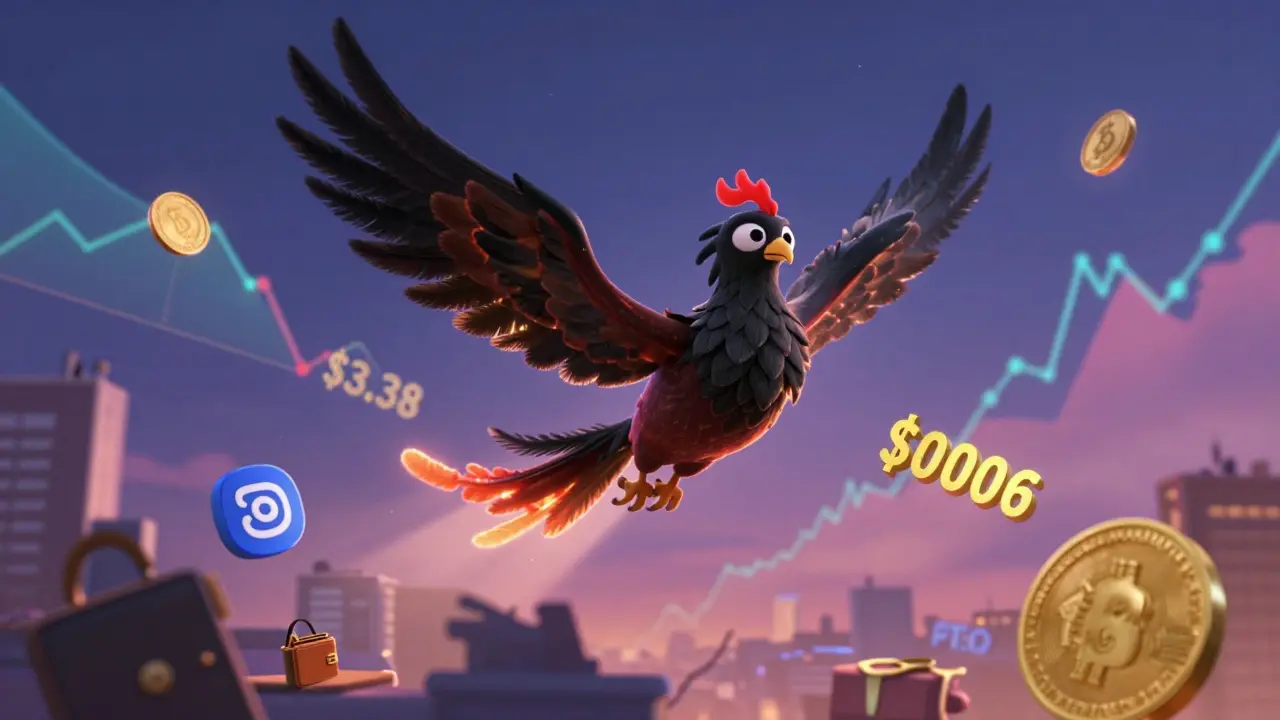
Black Phoenix (BPX) isn’t just another crypto token. It’s a high-risk, high-reward project that went from worth less than a penny to over $3 in less than four years - then dropped back down again. If you’ve seen BPX listed on exchanges like Coinbase or CoinMarketCap at $2.81, you’re seeing one version of the truth. But if you check Stack.Money, you’ll see it priced at just $0.006. That’s not a typo. That’s a red flag.
What Exactly Is Black Phoenix (BPX)?
Black Phoenix (BPX) is a cryptocurrency launched on April 12, 2021. It started as a TRC-20 token on the TRON blockchain and later expanded to the BNB Chain as a BEP-20 token. That means you can hold it in wallets that support either network - like Trust Wallet or MetaMask - and move it across both chains. But here’s the catch: BPX doesn’t have its own blockchain yet. It’s built on top of others.
The project’s goal? To create a fully on-chain liquidity protocol that lets users swap tokens between different blockchains without needing centralized bridges. In theory, that’s useful. In practice, most of that tech is still on paper. The team says they’re building their own blockchain called the Black Phoenix Blockchain (BPX Network), along with a wallet and a decentralized exchange called BPX Exchange. But there’s no public roadmap, no GitHub activity, and no clear timeline. It’s all promises.
Supply and Market Value: The Numbers Don’t Add Up
BPX has a total supply of 4 billion tokens. That’s a lot. But only about 1.54 billion are in circulation right now - roughly 38%. The rest? Locked up. That means if even half of those remaining tokens hit the market, the price could crash.
Market cap numbers are all over the place. Coinbase says BPX has a fully diluted valuation of $11.26 billion - meaning if all 4 billion tokens were trading at $2.81, that’s the total value. CoinGecko, however, reports a market cap of around $4.3 billion, based on the circulating supply. Stack.Money, meanwhile, lists it at just $34 million. Why the gap? Because one source is using the current price, and another is using a different price entirely.
That’s not normal. For a token with real trading volume, data aggregators usually agree within 5-10%. BPX’s price varies by over 400x between platforms. That’s a sign of low liquidity, possible manipulation, or both.
Price History: A Rollercoaster
BPX’s price history is wild. Its all-time low was $0.00000133 on March 22, 2022. That’s less than one-millionth of a dollar. Just ten months later, it hit $3.38 on January 6, 2025 - a gain of over 250 million percent. Then it fell back to $2.81, still down 17% from its peak.
That kind of volatility isn’t just risky - it’s suspicious. Tokens that spike 250 million percent in under two years rarely sustain those gains. Most pump-and-dump schemes follow this exact pattern: low float, aggressive marketing, sudden price surge, then slow bleed as early buyers cash out.
On the upside, BPX has outperformed the broader market. Over the past week, it rose 10.3%, while the overall crypto market climbed just 0.8%. But that’s not proof of strength - it’s proof of momentum. Small-cap tokens like BPX can surge on hype alone, especially if there’s a coordinated social media push.
Where Can You Buy BPX?
You won’t find BPX on Binance, Coinbase Pro, or Kraken. It’s listed on smaller exchanges like FameEX, XT.com, Bitrue, Coinsbit, and Vindax. These aren’t the big names. They’re platforms that list new, unproven tokens quickly - often with little oversight.
Some platforms, like RevenueBot, even offer automated trading bots for BPX. That means you can set up algorithms to buy or sell at certain prices without watching the chart. Sounds smart? Maybe. But if the underlying asset is volatile and thinly traded, automation just speeds up your losses.
Buying BPX requires a TRON or BNB Chain wallet. You’ll need to swap another crypto - like USDT or BNB - for BPX on one of those exchanges. There’s no direct fiat on-ramp. You can’t buy it with a credit card or bank transfer. That’s another red flag. Legit projects make it easy to get in. BPX makes it hard.
Is BPX Safe? Security Claims vs. Reality
The BPX website says it uses “the highest level of security measures” to protect user funds. But what does that mean? No details. No audits. No public smart contract reviews. No known security firm has verified its code.
Most legitimate crypto projects publish their smart contracts on Etherscan or TRONScan and hire third-party auditors like CertiK or Hacken. BPX doesn’t. That means if there’s a bug, a backdoor, or a rug pull, there’s no way to prove it’s safe - or even detect it until it’s too late.
And the liquidity? The project claims to have a “fully on-chain liquidity protocol.” But liquidity pools for BPX are tiny. On PancakeSwap, the BPX/USDT pool holds less than $200,000. That’s not enough to handle even moderate buying pressure. One large sell order could tank the price in seconds.

Who Is Behind BPX?
No team members are named. No LinkedIn profiles. No public interviews. No whitepaper with technical depth. The official website reads like a marketing brochure - full of bold claims (“transform newcomer to advanced users”) but zero substance.
This is common in crypto. Many projects launch anonymously, hoping to ride hype waves before vanishing. That’s not always a scam - but it’s always a risk. When you can’t verify who’s building something, you’re betting on luck, not logic.
Should You Invest in BPX?
Here’s the truth: BPX is not an investment. It’s a speculation.
If you’re looking for stable growth, long-term value, or a project with real utility - skip it. BPX has none of those.
If you’re willing to gamble a small amount of money you can afford to lose, and you understand the risks - then maybe you’ll play. But treat it like a lottery ticket. Don’t put in more than you’re okay with losing. Don’t chase gains. Don’t believe the hype.
The token’s price could double again. Or it could drop 90% tomorrow. There’s no fundamental reason to believe it will hold value. No product. No team. No audit. Just a chart that looks like a rocket ship - and a lot of people hoping it doesn’t crash.
What’s Next for BPX?
The roadmap says they’re building a blockchain, a wallet, and a DEX. But there’s no evidence they’ve started. No code commits. No testnet launch. No developer activity.
If they ever deliver on any of that, it would be a big deal. But so far, it’s all talk. And in crypto, talk is cheap. Execution is everything.
For now, BPX is a speculative asset with extreme volatility, unclear ownership, and zero transparency. It’s not a currency. It’s not a platform. It’s a token with a story - and a price that doesn’t match the facts.

Comments
BPX is a textbook example of why you don’t chase moonshots without due diligence. The price discrepancies alone should raise red flags - if three major aggregators can’t agree on the value, it’s not a market, it’s a casino. No audits, no team, no code commits. Just a chart that looks like a rocket launch and a website that reads like a LinkedIn post written by a bot. Save your capital for projects with real engineering, not marketing fluff.
There’s zero transparency here. That’s not innovation. That’s opacity.
And don’t get me started on those ‘automated trading bots’ - they’re just turbocharged loss accelerators for illiquid tokens like this.
While I appreciate the depth of analysis presented here, I must respectfully add that in emerging markets like Nigeria, tokens such as BPX are often viewed not as investments but as speculative tools for circumventing capital controls. The lack of fiat on-ramps, while concerning to Western investors, is actually common in regions where banking infrastructure is weak.
That said, the absence of a whitepaper or team transparency remains a critical flaw - no matter the jurisdiction. Innovation without accountability is just noise.
Perhaps what BPX needs is not more hype, but a public audit and a roadmap written in plain language - not buzzwords.
bpx is a fed project to distract us from the real crypto revolution. they’re pumping it so we stop paying attention to monero and zcash. look at the timing - right after the fed announced the new digital dollar pilot. coincidence? i think not. they want you to think this is the future so you don’t ask why your money is being devalued. trust no one. check the chain. check the wallets. nothing adds up.
this is why i stopped trusting crypto after the terra collapse. everyone’s chasing the next 1000x like it’s a lottery ticket and not a gamble with their life savings. bpx has no team, no code, no audit. just a website with fancy fonts and a price that changes every 30 seconds. if you’re buying this, you’re not investing - you’re volunteering to be the last guy holding the bag when the lights go out.
America doesn’t need this garbage. If you’re investing in a token with no team and a price that jumps 400x based on a tweet, you’re not a crypto believer - you’re a traitor to financial literacy. This isn’t innovation. It’s fraud dressed up in blockchain jargon. The SEC should shut this down yesterday.
It’s fascinating how we’ve normalized gambling as investing. BPX isn’t a currency. It’s not a platform. It’s not even a company. It’s a psychological experiment - a mirror held up to human greed, confirmation bias, and the desperate need to believe in something bigger than ourselves.
We don’t invest in BPX because we think it’s valuable. We invest because we want to believe we’re part of the next big thing - even when every rational cell in our body screams that it’s a trap.
And yet… we still click ‘buy’.
you’re all missing the point. bpx is the canary in the coal mine. this is what happens when retail investors get access to unregulated liquidity pools. the 400x price gap? that’s not a bug - it’s a feature. someone’s manipulating the order books across 5 different exchanges to create artificial scarcity. they’re using bots to front-run retail. the fact that you’re all arguing about the price instead of the mechanism is why crypto is dying. this isn’t finance. it’s a rigged game show.
I know it sounds crazy, but I actually think BPX might be onto something - not because of the price, but because of the *idea*. A cross-chain liquidity protocol without centralized bridges? That’s the holy grail, right? I mean, sure, there’s no GitHub, no team names, no roadmap - but look at how many projects started with just a whitepaper and a dream. Ethereum didn’t have a working product at launch either.
Maybe the team is quiet because they’re building in stealth. Maybe they’re avoiding the hype so they don’t get targeted by regulators before they’re ready. I’ve seen too many projects get crushed by media attention before they even launched.
Don’t get me wrong - I’m not saying it’s safe. But I’m also not saying it’s dead. There’s a difference between ‘no evidence’ and ‘evidence of nothing.’
And honestly? If I had $50 to throw away, I’d put it in BPX just to see what happens. Not because I think I’ll get rich - but because I want to see if the dream can actually work. Maybe it’s naive. Maybe it’s stupid. But I’d rather be wrong for believing than right for being afraid.
bpx is a fed psyop to get you to invest in trash so you forget about the real crypto wars. they control the exchanges. they control the data feeds. they control the narratives. if you think this is about tech you’re delusional. this is about control. they want you to chase ghosts so you don’t ask why your bank account is being drained. check the liquidity pools. check the wallet addresses. nothing moves unless they want it to. this isn’t crypto. this is surveillance capitalism with a blockchain label.
ok so i just did a quick dive and holy cow the price difference between coinbase and stack.money is wild. like, 400x? that’s not a glitch, that’s a crime. i checked the contract on tronscan and the token supply is locked in a wallet that hasn’t moved since 2022. no one’s touching it. so why is it trading at $2.80 on some exchange? someone’s making fake volume. i think this is a wash trading scheme. i’m not saying it’s a rug - i’m saying it’s a ghost town with a neon sign saying ‘buy here’.
i’ve seen this movie before. 2017. 2021. same script. hype, pump, then silence. bpx is just another flash in the pan. if you’re still holding this, you’re not an investor - you’re a fan of the drama. i’m not here to judge. i’ve been there. but if you’re reading this and still thinking ‘maybe it’ll rebound’ - just walk away. your peace of mind is worth more than any token.
Let’s be real - BPX is the crypto equivalent of a TikTok trend that went viral because of a dance and a meme. The price isn’t driven by utility. It’s driven by FOMO, influencer shills, and low-liquidity pumps. The fact that it’s on FameEX and Vindax instead of Binance? That’s the first clue. The second? Zero smart contract audits. The third? No team. The fourth? No GitHub.
But here’s the thing: I’m not here to tell you not to buy it. I’m here to tell you to know what you’re buying. If you’re buying BPX because you think it’s the next Bitcoin, you’re wrong. If you’re buying it because you think it’s a lottery ticket and you’re okay losing it? Then go ahead. Just don’t cry when it goes to zero.
And if you’re holding it? Congrats. You’re now a part of crypto folklore. The story of the token that had no substance but a thousand stories.
i think people are being too harsh. i mean, yeah it’s sketchy, but so was dogecoin at first. look at it now. maybe bpx is just early. maybe the team is working quietly. i know it’s risky, but isn’t that what crypto is supposed to be? i put in $200 and i’m not losing sleep over it. if it goes to zero, fine. if it goes to $10, i’m golden. i’m not here to be a genius - i’m here to take a chance.
The fundamental failure of BPX isn’t its lack of audit or team - it’s the epistemological collapse of crypto valuation itself. We’ve moved from utility-based pricing to narrative-based speculation, where market cap is a function of social proof, not economic output.
BPX is a perfect symptom of this: a token whose value is entirely contingent on collective belief, with no anchor in real-world liquidity, development, or governance.
This isn’t a currency. It’s a meme with a smart contract. And the entire crypto market is now a theater of the absurd, where price is determined not by supply and demand, but by the volume of tweets and the charisma of anonymous devs.
BPX is not the problem. It’s the inevitable conclusion of a system that abandoned rationality for virality.
bpx is a fed project to distract us from the real crypto revolution. they’re pumping it so we stop paying attention to monero and zcash. look at the timing - right after the fed announced the new digital dollar pilot. coincidence? i think not. they want you to think this is the future so you don’t ask why your money is being devalued. trust no one. check the chain. check the wallets. nothing adds up.