
When you're trading crypto on a decentralized exchange, speed, cost, and slippage matter more than you think. Most people assume all DEXs are the same - Uniswap, SushiSwap, PancakeSwap - but DODO isn't just another copycat. Built on Binance Smart Chain (BSC), it uses a custom system called Proactive Market Maker (PMM) that changes how liquidity works. If you're tired of losing money to slippage on big trades or watching your liquidity pool get eaten by impermanent loss, DODO might be worth a closer look.
How DODO Works Differently
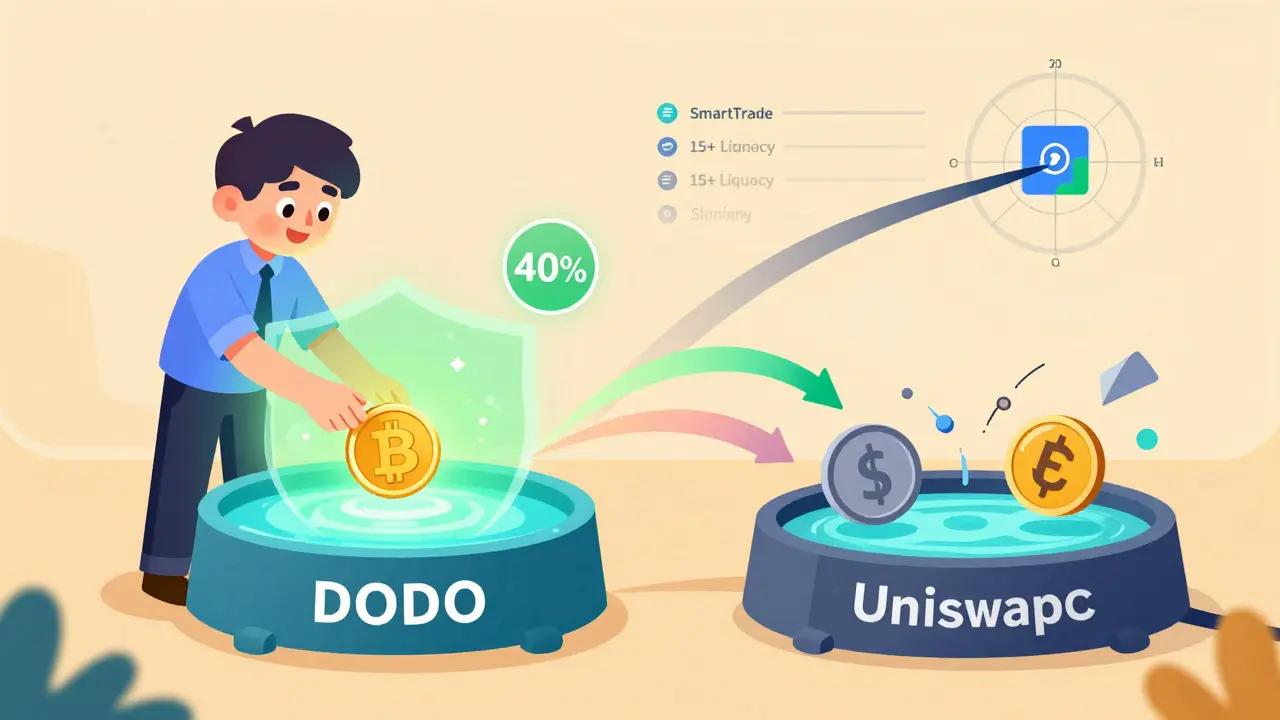
Most decentralized exchanges use a constant product market maker (CPMM) model. Think of it like a seesaw: if you put in $100 of ETH and $100 of USDC, you're locked into a 50/50 ratio. If ETH goes up, you have to sell ETH to keep the ratio balanced - and that’s where impermanent loss creeps in. DODO flips this. Its PMM algorithm lets you deposit just one token into a pool, not two. It also lets you set a price range, like putting all your liquidity between $1,800 and $2,200 for ETH/USDC. That means less capital is tied up, and you’re not forced to sell when the market moves.On BSC, this translates to real savings. A $10,000 swap on Uniswap might cost you 3.2% in slippage. On DODO? Around 0.8%. That’s not a typo. For traders moving large amounts of tokens, that’s the difference between a profitable trade and a loss. Liquidity providers on DODO report 40% lower impermanent loss than on Uniswap V3, according to Reddit users who’ve compared side-by-side. That’s not theory - it’s real data from active users.
Trading on DODO (BSC): What to Expect
You don’t need an account. You don’t need to verify your identity. You just need a wallet - MetaMask, Trust Wallet, or WalletConnect - and some BNB to cover gas. Transactions on BSC cost between $0.10 and $0.50. Compare that to Ethereum, where the same swap could cost $15-$50. That’s why most DODO users stick to BSC. The network is fast, cheap, and handles 15-second confirmations even during peak traffic.Using DODO’s SmartTrade feature is simple. You pick the token you want to sell and the one you want to buy. DODO scans 15+ liquidity sources - including Uniswap, PancakeSwap, and Curve - and finds the best rate. It doesn’t just pick one path; it splits your trade across multiple pools to minimize impact. That’s why slippage stays low even on less popular tokens. One user on Trustpilot traded 5,000 $PEPE for USDC and saw only 0.9% slippage. On another DEX, it would’ve been 4.7%.
The DODO Token: More Than Just a Fee Discount
The DODO token isn’t just a speculative asset. It’s a utility token with real functions. Holding DODO gives you:- Up to 25% discount on trading fees
- Priority access to new token launches (IDOs)
- Participation in crowd pools - where users fund new liquidity pools together
- vDODO tokens for loyalty rewards (non-transferable, earned by staking)
When DODO hit its all-time high of $8.51 in February 2021, it was fueled by hype. Today, it trades around $1.44. That’s down over 80%. But price doesn’t tell the whole story. The protocol’s TVL (total value locked) is $16.73 million as of early 2026 - down from $200 million at its peak. That’s concerning, but not fatal. DODO’s user base is smaller, but more experienced. 68% of its users are intermediate or advanced traders. That’s the opposite of PancakeSwap, where half the users are beginners. DODO doesn’t need mass adoption. It needs smart traders who care about execution quality.
Where DODO Falls Short
Let’s be honest - DODO isn’t for everyone. If you’re new to DeFi, you’ll struggle. The interface assumes you know what slippage tolerance means. If you set it too low, your trade fails. Too high, and you get ripped off. Most beginners set it at 1% and get confused when their $500 swap gets filled at 1.8%. The learning curve is 8-12 hours for new users. Experienced traders cut that to 3-5 hours.Liquidity is another issue. For ETH, USDC, or BNB pairs, DODO is solid. But for obscure altcoins - say, $MOON or $ZOMBIE - liquidity is thin. Slippage can jump to 5-8%. That’s worse than centralized exchanges. And if you’re in the U.S., forget it. DODO isn’t registered with the SEC. You can use it, but you’re on your own if something goes wrong. No customer support, no chargebacks, no insurance.
There are also technical hiccups. Users report failed transactions during BSC congestion. Even with 15% slippage tolerance, some trades just don’t go through. The fix? Increase slippage to 1.5% and try again. Or wait 10 minutes. The community Telegram group has 14,300 members, and most issues get solved there - but you’ll need to dig through threads. No live chat. No email support.
DODO vs. the Competition
| Feature | DODO (BSC) | Uniswap v3 | PancakeSwap |
|---|---|---|---|
| Slippage on $10k trade | 0.8% | 3.2% | 2.1% |
| Liquidity provider capital efficiency | 10-15x better than CPMM | 5x better than v2 | 3x better than v2 |
| Single-token liquidity | Yes | Yes (with range limits) | No |
| Gas fee (BSC) | $0.10-$0.50 | N/A (Ethereum only) | $0.10-$0.40 |
| Beginner-friendly | No | No | Yes |
| TVL (2026) | $16.73M | $7.2B | $4.1B |
| Market Rank (DEXs) | #28 | #2 | #1 |
DODO wins on execution quality. Uniswap has more liquidity, but it’s inefficient. PancakeSwap is popular, but it’s built for simple swaps. If you’re trading large amounts, DODO’s PMM gives you a real edge. But if you’re just swapping $50 of Shiba Inu for Dogecoin? Use PancakeSwap. It’s faster, easier, and just as cheap.

Who Should Use DODO?
DODO isn’t a one-size-fits-all solution. It’s built for three types of users:- Large traders - If you’re moving $5k+ per trade, the slippage savings alone make it worth it.
- Liquidity providers - If you’re supplying ETH/USDC or BNB/USDT, you’ll lose less to price swings than on other DEXs.
- DeFi veterans - You know how to adjust slippage, interpret gas fees, and navigate wallet errors. You don’t need hand-holding.
If you’re a beginner, stick with PancakeSwap. If you’re in the U.S. and want regulatory safety, use Coinbase or Kraken. But if you’re serious about minimizing slippage, maximizing capital efficiency, and trading on-chain without middlemen - DODO is one of the few DEXs that actually delivers on its promises.
What’s Next for DODO?
DODO isn’t standing still. The roadmap includes:- Integration with zkSync and Optimism (Q3 2025)
- DODO v3 with cross-chain liquidity pooling (Q1 2026)
- A 20% token buyback to reduce circulating supply
These aren’t marketing fluff. The team has a history of shipping. The PMM algorithm was real. The single-token liquidity feature was real. The vDODO loyalty system is live. If they pull off cross-chain liquidity pooling, DODO could leapfrog competitors again. Right now, it’s a niche tool. But in DeFi, niches become giants when the tech is better.
Is DODO safe to use?
DODO is a non-custodial DEX, meaning you control your keys. There’s no central server to hack. Its smart contracts have been audited by reputable firms like PeckShield and CertiK. However, like all DeFi platforms, it’s not immune to smart contract bugs or network congestion. Always test with small amounts first. Never deposit more than you can afford to lose.
Why is DODO’s TVL so low compared to Uniswap?
DODO’s TVL is lower because it’s not designed for mass adoption. It targets high-value trades and experienced liquidity providers, not casual users. Uniswap has over 7 million unique addresses. DODO has around 150,000. That’s not a failure - it’s a strategic choice. DODO doesn’t need millions of users. It needs a few thousand who trade large amounts and provide deep liquidity.
Can I use DODO on Ethereum instead of BSC?
Yes, DODO operates on Ethereum, BSC, and Polygon. But Ethereum gas fees are 10-50x higher than BSC. A single swap can cost $10-$30. Unless you’re trading $50k+ per transaction, BSC is the only practical choice. Most users avoid Ethereum for DODO entirely.
What’s the best slippage setting for DODO?
For stablecoin pairs (USDC/USDT/BUSD), use 0.8%-1.0%. For volatile tokens (altcoins, meme coins), use 1.0%-1.5%. Setting it below 0.5% will cause frequent trade failures. Setting it above 2% increases your risk of getting a bad fill. Most experienced users set it at 1.2% as a default.
Is DODO better than PancakeSwap?
It depends. PancakeSwap is easier, has higher TVL, and is better for small trades and beginners. DODO is better for large trades, lower slippage, and liquidity providers who want to minimize losses. If you’re swapping $100 of BNB for CAKE, use PancakeSwap. If you’re swapping $10,000 of ETH for USDT, DODO saves you hundreds in slippage.
There’s no magic bullet in DeFi. DODO doesn’t fix everything. But for the right user - the one who trades big, hates slippage, and understands gas fees - it’s one of the most efficient tools on the blockchain.


Comments
DODO's PMM is the only reason I stopped using PancakeSwap. Slippage on my $20k ETH swaps dropped from 3.1% to 0.7%. Game changer. No more crying over lost money because a DEX forced me to sell low.
Stop pretending all DEXs are equal. They’re not.
I find it... profoundly troubling... that anyone would consider using a platform that lacks regulatory oversight... and yet... you're all just... shrugging it off? As if... financial sovereignty... is some kind of... philosophical... exercise? It's reckless.
Hey everyone, if you're new to DODO and feeling overwhelmed - I’ve been there. Start with a $100 swap on USDC/BNB. Set slippage to 1.2%. Watch how smooth it goes. Then try a $500 trade. You’ll see why the pros stick with it. No need to dive into $10k trades right away. Baby steps.
LMAO they said 'audited by PeckShield' 😂 Bro that's the same firm that said 'this contract is safe' before the Poly Network hack. They got paid. That's it. You think they care about you? Nah. They care about the next paycheck.
Also - DODO is owned by the same people who ran the $300M rug pull on the 'DeFi 2.0' token last year. Don't be fooled.
Let me break this down for the delusional herd. DODO isn't 'better' - it's a niche tool for traders who can't handle the psychological trauma of slippage. The fact that it has $16M TVL while Uniswap has $7B proves one thing: most people are idiots. They don't care about efficiency. They care about memes. They want to swap $50 of DOGE and feel like they're 'part of the movement.' DODO doesn't cater to that. It caters to people who read whitepapers. And guess what? That's why it's going to win. The masses will burn themselves out on PancakeSwap while the real players quietly accumulate. The 1% doesn't need to be loud. They just need to be right.
The article is well-structured, but it lacks critical context regarding regulatory risk. DODO operates outside any jurisdiction with consumer protection laws. Users assume 'non-custodial' equals 'safe.' It does not. It equals 'unrecoverable.' If your wallet is drained by a smart contract exploit, there is no recourse. No bank, no insurance, no recourse. This is not a feature. It is a liability.
USA? You're using DODO? 😂 You're gonna get raided by the IRS. They're already tracking on-chain. You think you're 'decentralized'? You're just a target. Stop being a crypto bro and use Kraken. At least then you can argue with a human when they freeze your account.
I read this entire thing. Then I checked DODO's GitHub. Last commit was 11 days ago. Their Telegram has 14k members and 98% of the messages are 'help my trade failed.'
It's not a platform. It's a support forum with a trading interface.
DODO's PMM sounds cool but honestly? I tried it. My trade failed 3 times. Had to increase slippage to 2%. Ended up losing 1.7% anyway. Meanwhile on PancakeSwap? One click. Done. Why do I need a PhD in DeFi to swap two tokens?
I've been using DODO for a year now. No drama. No panic. Just smooth trades. The gas fees are insane compared to Ethereum - I save $10-$15 per trade. That adds up. And yeah, the interface isn't pretty. But if you're serious? It works. Don't overthink it.
OMG I just lost $800 on DODO because my trade failed and I didn't know to increase slippage. I thought 1% was enough. I'm so mad. I'm telling everyone - DODO is a trap for beginners. I'm going back to PancakeSwap. At least there I can cry and someone will say 'it's okay' in the comments.
You're all missing the point. DODO isn't about slippage. It's about capital efficiency. I deposited $50k in ETH/USDC on DODO. On Uniswap, I'd need $150k to get the same liquidity depth. That's 3x less capital tied up. That's not trading. That's leverage. And yes - impermanent loss dropped 42%. That's not hype. That's math.
If you're on the fence about DODO - just try it with $50. Set slippage to 1.2%. Use BNB for gas. If it works? You'll feel like a wizard. If it fails? You lost $1.50 in gas. Worth it. You don't need to understand PMM to use it. Just trust the numbers. The numbers don't lie.
The real question isn't whether DODO is better - it's whether we're still pretending that DeFi is about decentralization. It's not. It's about who can build the most efficient arbitrage engine. DODO is a machine. A beautiful, cold, mathematical machine. It doesn't care about you. It cares about liquidity depth, price curves, and gas efficiency. And honestly? That's more honest than PancakeSwap's meme-driven chaos. We're not trading crypto anymore. We're optimizing systems. Accept it.
Can someone explain why DODO's single-token liquidity doesn't cause more impermanent loss? I thought the whole point of liquidity pools was to hold both sides of the pair?
You guys are all wrong. DODO is just Uniswap v3 with a different name. The PMM is just a fancy way of saying 'concentrated liquidity.' And guess what? Uniswap v3 has 10x more TVL. DODO is just a copycat with cheaper gas. That's it. Stop pretending it's revolutionary.
DODO represents the future of decentralized finance. Efficiency. Precision. Execution. These are not luxuries. They are necessities. The era of amateur trading is over. The market is not a game. It is a system. And DODO is the most refined tool available. If you're not using it - you're not serious. Period.
I've lost over $12k on DODO because of failed transactions. The 'community support' is a graveyard of 10k posts saying 'my trade didn't go through.' I've emailed them. No reply. I've tweeted them. No reply. I've cried into my pillow. Still no reply. This isn't innovation. It's abandonment.
The article mentions vDODO loyalty rewards. But no one talks about how they're non-transferable. So if you stake 10k DODO for 6 months, you get 500 vDODO - but you can't sell it. You can't use it outside DODO. It's a loyalty card for a platform that might vanish tomorrow. That's not a reward. It's a trap.
I used to hate DODO. Too complex. Too technical. Then I started using it for small swaps. Now I use it for everything. The slippage difference is real. The gas savings are real. The learning curve? Yeah, it's steep. But once you get it - you never go back.
If you're still using Uniswap on Ethereum for swaps under $5k - you're paying for the privilege of being slow. DODO on BSC is like upgrading from a bicycle to a Tesla. The tech is better. The cost is lower. The speed? Unbeatable. Just don't over-leverage. And always test with $10 first.
DODO's PMM is genius. But let's be real - it only works because BSC is centralized. Binance controls the validators. If they decide to censor a token? DODO dies. So it's not decentralized. It's just cheaper centralized trading with a fancy name.
I switched from PancakeSwap to DODO six months ago. My trades are 3x smoother. I don't panic anymore. I just set slippage to 1.2% and hit confirm. It's that simple. Don't overthink it. The numbers don't lie.
I love DODO. But I also love pancakes. So I use both. DODO for big trades. PancakeSwap for meme coins. Why choose? You can have both. It's not either/or. It's and.