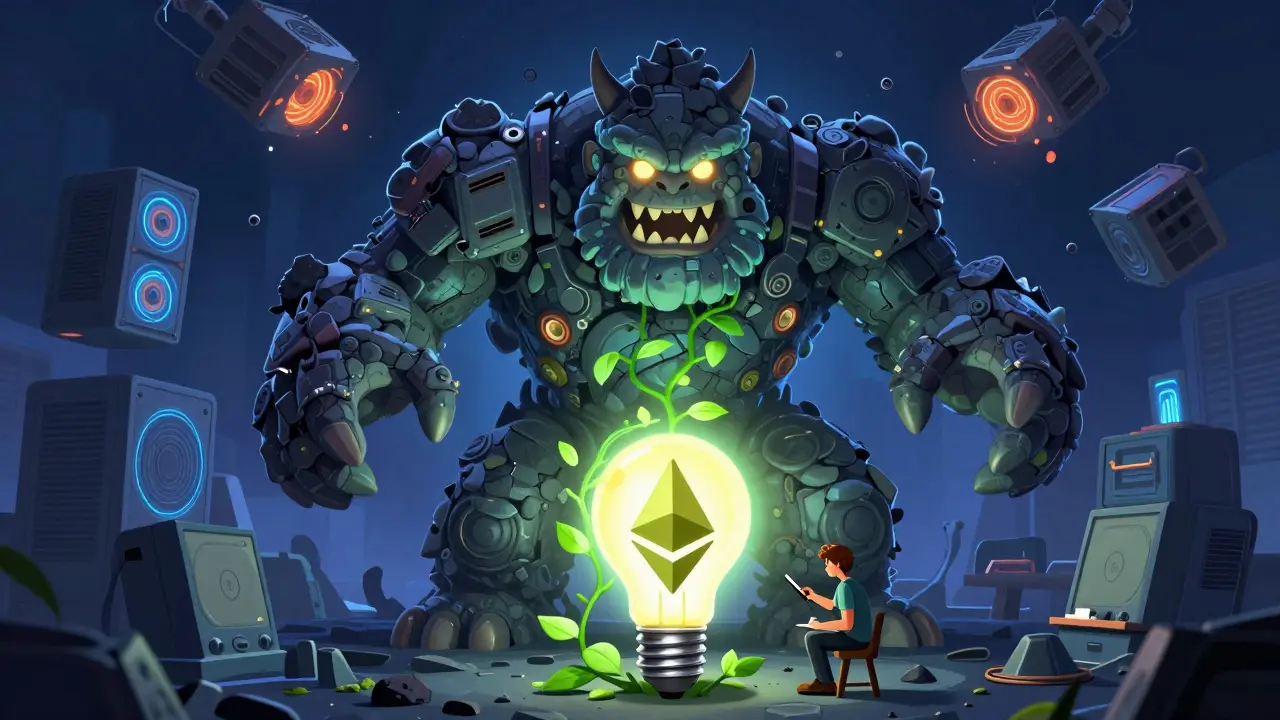
When NFT art exploded in popularity around 2021, it wasn’t just the prices that shocked people - it was the energy. A single NFT minted on Ethereum back then used as much electricity as an average U.S. household consumed in five days. That’s not a metaphor. That’s the math. And for a medium meant to represent creativity, the environmental cost felt like a betrayal.
Why NFTs Used So Much Power
NFTs aren’t files stored on a server. They’re records on a blockchain - a digital ledger that needs constant validation. Before September 2022, Ethereum, the most popular blockchain for NFTs, used a system called Proof-of-Work (PoW). This meant thousands of computers around the world were racing to solve complex math puzzles just to confirm a transaction. The winner got rewarded with cryptocurrency. The cost? Massive electricity use.One NFT minted on Ethereum pre-Merge consumed about 142 kWh. That’s the same as driving a car 100 miles. For a collection of 10,000 NFTs? That’s 1.4 million kWh - enough to power 130 homes for a year. And that’s just the minting. Every time someone bought, sold, or transferred an NFT, the same energy cost repeated. In 2021, the entire Ethereum network used 112 terawatt-hours (TWh) of electricity annually. That’s more than the entire country of the Netherlands.
Bitcoin, which also uses PoW, was even worse. One transaction used 707 kWh. For comparison, a single Bitcoin transaction used more energy than 150,000 Visa transactions. And while Bitcoin wasn’t the main chain for NFTs, its presence in the ecosystem meant the whole space was tied to a high-energy model.
The Merge Changed Everything
On September 15, 2022, Ethereum switched from Proof-of-Work to Proof-of-Stake (PoS). This wasn’t a tweak. It was a total overhaul. Instead of computers fighting to solve puzzles, validators were chosen based on how much cryptocurrency they locked up (staked). No mining. No energy wars.The result? Ethereum’s energy use dropped by 99.95%. Annual consumption fell from 112 TWh to just 0.01 TWh. That’s a 10,000-fold reduction. Think of it this way: if Ethereum was a power plant before, now it’s a single LED bulb.
That shift alone cut the carbon footprint of NFT art by nearly all of it. A single NFT transaction on post-Merge Ethereum now uses roughly 0.0004 kWh - less than sending five emails. The environmental panic didn’t vanish overnight, but the biggest source of the problem was gone.
Not All Blockchains Are Equal
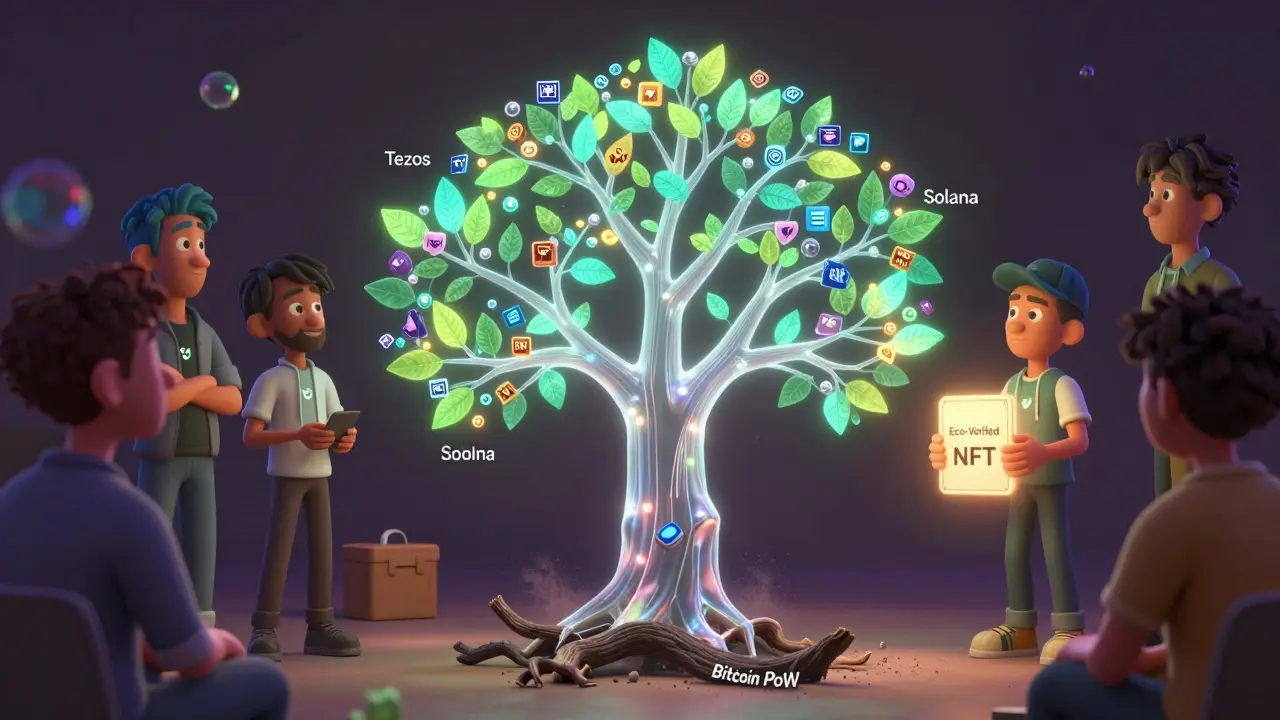
Ethereum’s switch didn’t make every NFT platform green. Some chains were always efficient. Others still burn power.- Tezos: Uses 0.0001 kWh per transaction - 1.4 million times less than old Ethereum.
- Hedera: 0.00017 kWh per transaction. Built for low energy from day one.
- Solana: 0.00046 kWh. Fast, cheap, and low-impact.
- Polygon: 0.000676 kWh. A sidechain that cuts Ethereum’s footprint by 99.9%.
- Bitcoin: Still 707 kWh per transaction. Avoid for NFTs.
Artists and collectors who care about sustainability now have clear choices. Platforms like Foundation, Objkt, and Hic et Nunc (on Tezos) have become go-to spots for eco-conscious creators. Meanwhile, OpenSea, which once dominated the market, now defaults to Ethereum’s PoS chain - a direct response to user pressure.
What’s Still Worrying Experts
Even with Ethereum’s cleanup, the environmental picture isn’t fully bright. Why? Because NFTs aren’t just on the blockchain.The digital file behind an NFT - the image, video, or audio - often lives on decentralized storage like IPFS or Filecoin. These networks still rely on servers running on fossil-fuel-powered grids. A 2023 study found that storing a single NFT’s metadata and file could add 0.5-2 kg of CO2, depending on where it’s hosted. That’s not much compared to old Ethereum, but it’s not zero.
Then there’s the rebound effect. As NFTs became cheaper and easier to mint, more people jumped in. In 2023, NFT transactions on Ethereum increased by 60% compared to 2021 - even with 99.95% less energy per transaction. The total energy use didn’t spike, but it didn’t vanish either.
And what about the legacy? Around 15.2 million tons of CO2 were emitted by NFTs on PoW blockchains before the Merge. That’s locked in. You can’t undo it. That’s why some researchers say we’re still in the red - even if we’re now moving forward.
What Artists and Collectors Are Doing About It
The community didn’t wait for regulators. People acted.Artist Beeple partnered with Coorest to plant 1,000 trees to offset the emissions from his 2022 NFT drop. That’s not just PR - it’s carbon accounting in action. Other creators now embed carbon footprint data directly into their NFTs using Adobe’s Content Credentials system. When you view the NFT, you see: “This item generated 0.002 kg of CO2.” Transparency is becoming the new standard.
Collectors are voting with their wallets. Tezos-based NFT sales jumped from 1.2% of the market in late 2021 to nearly 19% in mid-2023. Major auction houses like Sotheby’s and Christie’s stopped using Ethereum’s old chain entirely. Sotheby’s reported a 92% drop in emissions per NFT after switching.
Even marketplaces are changing. OpenSea’s negative reviews citing environmental concerns fell from 32% in late 2022 to 17% by mid-2023. Reddit communities like r/NFT saw a clear shift: “I used to avoid NFTs because of climate guilt. Now I mint on Tezos without a second thought.”

The Future Is Built on Standards
The EU’s MiCA regulation, which takes effect in 2024, will force all crypto platforms operating in Europe to disclose their energy use. That’s a game-changer. No more hiding behind vague claims.The W3F Blockchain Sustainability Working Group launched “Eco-Verified NFTs” - a certification for chains that use less than 0.1 kWh per transaction. As of August 2023, 47 platforms met the standard. By 2026, Gartner predicts 68% of NFT art will run on these low-impact chains.
And the tech keeps improving. Ethereum’s upcoming upgrades - Surge, Verge, Purge, Splurge - aim to cut energy use another 50-70% by 2025. That’s not a guess. It’s a roadmap.
Is NFT Art Sustainable Now?
Yes - but only if you choose it to be.The environmental nightmare of 2021 is over. The energy monster has been tamed. But sustainability isn’t automatic. It’s a decision. Every time you mint, buy, or sell an NFT, you’re choosing a blockchain. You’re choosing a server. You’re choosing whether your art contributes to a cleaner digital future - or just adds to the noise.
Artists who care? They’re on Tezos, Polygon, or Ethereum Post-Merge. Collectors who care? They check the chain before they click. Platforms that care? They now show carbon data upfront.
The tools are here. The knowledge is out there. The choice? That’s still yours.
Are NFTs still bad for the environment in 2026?
No - not if they’re made on modern blockchains. Ethereum’s switch to Proof-of-Stake in 2022 cut its energy use by 99.95%. Today, minting an NFT on Ethereum, Tezos, or Solana uses less energy than sending an email. The real problem now is legacy NFTs from 2021-2022, which still contribute to past emissions. But new NFTs? They’re mostly low-impact.
Which blockchain is the most eco-friendly for NFT art?
Tezos is currently the most energy-efficient, using just 0.0001 kWh per transaction - 2 million times less than old Ethereum. Hedera and Solana are also extremely low-impact. Ethereum Post-Merge is now safe, using 0.0004 kWh. Avoid Bitcoin and any chain still using Proof-of-Work.
Do NFTs still use a lot of electricity if I buy one?
No - not on modern chains. Buying, selling, or transferring an NFT on Ethereum, Tezos, or Polygon uses about the same energy as opening a webpage. The real electricity use happened during minting, and even that’s now minimal on sustainable blockchains. The bigger issue is how the digital file is stored - some platforms still use high-energy servers.
Can I offset the carbon footprint of my NFT?
Yes. Platforms like Coorest and IMPT let artists and collectors buy carbon offsets directly when minting or buying NFTs. Some artists now plant trees or fund renewable energy projects to balance emissions. Adobe’s Content Credentials system also lets creators embed carbon data into NFTs, so buyers know exactly what they’re supporting.
Why do some people still say NFTs are harmful?
Because they’re looking at old data. Many critics still cite 2021 numbers - when Ethereum used 142 kWh per NFT. That’s true, but it’s outdated. The bigger concern today is the legacy emissions from over 15 million tons of CO2 already released. Also, some platforms still use PoW, and storage networks like IPFS aren’t always green. The issue isn’t dead - it’s just changed.
Should I avoid NFT art because of the environment?
Not if you choose wisely. The environmental cost of NFT art has dropped dramatically since 2022. If you buy from platforms that use Ethereum Post-Merge, Tezos, or Solana - and check if the file storage is green - your impact is minimal. The real problem isn’t NFTs. It’s ignoring the choices you have.
Comments
I used to avoid NFTs like they were toxic waste... but now? I mint on Tezos and feel zero guilt. 🌱✨ Seriously, if you're still scared of NFTs because of 2021, you're living in the past. The tech moved on. Why not join us?
NFTs are fine now. Stop crying.
Ugh. Another ‘NFTs are green now’ article. Let me guess- you’re one of those people who thinks switching to PoS fixed everything? Lol. The carbon from 2021 is still out there. And guess what? People are minting 60% MORE now. So yeah. It’s not ‘fixed.’ It’s just quieter.
I mean... I love art. But the *idea* of owning a JPEG that’s stored on some server run by a guy in a basement in Latvia? And you’re telling me this is ‘sustainable’? Please. This is just capitalism with a blockchain hoodie. 🤡
I read this whole thing. I’m not an expert but... i think you’re right. the energy drop is insane. still... i wonder if the storage on ipfs is really being monitored. i feel like that’s the hidden cost.
I really appreciate how you broke this down. I used to be one of those people who’d scream ‘NFTs are destroying the planet!’ But after seeing the numbers post-Merge? I changed my mind. I now only buy on Tezos and Polygon. And I check where the file is hosted. It’s not perfect, but it’s progress. We can’t ignore the fact that we’re moving forward.
The narrative shift is textbook. You’ve successfully reframed ecological recklessness as ‘personal responsibility.’ How convenient. The systemic collapse of energy-intensive infrastructure is now reduced to a consumer choice. Bravo. You’ve turned climate accountability into a boutique lifestyle decision. How very 2023.
I don't trust this. I read somewhere that the 'merging' was just a PR stunt. They're still mining in secret. And who controls the validators? Big tech. Big crypto. Big oil. They're all the same. You think you're saving the planet? You're just being manipulated.
I just want to say thank you for writing this. I’m a digital artist and I used to feel so guilty about even thinking about NFTs. Then I found out about Tezos and it changed everything. Now I make art that tells a story and doesn’t cost the earth. Literally. I’ve even started teaching other artists how to do it. It feels good to be part of the solution.
It is imperative to acknowledge that the transition from Proof-of-Work to Proof-of-Stake constitutes a paradigmatic shift in the ontological framework of blockchain technology. However, one must not conflate technological efficiency with ecological rectitude. The latent emissions from prior iterations remain an indelible stain upon the digital landscape, and the normalization of transactional volume, irrespective of per-unit efficiency, perpetuates a metaphysical complacency.
I’ve been thinking about this a lot. It’s not just about energy. It’s about what we value. Before the Merge, we were rewarding computational brute force. Now we’re rewarding commitment-staking your coins means you have skin in the game. That’s not just efficient. It’s ethical. It’s a quiet revolution. And honestly? I think we’re just beginning to see what this means for how we build things in the future.
I’m a designer. I’ve sold 12 NFTs. All on Polygon. I don’t care if you think it’s ‘hippie tech.’ I care that my art doesn’t melt glaciers. 🌍✌️ And yeah, I check the storage. If it’s on IPFS, I make sure it’s hosted by a green provider. Small steps. Big difference.
I used to think NFTs were just a fad. Now I see them as a tool. Like any tool, it’s about how you use it. I’ve got a friend who’s using NFTs to fund clean water projects in rural India. That’s not hype. That’s hope.
I’ve been researching this for months. The real win isn’t just Ethereum’s drop. It’s that now, platforms are forced to show their numbers. Transparency is the new green. And that’s huge. We’re not just avoiding bad chains-we’re rewarding the good ones. That’s how change happens.
The transition from Proof-of-Work to Proof-of-Stake represents a significant advancement in the sustainability profile of blockchain ecosystems. However, one must remain cognizant of the fact that the cumulative environmental impact of prior transactions remains an irreversible externality. The current paradigm, while markedly improved, does not constitute a complete resolution.
NFTs? Nah. I’m not buying into this crypto cult. They’re just digital graffiti with a price tag. And don’t tell me ‘it’s green now’-I’ve seen the servers. They’re still running on coal. You think you’re saving the planet? You’re just pretending.
I’m a mom of two. I used to think NFTs were just for rich guys with too much time. But then I saw how artists I follow were using them to fund art programs for kids in foster care. Now I mint on Tezos. Not because I’m cool. But because I want my kids to grow up in a world where tech helps, not hurts. 🌱💖
yall act like the merge fixed everything but bro the servers are still running on power plants and the nfts are still stored on servers that use fossil fuels. you think you’re green? you’re just ignoring the real problem. the system is still rigged.
The real story here isn’t the energy drop. It’s the shift in incentive structures. PoS aligns economic value with long-term network health. That’s not just an upgrade. It’s a cultural evolution. The environmental win is a side effect of something deeper.