
For years, trading cryptocurrency in Nigeria is a country with one of the largest and most active digital asset markets globally felt like walking a tightrope. You could buy Bitcoin or Ethereum, but your bank might freeze your account if they caught wind of it. That era of ambiguity is officially over. As of mid-2026, the answer to whether crypto is regulated in Nigeria is a definitive yes. The landscape has shifted from restrictive bans to a structured, legally backed framework that defines how you can trade, hold, and tax your digital assets.
If you are holding crypto in Nigeria right now, understanding these changes isn't just about staying legal-it’s about protecting your money and knowing which platforms are safe to use. The government has moved quickly to bring order to a market that handled over $92 billion in value last year alone. Let’s break down exactly what this means for you, whether you are a casual trader or running a business.
The Big Shift: From Ban to Law
To understand where things stand today, you have to look at the recent history. For a long time, the Central Bank of Nigeria (CBN) is the monetary authority responsible for regulating banks and financial institutions in Nigeria was openly hostile toward crypto. In 2021, they issued circulars forbidding commercial banks from facilitating any transactions involving virtual assets. This didn’t stop Nigerians from using crypto; it just pushed the activity underground. People relied heavily on peer-to-peer (P2P) networks and informal dealers because traditional banking channels were blocked.
Then came the turning point. In December 2023, the CBN lifted the ban on crypto transactions. They introduced guidelines allowing banks to open accounts for licensed crypto businesses. But lifting the ban wasn’t enough. You needed a law that actually defined what crypto was under Nigerian jurisdiction. That arrived in March 2025 when President Bola Ahmed Tinubu signed the Investments and Securities Act (ISA) 2025 is legislation that officially recognizes digital assets as securities and establishes the regulatory framework for their trading. This act replaced the outdated 2007 law and gave the Securities and Exchange Commission (SEC) is the primary regulatory body overseeing capital markets and digital asset exchanges in Nigeria the power to regulate the industry properly.
This shift matters because it moves crypto from a gray area into the clear light of formal finance. It means there are rules, there are penalties for breaking them, and there are protections for consumers who use compliant platforms.
Who Is in Charge Now?
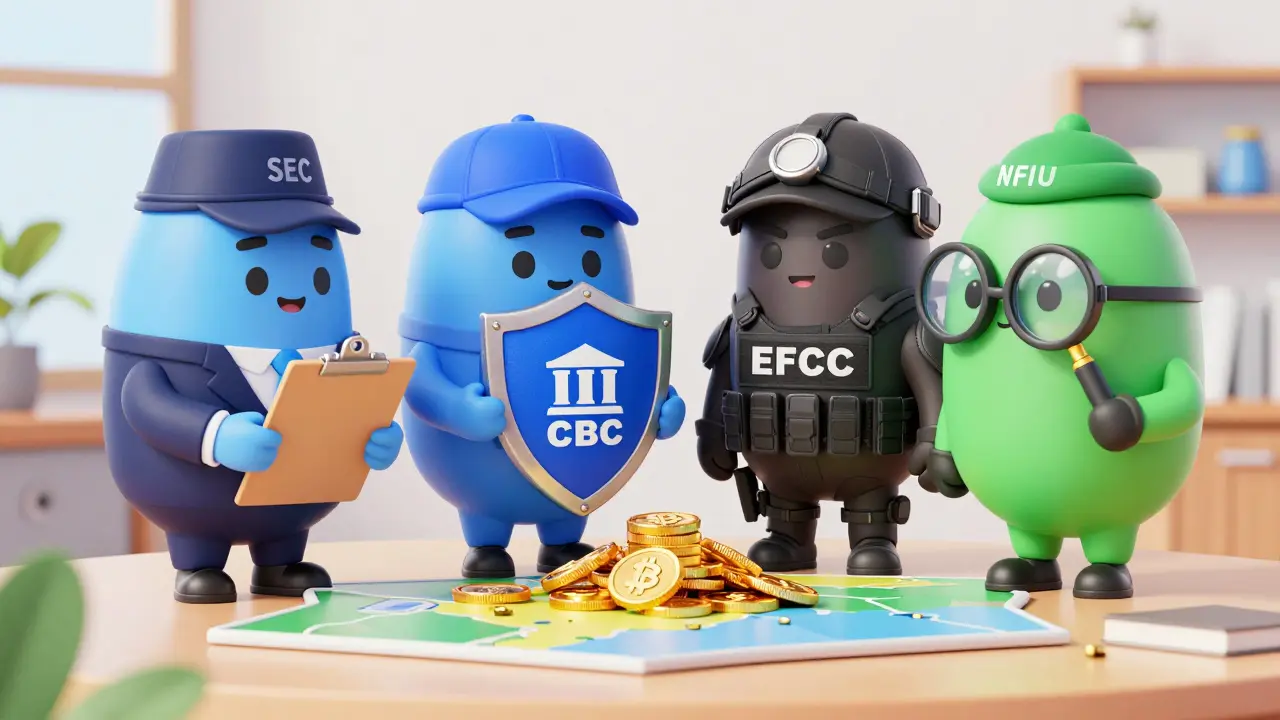
You might wonder who you need to listen to now that the ban is gone. It’s not just one agency anymore. The current system involves a coordinated effort between several key bodies:
- Securities and Exchange Commission (SEC): They are the main boss for crypto exchanges and token offerings. If you want to run an exchange in Nigeria, you answer to the SEC. They handle licensing, compliance checks, and enforcement against fraud.
- Central Bank of Nigeria (CBN): While they no longer ban crypto, they still control the banking side. They ensure that banks don’t facilitate money laundering through crypto channels. Their Virtual Asset Service Provider (VASP) guidelines dictate how banks interact with licensed crypto firms.
- Economic and Financial Crimes Commission (EFCC): This agency focuses on criminal activity. If someone is running a Ponzi scheme disguised as a crypto investment, the EFCC steps in. They work closely with the SEC to investigate suspicious transactions.
- Nigerian Financial Intelligence Unit (NFIU): They monitor financial data to prevent money laundering and terrorist financing. Under the amended National Anti-Money Laundering Act, they have specific tools to track virtual asset movements.
This multi-agency approach is different from some other countries where one regulator handles everything. In Nigeria, the division of labor means you get broader oversight, but it also means companies have to navigate more red tape to stay compliant.
Licensing Requirements for Exchanges
If you are looking to use a crypto platform in Nigeria, check if it is licensed. The SEC doesn’t just let anyone operate. Under the Digital Assets Rules 2022, which work alongside the ISA 2025, exchanges must meet strict criteria to get a license. By late 2024, only two major platforms had received provisional licenses: Busha is one of the first licensed cryptocurrency exchanges in Nigeria and Quidax is a leading licensed digital asset exchange operating in Nigeria. Dozens of other companies have applied, but the vetting process is thorough and slow.
To get licensed, a company must:
- Register as a Nigerian corporation with a physical office in the country.
- Appoint Nigerian management personnel.
- Meet minimum paid-up capital requirements (which vary by license type).
- Purchase fidelity bonds to protect client funds.
- Implement robust anti-money laundering (AML) and know-your-customer (KYC) systems.
Why does this matter to you? Because unlicensed platforms are operating illegally. If you use an unlicensed exchange, you have little recourse if they hack your funds or shut down overnight. Licensed platforms are subject to regular audits and must maintain reserves to cover user liabilities. Always verify the status of your exchange on the SEC’s official website before depositing large amounts.
| Feature | Pre-2025 Era | Post-ISA 2025 Era |
|---|---|---|
| Bank Accounts | Frozen for crypto activity | Allowed for licensed VASPs |
| Legal Status | Ambiguous/Restricted | Recognized as Securities |
| Primary Regulator | CBN (Ban Enforcement) | SEC (Oversight & Licensing) |
| Taxation | Unclear/Informal | Defined under NTAA 2025 |
| Consumer Protection | Minimal | Mandatory insurance/bonds for exchanges |
Taxes and Penalties: What You Need to Pay
Regulation brings clarity, but it also brings bills. The Nigeria Tax Administration Act (NTAA) 2025 is legislation introducing specific tax obligations and penalties for cryptocurrency activities in Nigeria, signed into law in June 2025, sets the stage for how crypto will be taxed starting in 2026. Unlike Kenya or South Africa, which introduced crypto taxes earlier, Nigeria waited until the regulatory framework was solid before implementing fiscal policies.
For individual users, this likely means reporting capital gains from crypto trades as part of your annual income tax return. The specifics for retail investors are still being fleshed out by the Federal Inland Revenue Service (FIRS), but the principle is clear: profit from crypto is taxable income. If you sell Bitcoin for a higher price than you bought it, that gain counts toward your taxable earnings.
For businesses and exchanges, the penalties for non-compliance are severe. The SEC has set strict fines for Virtual Asset Service Providers (VASPs) that fail to register or report correctly. The initial penalty for defaulting is ₦10 million (approximately $6,693) for the first month of non-compliance. After that, it adds up to ₦1 million ($669) for every additional month you remain unregistered. Beyond fines, the SEC can suspend or revoke licenses entirely. This shows the government is serious about cleaning up the sector and ensuring only legitimate players survive.

Impact on Everyday Users
How does all this affect you if you just want to send money to family abroad or save in stablecoins? The immediate impact is greater safety. With licensed exchanges, you are less likely to fall victim to scams. The SEC has explicitly banned Ponzi schemes and given regulators access to telecom records to investigate fraud. This makes the ecosystem safer for new users who might otherwise be targeted by bad actors.
However, convenience might take a slight hit. During the ban era, P2P trading was king because it bypassed banks. Now, while P2P still exists, licensed platforms are pushing users toward formal KYC processes. You will need to provide more identification documents to verify your identity. Some users worry about privacy and government surveillance, and those concerns are valid. The trade-off is security versus anonymity. If you value protection against fraud and legal certainty, the new system works in your favor. If you prioritize total anonymity, you may find the environment more restrictive than before.
Financial inclusion is another benefit. By bringing crypto into the formal economy, the government hopes to extend financial services to the millions of Nigerians who are unbanked. Crypto offers a low-cost way to store value and transfer funds without needing a traditional bank account. With proper regulation, these services become more reliable and accessible.
Challenges and Future Outlook
Despite the progress, challenges remain. The licensing process is slow. Many established platforms are still waiting for full approval, creating uncertainty for their users. There is also complexity in navigating the overlapping jurisdictions of the SEC, CBN, and EFCC. Companies often complain about conflicting guidance, which can delay product launches and increase compliance costs.
Looking ahead, Nigeria is positioning itself as a fintech hub for Africa. The combination of a young, tech-savvy population and a clear regulatory framework attracts foreign investment. We expect to see more institutional players entering the market, offering products like crypto-backed loans and decentralized finance (DeFi) services within the legal bounds. The National Blockchain Policy 2023 supports this trend by encouraging blockchain adoption beyond just currency, including supply chain and healthcare applications.
For the average user, the advice is simple: stick to licensed platforms, keep records of your transactions for tax purposes, and stay informed about updates from the SEC and FIRS. The days of flying under the radar are over, but the future of crypto in Nigeria looks brighter and more secure than ever.
Is it illegal to own cryptocurrency in Nigeria in 2026?
No, it is not illegal to own cryptocurrency in Nigeria. The Investments and Securities Act (ISA) 2025 legally recognizes digital assets as securities. However, you must use licensed platforms to trade, and you are required to pay taxes on any profits made from crypto transactions.
Which crypto exchanges are licensed in Nigeria?
As of late 2024 and early 2025, Busha and Quidax were the first to receive provisional licenses from the SEC. More platforms are expected to be approved as the registration process continues. Always check the SEC’s official website for the most current list of licensed entities.
Can I use my bank account for crypto transactions?
Yes, but only with licensed Virtual Asset Service Providers (VASPs). The Central Bank of Nigeria (CBN) lifted its ban in 2023, allowing banks to serve licensed crypto businesses. Using unlicensed platforms may still result in account restrictions.
Do I have to pay tax on my crypto gains?
Yes. Under the Nigeria Tax Administration Act (NTAA) 2025, profits from cryptocurrency trading are considered taxable income. You should keep detailed records of your buys and sells to report accurately during your annual tax filing.
What happens if I use an unlicensed exchange?
Using an unlicensed exchange carries significant risks. These platforms are not protected by consumer safeguards, meaning you could lose your funds without recourse. Additionally, the SEC actively penalizes unlicensed operators, which could lead to sudden shutdowns of the platform.