
When you send Bitcoin to an Ethereum wallet, something strange happens. It doesn’t just move. It gets locked up, a new token is minted on the other side, and suddenly you’re holding something called wrapped Bitcoin. This is cross-chain technology in action - a workaround for the fact that blockchains were never meant to talk to each other. Today, billions of dollars move between chains every day. But behind the scenes, this convenience is built on shaky ground. The problems aren’t just technical. They’re legal, financial, and even dangerous.
Why Cross-Chain Bridges Are the Weakest Link
Cross-chain bridges are the gateways that let assets hop between blockchains. Think of them like toll booths between countries - but instead of customs agents, they rely on smart contracts, or sometimes just a handful of operators. The problem? These bridges are the most targeted part of the entire crypto ecosystem. Between 2020 and 2024, researchers tracked 37 major exploits on cross-chain protocols. The biggest single loss? $320 million in 2022 on Wormhole. That’s not an outlier. It’s a pattern.Why are they so vulnerable? Because they’re complex. A trustless bridge - one that doesn’t rely on a central authority - uses cryptographic puzzles like Hashed TimeLock Contracts to lock and release assets. But if one part of the puzzle fails, the whole system collapses. And even trusted bridges, like those run by exchanges, aren’t safe. They become single points of failure. In 2021, attackers used four different bridges to move $55 million across three chains, making it nearly impossible to trace. The more chains a bridge connects, the more ways it can break.
The Money Trail Vanishes
Imagine tracking a stolen car. You follow its GPS, then it crosses a border. Suddenly, the signal cuts out. That’s what happens when crypto moves across chains. Blockchain analytics tools were built for single chains. They can track every Bitcoin transaction. But when those coins hop to Solana, then to Polygon, then to Arbitrum, the trail disappears.Elliptic’s 2025 report found that over $21.8 billion in illicit crypto was laundered using cross-chain bridges last year. That’s a fivefold increase since 2022. Criminals don’t just use one chain anymore. They spread their money across five or six, using different bridges each time. The result? Law enforcement agencies are stuck. One investigator told Merkle Science, “We lose the trail every time it crosses a bridge.”
Even worse, destination addresses are invisible. If you send $10,000 from Ethereum to Binance Smart Chain, you can’t see where it ends up. The bridge hides the final wallet. That’s why KYC-Chain calls cross-chain activity “a fully embedded feature of illicit activity.”
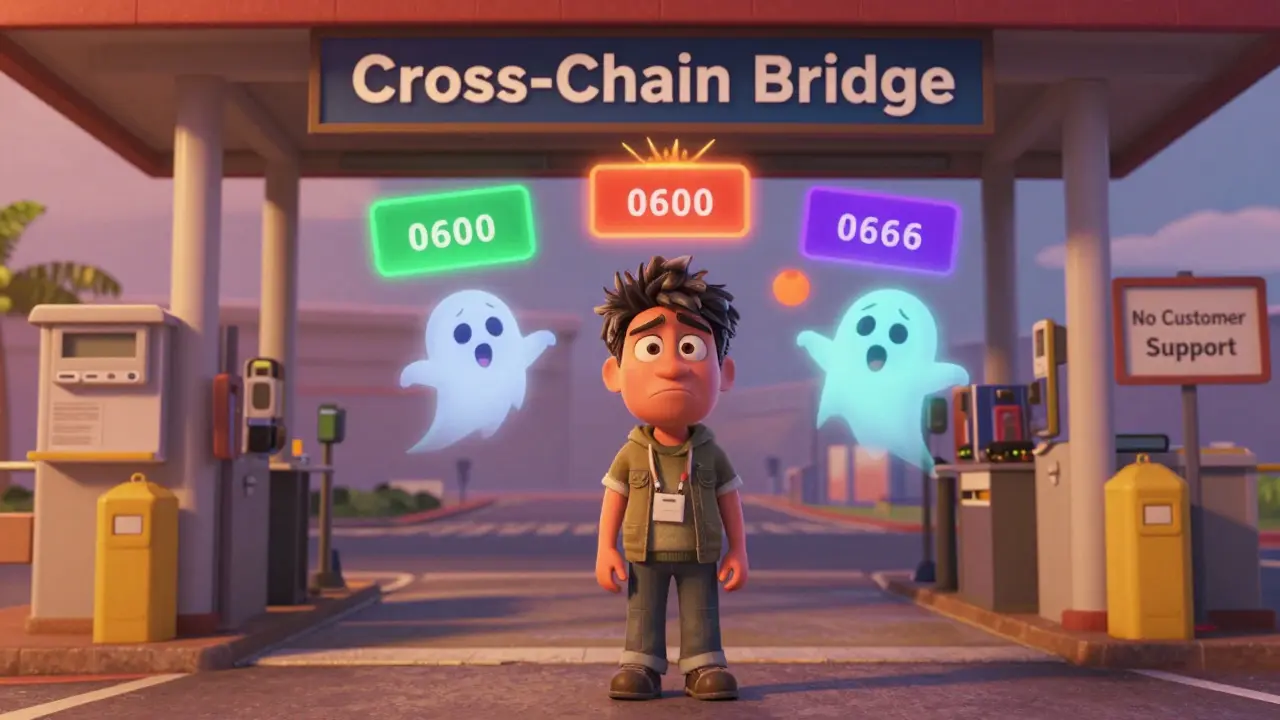
Users Are Frustrated - And Losing Money
It’s not just criminals who suffer. Everyday users are getting burned.Reddit user BlockchainNewbie42 tried to move $150 from Ethereum to Polygon in January 2025. It took 47 minutes. Three attempts failed. In the end, they paid $28.73 in gas fees - almost 20% of the amount they were transferring. That’s not a glitch. That’s normal.
Trustpilot reviews for major cross-chain services average just 2.8 out of 5 stars. Of the negative reviews, 63% mention “unexpected transaction failures.” Another 58% complain about no customer support when things go wrong. Most bridges have no live chat, no phone line, no help desk. If your funds get stuck, you’re on your own.
On the flip side, some users report smooth experiences. DeFiWhale88 moved $2.3 million across five chains using Axelar with only 0.87% slippage and zero failures. But that’s the exception. It requires deep technical knowledge, perfect timing, and luck. For most people, cross-chain transfers are a gamble.
Businesses Are Stuck Between Innovation and Regulation
Enterprises want to use cross-chain tech. It could cut costs, speed up payments, and open new markets. But they can’t.A 2025 survey of 350 enterprise blockchain projects found that 70% cite “unclear regulations” as their biggest barrier. What happens if you send data from a European blockchain to a U.S. one? Does GDPR still apply? Who’s liable if the data leaks? There are no answers.
Even when companies try to comply, the tools don’t exist. Traditional AML systems look for blacklisted wallets. But cross-chain activity scrambles those lists. A wallet might be clean on Ethereum, but after three hops, it’s been used by a drug dealer on Solana. KYC-Chain’s CEO says compliance teams can’t rely on static lists anymore. They need “behavioral risk detection and multi-entity resolution.” In plain terms: AI that can track how money moves across chains - not just where it starts.
That’s why companies like Elliptic and KYC-Chain are racing to build new tools. Elliptic’s March 2025 update claims to turn hours of manual investigation into minutes. But these tools are expensive. Only big players can afford them. That means small businesses, startups, and even mid-sized crypto firms are left in the dark.

The Standards Gap Is Widening
There are over 127 cross-chain protocols in use today. The top five - Axelar, LayerZero, Chainlink CCIP, Wormhole, and Multichain - control 68% of the total value locked. But none of them talk to each other. Each has its own message format, its own security model, its own rules.That’s why 80% of blockchain projects struggle to integrate cross-chain functionality. It’s not just hard. It’s expensive. One enterprise deployment takes 3 to 6 months. And even then, 78% of teams report issues with “key management across chains.” How do you securely store a private key that works on Ethereum, Solana, and Polygon? No one has a clean answer.
Documentation varies wildly. Wormhole’s docs get a 3.2/5 rating. Axelar’s? 4.5/5. That’s not just about clarity - it’s about survival. If you’re building a DeFi app and the bridge docs are outdated, your users lose money. And you lose trust.
What’s Next? Consolidation or Collapse?
The market is growing fast. Cross-chain protocols generated 57% of all DeFi revenue in 2025. Transaction volume hit $32 trillion in 2024. But growth doesn’t mean stability.Forrester predicts that by 2027, only 15 to 20 of these protocols will survive. Gartner warns that without standardized regulation, cross-chain tech has a 40% chance of becoming so fragmented it’s unusable for enterprise applications by 2028.
The biggest wildcard? The EU’s MiCA 2.0 framework, expected to roll out in Q3 2025. It could require every cross-chain bridge to log every transaction, report suspicious activity, and prove it can trace funds across all chains. If it passes, it might force the industry to standardize. If it fails? The chaos continues.
Right now, cross-chain technology is like a high-speed train with no brakes. It’s fast. It’s powerful. And it’s heading straight into a wall.
What is the biggest risk of using cross-chain bridges?
The biggest risk is security. Cross-chain bridges are the most exploited part of the blockchain ecosystem. Between 2020 and 2024, over $1.2 billion was stolen from bridges in known attacks. Many bridges rely on centralized operators or complex smart contracts that can be hacked. Once funds are moved across chains, they’re nearly impossible to recover.
Why can’t regulators track money moving across chains?
Traditional blockchain analytics tools are built for single chains. They can follow a Bitcoin or Ethereum transaction step by step. But when funds hop from Ethereum to Solana via a bridge, the destination address is hidden. The bridge doesn’t reveal the final wallet. This creates blind spots that criminals exploit. Even with new tools, tracing across five or six chains still takes hours - and often fails.
Are cross-chain transfers safe for everyday users?
Not really. Most users face high fees, long delays, and frequent failures. A 2025 survey found 35% of users struggled with cross-chain interfaces. Some transfers cost more in gas fees than the amount sent. Customer support is almost nonexistent. If a transaction fails, there’s no one to call. For casual users, the risks often outweigh the benefits.
How do cross-chain bridges differ from centralized exchanges?
Centralized exchanges (like Binance or Coinbase) act as trusted intermediaries. They hold your crypto, convert it, and send it out. That’s safer, but you give up control. Cross-chain bridges are decentralized - no company holds your funds. But that means you’re trusting code, not people. If the code fails, your money is gone. Centralized exchanges have customer service. Bridges don’t.
Will cross-chain technology become standard in finance?
It depends on regulation. Right now, 45% of organizations are worried about GDPR and CCPA compliance when using cross-chain tools. If global standards emerge - like the EU’s MiCA 2.0 - bridges may be forced to log and trace every transaction. That could make them usable for banks and enterprises. Without it, they’ll remain niche tools for crypto-native users, not mainstream finance.


Comments
Ugh, another post pretending cross-chain bridges are some revolutionary tech. They’re just glorified middlemen with worse security than your grandma’s Gmail. And don’t even get me started on ‘wrapped’ assets - it’s like buying a fake Rolex and calling it ‘authentic-looking.’
Meanwhile, real innovation? That’s happening in ZK-rollups and account abstraction. But nooo, we gotta keep patching together broken Lego towers and calling it ‘interoperability.’
Also, ‘$320 million lost’? That’s not a bug, it’s a feature of DeFi’s entire business model. Burn it all down and start over.
Look, I’m not saying I’m an expert-though I am-but have you considered that the entire premise of cross-chain bridges is fundamentally flawed because it assumes that blockchains are meant to be interoperable? They weren’t. They were designed as siloed, trust-minimized ledgers. The moment you try to force them to communicate, you introduce attack surfaces that are exponentially more complex than any single-chain system. And let’s not even talk about the fact that 87% of bridge operators still use multi-sig wallets with 3-of-5 thresholds… which, statistically speaking, means that at least one of those keys is probably stored on an unencrypted USB drive in someone’s basement in Minsk.
Also, gas fees? Pfft. You think $28.73 is bad? Try doing a swap on Arbitrum Nova during peak NFT minting season. I once paid $412 in gas to move $500. That’s not a fee. That’s a tax on desperation.
And don’t even get me started on how KYC-Chain is just a rebranded data broker with a fancy dashboard. They’re not solving anything-they’re just monetizing the chaos.
Hey, I get it-cross-chain tech is messy. But let’s not throw the baby out with the bathwater.
Yes, there are hacks. Yes, fees are insane. Yes, support is nonexistent. But I’ve seen users go from zero crypto knowledge to managing multi-chain portfolios in under a month. With better docs, better UX, and more empathy from devs, this can be a tool that empowers people-not just whales.
If you’re building something, don’t just complain. Build a better bridge. Teach someone. Share a tutorial. The tools are getting better. The users are learning. We just need more patience and less drama.
And if you’re stuck? There’s a Discord group called ChainHelpers that’s actually helpful. I’ll DM you the link.
AMERICA BUILDS BRIDGES. NOT CHINA. NOT EUROPE. AMERICA.
These bridges are just crypto’s way of letting foreigners steal our money. 🇺🇸
Why do we even let this happen? Blockchains should be AMERICAN. Secure. Strong. No foreign keys. No foreign chains. NO MORE WRAPPED BITCOIN. JUST BITCOIN. IN AMERICA.
Also, I saw a guy on TikTok say this is all a CIA plot. He had graphs. He was right.
It’s funny how everyone acts like this is new. The same exact problems existed in the early 2000s with SOAP and XML-RPC. Everyone wanted ‘interoperability,’ but no one wanted to standardize. So we got a thousand fragmented APIs and a decade of pain.
Now we’re doing it again, but with crypto jargon and more rug pulls.
The real issue isn’t security-it’s incentive alignment. Nobody has skin in the game except the users. The devs? They get paid in tokens. The investors? They exit before the exploit. The users? They lose everything.
And don’t even mention MiCA. That’s just the EU trying to regulate something they don’t understand. Again.
Oh wow. A 12-page essay on why cross-chain tech is a disaster. Congrats. You just wrote the most expensive blog post in history.
Here’s the truth: cross-chain bridges are the only reason DeFi still exists. Without them, Ethereum would be a dead island. Solana? A meme. Polygon? A glorified sidechain.
The fact that you’re shocked by $320 million in hacks means you’ve never actually used DeFi. I’ve lost more than that in failed swaps. And guess what? I’m still here. Because I know the game.
Stop treating crypto like a bank. It’s a casino with better code. And if you can’t handle the volatility, don’t touch it.
It’s not about bridges. It’s about identity. When you move assets across chains, you’re not moving money-you’re moving fragments of your digital self. And no one has figured out how to preserve the integrity of that identity across systems.
Think about it: if your Bitcoin becomes wBTC on Ethereum, then becomes USDC on Solana, then becomes a wrapped NFT on Arbitrum… are you still you? Or are you just a series of contract calls?
Maybe the real problem isn’t security. It’s existential. We’ve outsourced our ownership to machines that don’t care if we lose everything.
And that… is terrifying.
Everyone’s focused on the tech. But the real issue? No one’s accountable.
Who gets fired when a bridge gets hacked? Who goes to jail? Who pays for the losses? No one. Not the devs. Not the investors. Not the exchanges.
It’s all ‘decentralized,’ which means ‘nobody’s responsible.’
Meanwhile, banks have compliance officers, auditors, insurance, legal teams. Crypto? You get a Discord DM that says ‘check the docs.’
That’s not innovation. That’s negligence dressed up as ideology.
Just wanted to share-last week I helped a friend move $8k from Ethereum to Solana using LayerZero. Took 12 mins. Fees were $1.42. No issues.
Key thing? Use a trusted bridge, double-check the token address, and don’t rush. Most failures happen because people click ‘approve’ without reading.
Also, try using Zerion or Zerion Wallet. It auto-detects bridge risks. Super helpful for beginners.
And yeah, support is trash-but there’s a subreddit called r/crosschain that’s actually active. I’ve answered 47 questions there. You’re not alone.
Did you know the Wormhole hack was orchestrated by the NSA? They needed a test case for quantum decryption. The $320M? It was all fake. The funds were never lost-they were copied into a parallel blockchain only the government can access.
That’s why they’re pushing MiCA. To force everyone to use centralized logging. So they can track us.
Don’t use bridges. Use cash. Or gold. Or barter. Anything but this.
From India, I can say this: we don’t have access to fancy tools like Elliptic or KYC-Chain. But we still use bridges. Every day. For remittances. For small businesses. For buying crypto with UPI.
Yes, it’s messy. Yes, sometimes it fails. But it’s the only way many of us can participate.
Stop talking about ‘enterprise adoption.’ The real innovation is happening in villages, not Silicon Valley.
We don’t need perfect bridges. We need accessible ones.
Biggest takeaway? Stop blaming the tech. Start blaming the design.
Bridges aren’t broken because they’re decentralized. They’re broken because they’re designed to be used by people who don’t understand them.
If you build something that requires a PhD to use safely, you’ve already failed.
UX is the real vulnerability. Not the code.
Fix the interface. Fix the onboarding. Fix the error messages. Then the security will follow.
Everyone’s missing the point. Cross-chain tech isn’t about moving assets. It’s about moving trust.
When you bridge from Ethereum to Polygon, you’re not just moving tokens-you’re trusting that the validators on Polygon won’t collude, that the oracle won’t lie, that the contract won’t be upgraded maliciously.
That’s not technology. That’s theology.
And we’re all just praying to the smart contract gods.
Let’s be real: cross-chain bridges are the crypto equivalent of airline transfers.
You get to your destination. Eventually.
But you lose your luggage. Pay $300 in fees. Wait 12 hours. And end up in a different country than you planned.
Yet somehow, people keep doing it.
Because they’re desperate. Or foolish. Or both.
And the airlines? They’re making bank.
INNOVATION IS NEVER EASY
THE PATH TO THE FUTURE IS NEVER STRAIGHT
EVERY GREAT TECHNOLOGY WAS ONCE CONSIDERED A RISK
WE MUST EMBRACE CHAOS TO ACHIEVE TRANSCENDENCE
THE BRIDGES ARE NOT THE PROBLEM
THE FEAR IS
It’s not a technical problem. It’s a moral one.
Why are we building systems that allow criminals to launder billions while ordinary users lose their life savings?
Because we’ve normalized risk. We’ve glorified volatility. We’ve turned financial ruin into a badge of honor.
And now we’re surprised when it all collapses?
Wake up.
Here’s what nobody’s saying: cross-chain tech works better than it should.
Think about it-there are over 127 protocols, most built by anonymous teams, with zero funding, and yet they move trillions.
The real miracle isn’t the bridges. It’s that we’re still standing after all these hacks.
People keep using them. Because they have no choice.
And that says more about the system than any exploit ever could.
I just want to say thank you for writing this.
It’s rare to see someone lay out the real costs-not just financial, but emotional.
I lost $1200 last year trying to bridge to Arbitrum. No one helped. No one replied.
I didn’t post about it. I just… stopped.
But reading this made me feel less alone.
They’re all being controlled by the Illuminati. The bridges are just a front. The real money is being sent to Mars.
Look at the transaction hashes. They all end in 666.
Also, I saw a video on YouTube. A guy in a lab coat said the next bridge hack will happen on April 17. Mark your calendars.
Wow. A whole comment thread full of people pretending this isn’t just a giant Ponzi scheme with better PR.
Someone actually thinks LayerZero is ‘safe’? Lol.
Go back to your yield farms, Karen.
Hey, I appreciate the pushback.
But if you’ve got a better idea, I’m all ears.
Until then, I’m still helping people learn. One bridge at a time.