
When you hold Bitcoin, Ethereum, or even a memecoin, you’re not just investing in technology-you’re navigating a legal minefield that changes by the week. In 2025, crypto regulations didn’t just shift; they exploded into new shapes across continents. What was legal last year might be a felony today. And if you’re not tracking these changes, you’re risking fines, account freezes, or worse.
What’s Really Happening in the U.S.?
The U.S. didn’t just tweak its crypto rules in 2025-it rewrote them. After years of enforcement-heavy tactics-where agencies like the SEC sued first and asked questions later-the Trump administration flipped the script. On January 23, 2025, an executive order created a task force with one mission: regulatory clarity.
By February, the SEC dropped investigations into OpenSea and Robinhood. Coinbase’s legal troubles were dismissed. And on February 27, they made a bombshell move: memecoins are no longer classified as securities. That’s huge. It means Dogecoin, Shiba Inu, and similar tokens won’t face the same scrutiny as stocks. This wasn’t a softening-it was a structural shift.
But it’s not all smooth sailing. The Stablecoin Trust Act is moving fast. If passed, stablecoin issuers will need federal licenses, must hold segregated reserves, and submit to audits by the Federal Reserve and OCC. That’s a big hurdle for small players. Meanwhile, the FIT Act proposes splitting oversight: SEC for securities, CFTC for commodities. That should cut the red tape, but only if it passes.
And don’t forget OKX. On February 24, 2025, they pleaded guilty to running an unlicensed money service business and paid millions in fines. So yes-some enforcement still happens. The message? Play by the new rules, or get hit hard.
Europe: MiCAR Is Live, But It’s Complicated
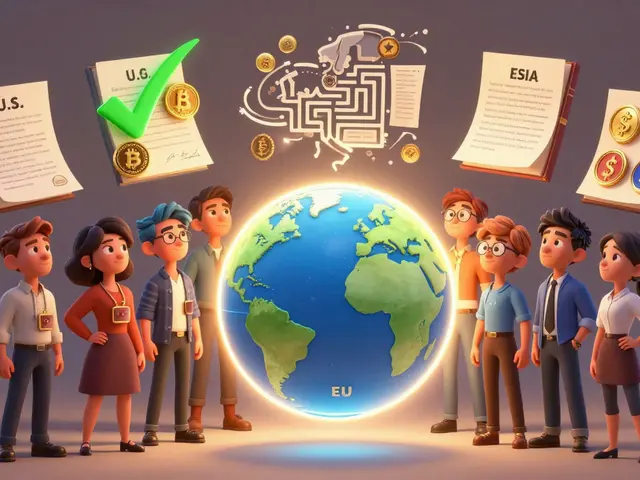
The EU’s Markets in Crypto-Assets Regulation (MiCAR) went fully into effect in 2025. It’s the most detailed crypto rulebook in the world. Every exchange, wallet provider, and token issuer operating in the EU now needs a license. They must prove they have enough capital, disclose risks clearly, and protect users’ funds.
Here’s the catch: MiCAR rolls out in phases. Some rules started in January. Others kick in later this year. That means a company in Germany might be fully compliant, while the same company’s branch in Italy is still scrambling. This isn’t a single rule-it’s a patchwork of deadlines.
Major cities like Frankfurt and Paris are competing to become Europe’s crypto hub. But they can’t cut corners. MiCAR is strict. If you’re running a DeFi protocol or issuing NFTs tied to financial rights, you’re likely covered. And if you’re not licensed? You’re not allowed to operate in the EU.
Asia: Hong Kong and Singapore Are Leading the Charge
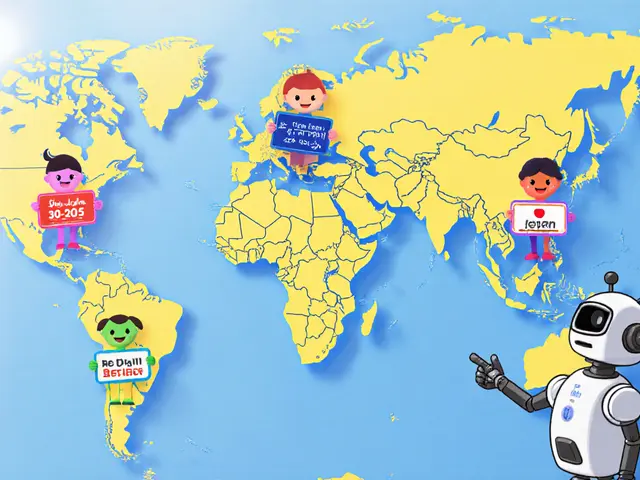
While the U.S. and EU debate, Asia moved. Hong Kong SAR launched a full licensing system for crypto exchanges in early 2025. Now, any platform offering trading, custody, or over-the-counter services needs government approval. They also introduced rules for crypto derivatives and lending-something most Western regulators still avoid.
Singapore didn’t just follow-they refined. They finalized their stablecoin framework, requiring issuers to back every token 1:1 with cash or short-term government bonds. No creative accounting. No hidden reserves. Just transparency.
These two hubs aren’t trying to be crypto utopias. They’re trying to be trustworthy. That’s why global firms like Binance, Kraken, and Coinbase are shifting key operations to Asia. The rules are clear. The penalties are known. And the business environment? Predictable.
Global Standards: Who’s Setting the Rules Behind the Scenes?
You think regulation happens in national capitals? Think again. The real work is happening in quiet rooms in Basel, Paris, and Washington, D.C.-where global bodies set the invisible rules.
The Basel Committee now requires banks to hold more capital if they hold Bitcoin or Ethereum. That means your bank might limit your crypto purchases-not because they’re against it, but because regulators told them to.
The Financial Action Task Force (FATF) pushed hard on the “travel rule.” Now, any transaction over $3,000 between wallets must include sender and receiver info. If your exchange doesn’t collect that data, they’re breaking international law.
The Bank for International Settlements (BIS) and Financial Stability Board (FSB) are working on cross-border standards for stablecoins. Why? Because if a U.S.-based stablecoin collapses, it could trigger panic in Europe or Asia. These groups don’t enforce-they influence. And their influence is growing.
The Hidden Trap: Unhosted Wallets and FinCEN’s New Rule
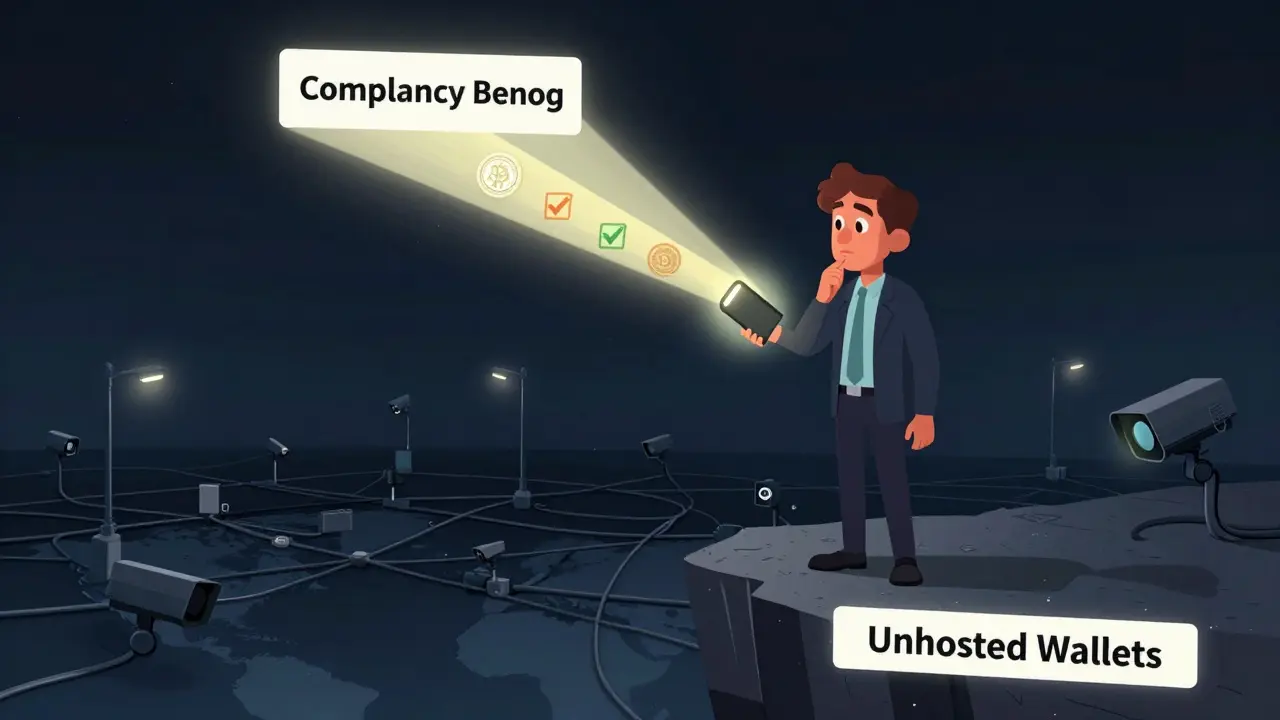
Here’s something most people miss: your personal wallet might soon be under government scrutiny.
FinCEN, the U.S. financial crimes unit, proposed a rule in 2025 that would treat Bitcoin and Ether as “monetary instruments”-just like cash. If you send more than $3,000 from your MetaMask wallet to someone else’s, your exchange might have to report it. Even if you’re not using an exchange.
Why? Because the rule targets “unhosted wallets”-wallets not controlled by a company. If you’re holding crypto on a hardware device or a self-custody app, you’re now in the crosshairs. Banks and MSBs will need to verify your identity and track your transactions. That’s not just surveillance-it’s a major shift in how privacy is treated in crypto.

Why This Matters: Your Wallet Is a Legal Asset Now
Crypto isn’t just about price charts anymore. It’s about legal status. Is your token a security? A commodity? A currency? The answer changes everything.
If you’re trading in the U.S., memecoins are safe-for now. But if you’re in the EU, you need a license to even list them. If you’re sending crypto from Singapore to a friend in Brazil, you might trigger a report. And if you’re using an unhosted wallet? You might be flagged by your bank.
Compliance isn’t optional anymore. It’s baked into the infrastructure. Exchanges won’t let you deposit unless you’ve passed KYC. Banks won’t process crypto transfers unless they’re labeled correctly. And if you’re running a business? You’re now part of a global regulatory web.
How to Stay Ahead: Your Action Plan
You don’t need to be a lawyer. But you do need a system.
- Track the big three: U.S. legislation (SEC/CFTC), EU MiCAR, and FATF travel rule updates.
- Know your jurisdiction: Are you based in the U.S.? The EU? Asia? Each has different rules. Don’t assume global rules apply locally.
- Use trusted sources: Follow official regulatory websites-not crypto influencers. The SEC, EU Commission, and HKMA publish updates in plain language.
- Update your tools: If your wallet or exchange doesn’t comply with new rules, switch. Non-compliant platforms get shut down fast.
- Document everything: Keep records of every transaction, especially large ones. If FinCEN comes knocking, you’ll need proof.
There’s no magic tool that auto-updates your compliance status. But if you spend 20 minutes a month checking official updates, you’ll avoid 90% of the risks.
The Bottom Line
Crypto regulation isn’t slowing down-it’s accelerating. And it’s no longer about banning or embracing crypto. It’s about controlling it. The winners will be those who adapt fast. The losers? Those who assume the rules won’t change.
Right now, the U.S. is relaxing, Europe is tightening, Asia is building, and global bodies are connecting the dots. Your crypto isn’t just digital-it’s legal. And if you ignore that, you’re playing with fire.
Are memecoins legal everywhere now?
No. The U.S. SEC no longer treats memecoins as securities, but that only applies within U.S. jurisdiction. In the EU, memecoins still fall under MiCAR’s token classification rules. In some countries like China or India, they’re outright banned. Always check local laws.
Can I use a non-KYC exchange without getting in trouble?
It’s risky. Even if the exchange doesn’t require KYC, your bank or payment provider might. FinCEN’s 2025 rule means financial institutions must report suspicious activity-even if the crypto came from an unregulated platform. Using non-KYC services could trigger bank freezes or tax audits.
Do I need to report every crypto transaction on my taxes?
In most countries, yes. The U.S. IRS treats crypto as property, so every sale, trade, or gift over $10 is taxable. The EU requires reporting under DAC8, which starts in 2026. Singapore and Hong Kong also require disclosure. Ignoring this can lead to penalties, audits, or criminal charges.
What happens if I move crypto between exchanges?
Moving between exchanges you own is usually not taxable-but it can trigger reporting. If you’re transferring from a U.S.-based exchange to a non-KYC one, your bank might flag it as suspicious. Always keep records of wallet addresses and dates. Some countries require you to declare all wallet holdings annually.
Is DeFi still legal under new regulations?
It depends. In the U.S., DeFi protocols aren’t directly regulated-but if you interact with them through a licensed platform, you’re covered by that platform’s compliance. In the EU, DeFi platforms that offer lending, staking, or trading must get a MiCAR license. If you’re running a DeFi app without a legal entity, you’re operating illegally in most jurisdictions.
Comments
i've been holding btc since 2021 and honestly the u.s. shift on memecoins is a breath of fresh air. no more SEC witch hunts over doge and shiba. finally someone gets it - crypto isn't stocks. just wish they'd clarify nfts too.
The regulatory clarity offered by the U.S. executive order is, in theory, commendable; however, the absence of harmonized international standards creates a fragmented ecosystem wherein compliance becomes an exercise in jurisdictional roulette.
why are indians still using binance when india has clear rules and the u.s. is now open for business? we dont need chaos we need structure and the u.s. just gave it to us
i read this whole thing and honestly the miCAR rollout is way more complicated than they make it sound. i work with a small eu-based deFi project and we’re still figuring out if our liquidity pool counts as a ‘token issuance’ or just ‘service provision’. the docs are 400 pages long and half of them are footnotes.
crypto regulation isn’t about control. it’s about integration. we’re moving from a wild west to a regulated market - and that’s evolution not oppression. the real threat is pretending this isn’t happening.
they say memecoins arent securities anymore but what about when they pump 500% in a day and then crash? thats still gambling
the fincen unhosted wallet rule is the real sleeper hit here. if my hardware wallet gets flagged just because i sent 3k to a friend, we’re one step from bank accounts tracking every crypto movement. privacy is dead.
i just want to buy shiba without my bank freezing my account. the fact that i have to check three different countries’ rules just to send crypto to my cousin in mexico is insane. can we please just… not?
regulation isn’t the enemy. the enemy is the assumption that regulation is monolithic. the truth is we’re seeing a patchwork of governance - national, supranational, and de facto - and the only thing that matters is whether you’re operating within the boundaries of the systems that actually enforce consequences. most people think they’re decentralized. they’re not. they’re just operating in the blind spots of a system that’s rapidly closing those gaps.
if you’re still using a non-kyc exchange after fincen’s 2025 rule, you’re not being edgy - you’re being a liability. your transaction history gets tied to your ip, your bank, your device. it’s not about trust - it’s about traceability. if you don’t want scrutiny, don’t send large amounts. simple.
i used to think crypto was about freedom. now i see it’s about responsibility. the more we demand privacy, the more regulators clamp down. maybe the answer isn’t fighting the system but building within it.
you guys are overthinking this. just use coinbase. they handle all the legal junk. stop being crypto purists and start being practical. 💸
As someone from India, I must say the clarity in Hong Kong and Singapore’s approach is truly admirable. Their focus on transparency and institutional-grade compliance is not just smart - it’s sustainable. We in emerging markets need models like this, not theoretical debates. Regulatory certainty attracts real capital, not just speculation.
Okay, so the U.S. says memecoins aren’t securities… but then FinCEN says my MetaMask is a ‘monetary instrument’? So now I’m a money transmitter just for holding Dogecoin? This isn’t regulation - it’s a bureaucratic nightmare wrapped in a PowerPoint deck.
The notion that regulation stifles innovation is a myth perpetuated by those unwilling to adapt. True innovation thrives within structure. Hong Kong’s licensing system does not hinder growth - it filters out fraud and elevates legitimate actors. Without standards, crypto remains a carnival, not a currency.
MiCAR is a regulatory overreach disguised as consumer protection. If I want to trade an NFT that represents a meme, why should I need a license? This isn’t finance - it’s culture. And culture doesn’t need a compliance officer to validate its existence.
if you’re still using unhosted wallets in 2025 you’re either a crypto anarchist or just clueless. the world moved on. your privacy fantasy is over. get a coinbase account and stop being a problem.
the real story here isn’t the u.s. or the eu - it’s asia. hong kong and singapore are building the future of finance. they’re not trying to ban crypto. they’re trying to own it. the global center of gravity is shifting - and if you’re not watching asia, you’re already behind.