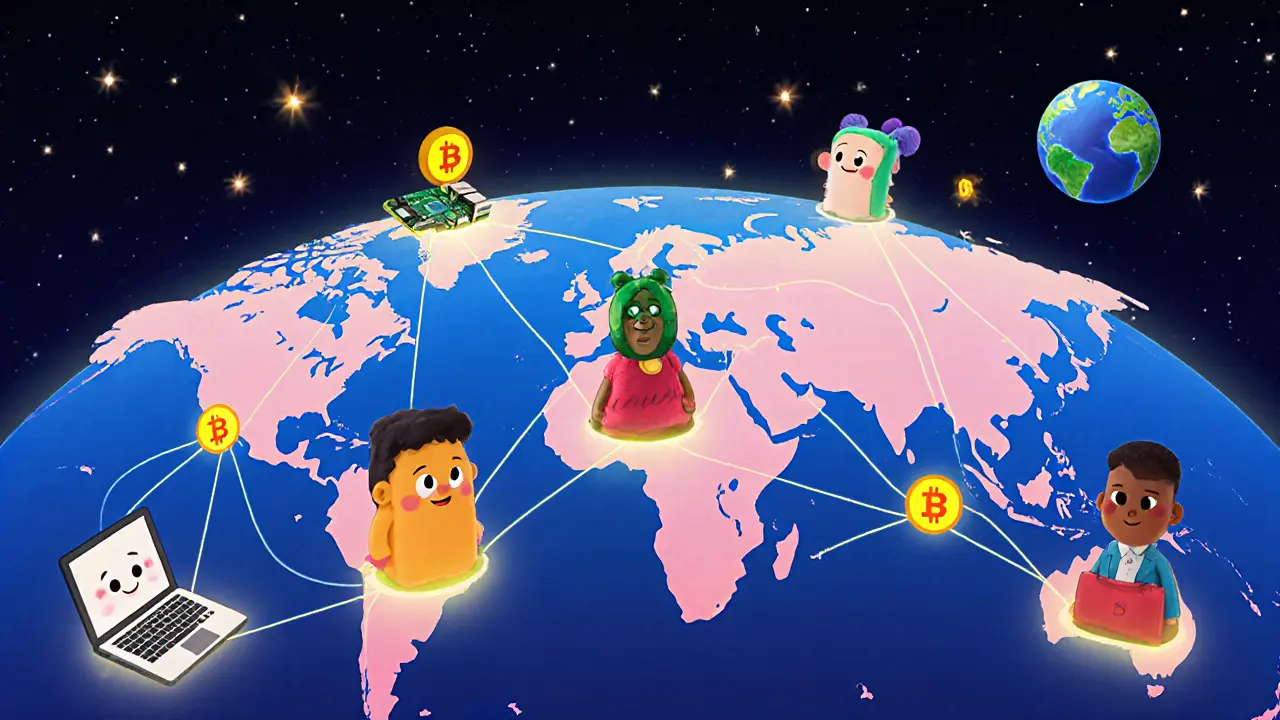
Bitcoin's peer-to-peer network lets users send money directly without banks. Thousands of nodes verify transactions globally, making it resilient, censorship-resistant, and free from central control. Learn how it works and why it matters.
Bitcoin Decentralization: What It Really Means and Why It Matters
When we talk about Bitcoin decentralization, the system where no single entity controls the network, and validation is handled by distributed nodes around the world. It's not just a buzzword—it’s the reason Bitcoin still exists after more than a decade of attacks, regulation, and hype. Unlike banks or payment apps, Bitcoin doesn’t rely on a central server or company to confirm transactions. Instead, thousands of computers—run by strangers in basements, data centers, and farms—agree on what’s valid, using math and incentives, not authority.
This system depends on three key pieces: blockchain decentralization, the public ledger that’s copied across every node, making tampering nearly impossible, cryptocurrency consensus, the rule set (Proof of Work) that lets nodes agree without trusting each other, and peer-to-peer network, the direct connection between users and miners, with no middlemen. If any one of these breaks, Bitcoin stops being Bitcoin. That’s why mining centralization in China, exchange custody risks, or regulatory pressure on nodes aren’t just technical issues—they’re existential threats.
You see this play out in the posts below. Some articles expose fake exchanges like Tatmas and AladiEx that pretend to be decentralized but actually hold your keys—exactly what Bitcoin was built to avoid. Others, like the one on centralized exchange token risks, show how holding crypto on a platform that can freeze your balance defeats the whole point. Even the airdrop guides? They often lead to scams that exploit trust in ‘decentralized’ projects that aren’t decentralized at all. Meanwhile, tools like PBFT consensus, used in private blockchains, are designed for control, not freedom—making them the opposite of Bitcoin’s philosophy.
Bitcoin decentralization isn’t about being perfect. It’s about being resistant. It’s about letting you send value without asking permission. It’s about having a network that can’t be shut down by a government, a CEO, or a server outage. That’s why, even when prices drop or headlines scream ‘Bitcoin is dead,’ the network keeps running—because it doesn’t need anyone’s approval to exist. The posts here don’t just talk about crypto. They show you where the real power lies—and where it doesn’t.
November 7, 2025
How Bitcoin's P2P Network Operates: A Simple Breakdown of Decentralized Transactions
About
Cryptocurrency