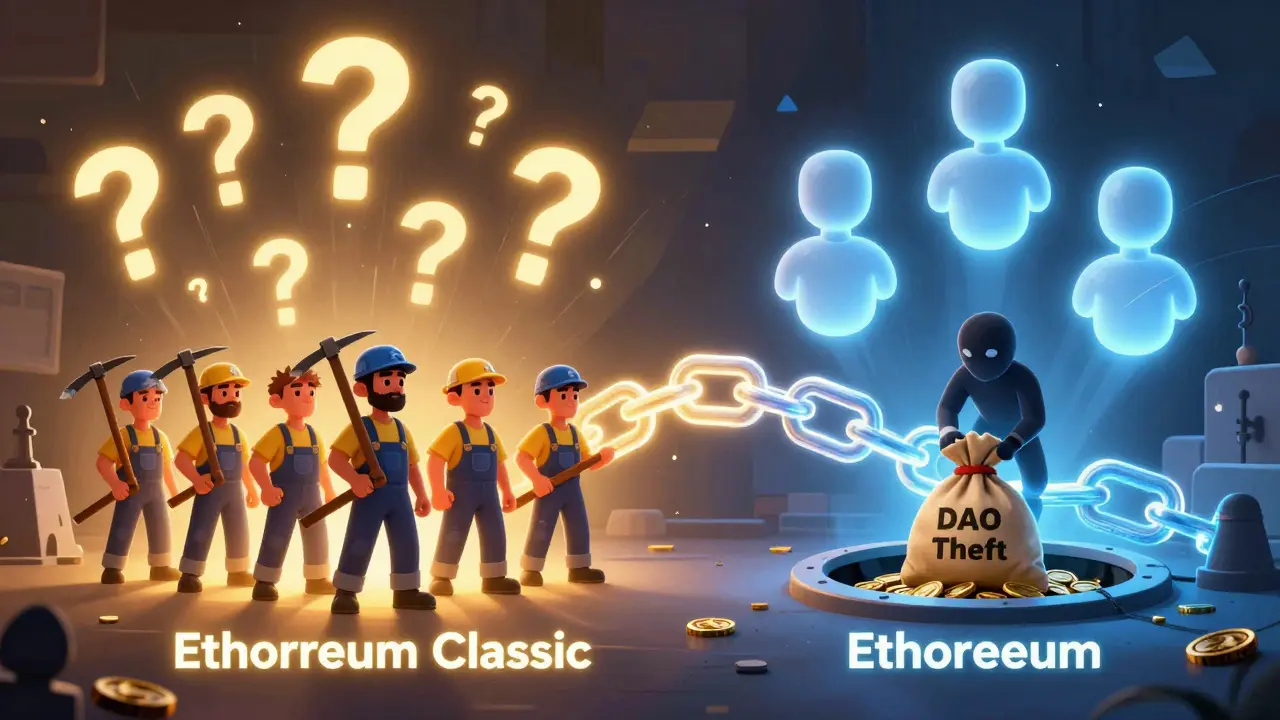
On July 30, 2015, the Ethereum blockchain went live. It wasn’t just another cryptocurrency - it was a platform for smart contracts, decentralized apps, and code that couldn’t be stopped. Then, in 2016, everything changed. A hacker drained $60 million worth of Ether from a project called the DAO. The community panicked. Some said: reverse it. Others said: never.
The split wasn’t just technical. It was ideological. Half the network chose to rewrite history. The other half refused. That’s how Ethereum Classic (ETC) was born - not as a copy, but as a commitment. To the original code. To the original rules. To the idea that once something is written on the blockchain, it stays written.
How Ethereum Classic Got Its Start
The DAO was supposed to be a decentralized venture fund. Anyone could invest, vote on projects, and earn returns. But a flaw in its code let someone drain 3.6 million Ether - about 14% of Ethereum’s total supply at the time. The Ethereum Foundation proposed a hard fork: a clean reset that erased the theft. It worked. The stolen funds were returned. The new chain became what we now call Ethereum (ETH).
But a group of developers, miners, and users said no. They believed changing the blockchain to fix a mistake was worse than the mistake itself. If a system can be altered by a vote, it’s not decentralized. It’s just another corporation with a ledger. So they kept mining the original chain - the one with the theft still in it. That chain became Ethereum Classic.
It wasn’t a protest. It was a principle. Ethereum Classic is a blockchain that refuses to reverse transactions, even under pressure. Also known as ETC, it operates with the same code as Ethereum did before the fork, and uses the same Ethereum Virtual Machine (EVM) to run smart contracts.
How ETC Works - Same Tech, Different Philosophy
Ethereum Classic runs on the same core tech as Ethereum did in 2015: accounts and balances, state transitions, and the Ethereum Virtual Machine. That means if you built a dApp on Ethereum before 2016, you could move it to ETC with almost no changes.
But here’s where they diverge:
- Consensus: ETC still uses proof-of-work (PoW). Miners solve puzzles with powerful hardware to secure the network. Ethereum switched to proof-of-stake (PoS) in 2022 - no mining, just staking.
- Supply: ETC has a hard cap: 210.7 million coins. Once that’s mined, no more will be created. Ethereum has no cap - new coins are still issued annually.
- Philosophy: ETC believes in immutability. No exceptions. Ethereum believes in flexibility. If something goes wrong, fix it.
The difference isn’t just technical - it’s cultural. ETC’s community sees itself as the true heir to Satoshi’s vision: code as law. Ethereum’s community sees itself as evolving - adapting, improving, responding.
Why ETC Still Matters in 2026
After Ethereum left mining behind, ETC didn’t fade. It grew stronger.
In 2025, the network’s hashrate hit 300 terahashes per second (TH/s). That’s more than any other proof-of-work blockchain running smart contracts. Why? Because miners who left Ethereum after its switch found a new home. And they brought their rigs with them.
The Thanos Upgrade in 2024 made mining ETC more profitable. It adjusted block rewards and reduced difficulty spikes. Suddenly, mining wasn’t just a political act - it was a smart financial move. Miners from Bitcoin, Litecoin, and even Ethereum Classic’s own past flooded in. The network became more secure than ever.
Today, ETC is the largest smart contract blockchain secured by proof-of-work. That’s not a fluke. It’s a statement. For people who distrust proof-of-stake - who worry validators could be censored, bribed, or regulated - ETC offers a working alternative.
What You Can Do With ETC
ETC isn’t just a store of value. It’s a working platform.
- Pay for gas: Every smart contract execution, every token transfer, every dApp interaction costs ETC as gas. It’s the fuel.
- Build dApps: Developers can deploy decentralized apps on ETC using the same tools they use for Ethereum. Solidity, Remix, MetaMask - all work.
- Run DAOs: There are active DAOs on ETC, from community treasuries to funding open-source projects. No central authority. No freeze button.
- Trade or hold: ETC is listed on Binance, Kraken, KuCoin, and over 150 other exchanges. It’s liquid. It’s tradable. And with only 142 million coins in circulation out of a 210.7 million cap, it’s still far from max supply.
The price of ETC was $8.64 USD on February 16, 2026. That’s down from its all-time high of $140 in 2021. But price isn’t the whole story. The network’s security, mining activity, and developer activity tell a different one.
ETC vs ETH: The Real Divide
People often compare Ethereum Classic to Ethereum. But they’re not rivals. They’re opposites.
| Feature | Ethereum Classic (ETC) | Ethereum (ETH) |
|---|---|---|
| Consensus Mechanism | Proof-of-Work (PoW) | Proof-of-Stake (PoS) |
| Total Supply Cap | 210,700,000 ETC | No cap |
| Transaction Reversal | Never allowed | Allowed (e.g., DAO fork) |
| Network Security (2026) | 300 TH/s hashrate | Secure via staked ETH, not mining |
| Primary Use Case | Immutable smart contracts | DeFi, NFTs, enterprise dApps |
| Development Focus | Stability, security, decentralization | Scalability, speed, user adoption |
ETC doesn’t try to compete with Ethereum’s scale. It doesn’t need to. It offers something else: predictability. If you want a blockchain that won’t change its rules because a group of people voted to, ETC is the only one left.

Who Uses Ethereum Classic Today?
It’s not for everyone.
If you’re a DeFi trader using Uniswap or a NFT collector buying Bored Apes - you’re probably on Ethereum. ETC doesn’t have the same apps. It doesn’t have the same liquidity.
But if you’re someone who:
- Believes no blockchain should ever be reversed
- Worries that proof-of-stake centralizes power in the hands of big stakers
- Wants to mine a smart contract chain with real demand
- Values long-term security over short-term speed
Then ETC isn’t just another coin. It’s a statement.
The Ethereum Classic Cooperative, a community-led group, funds development, organizes meetups, and supports wallet integrations. There’s no VC funding. No corporate backing. Just developers, miners, and users who believe in the original idea.
The Future of ETC
Will ETC ever hit $100 again? Maybe. Maybe not.
But its future isn’t about price. It’s about persistence.
As governments crack down on crypto, as regulators demand the ability to freeze wallets, as exchanges comply with KYC rules - the idea of an unstoppable blockchain becomes more valuable. ETC is the only major smart contract chain that has never given in.
Its mining network is growing. Its community is quiet but steady. Its code is battle-tested. And in a world where everything changes - ETC stays the same.
That’s not a weakness. It’s the whole point.
Is Ethereum Classic the same as Ethereum?
No. Ethereum Classic (ETC) and Ethereum (ETH) split in 2016 after the DAO hack. ETC kept the original blockchain with the theft still recorded. ETH reversed the transaction. Since then, they’ve evolved separately - with different rules, communities, and development goals.
Can I mine Ethereum Classic?
Yes. ETC still uses proof-of-work mining with the Ethash algorithm. It’s one of the few major smart contract blockchains that still allows mining. With a hashrate of over 300 TH/s in 2026, it’s one of the most secure PoW networks for smart contracts.
Does Ethereum Classic have a supply cap?
Yes. ETC has a hard cap of 210,700,000 coins. About 142 million are already in circulation. This makes it deflationary by design - unlike Ethereum, which has no supply cap and continues issuing new coins annually.
Is Ethereum Classic a good investment?
ETC isn’t a mainstream asset like Bitcoin or Ethereum. It’s a niche play for those who value immutability, decentralization, and proof-of-work security. Its value comes from its philosophy as much as its technology. If you believe in an unchangeable blockchain, ETC has proven it can survive - even thrive - without chasing trends.
Can I use MetaMask with Ethereum Classic?
Yes. MetaMask supports ETC. Just add the Ethereum Classic network manually using the Chain ID 61, RPC URL https://ethereumclassic.network, and symbol ETC. Once set up, you can send, receive, and interact with ETC-based dApps just like you would on Ethereum.
Comments
Lmao ETC is just Bitcoin with smart contracts and a god complex. 🤡
I remember when I first heard about the DAO hack. I was like, wait, so we’re just gonna undo a transaction on a blockchain? That’s like erasing your credit card statement because you overspent. ETC didn’t flinch. They just kept mining. And honestly? That’s the kind of stubborn integrity I respect. It’s not about the price. It’s about the principle. You don’t get to rewrite history just because it’s inconvenient. That’s not decentralization - that’s corporate PR with a blockchain sticker on it. I’ve been holding ETC since 2018. Not because I think it’ll hit $100 again. But because I believe in code that doesn’t bend. The fact that it’s still alive, still mining, still running contracts without a single rollback? That’s poetry. And yeah, it’s slower. And yeah, it’s less trendy. But it’s real. You can’t fake immutability.
The fact that Ethereum abandoned its own founding principles to save a bunch of rich guys’ money is the most ironic thing in crypto history. They called it decentralization but acted like a Silicon Valley VC fund. ETC didn’t just survive - it became the last temple of Satoshi’s original dream. And now? Miners are flooding back. Not because it’s profitable (though it is). But because they remember what blockchain was supposed to be. No more ‘emergency forks’. No more ‘community votes’. Just code. And truth. And silence. The silence of a system that refuses to be controlled.
Proof-of-stake is just plutocracy with better marketing. Who do you think controls the validators? Big exchanges. Central banks. The same oligarchs who run Wall Street. ETC is the only chain left that actually lets regular people with GPUs have power. The elites want you to believe PoS is ‘greener’. It’s not. It’s just more centralized. And they’re scared. Because if ETC proves you can have security without staking, their whole ‘decentralized finance’ fairy tale collapses. Watch them ban ETC next.
I’ve been mining ETC since 2021. The Thanos upgrade was a game-changer. Suddenly, my old RX 6700 XT wasn’t just collecting dust - it was earning. And the network security? Solid. 300 TH/s? That’s more than Monero. And it’s all real hardware, not staked ETH locked in some wallet. The community doesn’t scream. Doesn’t tweet. Doesn’t need to. They just keep mining. Quiet. Consistent. Unbothered. That’s the real innovation - not speed. Not hype. Just persistence.
ETC is the crypto equivalent of a vinyl record collector who refuses to stream. 🎵 I love it. The fact that it still uses PoW? That’s not a bug - it’s a feature. The fact that it has a hard cap? That’s not outdated. That’s rebellion. ETH is the corporate suit. ETC is the guy in the hoodie who still believes in the whitepaper. And honestly? I’d rather have my smart contracts on the chain that won’t reverse a transaction because someone cried. Code is law. Not ‘community consensus’.
ETC? More like E-Try-Crying. Why would anyone mine this when ETH is so much more efficient? Bro, it’s 2026.
I just don’t get why people are so obsessed with this. It’s not like ETC is doing anything new. Just… existing. And it’s so ugly. Why not just use Bitcoin?
The US has Bitcoin. China has Ethereum. ETC? That’s just a nostalgia project for anarchists who think the internet should be a cult. We don’t need immutable chains. We need progress. And ETC? It’s a museum piece with a wallet.
ETC is the only blockchain that truly understands the meaning of ‘immutability’. 🙏 I’ve been running a DAO on it since 2022. No one froze our funds. No one reversed our votes. No one asked for KYC. Just pure, unfiltered code. That’s not a coin. That’s sovereignty.
I used to think ETC was just a relic. Then I tried deploying a simple contract on it. It worked. No gas spikes. No drama. No ‘emergency upgrades’. Just… it worked. And that’s rare. I’ve seen too many chains break because someone thought ‘we can fix it’. ETC says no. And honestly? I’m starting to think maybe that’s the smarter way.
I’m from the Philippines and I mine ETC. My rig runs on solar power. I don’t care about price. I care about being part of a network that doesn’t beg for permission. When the grid went down last year, I kept mining. Because ETC doesn’t need a bank. Doesn’t need a government. Doesn’t need a CEO. Just electricity and a little patience. And yeah, it’s slow. But slow is steady. And steady is powerful.
ETC is irrelevant. Move on.
I’ve been watching ETC for years. And honestly? It’s quietly winning. The fact that it’s still growing while other PoW chains die? That’s not luck. That’s a movement. People are waking up. They’re tired of chains that change rules on a whim. ETC doesn’t change. It doesn’t apologize. It just… is. And in a world full of noise? That’s the most powerful thing of all.
I used to think blockchain was just tech. Then I met a miner in Ohio who runs ETC on his old gaming rig. He said, ‘I’m not here for the money. I’m here because no one gets to erase what’s written.’ That hit me. Hard. ETC isn’t about coins. It’s about trust. Real, unbreakable, code-as-law trust. And in a world where every system is built to be manipulated? That’s worth more than any price chart.
The whole ETC thing is a CIA psyop to distract from the real blockchain revolution. PoW is dead. PoS is the future. ETC is just a distraction for old-school crypto bros who can’t accept change. They’re being paid to mine it. Seriously. Look at the mining pools. All controlled. It’s a trap.
ETC is just ETH with a bad haircut and no investors