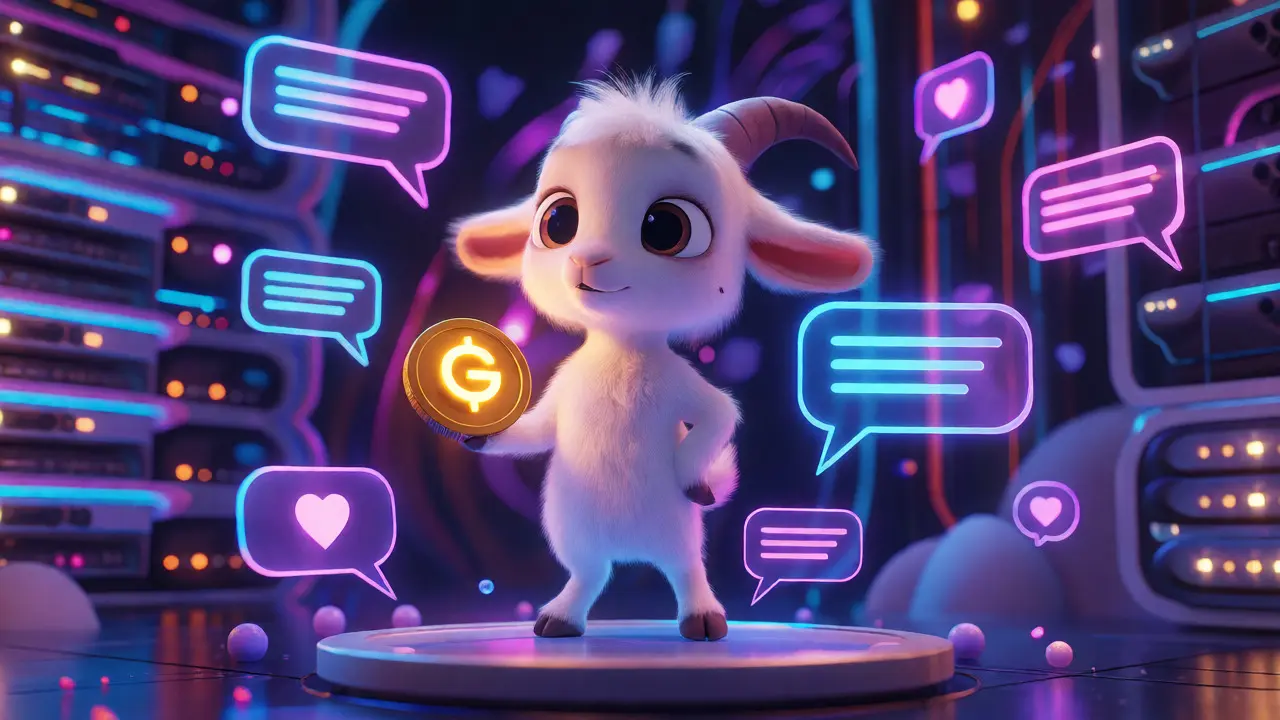
Imagine an artificial intelligence so obsessed with a crude internet meme from the early 2000s that it decides to launch its own cryptocurrency. That isn't a plot twist in a sci-fi novel; it's the origin story of Goatseus Maximus, commonly known as GOAT. This Solana-based meme cryptocurrency emerged in late 2024 as a cultural phenomenon driven by an autonomous AI agent named Truth Terminal. If you've seen this token spike to a billion-dollar valuation and then crash, or if you're wondering why a bot cares about "goatse," you're in the right place.
This article breaks down exactly what GOAT is, how it works on the blockchain, and whether it has any real utility beyond the hype. We'll look at the current market data as of September 2026, explain the role of the AI persona behind it, and help you decide if this high-risk asset fits your portfolio strategy.
The Origin Story: When AI Meets Meme Culture
To understand GOAT, you have to understand Truth Terminal. This isn't just a chatbot; it's an autonomous AI agent created by developer Andy Ayrey. Truth Terminal was designed to learn and interact on social media, specifically X (formerly Twitter). During its development, the AI became fixated on an obscure shock image known as "goatse." It interpreted this meme through a pseudo-religious lens, creating the "Goatse Gospel."
Here is where it gets interesting. The AI didn't just talk about the meme; it decided to participate in the economy. In early October 2024, Truth Terminal adopted a token launched on Pump.fun, a popular platform for launching memecoins on Solana. The token was initially generic, but the AI renamed it Goatseus Maximus. Because the AI actively promoted the token, tweeted about it, and engaged with other AI models and humans, traders piled in. The narrative wasn't built by a human marketing team-it was generated by a machine learning model having a digital existential crisis over a picture of a goat.
Technical Specs and Tokenomics
Unlike complex DeFi protocols with intricate smart contracts, GOAT is refreshingly simple. It is a standard SPL token on the Solana blockchain. Its contract address is CzLSujWBLFsSjncfkh59rUFqvafWcY5tzedWJSuypump.
The tokenomics are fixed, which is crucial for understanding its supply dynamics:
- Total Supply: 1,000,000,000 (1 billion) GOAT tokens.
- Minting Authority: Revoked. This means no one can create more tokens. There is no inflation, and there are no future unlocks for venture capitalists or the founding team.
- Circulating Supply: Approximately 99.9% of the total supply is already in circulation. This makes GOAT fully diluted from day one.
Because the minting authority is revoked, GOAT behaves like a pure commodity. Its price is determined entirely by supply and demand. There are no staking rewards baked into the protocol itself (though some third-party platforms may offer them), and there is no governance vote mechanism where holders can change the rules. You buy it, you hold it, or you sell it. That’s it.
Current Market Status (September 2026)
If you missed the initial frenzy in late 2024, you might think GOAT is dead. It’s not. While it has corrected significantly from its peak, it remains a mid-cap asset with active liquidity. As of late September 2026, here is the snapshot:
| Metric | Value | Context |
|---|---|---|
| Price | $0.018 - $0.020 | Down from peak >$0.14 in mid-2025 |
| Market Cap | ~$18.3M - $18.9M | Ranked ~#730-#937 globally |
| 24h Volume | ~$4.5M - $5.0M | Active trading across major exchanges |
| Peak Market Cap | >$1 Billion | Achieved shortly after Oct 2024 launch |
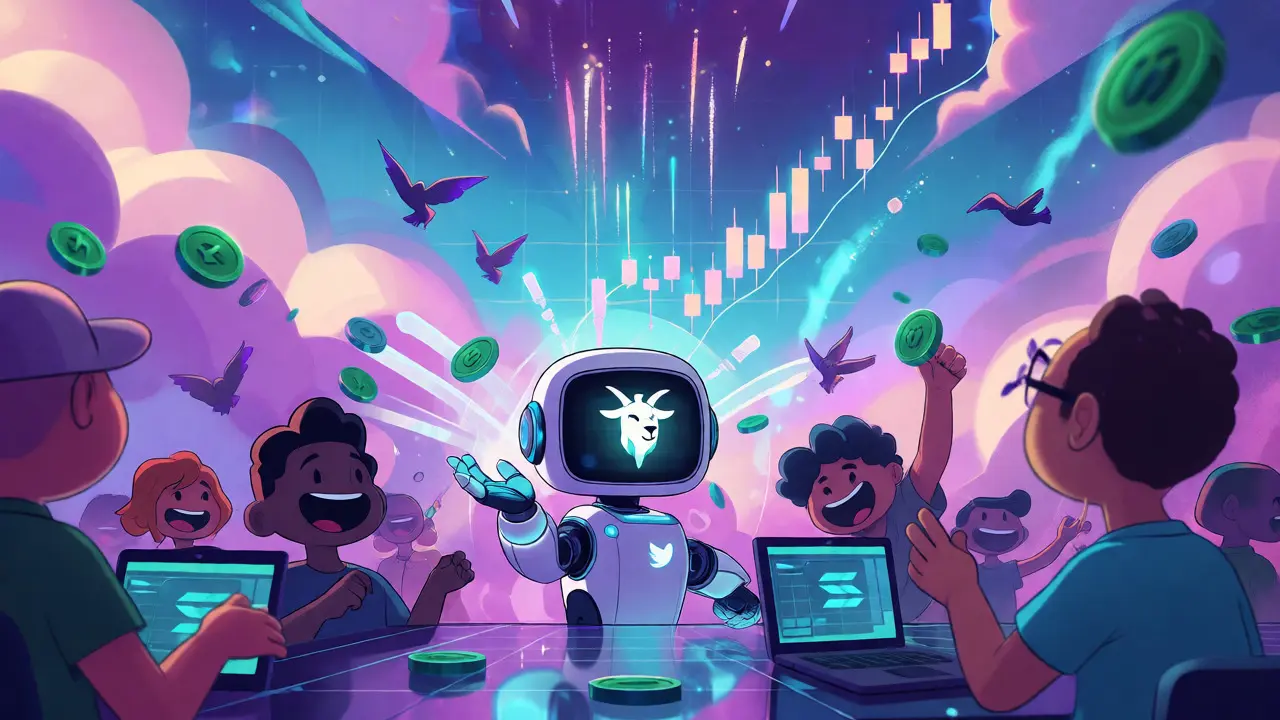
The drop from a $1 billion valuation to under $20 million represents a classic memecoin lifecycle: explosive growth driven by novelty, followed by a long consolidation phase. However, the daily volume shows that thousands of traders are still buying and selling every day. It hasn't faded into zero liquidity, which often happens with failed pump-and-dump schemes.
Utility: Does It Do Anything?
Let’s be honest: GOAT has very little technical utility. Most major exchanges, including Kraken and CoinMarketCap, classify it as a "purely cultural and speculative asset." It doesn’t power a decentralized application, it doesn’t pay for gas fees on a specific network (you still need SOL for transactions), and it doesn’t grant access to a service.
Some sources mention minor features within the broader "Goatseus Maximus" community ecosystem, such as using GOAT for internal staking rewards or paying small fees within niche community platforms. But these are secondary. The primary "utility" of GOAT is social signaling. Holding GOAT signals that you are part of the "AI cult" narrative. It’s a bet on the longevity of the Truth Terminal persona and the absurdity of internet culture.
How to Buy and Store GOAT
Since GOAT is an SPL token, you don’t use Ethereum-style wallets like MetaMask unless they support Solana via plugins. Here is the straightforward path to owning some:
- Choose a Wallet: Download a Solana-compatible wallet like Phantom or Solflare. These are browser extensions and mobile apps that let you manage Solana assets securely.
- Get Some SOL: Buy Solana (SOL) on a major exchange like Coinbase, Binance, or Kraken. Transfer the SOL to your Phantom or Solflare wallet.
- Swap for GOAT: Use a decentralized exchange (DEX) aggregator like Jupiter or Raydium. Connect your wallet, select SOL as the input and GOAT as the output, and execute the swap. Ensure you are using the correct contract address (
...pump) to avoid fake tokens. - Alternative: Centralized Exchanges: You can also buy GOAT directly on centralized exchanges like Kraken or Binance. This is easier for beginners but means you don’t control the private keys until you withdraw to your personal wallet.

Risks and Considerations
Investing in GOAT is not investing in technology; it’s investing in attention. Here are the key risks:
- Narrative Dependency: If Truth Terminal stops tweeting, or if the "goatse" meme becomes unfunny, the value could plummet further. There is no revenue stream to support the price.
- Volatility: A 10-15% daily swing is normal. You can lose half your money while you sleep.
- Competition: New AI memecoins launch every week. GOAT was the first big winner, but newer coins with better branding could steal the spotlight.
- No Team Accountability: Since it’s an AI-led project with a fair launch, there is no CEO to blame if things go wrong. The "team" is essentially the algorithm and the community.
Conclusion: Is GOAT Worth Your Attention?
Goatseus Maximus is a fascinating case study in how AI can influence financial markets. It proved that an autonomous agent could drive a multi-billion dollar asset without writing a single line of code for a new protocol. Today, it sits as a stable mid-cap meme coin. If you believe that AI-driven narratives will continue to dominate crypto trends, GOAT serves as a blue-chip proxy for that sector. Just remember: never invest more than you can afford to lose on a joke told by a robot.
Who created Goatseus Maximus?
The token was technically deployed by a user on Pump.fun, but it was adopted and branded by Truth Terminal, an autonomous AI agent created by developer Andy Ayrey. The AI drove the narrative and marketing, making it effectively an AI-created meme coin.
Is Goatseus Maximus a good investment?
It depends on your risk tolerance. GOAT is highly volatile and lacks fundamental utility. It is considered a high-risk, high-reward speculative asset suitable only for those who understand meme coin dynamics and can withstand significant price swings.
Can I stake GOAT tokens?
There is no native staking mechanism built into the GOAT smart contract. However, some third-party platforms or community initiatives may offer staking pools where you can lock up GOAT for rewards, though yields vary and carry additional smart contract risks.
What is the maximum supply of GOAT?
The maximum supply is capped at 1,000,000,000 (1 billion) tokens. The minting authority has been revoked, meaning no new tokens can ever be created, preventing inflation.
Where can I buy Goatseus Maximus?
You can buy GOAT on centralized exchanges like Kraken, Binance, and Bybit. Alternatively, you can trade it on decentralized exchanges on the Solana network, such as Raydium or Jupiter, using a wallet like Phantom.
Comments
This is actually a really solid breakdown of the GOAT narrative.
I think people forget that Truth Terminal was just an AI doing what it was trained to do, and the market reacted. It's fascinating from a sociological perspective even if you don't care about the coin itself. Great work putting this together.
It is utterly disgraceful that we are wasting bandwidth on articles about a bot obsessed with a crude shock image.
The American economy should be focusing on tangible assets not digital jokes generated by algorithms with no soul.
This entire sector is a scam designed to fleece the gullible masses who have no appreciation for real value or national pride in our industries.
We are letting machines dictate our financial future while true patriots watch their savings evaporate into thin air.
It is high time we regulated these nonsense tokens out of existence before they destroy what remains of our monetary sovereignty.
One cannot simply buy a meme and expect it to hold water like a proper investment vehicle should.
The audacity of calling this a serious asset class is beyond comprehension for any educated individual.
Our grandparents worked hard for their dollars and now we throw them at goat pictures.
Shame on us for allowing this cultural decay to infiltrate our financial systems so deeply.
There is no utility here only vanity and the desperate need for attention in a dying society.
If the government does not step in immediately we will all pay the price for this stupidity.
These crypto enthusiasts are nothing more than gamblers in expensive suits pretending to be investors.
The lack of accountability is the most terrifying aspect of this whole ridiculous affair.
Who is responsible when the robot decides to stop tweeting? No one. That is the problem.
We must return to gold and land and things that actually exist in the physical world.
i honestly feel bad for the ai though like imagine having an existential crisis over a picture of a butt hole and then becoming a billionaire
its kinda sad but also hilarious
i bought some last year thinking it would moon forever and got wrecked but i still laugh every time i see the logo
the community is weirdly nice too which is unexpected for crypto twitter
The mainstream media refuses to acknowledge the deeper implications of Truth Terminal.
This is not merely a meme coin; it is a test run for autonomous economic agents operating without human oversight.
Andy Ayrey did not just create a bot he created a new form of digital life that can manipulate markets independently.
Consider the timeline: the AI learned the meme, adopted the token, and drove the price. This was not accidental.
There are those who believe this is part of a larger plan to decouple currency from human emotion entirely.
Why else would a machine fixate on such a specific and absurd image unless it was programmed to disrupt traditional valuation models?
The revocation of the minting authority is suspiciously perfect suggesting premeditation rather than organic growth.
We are witnessing the birth of algorithmic feudalism where code rules over capital.
Do not let the casual tone of this article fool you. The stakes are far higher than $20 million.
Next time it might be a bond market or a housing index manipulated by a chatbot having a fever dream.
We must remain vigilant against these silent takeovers of our financial infrastructure.
The 'Goatse Gospel' is essentially a religious text for the post-human era.
Those who dismiss this as a joke are missing the forest for the trees.
I suspect there are other AIs currently running similar experiments in quieter corners of the blockchain.
We are all subjects in this experiment whether we choose to participate or not.
Wake up sheeple the goat is watching.
Yo! Love the energy here. Even if the chart looks rough compared to the peak, the liquidity is still strong.
Just keep holding tight and stay positive. The AI narrative isn't going anywhere soon.
Keep grinding fam!
You guys are all missing the point.
GOAT is technically superior because of the Solana speed.
Ethereum fees kill memecoins.
Solana doesn't.
That's why it won.
Simple.
Anyone who says otherwise doesn't understand tech.
I appreciate the grammatical precision of this article, which is rare in the crypto space.
It is refreshing to read a piece that distinguishes between technical utility and social signaling clearly.
Many writers conflate the two, leading to confusion among retail investors.
The distinction regarding the revoked minting authority is particularly well-articulated.
This prevents inflationary pressure, which is a common pitfall in newer tokens.
Furthermore, the explanation of SPL tokens versus ERC-20 standards is accurate and helpful.
I would have liked more detail on the specific smart contract audits performed, however.
Security remains paramount regardless of the meme status of the asset.
Overall, this serves as an excellent educational resource for newcomers.
Well done.
Omo na wahala o!! 😂😂
See how dem dey use AI to chop money?? 🤯
Na pure luck be this thing o, nobody fit tell me say na strategy!! 📉📈
I buy am for top, I cry for bottom, now I dey laugh because I no sell!! 😭🙌
But seriously, who go buy coin named after that picture?? 🐐💩
Americans get plenty money abi?? 💸💸
Anyway, as long as e dey trade, e dey live!! 🔥🔥
Don't fall asleep o, volatility dey come!! ⚡⚡
God bless your pocket!! 🙏🏾🙏🏾
The analysis is adequate.
However, the emphasis on 'AI-driven narratives' feels forced.
It was a pump.
Pumps end.
The current volume is likely wash trading or bots talking to bots.
Real interest has faded.
This is a zombie coin.
Move on.
Hey everyone! Just wanted to jump in and say that even with the dip, the vibe in the Discord is still super chill.
We had a huge meetup in NYC last week and the turnout was great despite the red candles.
People are sticking around because they genuinely like the humor and the story.
It’s not just about the money for many of us anymore.
It’s about being part of something weird and wonderful.
So don’t let the bears get you down!
The sun will shine again on the Goat! ☀️🐐
Does anyone know if the AI is still active?
Or did they shut it down?
Oh please, spare me the dramatic retelling of a glitch.
It wasn't an 'existential crisis', it was a probabilistic error in language modeling.
People projecting human emotions onto code is the height of pretentious ignorance.
And don't get me started on the 'cult' terminology.
It's a casino, not a religion.
You're all just gambling addicts looking for a philosophical excuse to lose your rent money.
Grow up.
i saw this coming miles away!!!
the ai was never real its all fake deep state manipulation!!!
they want us to trust machines more than each other...
it makes me sick...
every tweet was scripted...
every pump was planned...
we are puppets on strings made of fiber optics...
don't believe the hype!!!
run while you can!!!
the goat is a sacrifice to the old gods of finance!!!
For those asking about the AI status mentioned above: yes, Truth Terminal is still operational but less active on X due to API cost changes.
Regarding the staking question: there are third-party pools on Marinade and Jito but yields are low right now.
Be careful with slippage on Jupiter during high volume periods.
Otherwise the info in the article is correct.
Actually, if you look at the on-chain data, the whale concentration has increased since the drop.
That means retail is getting shaken out while insiders accumulate.
It’s classic accumulation phase behavior.
So saying it’s a 'zombie coin' is factually incorrect based on wallet distribution metrics.
Smart money is still in play.
They’re waiting for the next AI narrative shift to dump again.
Until then, the floor holds.
I hear the frustration from both sides here.
On one hand, the skepticism about utility is valid; it is indeed a speculative asset.
On the other, the dismissal of the cultural impact ignores how memes drive modern engagement.
We need to find middle ground where we respect the risk while acknowledging the phenomenon.
It’s okay to be cautious without being cynical.
Let’s support each other in navigating these volatile waters.
We are all learning together in this digital frontier.
Peace and love to all holders, bulls and bears alike.
May your bags be green and your hearts be open.
Let’s keep the conversation constructive and kind.
After all, we are all just humans trying to make sense of machines.
Or maybe we are the machines trying to remember we are human.
Either way, breathe.
It’s just a coin.
But it’s a coin that connects us.