If you have stumbled upon this coin and are wondering if it is a legitimate way to earn or a risky investment, you are not alone. The project has a unique hook, but the market data tells a complicated story of extreme volatility and low liquidity. Here is everything you need to know about how it works, where it lives, and what the risks are.
How GreenZoneX Actually Works
The magic of GZX isn't in the code, but in the business model. The GreenZone Foundation partners with recycling centers and processing facilities. When a user participates in recycling through these partners, they earn GZX tokens. The foundation makes money from the recyclable materials collected and then uses a portion of that revenue to support the token ecosystem.
It is essentially a loyalty program on steroids. Instead of getting a few cents or a coupon, you get a digital token that can potentially be traded on an exchange. This creates a direct incentive for people to stop throwing recyclables in the trash. However, it is a critical distinction that holding GZX does not make you a part-owner of the company. The foundation explicitly states that GZX holders do not own equity or shares in GreenZone Enterprises, LLC. It is a utility token, not a stock certificate.
The Technical Side: A Multi-Chain Approach
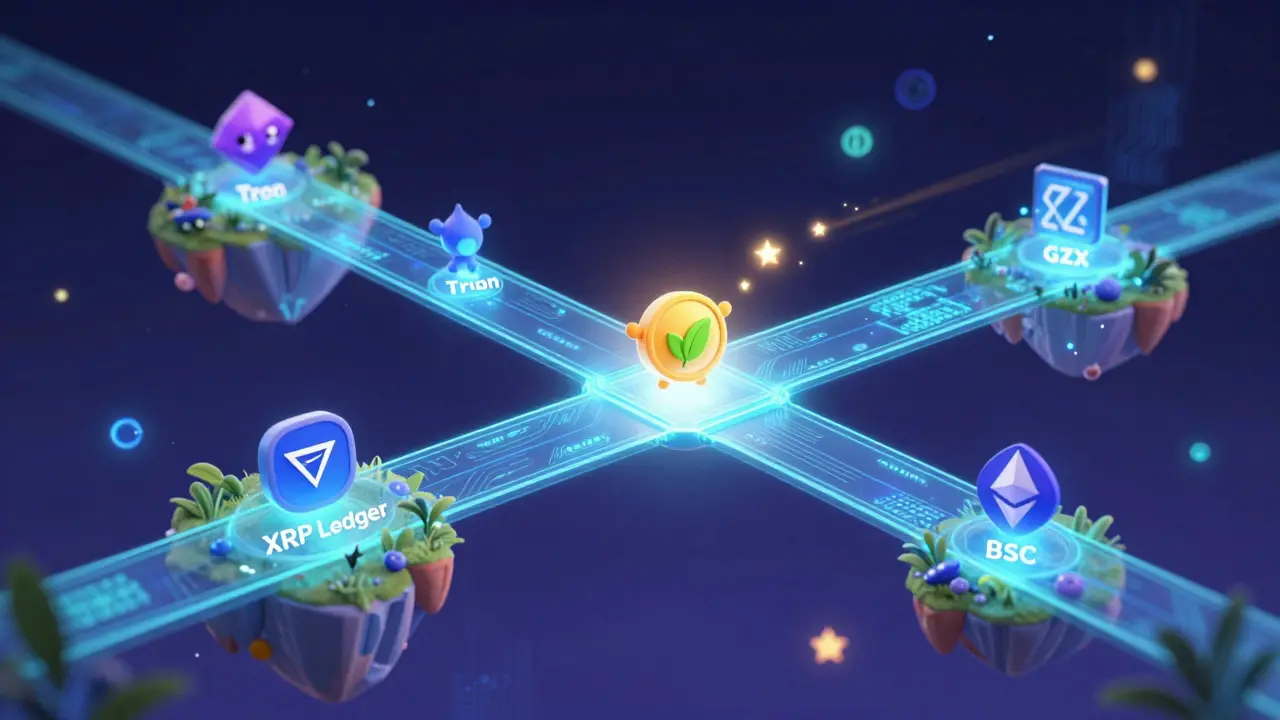
One of the more interesting parts of GZX is that it doesn't stick to just one blockchain. To make the token easier to move and trade, it operates across several networks. This is known as cross-chain functionality, allowing the token to exist where the users are.
The primary homes for GZX are the Tron (TRC20) network and the XRP Ledger (XRPL). By using the XRP Ledger, the token benefits from incredibly fast settlement times and, according to the foundation, zero swap fees for holders. For those who prefer the giants of the industry, there are also contract addresses on the Ethereum and Binance Smart Chain (BSC) networks.
| Attribute | Value / Detail |
|---|---|
| Max Supply | 1,000,000,000 GZX |
| Circulating Supply | ~381.8 Million GZX |
| Primary Networks | Tron (TRC20), XRP Ledger (XRPL) |
| Compatibility | Ethereum, BSC |
| Key Feature | Zero swap/transaction fees (on certain networks) |
Market Reality: Price and Volatility
When you look at the charts for GZX, things get a bit messy. Because it is a micro-cap cryptocurrency, there isn't a single "official" price that everyone agrees on. Depending on which platform you check, the price can vary wildly. For example, you might see one site listing it at $0.000011 and another at $0.000044. This happens because the coin has low liquidity, meaning there aren't enough buyers and sellers to keep the price stable across different exchanges.
If you are looking at the long-term history, the drop is staggering. GZX reached all-time highs around early 2022, with some platforms reporting peaks near $0.01. Since then, the token has crashed by roughly 99%. This is a common pattern in "eco-coins" where early hype drives the price up, but the actual day-to-day usage of the recycling program doesn't grow fast enough to support that valuation.
Where to Trade and Store Your GZX
You won't find GreenZoneX on the biggest exchanges like Binance or Coinbase. In fact, if you try to find it on KuCoin, you'll find it's not supported, and the platform actually suggests using alternative venues to cash out. To get your hands on GZX, you'll need to use smaller, more specialized exchanges. ProBit and Swift are two of the primary options. For those using the XRP Ledger, XUMM (now Xaman) is the go-to wallet and interface.
When it comes to keeping your tokens safe, you have a few choices based on how much of a "techie" you are:
- Custodial Wallets: Keeping your coins on the exchange. It's easy, but you don't own your private keys.
- Self-Custody Wallets: Using apps like XUMM where you control the keys. This is generally safer for long-term holding.
- Hardware Wallets: Physical devices that keep your keys offline. This is the gold standard for security.
- Paper Wallets: A literal piece of paper with your keys printed on it. Very secure against hackers, but easy to lose or damage.
The Risks and Red Flags
Is GZX a scam? Not necessarily-it has a real-world utility and a functioning foundation. However, there are significant risks that any regular person should consider before putting money into it. The first is liquidity risk. With 24-hour trading volumes sometimes dipping below $40, a single large sell order could tank the price even further. You might buy tokens today and find it nearly impossible to sell them tomorrow without crashing the market.
The second issue is the economic model. The value of GZX depends entirely on the GreenZone Foundation's ability to scale its recycling network. If people don't use the recycling centers, there's no demand for the token. Without a massive surge in global adoption of their specific recycling process, the token remains a speculative asset with very little floor support.
Final Verdict: Who is this for?
If you are an environmentalist who wants to earn some digital rewards while cleaning up the planet, GZX is a neat experiment. You don't even have to buy it; you can earn it by actually recycling. That's the healthiest way to interact with this project.
But if you are looking at this as a "get rich quick" investment, be extremely careful. The 99% drop from its peak and the fragmented pricing across exchanges are classic signs of a high-risk micro-cap asset. It's a project with a great heart, but a very shaky financial foundation. If you decide to dive in, only use money you are 100% comfortable losing, and stick to wallets like XUMM to keep your assets in your own control.
Do I have to buy GZX tokens to start recycling?
No, you don't. One of the main points of the GreenZone Foundation is that users can earn GZX tokens by participating in recycling activities with their partners. You can get the tokens as a reward for your environmental efforts without spending your own money.
Which blockchain is the best for holding GZX?
The XRP Ledger (XRPL) and Tron (TRC20) are the primary networks. The XRP Ledger is often preferred for those who want lightning-fast settlements and zero swap fees, especially when using the XUMM wallet.
Is GZX available on major exchanges like Binance or Coinbase?
No, GZX is not available on major top-tier exchanges. You will generally find it on smaller platforms like ProBit, Swift, or through XRPL-native interfaces like XUMM.
Does owning GZX give me ownership in GreenZone Enterprises?
Absolutely not. The GreenZone Foundation has made it clear that GZX is a utility token. Purchasing or holding the coin does not provide you with any equity, shares, or ownership stake in the company.
Why is the price of GZX different on different websites?
This is due to low liquidity. Because there aren't many trades happening, different exchanges may have different prices based on the last few transactions that occurred on that specific platform. This is common with micro-cap cryptocurrencies.
Comments
Oh great, another 'eco-coin' that solves world hunger by giving you digital dust for a plastic bottle. Truly revolutionary stuff right here.
Actually, I think the core concept is pretty solid. If it actually incentivizes people to clean up their neighborhoods, the price volatility is almost secondary to the real-world impact. Let's hope they can scale it properly!
Nah, it's just a scam.
I've spent quite a bit of time looking into the XRPL ecosystem and I have to say that the speed of the XRP Ledger is a massive advantage for a project like this because you don't want to be paying gas fees that are higher than the reward you're getting for your recycling. If you're new to this, I highly recommend starting with a self-custody wallet like Xaman because keeping your assets on a small exchange is just asking for trouble given how many of these micro-cap platforms disappear overnight without any warning, and honestly, the only way to actually benefit from a project with this much volatility is to be your own bank and manage your risk exposure carefully through diversification.
We really should be talking about the moral failure of needing a financial incentive to not pollute the earth in the first place. It's honestly kind of sad that we've reached a point where the only way to get people to do the right thing is by throwing tokens at them. But hey, if it works, I guess it works, though it feels like a band-aid on a bullet wound.
Liquidity is the main issue here!!! Always check the 24h volume before diving in!!!
Wait, so you're telling me I can't even be a part-owner of the company? What is the point of a utility token if I don't have any say in how things are run? This is a disaster waiting to happen and everyone is just pretending it's fine!
Small steps lead to big changes.
The slippage on those smaller exchanges is going to be brutal for any significant position. You're basically dealing with a thin order book where a single market sell could trigger a cascade. It's a classic liquidity trap for retail traders.
One must contemplate the duality of nature and digital scarcity. Is it not a poetic irony to exchange physical waste for a mathematical abstraction? ॐ
The sheer audacity of the price drop is practically a work of art. A 99% crash? That's not just a dip, that's a catastrophic plunge into the abyss of financial ruin! I can practically feel the desperation of the bagholders from here.
Let's look at the bigger picture! This is about shifting our consciousness toward sustainability. If a few people lose money but the planet gets a bit cleaner, isn't that a win for humanity? 🌍 Keep the energy positive people!
Basically, if you don't understand how a utility token differs from an equity share, you shouldn't be investing in crypto. It's simple.
We need to make sure we aren't excluding people who aren't tech-savvy from these rewards. The barrier to entry shouldn't be a hardware wallet; we need better onboarding for the average person.
I believe that through collective effort and a shared vision of a greener future, we can overcome these technical hurdles. It is truly inspiring to see technology being leveraged for the betterment of our environment, and I am eager to see how this ecosystem evolves further!