
If you've been scrolling through low-cap tokens and stumbled upon MESSIER (M87) is a decentralized cryptocurrency token that serves as the primary governance asset for the VirgoDAO ecosystem. It's not just a coin you hold and hope goes up; it's designed as the engine for a wider network of decentralized applications (dApps) and NFTs. But with prices fluctuating wildly across different exchanges, you're probably wondering if this is a serious project or just another volatile asset.
The Core Engine: How VirgoDAO Works
To understand M87, you have to understand VirgoDAO. This is a Decentralized Autonomous Organization (DAO) that manages a treasury and a collection of utility services. Instead of a CEO making decisions, the rules are written into smart contracts on the Ethereum blockchain.
Think of it as a community-run venture capital fund. The DAO generates revenue from various sources-like fees from its dApps and NFT sales-and funnels that money into the treasury. The people who hold and stake M87 tokens get to vote on how that money is spent, which tokens the DAO should invest in, and how the ecosystem should evolve. It's a cyclical system: the DAO invests in other assets, and the rewards from those investments are distributed back to the M87 stakers.
Tokenomics: The 'Buy and Burn' Strategy
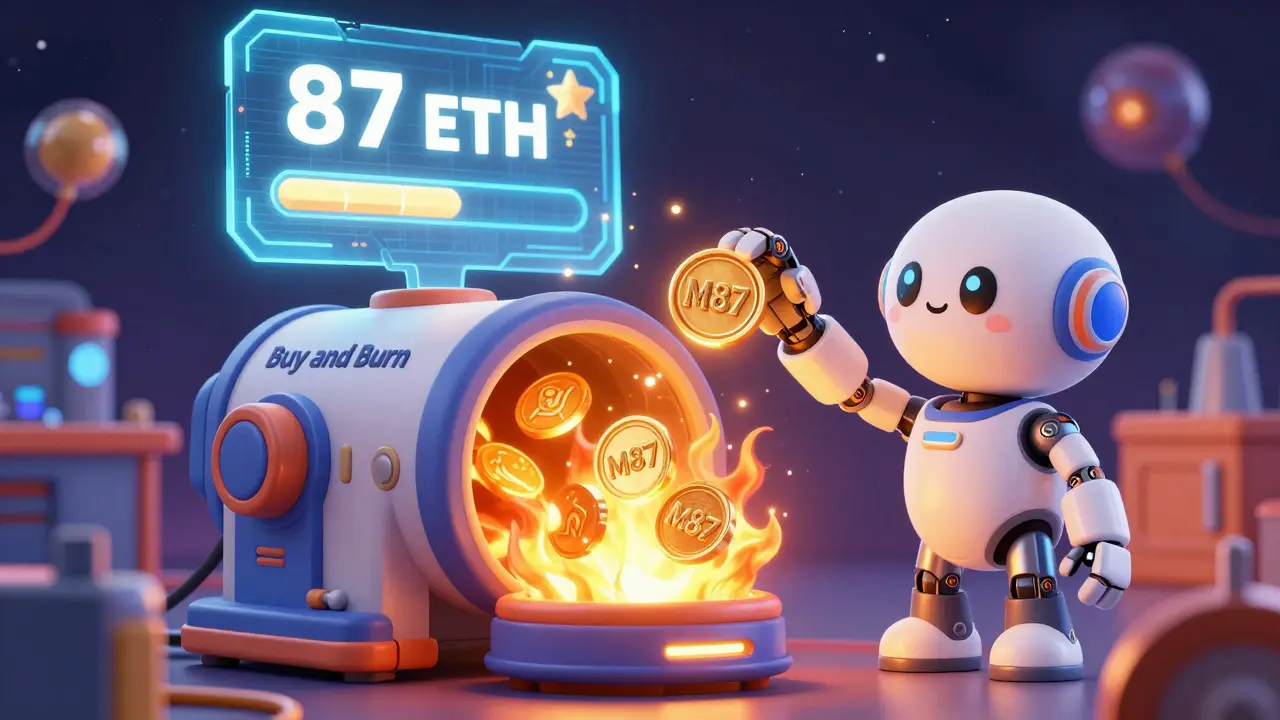
One of the most interesting parts of the M87 token is its automated supply management. Many projects promise to "burn" tokens to increase value, but M87 has a specific trigger. When the VirgoDAO treasury hits a balance of 87 ETH, the smart contracts automatically kick in to buy back M87 tokens from the open market and destroy them.
Why does this matter? By removing tokens from circulation, the total supply drops. If demand stays the same or grows while the supply shrinks, it creates upward pressure on the price. Anything in the treasury beyond that 87 ETH threshold is used to boost liquidity, which helps make trading smoother and reduces the massive price swings often seen in smaller coins.
| Component | Primary Function | Relationship to M87 |
|---|---|---|
| VirgoDAO Treasury | Capital Management | Funds M87 buybacks and burns |
| Messier Objects NFTs | Digital Collectibles | M87 is used for bidding/acquisition |
| Messier Applications | Utility Services | Generates fees for the DAO treasury |
| Staking Pool | Governance & Rewards | Locks M87 to grant voting rights |
Market Reality: Pricing Discrepancies and Volatility
If you check the price of M87 today, April 19, 2026, you'll notice something strange: different exchanges are reporting wildly different numbers. For instance, while CoinGecko might show it around $0.056, platforms like CoinMarketCap and Coinbase report figures closer to $0.000006.
This is a classic red flag for beginners but common for low-market-cap tokens. It usually happens because of low liquidity or the way different exchanges track "wrapped" versions of the token. Currently, the market cap sits anywhere from $8.7 million to $51.3 million depending on who you ask. It's a high-risk environment; the token hit an all-time high of $0.000146 back in December 2024 and has since dropped significantly.
What Can You Actually Do With M87?
M87 isn't just for trading on Kraken or Binance. It has several built-in utilities:
- Governance: You can vote on project proposals and treasury allocations.
- Staking: Lock your tokens to earn rewards from the DAO's successful investments.
- NFT Bidding: Use your tokens to bid on Messier Objects NFTs.
- Ecosystem Access: Access a suite of "Messier Applications" that are planned for rollout across multiple blockchains.
The Risks: What's Missing from the Picture?
Before jumping in, you should know where the project is thin. There is a noticeable lack of public security audits. In the world of DeFi (Decentralized Finance), an audit is like a safety certificate; without one, you're trusting the developers' code blindly.
Additionally, there's no detailed whitepaper available to the general public, and the founding team remains anonymous. There are no clear roadmaps with hard dates, which makes it difficult to judge if the "Messier Applications" are actually coming or if they're just marketing buzzwords. This lack of transparency is typical for nascent projects, but it's a critical point for anyone considering a long-term investment.
Is M87 a safe investment?
No investment in low-cap cryptocurrencies is "safe." M87 shows high volatility, significant price discrepancies across exchanges, and a lack of public security audits. It should be treated as a high-risk, high-reward speculative asset.
How does the buy-and-burn mechanism work?
The system is automated via smart contracts. When the VirgoDAO treasury accumulates exactly 87 ETH, the contract automatically buys M87 tokens from the market and burns them, reducing the total supply to potentially increase the value of remaining tokens.
Where can I trade M87 tokens?
M87 is listed on several exchanges including Kraken, Binance, and Coinbase. However, be careful to check the actual tradability, as some platforms like Crypto.com may provide price data without allowing actual trades.
What is the role of VirgoDAO?
VirgoDAO is the governing body of the Messier ecosystem. It manages the treasury, executes token burns, and allows M87 holders to vote on how capital is deployed across the network.
Does M87 operate on any blockchain other than Ethereum?
While it primarily leverages the Ethereum blockchain for its security and smart contracts, the project has announced plans to expand its applications and NFTs across multiple other blockchain networks.
Next Steps for Potential Holders
If you're still interested in M87, don't just buy the coin. First, check the current liquidity on the specific exchange you use to avoid getting trapped in a "ghost" price. If you're looking for passive income, look into the staking requirements for VirgoDAO to see if the reward percentage outweighs the risk of locking your funds. Finally, keep an eye on their social channels for any mention of a formal security audit-that's the most important piece of missing information that could turn this from a gamble into a legitimate investment.


Comments
Oh, look at this absolute gem of a 'deep dive' into a token that's basically a digital lottery ticket for people with more money than brain cells. Imagine thinking an 87 ETH trigger is some revolutionary economic breakthrough when it's actually just a desperate attempt to manipulate a dying chart. Truly, the pinnacle of financial innovation right here. I'm sure the anonymous devs are just waiting for the perfect moment to vanish with everyone's funds while we all clap for the 'burn mechanism'. Absolute joke.
The price discrepancy between CoinGecko and Coinbase is a massive red flag that can't be ignored.
Lol, a 'community-run venture capital fund' is just a fancy way of saying you're gambling with friends. Sounds chill though.
It's important to remember that in DeFi, the absence of a public security audit is essentially an invitation for a smart contract exploit. I've seen too many projects with 'innovative' burn mechanisms get drained because the code wasn't vetted. Please, everyone, only allocate capital you are entirely comfortable losing in an asset like this. The volatility mentioned isn't just a market quirk; it's a symptom of extreme liquidity fragmentation that can make it nearly impossible to exit your position during a crash.
Hey, I love the energy of these new DAO projects! Even if it's risky, it's cool to see how people are trying to organize ownership. Just be safe out there!
Obviously the buy-back is the only thing keeping this from hitting zero. Anyone with a basic understanding of market psychology knows that 'burns' are often used to trap retail investors while the whales exit. I've analyzed a dozen similar projects in India and the pattern is always the same: hype, an automated mechanism to distract you, and then a slow bleed. It's basic economics, really.
One must ponder if the pursuit of decentralized governance is merely a mask for the inherent chaos of human greed 🌌. The alignment of a celestial name like Messier with the volatile void of the crypto market is a poetic tragedy. We seek order in the blockchain, yet we find only the same ancient patterns of desire and loss. Truly, a spiritual wasteland 😔.
The anon devs are probly just fronts for a larger hedge fund tryin to manipulate the low caps... aint no way this is just 'community run' without a hidden agenda. laaaazy audit process too, probably cuz they dont want anyone seeing the backdoors in the contract. just wait till the 'flash crash' happens.
just be careful with the staking pools guys, some of these locks are way longer than they look
Its kinda wild how we just accept these anonymous teams as the new norm in finance, like just trust me bro im a genius coder lol. I feel like the whole vibe of the VirgoDAO is just trying to capture that space aesthetic because everything is more believable when it sounds like science. Maybe if we just slowed down and thought about why we need another governance token for a treasury that only holds 87 ETH, we'd realize it's just a tiny drop in the ocean compared to actual utility. But hey, the art for the NFTs is probably cool if you're into that sort of thing, even if the underlying value is basically a hallucination of the market at this point.
I think it's wonderful that there are so many ways to get involved in the crypto space these days, and for someone just starting out, looking at how a DAO works can be a really great learning experience. Even though the risks are high, the community aspect of voting on proposals can be very rewarding and it helps people feel like they have a real stake in the future of the technology. I always tell my friends that as long as you do your own research and don't put in more than you can afford to lose, these kinds of projects can be a fun way to explore the frontiers of the internet. Let's keep supporting each other and learning together!
Get those tokens locked in and start voting! 🚀 This is how we build the future! 💎🙌
The sheer audacity of calling a project with no whitepaper a 'serious project' is simply breathtaking. It's an absolute farce.
i tried to look for the road map but it's totaly missing from the site... realy weird
Liquidity is key!! Check the slippage before swapping!!!
If you're going to enter this trade, you need to have a strict stop-loss in place. Don't let the 'burn' hype blind you to the fact that the chart is basically a cliff.
I'm genuinely curious about the technical implementation of the 87 ETH trigger. Is it a simple if/then statement in the contract, or is there a more complex oracle involved to track the treasury balance?
Oh sure, because an automated buy-back is definitely the secret sauce that hasn't failed in 10,000 other shitcoins. Groundbreaking stuff.
This is exactly why we need to bring all our financial power back to the US and stop trusting these weird globalized DAO things that have no accountability!! its a disgrace to the free market that people buy into this garbage when we have real assets right here in the heartland. honestly its just a scam to steal money from hardworking americans who dont know any better and it makes me sick to my stomach to see it promoted as a legitimate investment!!!!
The anonymous team is just a cover for the central banks to test out tokenized control systems. They use the 'DAO' label to make us think we're in charge while they manipulate the liquidity from the shadows. I've seen this play out in other sectors. Just a puppet show for the masses.
I encourage everyone to look at the staking rewards carefully. If the yield is too high, it's usually a sign of inflation.
Pretty wild ride so far.
I'm staying cautiously optimistic, but the lack of an audit is definitely the biggest hurdle here.
The level of negligence displayed by the developers in omitting a basic whitepaper is utterly catastrophic! I am simply aghast that anyone would consider this a professional endeavor. It is a travesty of the highest order!
Listen up, trailblazers! If you're going to dive into the deep end of the low-cap pool, do it with your eyes wide open and your spirit fired up! This is the Wild West of finance, and while the risks are astronomical, the thrill of the hunt is what makes this space so vibrant. Don't let the fear-mongering keep you from exploring, but for heaven's sake, don't bet your house on a token named after a galaxy! Be bold, be smart, and keep that curiosity burning like a supernova!