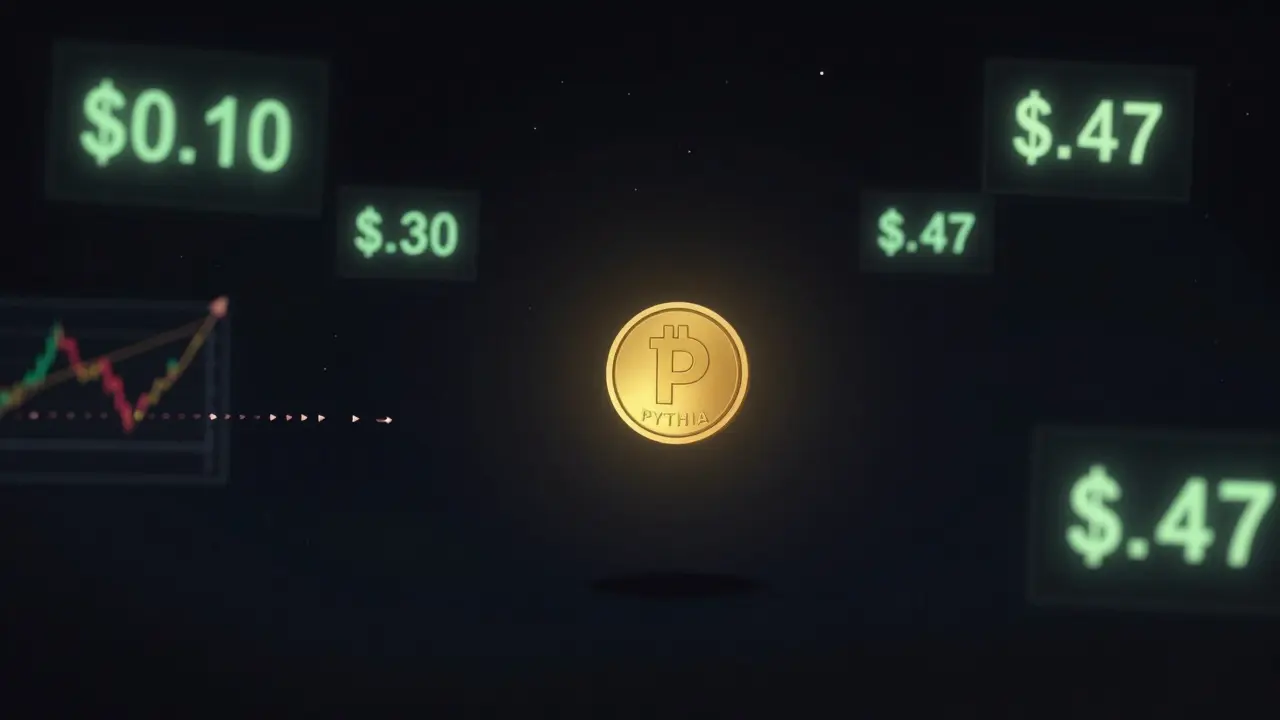
Pythia (PYTHIA) isn’t a household name like Bitcoin or Ethereum. You won’t find it on Coinbase or listed in mainstream finance news. But if you’ve been scrolling through lesser-known crypto exchanges, you’ve probably seen it pop up - a tiny token with a big price prediction story. As of early 2026, PYTHIA trades around $0.036, down 25% in just 24 hours. That kind of volatility isn’t unusual in crypto, but what makes Pythia different is how little we actually know about it.
What is Pythia (PYTHIA)?
Pythia is a cryptocurrency token, but beyond that, details are scarce. There’s no official website. No whitepaper. No GitHub repository. No team members named. No roadmap. If you’re looking for the story behind the coin - who built it, why it exists, or what problem it solves - you won’t find it. That’s not just unusual; it’s a red flag in an industry where transparency matters.
What we do know is that PYTHIA trades primarily on Poloniex and a few smaller exchanges like MEXC and LBank. Its 24-hour trading volume hovers around $620,000 - tiny compared to top-tier coins that move billions daily. It doesn’t appear to be listed on any major DeFi platforms, nor does it offer staking, yield farming, or any clear utility. It’s not built on Ethereum, Solana, or BSC - at least, no source confirms this. Some speculate it might be a BEP-20 token on Binance Smart Chain, but that’s just guesswork.
In crypto, tokens without clear purpose or development activity often fall into the category of “meme coins” or “pump-and-dump” projects. Pythia doesn’t have a mascot, a viral meme, or a celebrity backer. So why does it exist? The answer might be simpler than you think: it’s a speculative bet.
Price history and current market behavior
Pythia’s price has been all over the place. On January 15, 2026, it was trading at $0.04991. By January 25, it dropped to $0.03531 - a 29% fall in just 10 days. Then it bounced back slightly. That kind of swing isn’t driven by news or adoption. It’s driven by traders.
Technical indicators show mixed signals. The 50-day simple moving average is at $0.04991, while the 200-day is at $0.06622 - meaning the coin is trading below its long-term trend. The 14-day RSI is neutral at 50.75, suggesting no strong buying or selling pressure. But look closer: the EMA 5, 10, and 21 are all in BUY territory, while EMA 50 and 100 are SELL. That’s a classic sign of a coin stuck in a range - short-term traders see opportunity, but longer-term holders are staying away.
Volatility is low at 0.98%, which might make it seem safe. But low volatility in a low-volume coin usually means there’s not enough liquidity to move the price meaningfully. One big buy order can spike it. One wave of selling can crash it. That’s not stability - that’s fragility.
Price predictions: Hope vs. reality
Here’s where things get wild. Multiple price prediction sites are forecasting Pythia will hit $0.10 by the end of 2026. Some say $0.30 by 2040. DigitalCoinPrice claims it could reach $0.47 - over 1,200% above its current price. Where do these numbers come from? Not from fundamentals. Not from development progress. They’re based on historical price patterns and correlations with Bitcoin’s halving cycles.
That’s the problem. These forecasts treat PYTHIA like a stock with earnings reports, not a token with zero public code, zero team, and zero use case. Bitcoin halvings affect supply across the entire market. They don’t magically boost a coin that nobody’s building on. If Pythia had a working app, a real community, or even a Twitter account with 10,000 followers, you could at least test those predictions. But you can’t build a future on a ghost.
And yet, people are buying. Why? Because they saw a chart that went up last month. Because someone on a Telegram group said, “Buy now, it’s going to 10 cents.” Because they’re chasing a dream, not a project.

Who’s trading Pythia - and why?
There’s no evidence of institutional investors in Pythia. No venture capital firms backing it. No partnerships with companies. The only people trading it are retail traders looking for quick gains. The Fear & Greed Index was at 61 (“Greed”) in mid-January - meaning fear had faded, and greed was taking over. That’s usually a sign the top is near.
Community sentiment is lukewarm. Over 30 days, 19 days showed price increases - just 63%. That’s not bullish momentum. That’s a coin slowly drifting, with no strong narrative pulling it up. No Reddit threads. No Twitter buzz. No Discord servers with active members. If you search “Pythia crypto” on Google, most results are price charts and prediction blogs - not user discussions or developer updates.
This isn’t a community-driven project. It’s a liquidity pool with a ticker symbol.
Risks of investing in Pythia
Investing in Pythia isn’t like investing in Bitcoin or even a mid-cap altcoin. It’s closer to buying a lottery ticket with a crypto label.
- No transparency: No team, no code, no roadmap - you’re trusting strangers on an exchange.
- Low liquidity: With only $620K traded daily, a single large sell-off can crash the price fast.
- No utility: You can’t use it to pay for anything. You can’t stake it. You can’t earn interest on it.
- High risk of rug pull: If the creators decide to pull the plug, there’s no recourse. Your tokens become worthless.
- Price predictions are fictional: $0.47? That’s not a forecast. It’s a fantasy.
Some might argue, “What if it’s the next Dogecoin?” But Dogecoin had a cult following, meme culture, and Elon Musk tweeting about it. Pythia has none of that. It’s just a ticker symbol with a chart.
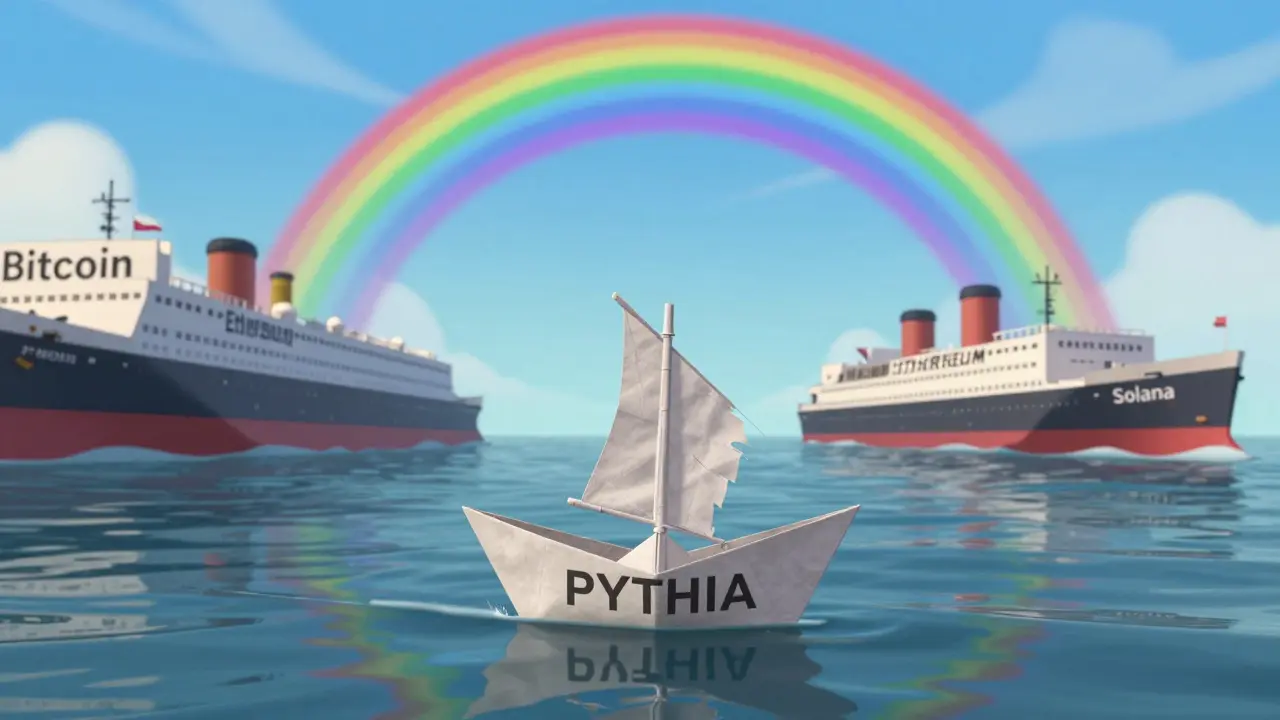
Should you buy Pythia?
If you’re looking for a long-term investment with real value, skip Pythia. It doesn’t qualify.
If you’re willing to gamble a small amount - say, $50 or $100 - and you understand you could lose it all, then maybe it’s worth a tiny bet. Treat it like a lottery ticket. Don’t expect returns. Don’t base your financial plan on it. Don’t tell yourself, “I’ll wait until it hits $0.10.” That day may never come.
And if you’re thinking of putting in more than you can afford to lose - don’t. This isn’t investing. It’s speculation with extra steps.
Where to track Pythia
If you’re still curious, here are the only places with live data:
- CoinGecko: For 24-hour volume and price trends
- CoinCodex: For technical indicators and price forecasts
- Investing.com: For historical price data on Poloniex
- MEXC and LBank: For trading the token directly
But don’t expect to find anything beyond charts. No blog posts. No interviews. No updates. Just numbers moving up and down.
Final thoughts
Pythia (PYTHIA) is a crypto mystery. There’s no story behind it. No innovation. No team. No future plan. Just a price chart and a lot of optimistic predictions that have no foundation in reality.
It’s easy to get sucked in by the idea of finding the next big thing. But the next big thing doesn’t hide in plain sight with zero information. It doesn’t disappear from public view the moment you ask for details. It doesn’t rely on hope and chart patterns to justify its existence.
If you’re looking for real crypto projects - ones with code, teams, and purpose - look elsewhere. Pythia isn’t the future of blockchain. It’s just another noise in a crowded market. And noise doesn’t last.
Comments
Let me guess - someone bought this because they saw ‘PYTHIA’ and thought of the Oracle of Delphi? Cute. No whitepaper, no team, no code - just a ticker and a dream. This isn’t crypto, it’s a digital séance.
Oh sweet baby Zeus, another ‘mystery coin’ that’s just a shell with a chart? People are literally betting their rent money on this? I swear, if I had a dollar for every time someone called a rug-pull ‘the next Dogecoin’… I’d be rich enough to buy a yacht and sail away from this dumpster fire.
There’s zero utility. Zero transparency. Zero soul. And yet, somehow, the ‘buy the dip’ crowd is still out here like it’s Black Friday and the discount is ‘your life savings.’
Don’t be the guy who loses $500 because a Telegram group said ‘10 cents by June.’ That’s not investing. That’s volunteering for financial suicide.
It’s fascinating how the entire crypto ecosystem has devolved into a postmodern performance art piece where liquidity is the only metaphysics left - and Pythia, in its glorious vacuum, is the purest expression of that nihilism. No whitepaper? Perfect. No team? Even better. It’s not a token; it’s a Rorschach test for greed.
The fact that anyone still believes in ‘price predictions’ derived from Bitcoin halving cycles is like forecasting the weather by reading tea leaves - except the tea leaves are being manipulated by bots with no moral compass and a 2009-era understanding of economics.
And yet, here we are. Watching a ghost trade at $0.036 while pretending it has a future. The real tragedy isn’t the loss of capital - it’s the loss of critical thought.
They’re not trading PYTHIA. They’re trading the ghost of a dream. And the ghost? It’s already dead.
I get why people are drawn to stuff like this - the hope of finding something hidden, something the ‘system’ doesn’t want you to see. But hope without facts? That’s just wishful thinking dressed up as speculation.
If you’re going to gamble, at least know you’re gambling. Don’t fool yourself into thinking you’re ‘early’ on something revolutionary. Pythia isn’t revolutionary. It’s a placeholder.
There’s nothing wrong with risking a little on a long shot - I’ve done it myself. But don’t let it become your plan. Your future doesn’t need a mystery coin. It needs a strategy.
Look - if you’ve got $20 to burn and you wanna see if this thing goes to $0.10, go for it 😊
But don’t quit your job. Don’t borrow money. Don’t tell your parents. Just treat it like a lottery ticket and walk away.
Most of these coins die quietly. No fanfare. No headlines. Just… gone.
Ugh. Another ‘crypto mystery’ that’s just a scam with a Greek name. People are so desperate for the next big thing they’ll buy a coin that doesn’t even have a GitHub repo. It’s not ‘risk-taking’ - it’s stupidity with a blockchain label.
And don’t even get me started on those ‘$0.47 predictions.’ That’s not analysis - that’s fanfiction written by someone who thinks ‘technical indicators’ are magic spells.
There’s no ‘next Dogecoin.’ There’s only people who refuse to learn from the last 100 rug pulls.
Low volume + no transparency = guaranteed exit liquidity.
Imagine waking up one day and realizing your entire crypto portfolio is built on a coin with zero code, zero team, and zero soul - and you still held it for 6 months because ‘the chart looked nice.’
That’s not FOMO. That’s a cry for help.
Pythia isn’t the future. It’s the warning.
so like… if no one knows who made it… how do we know its not a scam??
Let’s be real - the entire crypto space has become a cognitive dissonance factory. We’re told to ‘do your own research,’ yet the most popular tokens have zero documentation, zero development activity, and zero accountability. Pythia isn’t an anomaly - it’s the norm.
The fact that people still believe in ‘price targets’ derived from historical patterns - without any fundamental anchor - speaks volumes about how little we’ve learned since 2017.
It’s not about whether Pythia will hit $0.10. It’s about why we still let ourselves be seduced by the illusion of profit when every signal screams ‘danger.’
We’re not investing. We’re participating in a collective delusion - and Pythia is just the latest symbol of it.
Bro. You’re not ‘early.’ You’re the last guy holding the bag.
I’ve seen this movie 200 times. The chart goes up. The Telegram group gets loud. The ‘guru’ posts a ‘10x’ screenshot. Then… silence. The devs vanish. The exchange delists it. And you’re left wondering why you didn’t just buy a pizza instead.
Pythia? It’s not a coin. It’s a funeral waiting to happen.
While the skepticism surrounding Pythia is entirely valid, one must consider the broader macroeconomic context: in an era of unprecedented monetary expansion and institutional distrust, even seemingly opaque assets can experience speculative surges driven by algorithmic arbitrage and behavioral finance dynamics.
The absence of a whitepaper does not inherently negate potential utility - many early-stage blockchain projects operate under stealth mode to avoid regulatory precognition and predatory front-running.
Furthermore, the low trading volume and minimal liquidity are not necessarily indicators of fragility, but rather symptoms of a nascent market still in its infancy - analogous to Bitcoin’s pre-2013 phase, when daily volumes were under $1 million and institutional participation was negligible.
It is precisely this environment that enables asymmetric upside for those who possess the intellectual fortitude to peer beyond the veil of opacity and discern latent value where others see only noise.
While the RSI may appear neutral, the convergence of EMA crossovers in the short-term horizon suggests a potential breakout configuration - especially if Bitcoin’s halving cycle catalyzes a broader altcoin season.
Moreover, the absence of a public team may reflect a deliberate decentralization strategy, akin to the early Satoshi model - where anonymity was not a flaw, but a feature of ideological purity.
One must not confuse lack of visibility with lack of substance. The market is not always rational - but it is rarely wrong for long.
Pythia may not be for the timid. But for the disciplined, the patient, and the strategically audacious - it could be the quiet anomaly that reshapes the next crypto cycle.
Do your due diligence - but do not dismiss the unseen.
Interesting breakdown. I’ve seen this movie before - coin with no info, chart goes up, people get excited, then it fades. Happens every cycle.
Best to keep it small, if you touch it at all.
What if Pythia isn’t meant to be traded? What if it’s a honeypot - designed to trap retail traders so the real players can quietly accumulate Bitcoin while everyone’s distracted by this ghost coin?
I’ve watched this play out before. The most dangerous scams aren’t the ones with flashy websites. They’re the ones that look like noise - so you don’t even question them.
Pythia isn’t a coin. It’s a distraction.
Every single time - every. single. time - someone says ‘this could be the next Dogecoin’… the market laughs. And then it takes your money.
Dogecoin had memes. It had Elon. It had a culture. Pythia has… a chart and a name that sounds like a Greek goddess who predicts doom.
And guess what? She’s already predicting yours.
Pythia? More like Pythia-NO. This isn’t crypto. It’s a tax write-off for scammers.
I don’t know if Pythia will go up or down. But I do know that if you’re reading this and thinking about putting in more than $50… you’re already in too deep.
Walk away. Breathe. Go buy some coffee. Or a book. Or a real asset.
There’s no shame in not playing.
Thanks for the clear breakdown. I’ve been watching this one - and honestly, the lack of any real info is more telling than the price action.
Best to leave it alone.