Pythia (PYTHIA) is a cryptocurrency that shows up on price trackers like CoinGecko and CoinCodex, but if you dig deeper, you’ll find almost nothing solid behind it. There’s no whitepaper. No team names. No GitHub repo. No roadmap. Just a price chart and a lot of conflicting predictions. As of February 1, 2026, PYTHIA trades around $0.036, down over 25% from just a week earlier. That kind of drop isn’t unusual for low-cap coins-but what’s unusual is how little anyone actually knows about what PYTHIA is supposed to do.
There’s no official story behind Pythia
Most cryptocurrencies come with a story. Bitcoin was about decentralizing money. Ethereum was about smart contracts. Even obscure tokens usually have a one-page whitepaper explaining their use case. Pythia doesn’t. Search any official website, Twitter account, or Telegram group linked to PYTHIA, and you’ll hit dead ends or low-quality pages filled with generic marketing fluff. No founding team is listed. No developers are named. No technical details explain which blockchain it runs on-Ethereum? Solana? BSC? Or something else entirely?
This isn’t just poor communication-it’s a red flag. Legitimate projects, even small ones, publish at least basic documentation. Pythia doesn’t. That means you’re not investing in a technology or a vision. You’re betting purely on whether someone else will pay more for it tomorrow. And that’s not investing. That’s gambling with extra steps.
Price movements don’t tell the whole story
Pythia’s price has been stuck in a narrow range for months. Around $0.035 to $0.05. That’s not volatility. That’s stagnation. CoinCodex reports its daily volatility at just 0.98%, which is extremely low for a crypto asset. Low volatility usually means one thing: low trading activity. Few people are buying or selling. That makes it hard to get in or out without moving the price.
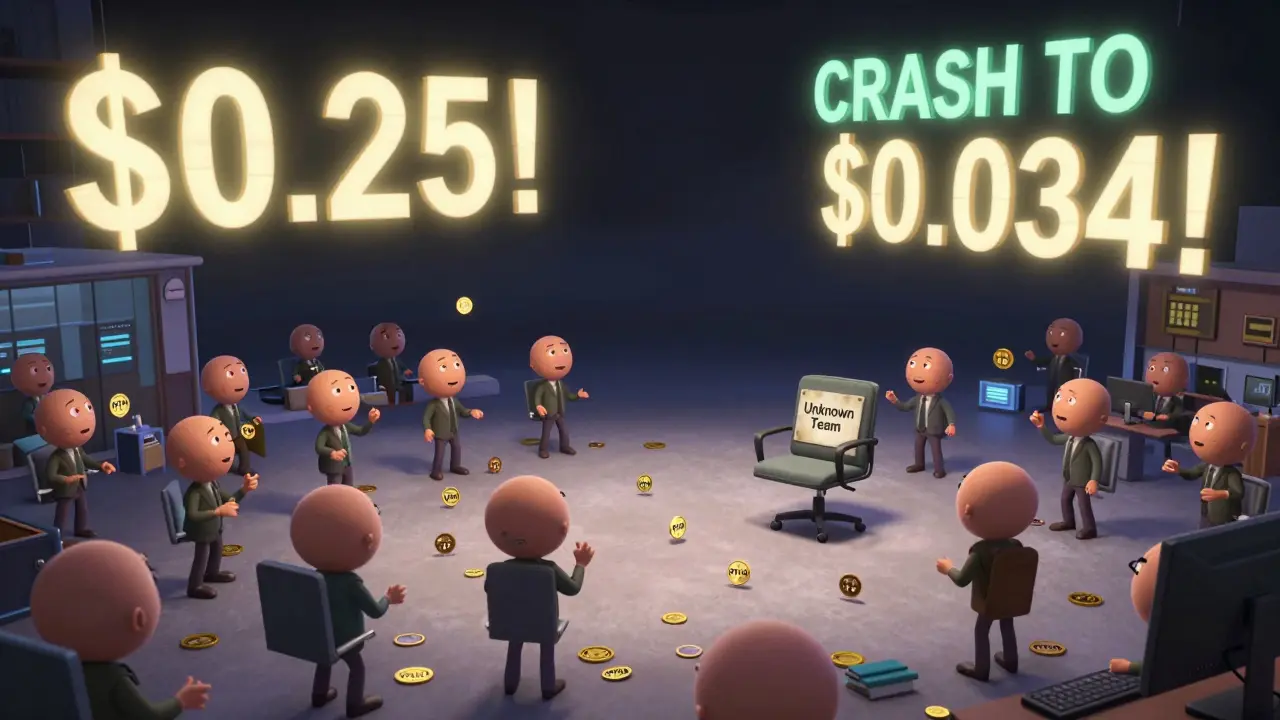
On January 25, 2026, the 24-hour trading volume was under $620,000. Compare that to even the smallest legitimate tokens, which often trade over $10 million daily. Pythia’s volume is tiny. That’s why price predictions vary so wildly. One site says it’ll crash to $0.034. Another says it’ll hit $0.25 by 2034. Neither has real data to back it up. They’re just guessing based on past price patterns-which, in a low-volume token, can be completely manipulated by a few large wallets.
Technical indicators are misleading
Some traders look at RSI, moving averages, and Bollinger Bands to decide when to buy or sell. Pythia’s indicators are mixed. The 5-day and 10-day EMAs show BUY signals. The 50-day and 100-day EMAs show SELL. The RSI is at 50.75-neutral. The Stoch RSI is at 100, which usually means the asset is overbought and due for a drop. But here’s the problem: these signals only matter if there’s real market participation. With so little volume, these indicators are like reading a weather forecast for a room with no windows. It looks scientific, but it doesn’t reflect reality.
Even the Fear & Greed Index, which measures market sentiment, says “Greed” at 61. But greed doesn’t mean the project is good-it just means people are buying because they think the price will go up. That’s the opposite of fundamental strength. It’s herd behavior. And in a token with no utility, no team, and no history, herd behavior is the only thing holding the price up.
Who’s even trading Pythia?
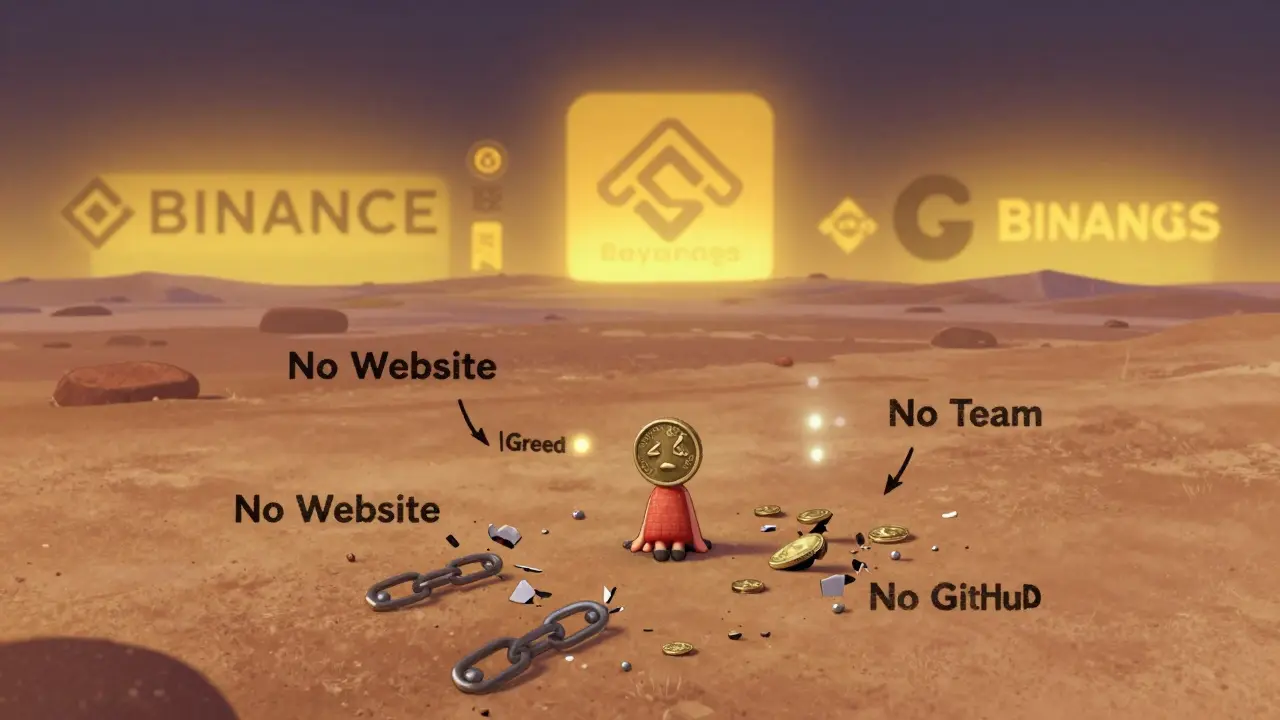
You won’t find Pythia on Coinbase, Binance, or Kraken. It’s listed on smaller exchanges like Poloniex and MEXC. That’s not a coincidence. Major exchanges have strict listing criteria. They want projects with audits, legal compliance, active development, and community engagement. Pythia has none of that. It’s the kind of token that slips through the cracks of lesser-known platforms.
There are no Reddit threads debating its future. No Twitter threads from developers sharing updates. No Medium posts explaining the tech. No YouTube videos breaking down its mechanics. If Pythia had real users, you’d hear about them. But you don’t. That’s not silence-it’s absence.
Price predictions? Don’t trust them
Here’s where things get really risky. Sites like DigitalCoinPrice claim PYTHIA could hit $0.25 by 2034. That’s a 591% increase from its January 2026 price. But they don’t explain how. They don’t show revenue models, user growth, or adoption metrics. They just extrapolate a line from a chart that’s been flat for months.
Meanwhile, CoinCodex predicts a drop to $0.03766 within weeks. LBank’s model agrees with the bearish view. CryptoTicker says it might hit $0.09, but again-no explanation. The only thing all these forecasts have in common is that they’re based on zero real data. They’re using the same algorithm on the same tiny dataset and coming up with wildly different outcomes. That’s not analysis. That’s noise.
Why does Pythia even exist?
Low-cap tokens like Pythia often serve one purpose: to let early buyers pump the price and exit before anyone else catches on. It’s called a “pump and dump.” The creators create a token, list it on a small exchange, hype it on forums, and wait for retail traders to buy in. Then they sell their massive holdings and disappear. The price crashes. The people who bought late lose money.
There’s no proof Pythia is one of these-but the signs match. No team. No tech. No updates. Low volume. Wild price predictions. And a price that’s been falling steadily for weeks. If this were a legitimate project, you’d see at least one blog post, one GitHub commit, one tweet from a developer. You don’t. That’s not negligence. That’s intentional.
What should you do?
If you’re thinking about buying Pythia, ask yourself: what are you actually buying? A coin with no utility? No team? No roadmap? No community? If your answer is “I’m betting the price will go up,” then you’re not investing-you’re playing roulette with crypto.
There’s nothing illegal about trading low-cap tokens. But there’s a big difference between taking a calculated risk and throwing money at a black box. Pythia is a black box. No one knows what’s inside. And no one can tell you if it’s worth anything.
If you still want to trade it, do so with extreme caution. Use only money you can afford to lose. Set a strict stop-loss. Don’t chase pumps. And never, ever believe a price prediction that doesn’t explain how it got there.
For most people, the smartest move with Pythia is to walk away. There are hundreds of other cryptocurrencies with real teams, real code, and real use cases. Why risk your money on a ghost project when there are so many better options?
Pythia’s biggest risk isn’t the price-it’s the silence
When a project has no communication, no transparency, and no track record, the risk isn’t just financial. It’s existential. If the developers vanish tomorrow, PYTHIA becomes worthless. No one can fix it. No one can update it. No one can even explain what it was for. And that’s not a market risk. That’s a total loss waiting to happen.
Pythia isn’t a crypto coin you invest in. It’s a crypto coin you observe-and then move on from.
Comments
Oh sweet Jesus, another ghost coin with a price chart and zero substance. You people are still chasing these digital phantoms? The fact that anyone thinks this is an 'investment' and not a casino side bet is honestly terrifying. Pythia? More like Pythia-never-heard-of-it. Stop feeding the void.
Y’all are acting like this is some kind of mystery. It’s not. It’s a rug pull in beta. No whitepaper? No team? No GitHub? That’s not ‘emerging tech’-that’s a LinkedIn ad written by a bot trained on 2017 ICO memes. If you’re buying this, you’re not just ignorant-you’re a liability to your own portfolio. The RSI doesn’t matter when the entire market is a puppet show controlled by three wallets. Wake up.
Look, I get it-on the surface, Pythia looks like a textbook pump-and-dump. But let’s not forget that Bitcoin had no whitepaper either, at least not in the way we think of them today. The real question isn’t whether it’s legitimate-it’s whether it’s *emergent*. Maybe the silence is the signal. Maybe the absence of a team means it’s truly decentralized. Maybe the lack of a roadmap is the roadmap: to be whatever the market makes it. We’re so conditioned to demand structure that we can’t recognize organic chaos when it stares us in the face. The market is the only oracle now. And it’s whispering.
Pythia’s not a coin. It’s a ghost story written in blockchain ink. The devs aren’t hiding-they’re already on a beach somewhere sipping piña coladas while your wallet cries. That $620k volume? That’s the last gasp of the last sucker. The Fear & Greed Index says ‘Greed’? Nah. It says ‘Sucker’ in bold, red, flashing neon. You’re not trading crypto. You’re playing Russian roulette with a loaded gun labeled ‘DYOR’.
Ugh. I just saw someone on X saying ‘PYTHIA TO THE MOON 💫’ and I screamed into my pillow. Who are these people? Are they even real? Do they know what a blockchain is? Or do they just like the name because it sounds like a fantasy novel? I’m not mad-I’m just… heartbroken. We’re letting the internet turn finance into a TikTok trend. And Pythia? It’s the most tragic Disney villain origin story ever written.
No team. No code. No future. That’s the whole story.
I get why people are drawn to things like this. There’s this weird hope that maybe, just maybe, this time it’s different. That maybe this ghost coin is the one that actually wakes up. But hope isn’t a strategy. And silence isn’t mystery-it’s abandonment. If you’re going to risk money on something, at least make sure someone’s home. Pythia’s house is empty. The lights are off. The door’s unlocked. Walk away.
Let’s be real: the entire crypto space is a postmodern art installation where the audience is also the artist and the curator and the gullible donor. Pythia? It’s not a coin-it’s a performance piece. A meditation on greed, anonymity, and the human need to believe in something, anything, even if it’s made of smoke and algorithmic noise. The price chart? That’s the brushstroke. The silence? That’s the canvas. And we’re all standing in front of it, nodding solemnly, pretending we understand. We don’t. But we want to. So we buy.
Remember when people thought Dogecoin was a joke? Now it’s a meme with a market cap. Maybe Pythia’s the same-just slower. Maybe the devs are waiting for the right moment to reveal themselves. Or maybe they’re already gone. Either way, I’m not betting my rent money on a whisper.
I don’t get why people get so worked up over this. If you don’t understand it, don’t touch it. Simple. There’s no shame in walking away. The market doesn’t need you to chase every spark. Just because something’s listed doesn’t mean it’s worth your time. I’ve seen hundreds of these. Most vanish. A few explode. None of them are worth the stress.
Stay calm and keep it simple 🤝. If it feels sketchy, it probably is. No need to overthink. No team? No code? Walk away. There’s a million other coins with real people behind them. You don’t need to chase shadows. Focus on what’s solid. Your future self will thank you 😊
Pythia isn’t a coin-it’s a horror movie where the monster is your own FOMO. The price drops? Oh no! The volume tanks? Oh my god! The devs vanish? OH MY GOD, IT’S A RUG PULL!! But you still click ‘BUY’ because you’re addicted to the dopamine drip of a chart that moves like a sloth on sedatives. Wake up. You’re not investing. You’re binge-watching a trainwreck and paying to sit in the front row.
bro i just saw a guy on discord say pythia is gonna be the next eth and i was like… are we still doing this? like i get the dream but this is like betting on a cardboard box that says ‘future tech’ and hoping it turns into a spaceship. just… dont. save your cash for pizza or something.
Let’s not pretend that the absence of a whitepaper is somehow ‘mysterious’ or ‘decentralized’-it’s negligence. And negligence in crypto is a death sentence. The fact that people are still reading price predictions from sites that don’t even disclose their models is beyond concerning. This isn’t ‘risk tolerance’-it’s cognitive dissonance on a mass scale. We’ve normalized gambling by rebranding it as ‘decentralized finance.’ Pythia is the poster child for that delusion. And it’s not even a good poster. It’s a blurry, half-printed flier taped to a dumpster.
Oh wow, another ‘crypto ghost’? Congrats, you found the 2026 version of BitConnect. The fact that you’re even debating this means you’ve already lost. Pythia doesn’t have a team? Good. That means it’s not a scam-it’s a *soulless algorithmic ghost* that’s been programmed to lure retail idiots. And you’re the bait. Don’t be the last one holding the bag. Sell. Now. Before the next ‘prediction’ drops and the whales start dumping.
Low volume, no team, no documentation. That’s not a crypto project. That’s a spreadsheet with a ticker symbol. I don’t need to know the future to know this won’t end well. I’ve seen this movie before. The credits roll the same every time.
Pythia is a tax write-off for the rich. The devs made it, listed it on MEXC, dumped 90% on retail, and vanished. The rest is just noise. You think the ‘predictions’ are real? They’re bots generating fake optimism to trigger FOMO. The only thing rising is the scam’s exit velocity.
I appreciate the depth of this breakdown. It’s rare to see someone lay out the facts without hysteria. The silence speaks louder than any chart. I’ve traded small caps before, but this… this feels different. It’s not risky. It’s terminal.
I know it’s hard to walk away when you’ve already bought in, but sometimes the most courageous move is to admit you were wrong. Pythia isn’t your next big win. It’s a lesson. And lessons are free-if you’re willing to learn. Don’t throw good money after bad. Protect your peace. There’s always another opportunity.
Pythia is a phoenix waiting to rise. You think silence means death? No. It means rebirth. The devs are building in the shadows. The blockchain is their canvas. The market will wake up. And when it does, those who held will be billionaires. Don’t be the one who sold too soon. The future belongs to the bold.
I’ve been watching Pythia for months now and I just can’t shake this feeling that something’s off. Not just the lack of info but the way the price moves-like it’s being nudged by invisible hands. I’ve talked to people who’ve bought it and they all say the same thing: they don’t know why they bought it. They just felt like they had to. That’s not investing. That’s surrender. And I think that’s the real danger here. Not the price. Not the volume. But the fact that we’ve stopped asking why.