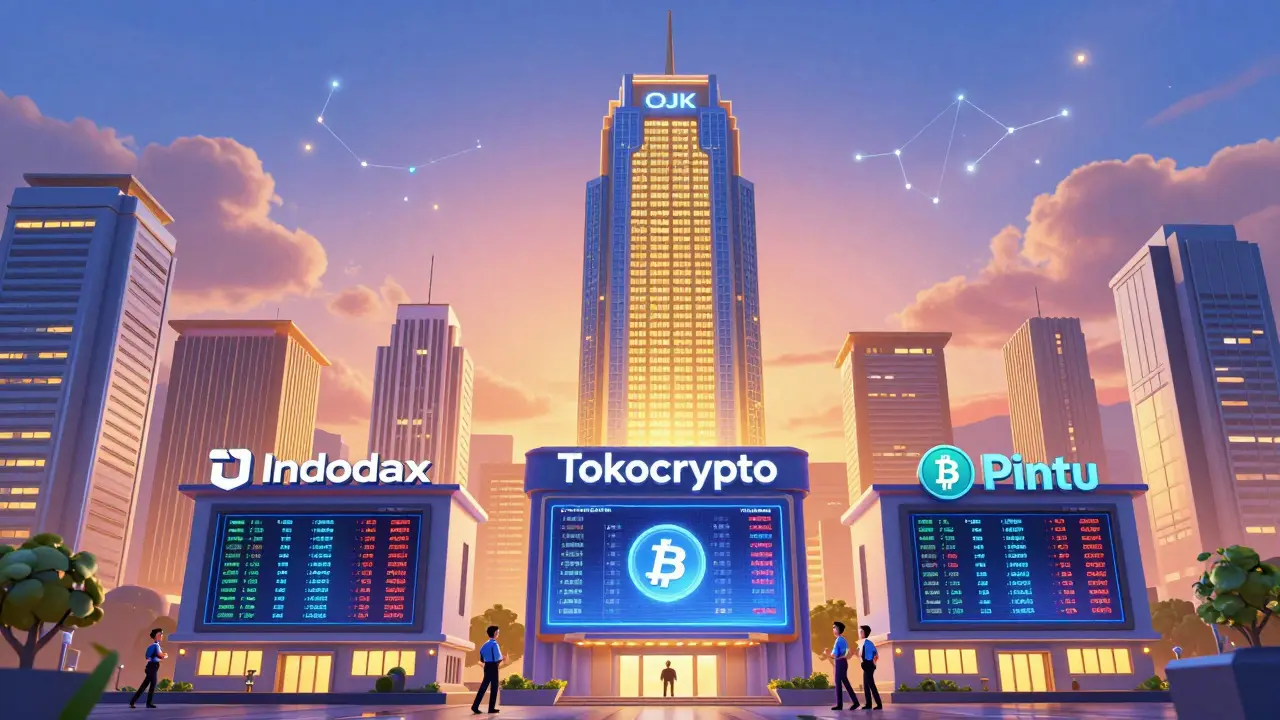
When Indonesia switched its crypto regulator from BAPPEBTI to the Otoritas Jasa Keuangan (OJK) on January 10, 2025, it didn’t just change a name-it rewrote the rules for everyone trading digital assets in the country. If you’re running or planning to launch a crypto exchange in Indonesia, you’re now operating under a far stricter, more complex system called the Digital Financial Assets (DFA) Framework under POJK 27/2024. This isn’t a minor update. It’s a full overhaul designed to protect investors, shut down shady operators, and position Indonesia as a serious player in Southeast Asia’s digital finance scene.
Who Needs a License and What’s Changed?
Under the old system, crypto platforms were called exchanges and reported to BAPPEBTI. Now, they’re officially Digital Financial Asset Trading Providers. The term "exchange" is reserved for one single entity-the DFA Exchange Authority-that controls which assets can be traded. All other platforms are traders, not marketplaces. This distinction matters because it centralizes control over asset listings and removes ambiguity about who’s responsible for what.If you were already licensed under BAPPEBTI before January 2025, you’re not automatically grandfathered in. You have until July 2025 to reapply under the new DFA rules. Miss the deadline, and your license expires. No extensions. No exceptions. That’s how serious OJK is about compliance.
Capital Requirements: It’s Not Just a Suggestion
The financial bar is high-and it’s not going down. To get licensed, you need:- 100 billion Indonesian rupiah (about $6 million USD) in paid-up capital
- 50 billion rupiah (about $3 million USD) in minimum equity
These numbers haven’t changed from the old BAPPEBTI rules, but now they’re enforced with real consequences. OJK doesn’t just ask for proof-you have to show it’s locked in a local bank account, audited, and tied to your legal entity. No offshore funding. No shell companies. No creative accounting.
This effectively blocks small startups and fly-by-night operators. Only well-funded companies with real backing can enter. That’s intentional. OJK wants platforms that can absorb losses, survive market crashes, and handle regulatory audits without collapsing.
The Licensing Process: Five Steps, No Shortcuts
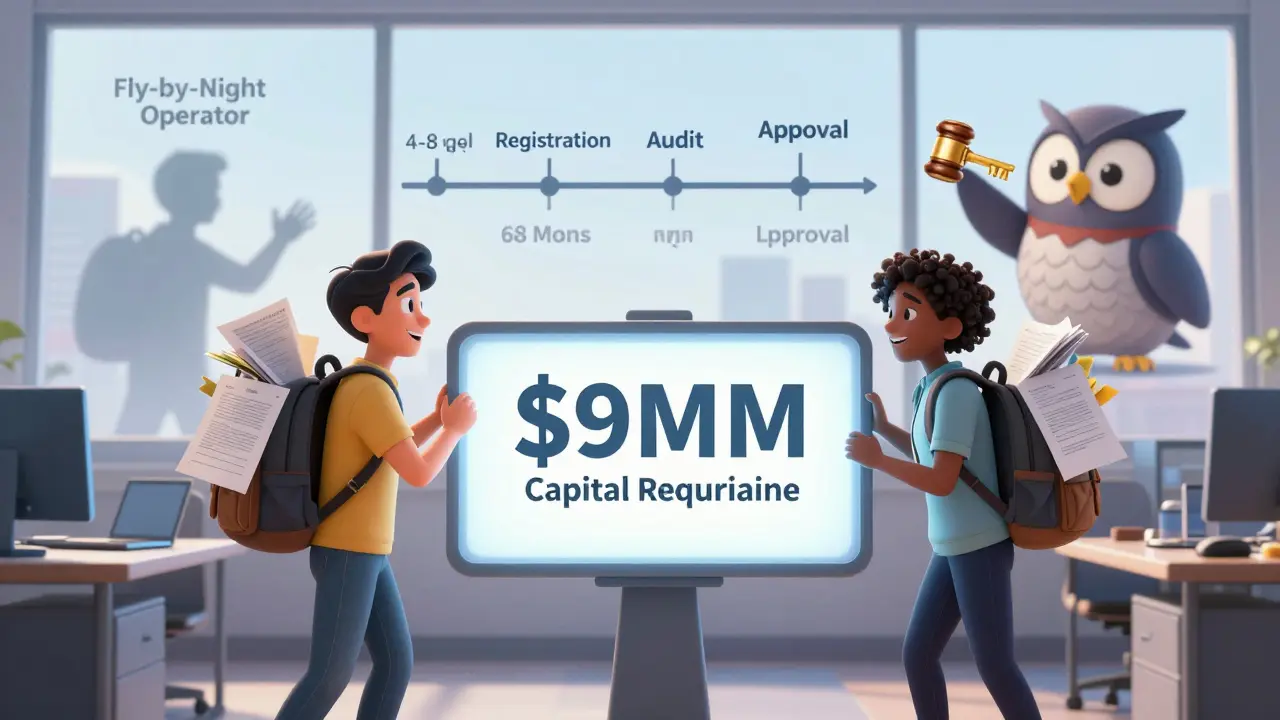
Getting licensed isn’t a form you fill out online. It’s a multi-month legal and technical marathon:- Register your company in Indonesia through the Ministry of Investments website. You’ll need to set up a PT PMA (foreign investment limited liability company) if you’re not Indonesian-owned.
- Gather documents-this includes articles of association, proof of capital, beneficial owner profiles, governance structure, operational manuals, and detailed cybersecurity plans.
- Submit everything to OJK in Indonesian. All documents must be translated by a certified translator and notarized.
- Undergo inspection. OJK sends auditors to review your physical and digital infrastructure. They’ll test your KYC system, check your server security, and verify that your AML protocols actually work.
- Receive approval. Only after all checks pass will you get your license. The entire process can take 4 to 8 months.
There’s no fast-track option. Even big players like Indodax and Tokocrypto had to go through this. If your KYC system can’t verify a user’s ID with a live selfie and government document match, you won’t pass. If your server logs aren’t encrypted and stored for 5 years, you won’t pass. If your beneficial owners have any past financial violations, you won’t pass.
Asset Listing: One Authority, One List
Before 2025, each exchange picked its own coins and tokens. Now, only the DFA Exchange Authority can approve what’s tradable. The first official list, released in April 2025, included 1,444 digital assets-up from 851 under BAPPEBTI. That’s a 70% increase, but don’t assume it’s a free-for-all.Every asset on the list had to pass a rigorous review for technical security, liquidity, team transparency, and legal standing. OJK doesn’t just look at the coin-it looks at the team behind it, the whitepaper, the smart contract audits, and whether it’s been flagged elsewhere globally.
Trading platforms can suggest new assets, but the final call is OJK’s. And if OJK decides a coin is risky-say, a new meme token with no real utility or a token linked to a sanctioned entity-they can remove it immediately. You don’t get to argue. You just stop trading it.
Compliance: KYC, AML, and Real-Time Monitoring
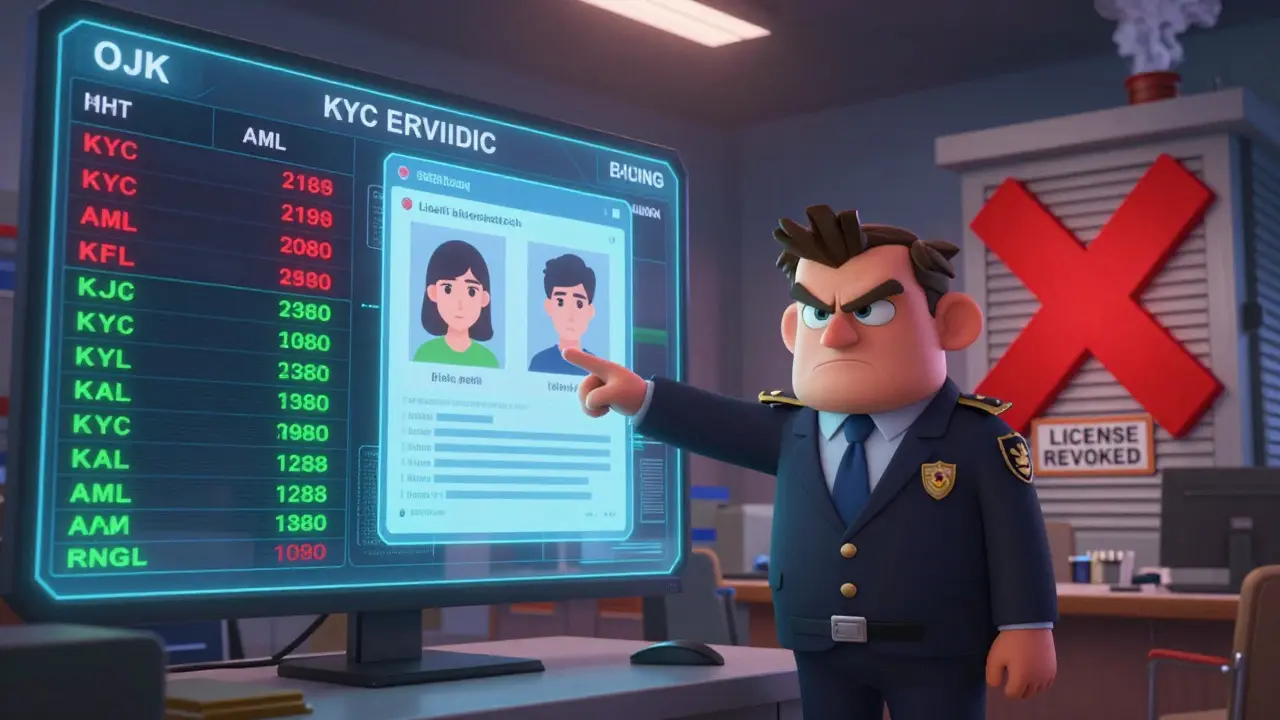
You can’t just collect IDs and call it a day. Under SEOJK No. 20 of 2024, you must implement:- Real-time KYC verification using biometric matching (face + ID document)
- Automated AML screening that flags suspicious transactions (large transfers, rapid deposits/withdrawals, layered trading)
- Direct reporting to PPATK (Indonesia’s Financial Transaction Reports and Analysis Center) for all flagged activity
- Secure, encrypted logs of every transaction, stored for at least five years
OJK doesn’t wait for complaints. They monitor trading activity in real time. If they see patterns that look like money laundering or market manipulation, they can freeze accounts, halt trading, or shut down your platform-within hours.
Non-compliance isn’t just a fine. It’s license revocation, criminal charges, and asset seizure. In 2025, two platforms were shut down for failing to report suspicious transactions. Their founders were barred from ever working in Indonesia’s financial sector again.
Taxes: Simpler, But Still Mandatory
As of August 1, 2025, Indonesia changed how crypto is taxed. The old VAT on crypto trades? Gone. Now, there’s a flat 0.21% final income tax on every transaction-buy, sell, or trade. It’s automatically calculated and withheld by the exchange. You don’t need to file separate tax returns.This is a huge shift. Before, crypto was treated like goods-subject to VAT and complex reporting. Now, it’s treated like a financial instrument. The goal? Reduce administrative burden and make compliance easier. But don’t think it’s a loophole. The tax is mandatory, tracked, and reported to the Ministry of Finance. Avoiding it is now a criminal offense.
What Happens If You Don’t Comply?
The penalties aren’t warnings-they’re endings.- License revoked
- Assets frozen or seized
- Trading banned for all users on your platform
- Founders and executives banned from financial services in Indonesia
- Criminal prosecution under Indonesia’s Financial Services Law
There’s no "first offense" rule. OJK operates on zero tolerance. Even a single failure in KYC or a missed PPATK report can trigger an audit that ends your business.
Who’s Already Licensed?
As of March 2025, OJK has granted one official DFA Exchange license (the central asset listing body). But over 20 platforms still operate under their old BAPPEBTI licenses while they reapply. Major names include:- Indodax
- Tokocrypto
- Pintu
- Reku
These companies spent millions upgrading their systems, hiring compliance officers, and restructuring ownership to meet the new rules. Smaller exchanges either merged with bigger ones or shut down.
The Future: Innovation Within Bounds
OJK isn’t just cracking down-it’s also creating space for innovation. The regulatory sandbox lets licensed platforms test new products like crypto-backed loans, staking services, or tokenized assets-under supervision. But you can’t just launch anything. Every test must be approved, limited in scale, and monitored for consumer risk.Indonesia’s goal is clear: become a regional crypto hub, but not a Wild West. The rules are tight, the oversight is real, and the cost of entry is high. But for those who make it through, the payoff is legitimacy, investor trust, and long-term growth in one of the world’s fastest-growing digital economies.
What You Need to Do Now
If you’re operating in Indonesia:- Check if your license is still valid under OJK’s new system
- Start gathering documents for reapplication-translation and notarization take time
- Upgrade your KYC/AML systems to meet real-time monitoring standards
- Confirm your capital is in a local Indonesian bank account
- Prepare for a 4-8 month review process
If you’re thinking of launching a new exchange: walk away unless you have at least $9 million in ready capital and a team that understands Indonesian financial law. This isn’t a startup playground. It’s a regulated financial market-and OJK is the sheriff.
Do I need to be an Indonesian citizen to run a crypto exchange in Indonesia?
No, you don’t need to be a citizen, but you must register as a foreign-invested company (PT PMA). Foreign ownership is allowed, but all operations, capital, and compliance must be based in Indonesia. You’ll need local legal representation, an Indonesian bank account, and a local address for official correspondence.
Can I still list new cryptocurrencies after getting licensed?
No, not directly. Only the DFA Exchange Authority can approve which assets are tradable. You can submit suggestions, but the final decision rests with OJK. Your platform can only trade assets on the official list. If you try to list something not approved, your license will be revoked.
What happens if my exchange gets hacked?
You’re required to have cyber insurance and proof of secure infrastructure. If a hack occurs, you must report it to OJK and PPATK within 24 hours. Failure to report can lead to license suspension. OJK will investigate whether your security measures met regulatory standards. If they didn’t, you could face fines, asset freezes, or revocation-even if you weren’t at fault.
Is staking or yield farming allowed under the new rules?
Not yet, unless you’re in OJK’s regulatory sandbox. General staking services aren’t permitted on licensed platforms as of 2026. OJK considers them high-risk and unregulated. If you want to offer staking, you must apply for sandbox approval, prove your model is secure, and limit participation to verified institutional users.
How often does OJK review licensed exchanges?
OJK conducts mandatory annual audits and can perform surprise inspections at any time. Real-time transaction monitoring is continuous. If your platform shows unusual activity-like sudden spikes in withdrawals or KYC failures-you’ll be flagged immediately. Compliance isn’t a one-time check-it’s an ongoing obligation.

Comments
The DFA Framework’s capital requirements are a classic case of regulatory capture disguised as investor protection. 100B IDR? That’s not a barrier to entry-that’s a gatekeeper license for oligarchs. The real innovation here isn’t compliance-it’s the consolidation of power into a single asset-listing authority. OJK isn’t regulating crypto; it’s nationalizing the permission layer.
And let’s not pretend the 0.21% tax is about simplification. It’s a stealth transaction tax disguised as a final withholding mechanism. Every trade becomes a revenue stream for the state. Welcome to financial socialism with Indonesian characteristics.
This is actually kind of beautiful. I know it sounds crazy, but for once, a government is saying: ‘We care about your money, and we’re not letting scammers take it.’
Imagine if every country did this. No more rug pulls. No more anonymous wallets. No more ‘I lost everything because I trusted a Telegram group.’ Indonesia’s saying: ‘You want to trade crypto? Fine. But you’ve got to do it like an adult.’
And that 0.21% tax? Genius. No more filing nightmares. Just trade, pay, and move on. I’m so proud of them for getting this right.
Regulation is the price of legitimacy. The market will sort itself. The strong survive. The weak disappear. That’s not cruelty. That’s evolution.
I’ve been watching this rollout from the sidelines and honestly? I’m impressed. Most countries are either banning crypto or pretending it doesn’t exist. Indonesia is saying: ‘We’re here, we’re serious, and we’re building something real.’
It’s not perfect-but it’s a blueprint. Other Southeast Asian nations should take notes. This is how you do it right.
The structural clarity of the DFA framework is noteworthy. Centralizing asset listing under a single authority eliminates the regulatory arbitrage that plagued the BAPPEBTI era. The capital requirements, while substantial, align with international standards for systemically important financial intermediaries.
Moreover, the mandatory real-time KYC/AML integration with PPATK represents a significant advancement in financial integrity infrastructure. This is not merely compliance-it is institutional modernization.
Bro. This is wild. Indonesia just turned crypto into a regulated financial market. Like… actual Wall Street rules. 6 million USD just to apply? 😳
And they’re forcing exchanges to use live selfies for KYC? That’s next level. I’ve seen some sketchy platforms in my day, but this? This is the future. I’m not mad. I’m inspired. 🚀
Also, the 0.21% tax? YES. No more tax season nightmares. Just let the exchange handle it. Perfect.
They call it ‘investor protection’ but it’s really just a state-sanctioned cartel. Who benefits? The big boys who already had the cash. The little guy? Crushed before he even starts. And that ‘DFA Exchange Authority’? That’s not a marketplace-it’s a choke point. OJK is the new central bank of crypto and they’re not letting anyone else play.
And don’t get me started on the ‘regulatory sandbox.’ That’s just a velvet rope for their buddies. Meanwhile, the real innovators? They’re banned, jailed, or gone. This isn’t progress. It’s control dressed up in compliance pajamas.
Man, I came here expecting chaos. What I got? A damn blueprint. Indonesia didn’t just update rules-they rewrote the playbook. No more shady tokens. No more anonymous accounts. No more ‘oops I got rug pulled’ memes.
Yeah, the money’s crazy high. But if you’re serious about this? You’ve got the brains and the backing. This isn’t a barrier-it’s a filter. And honestly? I respect that. The Wild West is over. Time to build something that lasts.
I think a lot of people are missing the bigger picture here. This isn’t just about crypto-it’s about Indonesia asserting itself as a serious financial hub. The capital requirements, the centralized listing, the real-time monitoring… these aren’t just rules. They’re signals.
They’re telling the world: ‘We’re not a backwater. We’re not a tax haven. We’re a modern economy with standards.’ And honestly? That’s kind of inspiring.
100 billion rupiah? Who even has that? This is just a way for the government to hand the market to their cronies. And that DFA Exchange Authority? That’s not a marketplace-it’s a monopoly. You think they’re letting some startup list a new token? Nah. They’re saving that for their cousin’s project.
And don’t even get me started on the tax. 0.21% sounds small but it’s a drip-feed extraction system. Every trade gets taxed. Every move gets tracked. Welcome to the surveillance economy, folks.
They call it protection. I call it theft with paperwork.
Let’s be real-this is overkill. You’re telling me a guy in Jakarta can’t start a crypto platform unless he’s got $6 million in the bank? That’s not regulation. That’s a corporate welfare program for the already rich.
And don’t even get me started on the asset listing monopoly. You’re killing innovation before it even breathes. Who’s to say the next Bitcoin wasn’t some guy in a garage with a whitepaper? Now? He’s dead on arrival.
So let me get this straight. You need $6 million to trade crypto in Indonesia… but you can’t stake it? That’s like saying you can drive a Ferrari… but only on Tuesdays. And only if you wear a hat.
Also, the 0.21% tax? Cute. So now every time I swap DOGE for SHIB, the government gets a little slice. Cool. I’ll just… keep my money in a sock.
Of course. Of course they did this. The same people who banned TikTok because it ‘threatens national values’ now want to control digital assets? How convenient. This isn’t about investor protection-it’s about control. OJK isn’t a regulator. It’s a gatekeeper for the elite. The ‘DFA Exchange Authority’? That’s not a marketplace. It’s a state-owned exchange in disguise.
And don’t even mention the sandbox. That’s just a velvet rope for their friends in Jakarta’s elite circles. The rest of us? We’re not even on the guest list.
People are acting like this is a crackdown. It’s not. It’s a cleanup. For years, Indonesia’s crypto scene was a jungle-no rules, no accountability, no safety nets. Now? You’ve got real infrastructure. Real oversight. Real consequences.
Yes, it’s expensive. Yes, it’s strict. But if you’re building something real, you should have to meet real standards. This isn’t a barrier-it’s a foundation. And honestly? I’m glad someone finally built it.
The capital requirements, while stringent, are necessary to ensure operational resilience and prevent systemic risk. The centralized asset listing model, though controversial, eliminates conflicting standards and reduces investor confusion. Furthermore, the integration of real-time monitoring with PPATK establishes a robust anti-money laundering framework that aligns with FATF recommendations.
This framework represents a significant step toward institutional credibility in digital finance.
Indonesia thinks it’s some financial powerhouse now? Please. This isn’t regulation-it’s cultural imperialism disguised as compliance. They’re forcing Western-style finance on a developing nation with zero understanding of its own people. Who needs $6 million to trade crypto? The average Indonesian makes $4,000 a year.
This isn’t protecting investors. It’s protecting Western banks from competition. And the ‘DFA Exchange Authority’? That’s just a front for IMF puppeteers. Wake up.
It is, without question, a paradigmatic shift in the governance architecture of digital financial assets within the Indonesian jurisdictional framework. The transition from BAPPEBTI to OJK, under POJK 27/2024, constitutes not merely an administrative realignment, but a profound epistemological reorientation toward institutionalized financial integrity.
The imposition of mandatory capitalization thresholds, coupled with the centralization of asset listing authority under the DFA Exchange Authority, reflects a deliberate prioritization of systemic stability over speculative liquidity-a stance that, while potentially inhibitive to entrepreneurial entry, is ethically and economically defensible in light of global precedents such as the EU’s MiCA framework.
I’ve spent the last year working with crypto startups in Southeast Asia, and honestly? Indonesia’s move is the most thoughtful thing I’ve seen. Most countries either ban it or ignore it. Indonesia said: ‘We’re going to do this right.’
Yes, the capital is high. Yes, the process is long. But think about it-how many people lost everything because an exchange vanished overnight? How many got scammed by fake tokens with no team? This isn’t about stopping innovation-it’s about making sure innovation doesn’t hurt people.
And the 0.21% tax? That’s genius. No more confusion. No more audits. Just trade, pay, and move on. It’s simple. It’s fair. It’s actually… kind of beautiful.
Okay, so let’s break this down, because honestly, this is kind of a big deal, and I think people are missing how revolutionary it is: centralized asset listing? That’s huge. No more random meme coins popping up every Tuesday. Real oversight. Real accountability. And the KYC with live selfies? That’s not invasive-that’s necessary. We’ve seen too many cases where people got hacked because the exchange didn’t even verify who they were.
Plus, the tax being auto-withheld? Finally. No more scrambling at tax season. And the sandbox? That’s not a trap-it’s a lifeline for legit innovators who want to test staking or tokenized assets without getting shut down on day one.
Yes, the capital requirement is steep, but if you’re serious about this, you’re not a side-hustler-you’re a builder. And builders deserve to operate in a system that doesn’t collapse under its own weight. Indonesia isn’t killing crypto. They’re giving it a spine.
There’s something poetic about Indonesia doing this. Not the richest country. Not the most powerful. But one that decided: ‘We’re going to do this properly.’
It’s not glamorous. It’s not fast. But it’s honest. And in a world full of crypto chaos, that’s rare. I don’t know if it’ll work long-term. But I respect the attempt. Sometimes, the right thing isn’t the easiest thing. And sometimes, that’s enough.