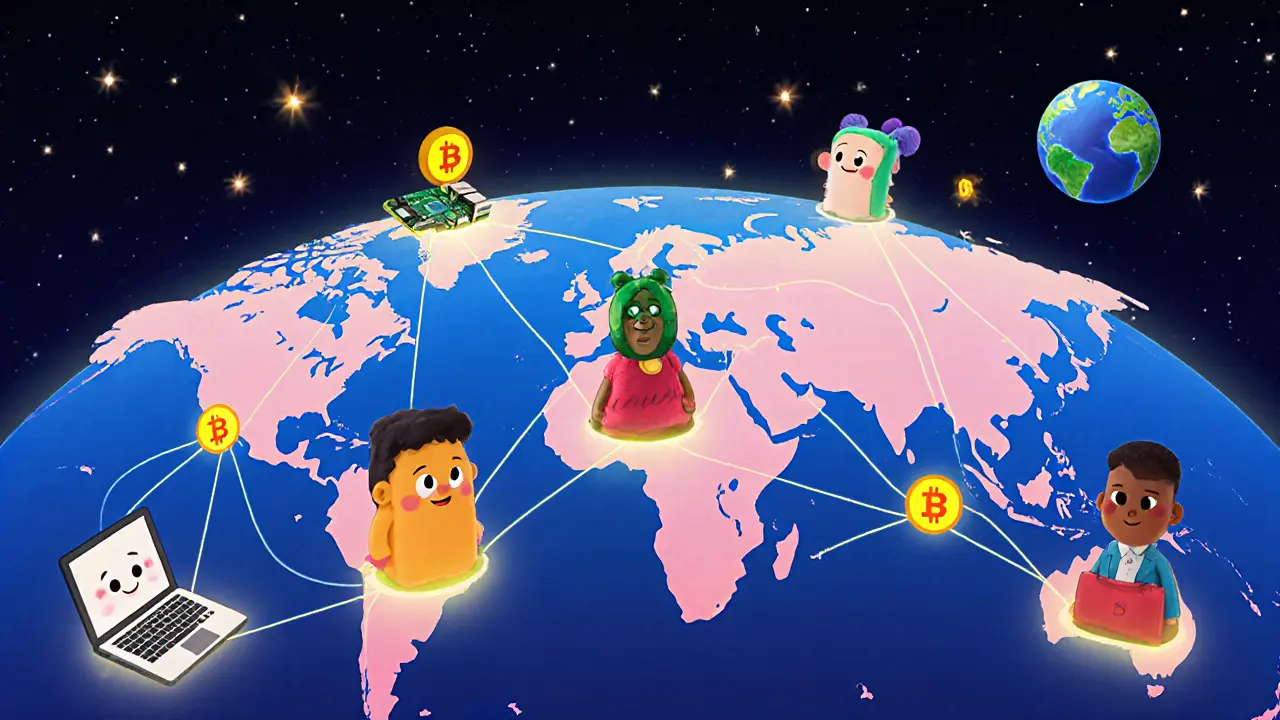
Bitcoin's peer-to-peer network lets users send money directly without banks. Thousands of nodes verify transactions globally, making it resilient, censorship-resistant, and free from central control. Learn how it works and why it matters.
Bitcoin blockchain: How it works, why it matters, and what you need to know
When you hear Bitcoin blockchain, the original decentralized digital ledger that records every Bitcoin transaction since 2009. Also known as public blockchain, it’s not just a tech buzzword—it’s the first working example of trust without middlemen. Unlike banks or payment apps, no single company controls it. Instead, thousands of computers around the world verify and store every transaction in blocks, linked together in a chain that’s nearly impossible to alter.
This system relies on three core ideas: blockchain technology, a distributed system where data is copied across many nodes and secured with cryptography, peer-to-peer network, a direct connection between users without servers or intermediaries, and decentralized ledger, a public record that anyone can verify but no one can secretly change. These aren’t theoretical—they’re what let someone send Bitcoin to a stranger in another country without a bank, and why exchanges like CoinExchange and Hpdex exist as non-custodial platforms. You don’t need permission to use it. You just need a wallet and an internet connection.
But here’s the thing: most people think the Bitcoin blockchain is only about money. It’s not. It’s the blueprint. Projects like BendDAO, RingDAO, and Aperture Finance all borrowed its core design to build DeFi protocols. Even tokens like FLOKITA or DZOO, for all their flaws, piggyback on the same idea: open, transparent, and immutable records. That’s why you’ll see it referenced in guides about crypto taxes in Mexico, SEC Philippines enforcement, and even NFT creator economies. The blockchain doesn’t care if you’re trading, gaming, or donating—it just logs it.
And yes, it’s slow. And yes, fees can spike. But that’s because it’s designed to be secure, not fast. Every block takes about 10 minutes to confirm. That’s by design. It’s not a bug—it’s the trade-off for being tamper-proof. If you’re looking at a crypto exchange that claims to be "instant" or "unhackable," check if it’s actually built on Bitcoin’s model—or if it’s just using the word to sound legit. The real Bitcoin blockchain doesn’t need hype. It’s been running non-stop since 2009, surviving crashes, bans, and scams.
What you’ll find below isn’t just a list of articles. It’s a collection of real-world tests of that system. From reviews of exchanges that use its principles to deep dives on tokens that rely on its structure, these posts show you what works, what doesn’t, and how to tell the difference. Whether you’re tracking airdrops on Polygon or trying to understand PBFT consensus, you’re still dealing with the same foundation: the Bitcoin blockchain. And if you understand that, you’re already ahead of most people in crypto.
November 7, 2025
How Bitcoin's P2P Network Operates: A Simple Breakdown of Decentralized Transactions
About
Cryptocurrency