Imagine a crypto project promising you up to 1,000% annual returns just for holding an NFT. Sounds too good to be true? In the world of decentralized finance, that promise usually comes with a heavy price tag. MetFi (METFI) is exactly that kind of project. It bills itself as the world’s first DeFi utility NFT ecosystem, designed to incubate metaverse, AI, and Web3 startups while sharing profits with its community. But beneath the glossy marketing lies a complex mix of aggressive tokenomics, unverified claims, and significant red flags that every investor needs to understand before putting money at risk.
As of July 2026, MetFi remains a niche player in the broader cryptocurrency market. While proponents argue it disrupts traditional venture capital by democratizing early-stage investing, critics point to structural similarities with multi-level marketing schemes and a lack of transparent, audited revenue sources. This guide breaks down what MetFi actually is, how its mechanics work on the blockchain, and why you should approach it with extreme caution.
How MetFi Works: The Core Mechanics
To understand MetFi, you have to look past the buzzwords and examine the actual technology. At its heart, MetFi operates on the BNB Smart Chain, using the BEP-20 standard for its native token, METFI. This means it is compatible with Ethereum Virtual Machine (EVM) wallets like MetaMask and can be traded on decentralized exchanges such as PancakeSwap.
The system relies on two main components:
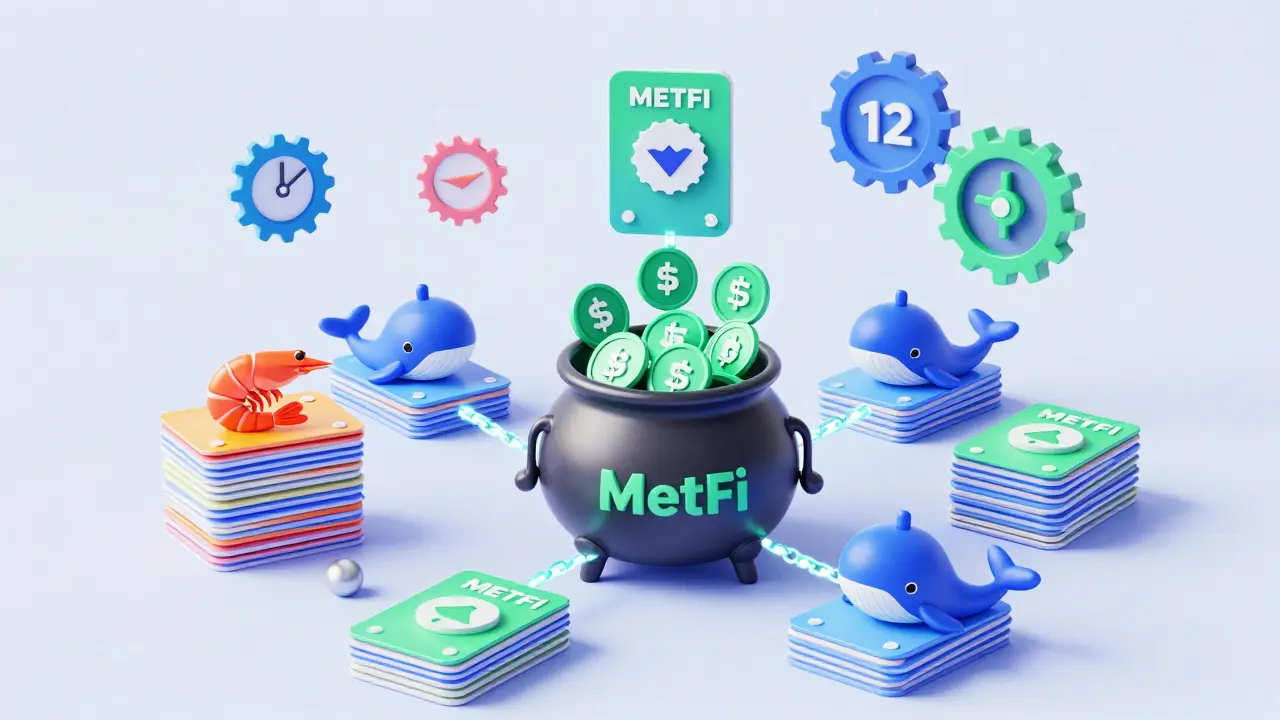
- Utility NFTs: These are digital collectibles that act as keys to the ecosystem. You buy them using stablecoins like BUSD. Each NFT tier has a multiplier that determines your reward rate. For example, a "Shrimp" tier might have a 1x multiplier, while a "Humpback" tier offers 10x rewards.
- METFI Token Staking: Once you own an NFT, you stake METFI tokens to it. The smart contracts automatically compound these rewards every 12 hours. The more METFI you stake and the higher your NFT tier, the more rewards you accumulate.
The theory is simple: the treasury invests in promising Web3 projects, generates profits, and distributes those profits to NFT holders. However, the reality is far more complicated. The whitepaper describes a "rebase token" model where the supply changes based on staking activity. Over 99% of the MFI/METFI supply is reportedly staked, meaning very few tokens are freely circulating. This creates artificial scarcity but also locks most value into the protocol’s smart contracts.
Tokenomics: Halvings, Burns, and Supply
MetFi’s economic model is built around creating scarcity to drive up the token’s value. The team implemented a halving schedule similar to Bitcoin’s, but compressed into a much shorter timeframe. According to their documentation, six halving events occurred between April 2023 and October 2025. Each event reduced the block rewards by half, theoretically increasing the value of remaining tokens if demand stayed constant.
In addition to halvings, MetFi uses token burns. When specific ecosystem events happen, a portion of the METFI supply is permanently removed from circulation. The goal is to make the token deflationary over time. As of mid-2026, the total supply sits around 450 million tokens, with a circulating supply closer to 215 million. This discrepancy highlights how much of the asset is locked in staking contracts or held by the treasury.
| Metric | Value |
|---|---|
| Current Price | $0.011 - $0.013 USD |
| Market Cap | ~$3.7 Million USD |
| Circulating Supply | ~215 Million METFI |
| Total Supply | ~450 Million METFI |
| Blockchain | BNB Smart Chain (BEP-20) |
| Claimed APY | Up to 1,000% (Compounded) |
The Promise vs. The Reality: Risk Analysis
Here is where things get tricky. MetFi markets itself as a transparent, democratic DAO (Decentralized Autonomous Organization) that replaces traditional venture capitalists. They claim that when they invest in AI or metaverse startups, the profits flow back to the community. On paper, this sounds revolutionary. In practice, there are major holes in this narrative.
First, consider the yields. Promising 1,000% APY is a massive red flag in finance. Sustainable returns rarely exceed 10-20% without significant risk. Where does this money come from? If the treasury isn’t generating billions in profit from successful startup exits, then the rewards must be coming from new participants buying NFTs and staking tokens. This is the classic definition of a Ponzi structure: paying old investors with new investors’ money.
Second, look at the transparency. While the smart contracts are visible on the blockchain, the actual investment portfolio of the treasury is not clearly disclosed. Claims that the treasury holds blue-chip assets like Bitcoin and Solana are made in marketing materials, but independent audits verifying these holdings are scarce. Without proof of external revenue, the high yields appear unsustainable.
Third, the regulatory landscape is tightening. In 2025 and 2026, global regulators have cracked down heavily on projects with multi-level marketing (MLM) characteristics. MetFi’s heavy reliance on referral bonuses and recruitment incentives places it in a dangerous legal gray area. Several user reviews on platforms like Trustpilot have accused the platform of displaying fictitious balances that do not match on-chain data, further eroding trust.
Community Sentiment and Reputation
If you dig into online discussions, you’ll find a polarized community. On one side, supporters praise the daily rewards and the ease of use. Social sentiment analytics from 2025 showed roughly 43% bullish tweets, suggesting a dedicated base of believers. Some users report positive experiences with customer support and timely payouts.
On the other side, the criticism is severe. Independent reviewers on sites like Ecency and French investigative channels have assigned MetFi low trust scores (around 28/100). Common complaints include:
- Lack of clear founder identification or registered operating entities.
- Allegations that the interface shows fake balances not recorded on the blockchain.
- Concerns that the project resembles a pyramid scheme due to its emphasis on recruiting new members.
- Absence of comprehensive third-party security audits beyond basic contract checks.
This divide is typical for high-yield DeFi projects. Early adopters often profit while later entrants face diminishing returns or total loss. The absence of a widely recognized audit firm like CertiK or OpenZeppelin validating the entire system-not just individual tokens-adds another layer of risk.

How to Participate (If You Choose To)
If you decide to proceed despite the risks, here is the technical process. Remember, this involves interacting with smart contracts on the BNB Smart Chain, so ensure you understand gas fees and wallet security.
- Set Up a Wallet: Install MetaMask or Trust Wallet. Configure it to connect to the BNB Smart Chain network. Never share your seed phrase with anyone.
- Acquire BNB: Buy BNB on a reputable exchange like Coinbase or Binance. Transfer it to your wallet address.
- Connect to MetFi dApp: Visit the official MetFi website. Connect your wallet. Verify the URL carefully to avoid phishing sites.
- Purchase an NFT: Use BUSD or BNB to buy a utility NFT. Start with the lowest tier to test the system. Higher tiers require larger investments and carry higher risk.
- Stake METFI: Buy METFI tokens via PancakeSwap or another DEX. Stake them to your NFT through the dashboard. Rewards will begin compounding every 12 hours.
Always start small. Treat any money invested as potentially lost. Do not borrow funds or invest rent money into high-yield staking protocols.
Conclusion: Is MetFi Worth It?
MetFi represents a bold experiment in combining NFTs, DeFi, and venture capital. Its vision of democratizing access to early-stage tech investments is appealing. However, the execution raises serious concerns. The promised 1,000% APY is economically questionable without verified external revenue. The lack of transparent treasury reporting and the MLM-like recruitment incentives are significant warning signs.
For experienced crypto investors who understand smart contract risks and are willing to gamble small amounts, MetFi might offer short-term gains. For conservative investors or beginners, the risks far outweigh the potential rewards. Always prioritize projects with audited code, clear revenue models, and established track records. In the volatile world of crypto, skepticism is your best defense.
Is MetFi (METFI) a scam?
While no definitive court ruling has labeled MetFi a scam, it exhibits many red flags associated with fraudulent schemes. These include unsustainable yield promises (1,000% APY), lack of transparent revenue sources, heavy reliance on recruitment, and negative user reviews alleging fake balances. Independent analysts assign it low trust scores, suggesting high risk.
How do I withdraw my earnings from MetFi?
To withdraw, you typically need to unstake your METFI tokens from the NFT in the MetFi dashboard. Once unstaked, the tokens return to your connected wallet (e.g., MetaMask). You can then swap them for BNB or USDT on a decentralized exchange like PancakeSwap. Note that some users have reported issues with withdrawals matching their displayed balances.
What blockchain is MetFi built on?
MetFi is built on the BNB Smart Chain (BSC), using the BEP-20 token standard. This makes it compatible with Ethereum-based tools like MetaMask and allows for low transaction fees compared to the main Ethereum network.
Are the 1,000% APY claims real?
The 1,000% APY is a theoretical maximum based on compounding mechanics and token emissions. There is no public evidence that this yield is funded by profitable external investments. Such high returns are generally unsustainable in legitimate finance and often rely on new participant inflows, which is risky.
Who founded MetFi?
The founders of MetFi are not publicly identified in a transparent manner. The project brands itself as a decentralized autonomous organization (DAO) owned by the community. However, critics note that key governance controls may still be concentrated among a small group of developers, raising centralization concerns.